Blackbody radiation defeated classical equipartition because it predicts excessive short-wavelength emission. Quantized oscillator energy exchange hν, and ultimately the photon occupation law, gives the Planck spectrum. In the photoelectric effect, electron energy follows light frequency with a threshold, rather than simply increasing with beam intensity; individual photons supply hν and the maximum kinetic energy is hν−W. Intensity chiefly changes the event rate at a fixed frequency. These explain two distinct failures of a purely continuous classical wave-plus-matter model, while retaining wave propagation and interference.
Approximate helium mass by 2mp+2mn≃6.69×10⁻²⁷ kg. Nonrelativistic momentum is p=2mT, giving λ=h/p≃0.203 nm. A transverse width of one micrometre implies a characteristic position uncertainty of that order and a minimum momentum uncertainty of order ℏ/a∼10−28 kg m s−1, with factors depending on profile convention. For a uniform interval Δx=a/12, but an exactly abrupt rectangular wavefunction actually has infinite rms momentum spread. Width alone does not uniquely specify both rms uncertainties; a smooth near-minimum-uncertainty beam is needed for a finite order-of-magnitude estimate.
Immediately after a uniformly illuminated hard slit, the normalized transmitted state is ψ(x)=w−1/2 for ∣x∣<w/2, zero elsewhere. With Fourier convention ψ(p)=(2πℏ)−1/2∫e−ipx/ℏψ(x)dx,The supplied sinc integral verifies unit normalization. The first zeros occur at ±δpx, but this finite central-lobe width is not the rms uncertainty: px2p fails to have a convergent integral.
ψ(px)=2πℏwsinc2ℏpxw,p(px)=δpx1sinc2δpxπpx,δpx=wh.
For an aligned narrower slit placed immediately after the first, uniform illumination gives transmission probability d/w. Conditional on passage the same normalized formula applies with w replaced by d and central-lobe momentum scale h/d. Position rms is d/12, while the exact hard-edge rms Δpx is infinite. Thus the source's finite “uncertainty” can only mean a characteristic diffraction width; the rigorous Heisenberg inequality is not violated, and smoothing the edges restores finite rms moments satisfying it.
A 10 keV X-ray has λ≃0.124 nm. The ideal position-filter probability and momentum formula at fixed aperture widths are unchanged, since the Fourier transform involves h and the aperture geometry. Its larger total momentum makes the angular diffraction width smaller, approximately λ/d. Real slit-material transmission and absorption are additional experimental issues.
To distinguish 2b equal transverse bins across width w, d=w/2b. Six bits gives one-nanometre pixels; ten gives 0.0625 nm, below the helium wavelength. In the stipulated fixed-energy freely propagating beam, the latter entails transverse diffraction momenta comparable to or exceeding the available total momentum and lies outside the paraxial aperture model. Six-bit localization is less demanding, although fine detector resolution and losses remain practical constraints. This is not a universal theorem that an atom can carry at most six bits in every encoding: accessible modes, energy, aperture, measurements and success probabilities define the channel.
The equation is iℏ∂tψ=[−ℏ2∂x2/(2m)+V(x)]ψ. The generator of time evolution is the sum of kinetic and potential energy operators. For a sharp stationary energy, insert ψ(x,t)=ϕ(x)e−iEt/ℏ to obtain [−ℏ2ϕ′′/(2m)+Vϕ]=Eϕ. The probability in dx is ∣ψ∣2dx, normalized to one; hence a normalized one-dimensional wavefunction has dimensions length−1/2. Its overall phase is unobservable, but relative phase affects interference.
Integrating F=−kx gives V=kx2/2 up to a constant. Thus −ℏ2ϕ′′/(2m)+mω2x2ϕ/2=Eϕ, with ω=k/m. The potential is a symmetric upward parabola and tends to infinity in both directions; normalizable states decay at large ∣x∣.
For the Gaussian, ϕ0′′=(x2/σ4−1/σ2)ϕ0. Using ℏ/(mω)=σ2, the x2 terms cancel and leave E0=ℏω/2. For ϕ1∝xϕ0, differentiation gives ϕ1′′=(x2/σ4−3/σ2)ϕ1, and the same cancellation gives E1=3ℏω/2. The normalization constants do not affect these eigenvalue equations.
Squaring the states gives p0=e−x2/σ2/(πσ),p1=2x2e−x2/σ2/(πσ3). The first peaks at zero; the second has a node there and peaks at x=±σ. For a centered interval of width δx≪σ, P0≃δx/(πσ), whereas P1≃(δx)3/(6πσ3). Its leading linear term vanishes, but the probability in a finite interval is not exactly zero.
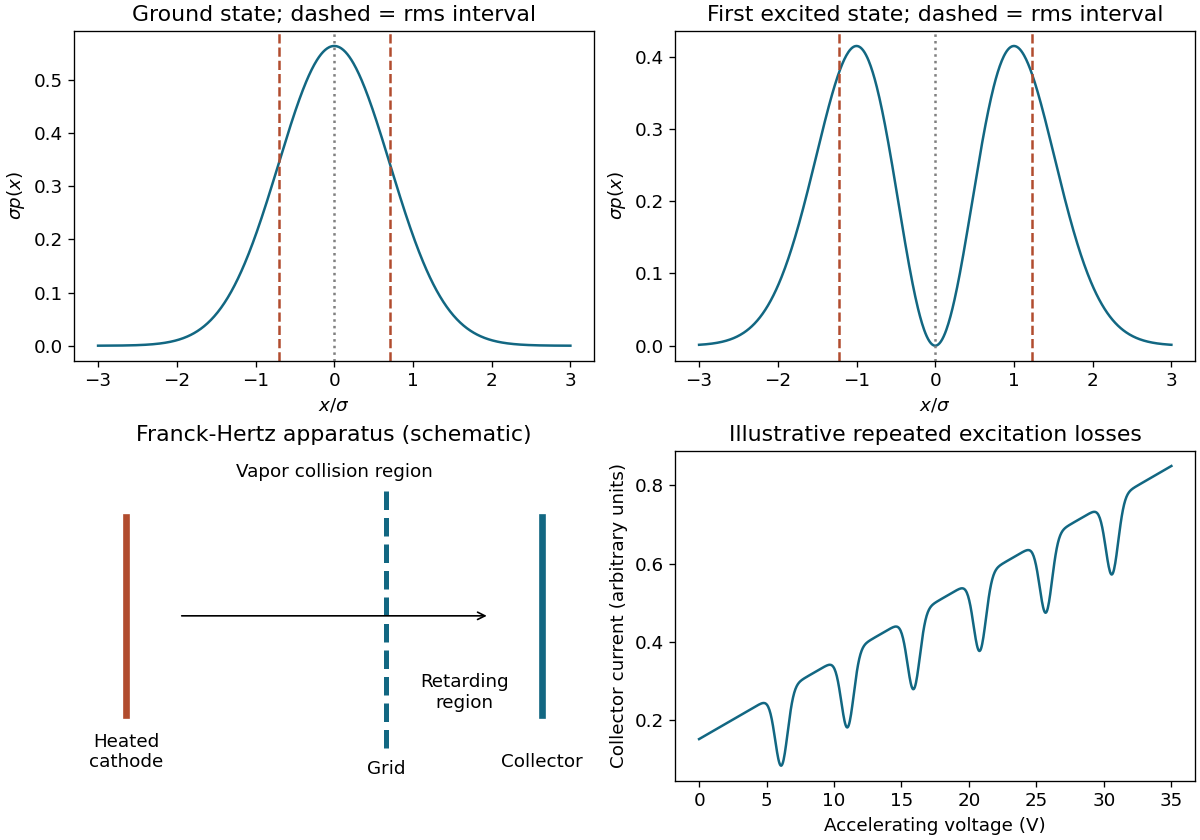
Ground and first-excited oscillator distributions, and an original Franck-Hertz apparatus and signal schematic
. Details. 
Both probability densities are even, so ⟨x⟩=0. The supplied Gaussian moments give ⟨x2⟩0=σ2/2 and ⟨x2⟩1=3σ2/2. Therefore Δx0=σ/2,Δx1=3/2σ. The original plots mark these two symmetric rms intervals around the common mean.
Time evolution gives e−iE0t/ℏ[ϕ0+e−iωtϕ1]/2. It becomes the opposite relative-sign superposition when e−iωt=−1, first at tmin=π/ω. The overlap with the initial state is proportional to 1+e−iωt and vanishes then; global phase is immaterial.
A heated cathode emits electrons into low-pressure atomic vapor, and a variable accelerating voltage gives them kinetic energy. A grid and small retarding region precede the collecting anode. Below the first excitation threshold most collisions are elastic; above it, electrons can transfer a definite excitation energy to atoms and may then fail to overcome the collector's retarding field. Collector current develops repeated minima as accelerating voltage increases, separated by roughly the same excitation voltage, approximately 4.9 V for mercury. Contact potentials and energy spreads shift or smear the minima without removing their characteristic spacing. A smooth loss mechanism would not produce these repeated fixed-energy thresholds.[ref]
A classically accelerating Coulomb electron radiates and loses orbital energy, so a stable nonradiating orbit is impossible within that unmodified theory. Bohr instead postulates stationary nonradiating orbits, quantized angular momentum μvr=nℏ and photon emission/absorption with hν=Ei−Ef. Here μ=meM/(me+M) describes relative motion. The angular-momentum condition is the standing-wave relation 2πr=nλdB for the relative orbit. These are additional quantum postulates, not consequences of classical radiation theory.
Coulomb centripetal balance and μvr=nℏ giveThe radius is the electron-nucleus separation. For positronium, Z=1 and μ=me/2, so rn=2a0n2 and En=−Ry/(2n2). Each constituent's radius about the center of mass is half the separation; calling both that radius and rn the orbital radius without distinction would create another factor-two error.
rn=μmeZa0n2,En=−meμn2Z2Ry.
The relative orbital speed is Ze2/(4πϵ0ℏn). Divide the circumference by this speed to findPositronium has twice the hydrogen period at the same principal quantum number. The symbol n here labels principal levels with n=1 the ground state; if “nth excited state” is read literally as excitation count, replace n by n+1.
Tn=Z2μe44ϵ02h3n3.
Ancestors (9)
- 2016
- Past exam of the short options paper shared by Prelims and Parts A and B of the physics course of the University of Oxford
- Short options paper shared by Prelims and Parts A and B of the physics course of the University of Oxford
- Physics course of the University of Oxford
- Undergraduate course of the University of Oxford
- Course of the University of Oxford
- University of Oxford
- List of universities
- Home
Discussion (0)
New discussionThere are no discussions about this article yet.
Articles by others on the same topic (0)
There are currently no matching articles.