Assume the composite pure state has unit norm. Put its amplitudes into the matrixThe partial trace contracts the same index between ket and bra:ThusIt is Hermitian, positive semidefinite and has trace one. Its determinant is particularly useful:This follows from multiplicativity of the determinant, or by expanding the two-by-two expression. If the supplied amplitudes were not normalized, the physical reduced state would be instead.
The specified Bell-state phases giveThereforeThe sum contains complex squares, not squared moduli. Define and . Normalization gives , so the triangle inequality ensures .
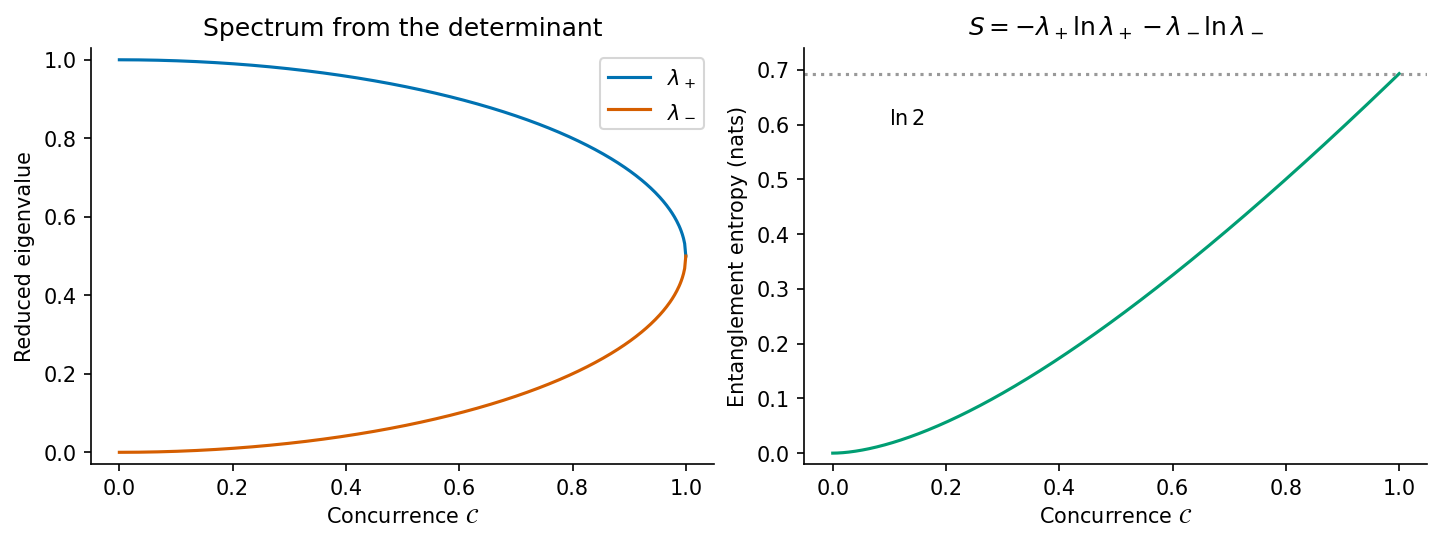
The characteristic polynomial is . HenceHere logarithms are natural and means its limiting value zero. Using logarithms to base two gives entropy in bits instead. Product states have , spectrum and entropy zero; maximally entangled states have , spectrum and entropy .
This phased Bell basis is a magic basis, and is the pure-state concurrence. The paper's ordering is a permutation of the usual magic-basis ordering, which leaves unchanged.[ref]

A matrix belongs to the special orthogonal group in four dimensions precisely whenDifferentiating the orthogonality relation along a path gives . Thus its Lie algebra consists of real antisymmetric four-by-four matrices. Such a matrix has one free entry for each unordered coordinate pair, giving dimension .
Each displayed generator has a single two-coordinate antisymmetric block. The matrices cover planes ; the matrices cover , with their printed orientations. These are all six distinct planes. Therefore the generators are linearly independent and span the full antisymmetric space: they form a basis of .
Conversely, exponentiating any real antisymmetric gives and . This verifies that the infinitesimal matrices generate proper rotations rather than reflections.
Use and the supplied commutators. Antisymmetry also gives . Expanding the combinations,The mixed commutator cancels:ThusThere are two mutually commuting three-generator rotation algebras. As real compact Lie algebras,For example, the anti-Hermitian basis obeys the same commutation convention in each factor. This is an algebra statement. Globally, the simply connected group is , andDropping that central quotient would incorrectly identify the global groups.
In the printed phased Bell basis, the actions on its four kets areEach matrix is purely imaginary and antisymmetric. Let have these four basis kets as columns in the computational basis. The infinitesimal generators of the standard rotation areUsing the displayed actions gives the phase-convention-specific identitiesThey are real antisymmetric matrices. A finite rotation on therefore acts on the magic-basis coefficient vector as , with . ConsequentlyIt preserves concurrence and hence preserves the reduced eigenvalues and entanglement entropy. A general operation adds a common phase to ; that changes by a phase of twice the angle but leaves unchanged. The real-rotation description of local transformations is a characteristic property of the magic basis.[ref]
Entanglement of a Pair of Quantum Bits by Scott Hill and William K. Wootters. After Eq.(6), real magic-basis matrices and independent local transformations
As an independent direct check, a local unitary sends to , which is a unitary similarity transformation and cannot change its spectrum. This local-unitary invariance of entanglement entropy also explains why merely rotating one subsystem cannot create entanglement.
Articles by others on the same topic
There are currently no matching articles.