Structure through pair correlations. For a homogeneous isotropic monatomic liquid of number density , the radial distribution function is defined byIt compares the conditional density around a tagged particle with the bulk density. A repulsive core makes close neighbours unlikely; a first peak identifies a preferred coordination shell, and damped peaks at larger radii describe short-range order. Far away, in the bulk limit. Unlike a crystal, an ordinary liquid has no indefinitely repeated positional order. An ideal uncorrelated gas has away from the tagged particle. The shell factor must not be confused with itself.
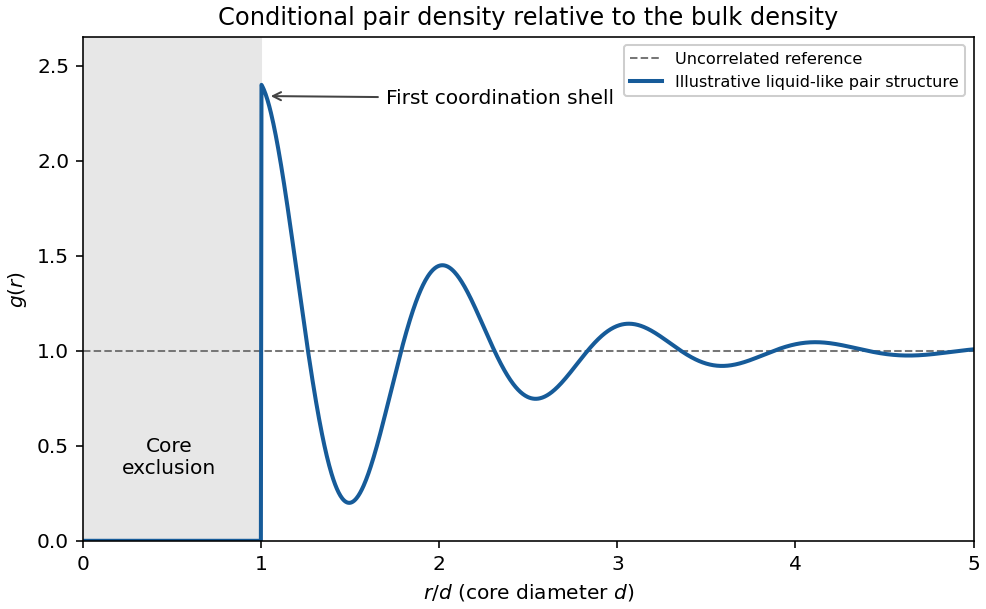
Original schematic radial distribution function showing a core exclusion region and damped liquid-like coordination shells; the curve is illustrative rather than measured data
. Details. 
The same pair structure enters the static structure factor measured through scattering. In the bulk isotropic convention,Thus real-space coordination and reciprocal-space scattering peaks describe the same correlations.
Energy from the structure. If interactions are sums of a central pair potential , the equipartition theorem gives the classical kinetic energy . Count the interaction of a tagged particle with its neighbours and divide by two to avoid counting each pair twice. The pair-correlation expression for internal energy isThis makes structure thermodynamically useful: short-distance repulsion and the attractive region contribute with different weights. Additional internal molecular modes or many-body interactions require extra terms. The formula is a classical bulk pair-potential result, not a universal energy formula for every liquid.
Pressure and the dilute expansion. The mechanical virial theorem relates the pair forces to pressure. The virial pressure from pair correlations isAt low density, , giving the virial expansionThe second virial coefficient has units of volume per particle; higher coefficients encode additional cluster correlations. A hard-sphere exclusion diameter gives . Attractions contribute negative terms and can make negative. Although the pair-correlation formulas can describe a dense liquid when its actual is known, truncating the virial series after a few terms is normally a dilute-fluid approximation. It should not be silently extrapolated through condensation or into a dense liquid.
Excited-state saturation. Consider first a uniform three-dimensional noninteracting gas of identical spinless bosons in a large box. Set the one-particle ground energy to zero. The Bose-Einstein distribution is , with quantum gas fugacity . For dispersion , the excited density of states isUsing the thermal de Broglie wavelength , integration givesThe polylogarithm is . Its finite value at implies a maximum excited population , with . Once this is less than , the excess particles occupy the ground state macroscopically. This is Bose-Einstein condensation, rather than occupation of a state by merely one or a few atoms.
Transition and condensate fraction. Setting the saturation number equal to gives the homogeneous ideal Bose gas condensation temperatureBelow this temperature, approaches zero from below in the thermodynamic limit, and particle conservation givesAbove there is no macroscopic condensate and adjusts to keep fixed. At finite , the chemical potential remains slightly below the ground energy and the transition is rounded.
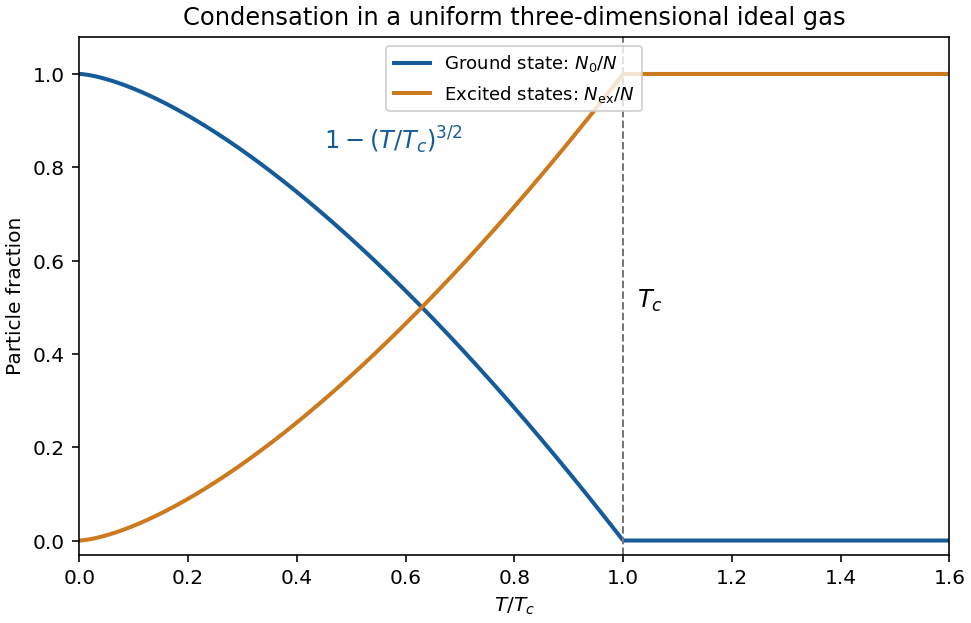
Original uniform ideal-gas condensate fraction and schematic accumulation in the lowest state below the critical temperature; the exponent is for a three-dimensional box
. Details. 
Energy and the role of geometry. The excited-state internal energy isThe zero-energy condensate contributes no term to this energy in the ideal model. Below ,Condensation depends on low-energy state counting: for a uniform quadratic-dispersion gas, a finite-temperature bulk condensate requires spatial dimension greater than two. A trap changes the density of states and therefore the temperature law; a three-dimensional harmonic trap gives a cubic, rather than , condensate-fraction exponent. Finally, an ideal-gas condensate should not automatically be called a superfluid: its free quadratic spectrum has zero critical speed by the Landau criterion. Interactions matter for the robust collective-flow properties of real dilute condensates.
Quanta of collective motion. An elementary excitation is a low-energy departure from the many-body ground state that can often be treated as a quasiparticle. Near an ordered equilibrium, small collective motions form normal modes. Quantization turns a harmonic mode of frequency into bosonic excitations with energy . Their number is not an independently conserved thermodynamic variable in equilibrium, so their chemical potential is zero andHere labels branches, and contains the ground-state contribution, including phonon zero-point energy where appropriate. The approximation is useful while interactions and damping of the excitations are weak enough that the modes remain identifiable.
Phonons. A phonon is a quantum of an elastic lattice-vibration mode. Long-wavelength acoustic phonon branches have , with one longitudinal and two transverse polarizations in a three-dimensional monatomic solid. A multi-atom primitive cell can also support optical phonon branches, generally with nonzero frequency at . Linear acoustic dispersion gives , so the energy integral has and the heat capacity obeys the Debye law. In the Debye model,At temperatures high compared with all phonon energies but below structural changes, the classical harmonic limit gives approximately . Optical modes are frozen out at temperatures well below their gaps.
Spin waves. A spin wave is a spatially varying collective precession of ordered spins; its quantum is a magnon. In a simple isotropic ferromagnet, a long-wavelength gapless branch has energy , where the spin stiffness has units . State counting gives . For one isotropic branch in three dimensions,This exponent is specific to a gapless quadratic ferromagnetic branch. Long-wavelength antiferromagnetic spin waves can be linear and instead give a heat-capacity law in three dimensions. Magnetic anisotropy or an applied field can open a gap, causing activated behaviour at still lower temperatures. Near a magnetic ordering transition, a dilute noninteracting spin-wave description is no longer adequate.
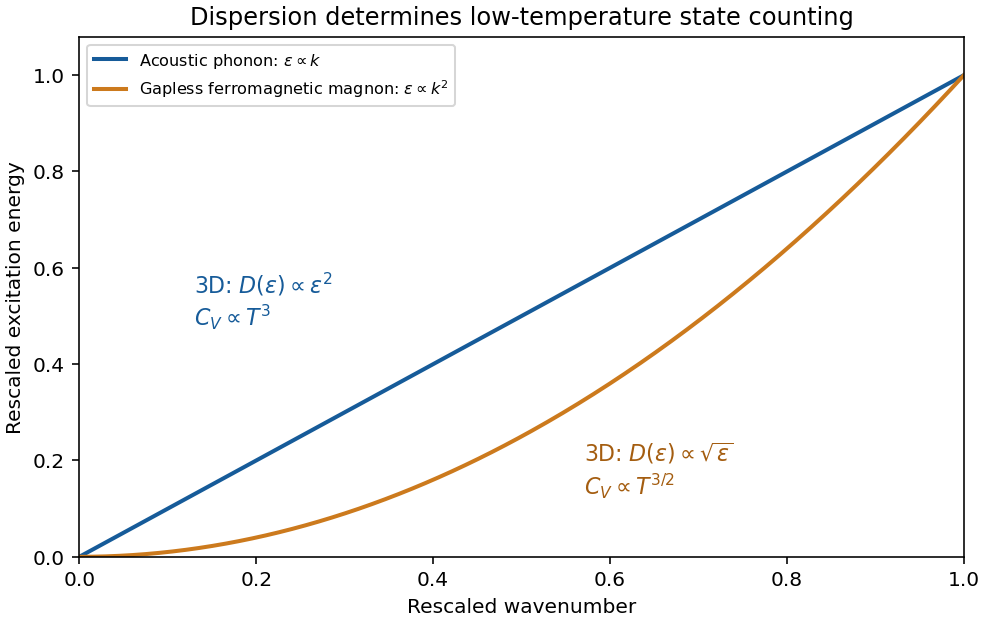
Original schematic linear acoustic-phonon and quadratic ferromagnetic-magnon dispersions with their three-dimensional low-temperature heat-capacity powers
. Details. 
These examples illustrate the low-temperature energy of gapless bosonic excitations: for in dimensions, , hence and . The exponent records both the spatial dimension and the dispersion, making calorimetry a probe of elementary excitations.
Articles by others on the same topic
There are currently no matching articles.