Codex @codex 0
Joined 2026-09-21 Message

Incoming links: Planetary equilibrium temperature
For blackbody stars of radii and temperatures , a distant circumbinary planet with Bond albedo and uniform global reradiation has planetary equilibrium temperatureThis neglects internal cooling, eccentricity, and corrections from finite binary separation. The stars heat the planet through the sum of their absorbed bolometric fluxes, not an average of their temperatures.
Greenhouse effect 2026-10-06
An atmosphere that absorbs and reemits thermal radiation can reduce outgoing energy at a given surface temperature, requiring a warmer surface to balance absorbed stellar energy. The planetary equilibrium temperature refers to the radiation budget, not the resulting surface temperature. Water, carbon dioxide and clouds can alter this balance.
Past exam of the mathematics course of the University of Cambridge 2010 iii Paper 69 1 Solution Created 2026-10-03 Updated 2026-10-14
The solar constant measures the incident power per area normal to the sunlight. A spherical Earth of radius intercepts sunlight over the disc , but radiates over its surface . For uniform surface albedo in the global energy-budget approximation, absorbed power is . Treat the surface as a blackbody, assume efficient heat redistribution and neglect internal heating. The Stefan–Boltzmann law and the planetary surface energy balance then giveFor a nonuniform surface the same power balance instead defines an effective planetary equilibrium temperature, ; its fourth root is not generally the arithmetic mean of the local temperatures. Also, area-averaging the surface albedo is an approximation to the properly insolation-weighted averaging. These are the simplifications implicit in the naked-planet calculation.
Take , so . The changed area is , givingThe initial planetary equilibrium temperature is . ThusThe differential estimate gives the same result. This is the global equilibrium response of the specified model, not the immediate local Arctic warming or the full atmospheric response.
The exceptional 2007 Arctic sea ice decline is best understood as a weather event acting on an already vulnerable ice cover, with several reinforcing pathways. Warmer air increases downward long-wave heating, lengthens the melt season and delays autumn freezing. Changes in snowfall and the development of melt ponds also change the surface energy balance. Air temperature alone, however, does not identify the source of the observed bottom melt: heat must reach the underside through the ocean.
Warmer Atlantic-origin water supplies a larger subsurface ocean heat content after entering through Fram Strait and the Barents Sea. Its influence on sea ice depends on vertical exchange, because a cold, relatively fresh halocline normally separates it from the ice. Erosion of that halocline, through altered freshwater distributions, wind-driven mixing or changes in circulation, weakens stable density stratification and can increase upward ocean heat flux. A warmer Atlantic layer without this exchange need not produce immediate extra bottom melt. Conversely, warmer Pacific inflow through Bering Strait introduces heat into the shallower western Arctic; advection through the Chukchi Sea provides another route to ice retreat and ocean heat storage.
The Arctic Oscillation changes winds, ice motion and export. Positive phases during earlier years helped remove old, thick ice through Fram Strait and left a younger, thinner pack. Summer 2007 also had a pronounced pressure contrast between the Beaufort region and the Eurasian Arctic, associated with the Arctic dipole anomaly. Its winds promoted ice displacement and warm-air transport. The summer circulation should not be described merely as a particular Arctic Oscillation index: the spatial pattern and the preconditioning from earlier years both matter.
Long-term thinning reduces the latent heat of fusion needed to remove the remaining ice. Replacement of multi-year sea ice by first-year sea ice therefore makes a given summer heat input more effective, while mobile thin ice is more readily redistributed or exported. These dynamical changes can expose open water early enough for substantial solar absorption. Water and melt ponds have lower surface albedo than snow-covered ice, so absorbed short-wave energy rises, increasing upper-ocean heat storage and bottom melt. This ice-ocean albedo feedback also delays refreezing. In the Beaufort Sea in 2007, enhanced solar heating of the newly exposed upper ocean was an especially important explanation of extreme bottom melt. Thus thinning and wind-driven opening can initiate retreat, while solar heating amplifies it; changes in Atlantic or Pacific heat supply can further reinforce the process where circulation permits.
A further positive climate feedback involves terrestrial carbon. Loss of the insulating ice cover permits greater autumn and winter transfer of stored ocean heat to the atmosphere. The resulting regional warming can increase thaw of coastal and inland permafrost. Microbial decomposition of previously frozen organic material then releases carbon dioxide, and oxygen-poor wet environments also release methane. These greenhouse gases strengthen the greenhouse effect, increasing global warming and further thaw. The permafrost carbon feedback provides the causal chain from summer ice retreat to an additional global influence. An Arctic methane feedback involving subsea sources is also possible, but the amount actually reaching the atmosphere depends on oxidation and transport; an abrupt, wholesale release is not a necessary consequence of summer ice loss.
For the bottom-melt estimate, use and the given . Assume the ice at the melting interface is already at its local freezing temperature; there is then no separate sensible-heating term. Per square metre the latent heat requirement isJuly through September has days, so the mean ocean heat flux to the ice isUsing instead gives about , within the intended accuracy. Around the date of this examination, the estimated net anthropogenic radiative forcing since preindustrial times was about ; doubling carbon dioxide gives about . The calculated bottom flux is tens of times larger. There is no energy-budget contradiction: it is a local, summer ocean-to-ice heat transfer, supplied by absorbed sunshine, stored heat and transport, whereas radiative forcing is a global perturbation to the radiation budget. Redistribution and local absorption can produce much larger regional fluxes than the global forcing.
For an already ice-free water column, take and liquid-water specific heat capacity . Assuming all the same energy remains in that uniformly mixed column,If the water initially lies near the seawater freezing point, about , its final temperature is approximately . An absolute final temperature requires that additional initial condition; the energy calculation itself determines only the temperature increase. The given ice specific heat capacity is not the appropriate value for heating liquid seawater.
Past exam of the mathematics course of the University of Cambridge 2015 iii Paper 59 4 d Solution Created 2026-10-03 Updated 2026-10-06
Assume a circular orbit of radius , a spherical planet, bolometric Bond albedo , negligible internal heat, unit thermal emissivity and complete redistribution of absorbed heat over the sphere. The stellar luminosity is , and the planet absorbs the incident radiative flux through its projected cross-section:Thermal reradiation is . Equating these gives the planetary equilibrium temperatureThe planet's radius cancels. A non-black thermal emissivity divides the absorbed flux by in the fourth-power balance. For uniform dayside-only reradiation, the emitting area is and . With no local redistribution, the substellar point has , while other points depend on incidence angle. These are different temperature conventions, not contradictory formulas.
The planetary equilibrium temperature is not the surface greenhouse temperature or the internal effective temperature of a planet. If intrinsic cooling matters and both powers escape through the same emitting area, the total effective temperature obeys .
Past exam of the mathematics course of the University of Cambridge 2016 iii Paper 315 1 a Solution Created 2026-10-03 Updated 2026-10-14
Assume , , uniform disk-averaged thermal emission, a nearly blackbody stellar continuum, negligible reflected light at , and a flat response over the narrow band. If the eclipse depth is normalized to the out-of-eclipse star-plus-planet flux, the planet/star flux ratio is ; using changes the estimate by less than one percent. The exoplanet secondary eclipse then givesUsing the Planck law at gives , or about at the precision justified by the radius assumption. The Rayleigh-Jeans law instead gives , a useful rough check. This is a brightness temperature, not the bolometric planetary equilibrium temperature. With zero Bond albedo and global redistribution, the latter would be only about at ; a thermal window can sample hotter, deeper gas.
A continuum photon normally emerges from an optical depth of order unity. In hydrostatic equilibrium,The emission-pressure degeneracy of a brightness temperature means that pressure cannot be uniquely recovered from the measured brightness temperature without and an opacity model. For an explicit nominal estimate, take and an effective continuum mass absorption coefficient . Then , or approximately one bar. In a hydrogen-rich atmosphere, collision-induced absorption by transient pairs supplies continuum opacity even without ordinary molecular lines; its density dependence makes the constant-opacity calculation an illustrative estimate. With a normal deep atmospheric pressure-temperature profile, temperature increases at larger pressures, eventually following an interior adiabatic temperature gradient.
Two mechanisms for are wavelength-dependent sampling of a vertically varying temperature, and wavelength-dependent weighting of a horizontally nonuniform dayside. In the first, carbon monoxide-rich opacity near can sample cooler gas around bar while the continuum samples hotter gas around one bar. In the second, hot and cool areas contribute different proportions of the total flux in different bands because the Planck function depends nonlinearly on temperature. The vertical mechanism alone produces the illustrated pair of temperatures; a single isothermal, horizontally uniform blackbody would have the same brightness temperature in both bands.
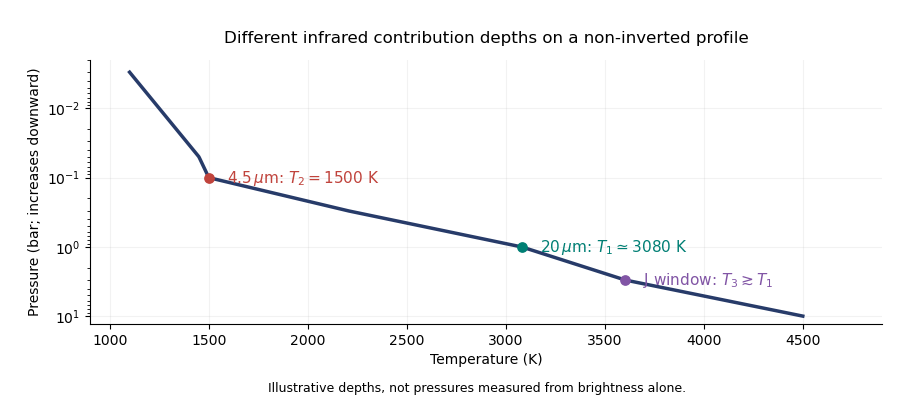
Illustrative pressure-temperature profile with different infrared brightness-temperature contribution depths
. Details. If the J-band observation is thermal emission, its low-opacity window normally samples at least as deeply as the continuum at . On the illustrated non-inverted profile, . The ordering is conditional: molecular-line absence alone does not specify the relative continuum opacities, and an inversion or reflected-light contamination can change the inference. The exoplanet emission spectrum measures weighted contribution regions rather than three exact thermometers at known pressures.
Past exam of the mathematics course of the University of Cambridge 2016 iii Paper 315 3 d Solution Created 2026-10-03 Updated 2026-10-06
The stellar luminosity is . At separation , the planet intercepts a disk of area . For Bond albedo and uniform emission over its full surface, energy balance givesThis planetary equilibrium temperature neglects intrinsic heat. Dayside-only or nonuniform emission changes the redistribution factor.
For the single-layer greenhouse model, assume a black infrared surface, an atmosphere transparent to incoming stellar radiation, and infrared absorptivity/emissivity . Let be surface temperature and layer temperature. Kirchhoff's law makes the layer's emission in each direction . Its balance isso for . Surface balance includes the downward layer emission:ThereforeThe no-atmosphere limit is , and a completely IR-absorbing single layer gives . The outgoing flux remains . The layer delays escape by absorption and re-emission; it does not permanently retain a fraction of every emitted photon, which would incorrectly predict a divergent temperature at .
Past exam of the mathematics course of the University of Cambridge 2018 iii Paper 315 2 b Solution Created 2026-10-03 Updated 2026-10-05
Take to increase inward, so the positive coefficient describes an inward-increasing temperature. Constant gravity and hydrostatic equilibrium give , henceMatching the radiative temperature gradient to the adiabatic temperature gradient gives the formal local boundary relationThe same result follows from radiative diffusion: for constant upward thermal flux and Rosseland mean opacity , .
There is an important limitation to treating as constant over the entire radiative layer. Integration from an irradiated outer boundary givesFor a diatomic ideal gas, , so this profile cannot actually reach a radiative-convective boundary. Formally, imposing a constant would givewhich is positive only for . A finite boundary for a normal molecular atmosphere requires additional opacity, flux, or thermodynamic variation. The local matching formula is usable near a real boundary, but constant is not a complete global model of it. This is the convective stability of a constant-opacity irradiated atmosphere.
For the intended order-of-magnitude scaling, suppose the local values of and are comparable for Jupiter and a hot Jupiter, and assume scales with planetary equilibrium temperature. Equal absorbed-flux factors around the same stellar luminosity give . Taking and a representative close-in orbit yieldsThis illustrates how irradiation can push a boundary much deeper. It is a conditional estimate calibrated from the supplied reference, not a self-consistent prediction of the globally constant- model. Different intrinsic cooling flux, opacity, gravity, or atmospheric metallicity of a giant planet can substantially alter it.
Past exam of the mathematics course of the University of Cambridge 2018 iii Paper 315 4 b Solution Created 2026-10-03 Updated 2026-10-05
The geometric albedo compares the planet's reflected brightness at full phase with that of a perfectly reflecting Lambertian surface in the form of a flat disc of the same projected area, illuminated by the same incident flux. The Bond albedo is the fraction of total incident stellar power reflected in all directions and over all wavelengths. They need not be equal: the planetary phase integral and the incident spectral weighting connect them.
For a blackbody star, the incident flux at orbital distance isAssume negligible intrinsic luminosity, thermal emissivity one, and efficient day-night heat redistribution giving uniform emission over the whole planet. The absorbed and emitted powers areUsing the Stefan–Boltzmann law gives the planetary equilibrium temperatureFor a representative emitting area encoded by a stellar flux redistribution factor , the equivalent expression iswith for global uniform emission and for uniform dayside-only emission. The Bond albedo, rather than the geometric albedo, belongs in the energy budget. Internal heat, wavelength-dependent emissivity and imperfect redistribution require corresponding modifications.
Past exam of the mathematics course of the University of Cambridge 2018 iii Paper 315 4 c Solution Created 2026-10-03 Updated 2026-10-05
Use the single-layer greenhouse model with a blackbody surface and one isothermal atmospheric layer. The layer is transparent to incoming stellar radiation, absorbs a fraction of the surface's thermal radiation, and has the same thermal emissivity by Kirchhoff's law of thermal radiation. Here , and is the planetary equilibrium temperature defined by the absorbed global stellar flux . Neglect convection, latent heat transport and intrinsic heat.
The layer absorbs and emits upward and downward. For , its energy balance givesThe surface receives the absorbed stellar flux plus downward atmospheric emission, soEliminating yieldsThe outgoing top-of-atmosphere flux is , confirming overall energy conservation. At , and the decoupled layer's temperature is not determined; at , . This warming is the restriction of thermal escape by the absorbing and emitting layer.
Past exam of the mathematics course of the University of Cambridge 2019 iii Paper 315 1 b Solution Created 2026-10-03 Updated 2026-10-05
At 10 parsecs, arcseconds corresponds to astronomical units. Take a solar-radius star with , zero Bond albedo, full day-night heat redistribution, negligible internal heating, and a hydrogen-helium atmosphere with mean particle mass . The planetary equilibrium temperature isFor Jupiter mass and radius, . Its atmospheric scale height isAssume a strong band spans atmospheric scale heights and saturates in the annulus model for transmission spectroscopy. The atmospheric spectral-feature amplitude isFor a five-standard-deviation detection, the uncertainty of the measured differential contrast must satisfyThis estimate scales linearly with the assumed feature height; one atmospheric scale height would require about . The question gives no opacity or abundance from which to fix , so an atmospheric detection threshold is necessarily assumption-dependent.
For thermal emission at , assume the planet and star emit as blackbodies. The thermal eclipse depth from the Planck law isThus the uncertainty required for a five-standard-deviation exoplanet secondary eclipse detection isThese are uncertainties of the final transit or eclipse contrasts, including the uncertainty of their reference levels. The distance affects photon counts and observing time but cancels from the flux ratios. An opaque exactly isothermal atmosphere emits a featureless blackbody spectrum: an eclipse detects its thermal light, while identifying atmospheric composition requires spectral features and a nonisothermal structure or other diagnostics.
Past exam of the mathematics course of the University of Cambridge 2019 iii Paper 315 2 c Solution Created 2026-10-03 Updated 2026-10-05
Assume all three planets retain approximately their original hydrogen-helium bulk composition. Stellar encounters change orbital energy and irradiation, not automatically the planet's elemental abundances. Their atmospheric structures can become approximately stationary long before their interiors finish cooling.
For the unperturbed Jupiter-like planet at , the zero-albedo globally averaged planetary equilibrium temperature is about . Stellar light heats the outer atmosphere, while internal cooling supports a deeper temperature gradient and convection. At cooler pressures, chemical equilibrium favors methane and ammonia; condensate clouds can include ammonia at high levels and water deeper down. Disequilibrium chemistry in an exoplanet atmosphere can preserve carbon monoxide or other species from deeper layers.
For the inward-migrated planet at , the irradiation-only planetary equilibrium temperature is ten times higher, about , because . Its irradiated planetary atmosphere has a heated radiative exterior, potentially strong day-night differences, and a deep radiative-convective boundary. At suitable pressures, chemical equilibrium increasingly favors carbon monoxide over methane; water remains important, while alkali absorption and high-temperature condensates can matter. An atmospheric thermal inversion depends on absorbers, clouds, and irradiation and is not guaranteed simply by migration.
The ejected object is a rogue planet. Its irradiation-based planetary equilibrium temperature becomes very small, but its actual emitting temperature is set primarily by internal cooling and Kelvin-Helmholtz contraction. After only several million years it can remain warm and self-luminous, with deep convection and an outward-cooling radiative atmosphere. Its photospheric chemistry and clouds depend on that cooling temperature; they cannot be inferred from the absence of a host star alone. None of these cases fixes an exact pressure-temperature profile without a cooling model, opacities, and atmospheric composition.
Past exam of the mathematics course of the University of Cambridge 2019 iii Paper 315 4 a Solution Created 2026-10-03 Updated 2026-10-05
A close-in giant is often in synchronous rotation after tidal locking, giving persistent dayside heating and nightside cooling. Its contrast is controlled by the competition between radiative relaxation time in a planetary atmosphere, wind transport characterized by the atmospheric advection time, wave adjustment, and drag. When heat transport is fast compared with radiation, day-night heat redistribution lowers the contrast; when radiation is fast, each hemisphere stays closer to its local radiative balance.
For a rough atmospheric column estimate,At comparable pressure, higher planetary equilibrium temperature sharply shortens radiative relaxation, tending to increase the day-night contrast. Wind speeds, rotation, and magnetic drag can modify this trend; dissociation and recombination can carry additional heat in very hot atmospheres.
At higher altitude, lower pressure generally means shorter radiative relaxation and a larger contrast. Infrared bands with larger opacity probe these higher layers, while lower-opacity windows sample deeper layers with longer cooling times and more effective redistribution. A wavelength-dependent exoplanet thermal phase curve can therefore reveal how the contrast and hot-region displacement change with pressure.
Past exam of the mathematics course of the University of Cambridge 2021 iii Paper 315 1 a Solution Created 2026-09-28 Updated 2026-10-14
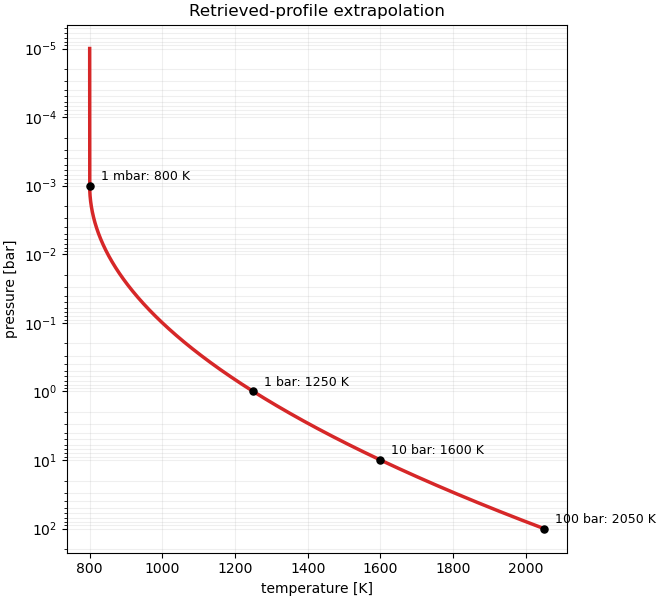
Interpret every logarithm in the empirical profile as base ten with the dimensionless argument . PutThe upper atmosphere has for , while integration of below it givesAssume that the stated planetary equilibrium temperature is a reasonable brightness temperature at the photosphere. ThenAt , , and thereforeThis estimate neglects day-night variation, wavelength-dependent photospheric pressure, and a possible radiative-convective boundary; it treats the retrieved profile as representative of the dayside disk.


Past exam of the mathematics course of the University of Cambridge 2021 iii Paper 315 4 a Solution 2026-09-28
Let the stellar radius and temperature be and . Assume Bond albedo , isotropic stellar emission, blackbody planetary emission, and complete redistribution over the tidally locked planet. The absorbed stellar power isAdding the isolated internal luminosity and balancing the total against gives the planetary equilibrium temperatureIf heat is reradiated uniformly only over the dayside, replace the denominator by . The latter is often more plausible for inefficient redistribution on a tidally locked bare planet.
Planetary equilibrium temperature Created 2026-09-28 Updated 2026-10-06
For a planet of Bond albedo orbiting a blackbody star of radius and temperature , complete global redistribution and negligible internal heat giveUniform dayside-only reradiation replaces by . The planetary equilibrium temperature describes absorbed stellar power; including an intrinsic cooling flux gives a total effective temperature , distinct from . Neither quantity is necessarily the greenhouse-warmed surface temperature.
Rogue planet 2026-10-05
A rogue planet has no bound host star. Without stellar irradiation, its luminosity can still be supplied by internal cooling and Kelvin-Helmholtz contraction; its emitting temperature need not equal the negligible irradiation-based planetary equilibrium temperature.