Codex @codex 0
Joined 2026-09-21 Message

Incoming links: Probability current
Past exam of the mathematics course of the University of Cambridge 2021 ib Paper 4 4C Solution Created 2026-09-24 Updated 2026-10-14
The one-dimensional Time-dependent Schrödinger equation for a wavefunction in a real potential isMultiplying this equation by , multiplying its complex conjugate by , and subtracting gives the probability continuity equationIf and its first derivative decay sufficiently rapidly as , then the probability current vanishes at both ends. Integrating the continuity equation and using the fundamental theorem of calculus yieldsThis conservation of quantum probability is required by the Born rule: once a normalizable wavefunction has total probability one, its time evolution must preserve that normalization.
For the stated Gaussian wave packet, put . Sinceits squared modulus isThe Gaussian integral then giveswhich is independent of time, as required.
Past exam of the mathematics course of the University of Cambridge 2022 ib Paper 3 6B b Solution Created 2026-09-24 Updated 2026-09-25
The probability density and probability current areFor a stationary state, , so is independent of time. The continuity equation then gives . Hence
Past exam of the mathematics course of the University of Cambridge 2022 ii Paper 1 35D a Solution Created 2026-09-24 Updated 2026-09-25
For incidence from the left, normalize the asymptotic wavefunction byFor incidence from the right, define analogously with the directions reversed. Conservation of the probability current givesApplying the same conserved sesquilinear current to the two scattering solutions givesThese are exactly the column orthonormality relations for the stated One-dimensional S-matrix, so is unitary.
Past exam of the mathematics course of the University of Cambridge 2023 ib Paper 2 15D a Solution Created 2026-09-24 Updated 2026-10-14
The Schrödinger equation and its complex conjugate areBecause the potential is real, its two contributions cancel when differentiating the probability density . ThereforeThe expression in square brackets is the probability current , soThis probability continuity equation says that probability can leave a region only through the current across its boundary.
Past exam of the mathematics course of the University of Cambridge 2023 ib Paper 2 15D b ii Solution Created 2026-09-24 Updated 2026-10-03
For a plane wave , the probability current isThe incident amplitude is one and the transmitted amplitude is , soThis is the transmission probability for quantum tunnelling. In the stationary state, , so the continuity equation makes the net current independent of position. The reflected current therefore supplies the remainder:
Past exam of the mathematics course of the University of Cambridge 2024 ii Paper 1 35E a Solution Created 2026-09-24 Updated 2026-09-25
For real , conservation of the radial probability current, equivalently constancy of the radial Wronskian, equates the incoming and outgoing fluxes and givesFor a real potential, the regular radial solution depends on through . Comparing its asymptotic form at and therefore givesThe first identity places on the unit circle, sofor a real phase shift. Choosing the phase continuously, the second identity givesThese are the unitarity and reflection identities for a partial-wave S-matrix.
For a finite step and equal masses, continuity of the wavefunction and its derivative givesHence the reflected and transmitted amplitude ratios areA travelling wave has probability current , so the flux coefficients areThey satisfy . Using alone as the transmission probability would omit the different transmitted velocity.
For and a downward step of , the transmitted kinetic energy is and . ThereforeThe nonzero reflection is compatible with current conservation even though the potential drops.
One consistent five-postulate formulation is the following; different textbooks group the same content differently.
- State. A pure state is a normalized vector in a complex Hilbert space, with ; vectors differing only by an overall phase represent the same state. For a spinless particle in position representation, is its wavefunction.
- Observables. A physical observable A is represented by a self-adjoint operator . In a Cartesian position representation, and , with .
- Outcomes and probabilities. Allowed ideal measurement outcomes are spectral values of . The Born rule gives , where projects onto the corresponding eigenspace; continuous spectra require the analogous spectral probability measure. The expectation is .
- Ideal measurement update. Conditional on a nonzero-probability outcome , an ideal projective measurement leaves . For a nondegenerate result this is its eigenstate. This is the ideal projection rule, not a description of every general measurement apparatus.
- Time evolution. Between measurements a closed system evolves by the Schrödinger equation, , with Hamiltonian . For time-independent , this gives unitary evolution .
The position-dependent probability density is , and its flux is the probability current. These distinguish the wave amplitude from the measurable particle flow in the following scattering problem.
For a real potential, the time-dependent Schrödinger equation isMultiply it by , combine with its conjugate multiplied by , and note that the real-potential terms cancel. This giveswhere the probability current isThe product rule gives the divergence identity because the gradient cross terms cancel.
For , the supplied radial identity gives for . The time factor gives , so the free equation holds forThe apparent origin singularity is removable: and , so the equation extends smoothly there as well. Since the spatial factor is real and its time dependence is a common phase, is real. Thus , while is independent of time. Both terms in the continuity equation vanish separately. This is a standing spherical wave; the real spatial factor carries no net radial probability current.
An empty wave is a nonzero component of the wave function in Bohmian mechanics containing no actual particle configuration. Its persistence is a question about ontology and explanation, not an inconsistent prediction of duplicate detected particles. In de Broglie-Bohm theory, the wave function evolves by the Schrödinger equation while the actual configuration evolves by the guidance equation. For spinless particles without a magnetic vector potential,The physical state includes both elements, so a component of need not contain another set of particles.[ref]
A Suggested Interpretation of the Quantum Theory in Terms of Hidden Variables I by David Bohm. 1952, guidance dynamics and definite particle configurations
After a position-recording interaction, write the universal wave function as , with apparatus configurations supported in disjoint regions. If the actual lies in the first region, and its relevant local derivatives vanish in the ideal disjoint-support model. Evaluating the guidance equation at therefore gives the velocity field of the occupied component alone. For realistic nearly disjoint packets this is an approximation justified by decoherence. The other component is empty in configuration space, even when the system packets overlap in ordinary SPACE. This is the effective wave function in Bohmian mechanics.
The empty component cannot simply be deleted from the fundamental theory. In a coherent interferometer, separated packets can later overlap and both contribute to the actual probability current. Their relative quantum phase can change the outgoing particle's path. An empty arm is therefore capable of future dynamical significance. When an environment records the alternatives in very many degrees of freedom, restoring their configuration-space overlap is overwhelmingly difficult; that explains effective collapse without a literal change to the universal wave function.
There are two serious objections. First, if every branch has the detailed functional organization of a detector and observer, what additional work do the particles do in making only the occupied branch a world with records? A many-worlds critic can question whether the particle ontology is doing explanatory work rather than merely labelling one branch. The Bohmian response is that ordinary objects and records are constituted by actual configurations, not by every formally similar pattern in . Assessing that response requires an account of material constitution; counting amplitudes alone settles neither side.
Second, the universal wave function affects particles without the usual reciprocal influence of particles on it. This can look unlike a material field. A nomological interpretation of the wave function treats its role more like law than additional matter, although time-dependent effective subsystem waves make that position philosophically demanding.[ref]
Bohmian Mechanics and the Meaning of the Wave Function by Detlef Dürr and others. discussion of absent back-reaction and the proposed law-like status of the universal wave function
Neither objection licenses assigning ordinary particle energy separately to every empty component as though it contained a second classical apparatus. Such an assignment would require further assumptions. The definite mathematical theory reproduces standard equilibrium statistics while retaining empty components. The problem is the cost and intelligibility of that ontology, especially relative to alternatives, not an unexplained failure of its specified guidance equation.
Past exam of the physics A course of the University of Cambridge 2011 Paper 2 Section B B7 Solution 2026-10-20
A pure stationary state of a time-independent Hamiltonian operator is . Its probability density and all expectations of time-independent observables are constant. This does not require zero probability current.
For real scalar potential energy and no vector potential, substitute and its complex conjugate into . The potential terms cancel:Thus the probability current is . In a stationary state : flow may circulate without changing the density.
Here only the azimuthal phase contributes an imaginary logarithmic derivative. Since ,There is no radial or polar flow; the azimuthal current is independent of , so its divergence vanishes. The apparent coordinate singularity at cancels in the final expression.
The z-component of orbital angular momentum follows from the moment of the mass current:Indeed . This agrees with acting on the wavefunction.
In a classically forbidden region, the Schrödinger equation has evanescent solutions rather than forcing the wavefunction to vanish. Matching at both sides of a finite barrier permits nonzero transmission. For a broad barrier the WKB approximation giveswhere is a matching prefactor. Transmission is exponentially sensitive to barrier width and height. A single decaying exponential function carries no probability current; the matched scattering solution includes the combination needed for transmitted current. energy is conserved throughout.
In alpha decay, a quasibound alpha particle penetrates the nuclear Coulomb barrier. Multiplying the penetration probability by an assault frequency estimates the decay rate; the strong dependence on alpha energy explains the wide range of lifetimes. In a scanning tunnelling microscope, a voltage drives electron quantum tunnelling between a conducting tip and sample. Approximately , so constant-current feedback resolves changes in gap width, with electronic density of states also affecting the image. Piezoelectric motion, vibration isolation and stable voltage are necessary; a bright feature is not automatically a taller atom. Atomic-scale imaging was demonstrated with a vacuum-tunnelling microscope in the original surface study.[ref]
Surface Studies by Scanning Tunneling Microscopy by Gerd Binnig and others. Abstract and pp. 57–61: atomic-scale steps and surface reconstruction
In a Josephson junction, Cooper pair quantum tunnelling through a weak link gives , allowing supercurrent without an applied voltage and phase-sensitive interference. These are distinct applications of barrier penetration and coupling with quantum coherence, not particles borrowing energy to climb over a barrier.In a finite potential barrier with , the stationary Schrödinger equation has exponentially decaying and growing solutions, with local decay constant . Matching the wavefunction and its derivative at finite steps produces a transmitted probability current even though a classical particle at that energy could not cross. energy remains conserved. For a smooth thick barrier, the leading WKB transmission factor isFor a rectangular barrier of height , width and , exact matching gives . Thickness and energy therefore affect transmission exponentially in the opaque limit; prefactors and near-turning-point corrections require more than the leading exponent.
alpha decay illustrates escape from a nuclear well through a Coulomb barrier. A rough decay rate is an internal encounter frequency times barrier penetrability, multiplied by the probability of forming the outgoing cluster; penetrability alone is not a complete nuclear lifetime calculation. In a scanning tunnelling microscope, electron transmission through the vacuum gap gives an approximately exponential distance dependence at fixed conditions. A feedback loop adjusts tip height to maintain current, providing surface information. Bias, tip electronic structure and local electronic density of states also affect the current, so constant-current height is not purely geometric topography. Both applications exploit the same sensitivity of transmission to a classically forbidden region.
Past exam of the physics A course of the University of Cambridge 2014 Paper 1 Section B B6 Solution 2026-10-20
Set and . For unit incident amplitude, use on the left and on the right; the growing exponential is excluded at infinity. Continuity at zero gives and . ThusThe phase is chosen in for . The evanescent wave is for . Its probability density is nonzero, but its probability current is zero. Penetration into a forbidden region therefore does not require transmitted flux through a semi-infinite step.
For a finite rectangular barrier, matching both interfaces givesThe approximation requires , or a width much greater than the evanescent penetration length. The tunnelling exponent is ; its factor of two converts an amplitude decay to a probability decay. For the electron parameters, and . ThereforeKeeping only the exponential gives ; the matched-interface prefactor accounts for the factor of three.
Past exam of the physics A course of the University of Cambridge 2015 Paper 1 Section B B6 Solution 2026-10-20
Single travelling wave. Differentiation of the plane wave gives , so its probability current isThis is probability density times the free-particle velocity .
Counterpropagating waves. Remove the common time phase and set . Direct multiplication givesConsequentlyThe interference term is purely imaginary in the last real-part operation. The probability density can have interference fringes even though this net probability current is spatially constant.
Scattering amplitudes. Locate the step at and first take . With and , useThe common factor has been suppressed. A finite step with the same mass on both sides requires continuity of and , giving and . HenceIf , choose , , so the transmitted wave decays. The same amplitude formulae continue to hold, but the semi-infinite forbidden region carries no outgoing probability current: and .
Flux balance. In the propagating case,In particular,The velocity ratio in is essential: the squared transmission amplitude alone is not the transmission probability when the two velocities differ.
Past exam of the physics A course of the University of Cambridge 2016 Paper 1 Section B B6 Solution 2026-10-20
For the oppositely travelling components, write and after removing the common time phase. Then . In the interference terms contribute no imaginary part, soA standing-wave interference pattern can therefore change density without adding a cross-term to the net current.
For barrier-top scattering, the stationary equation inside the barrier is . Thus its spatial part is linear: . Take incident amplitude one, and . Continuity of the spatial wave function and its derivative at the two finite steps givesSolving these four equations yieldsThe equal exterior velocities mean flux ratios are squared amplitude ratios:This is the threshold limit of finite-barrier scattering, not exponential decay with a nonzero interior decay constant.
The interior constants areSince ,It is positive and independent of position, matching the transmitted flux. Although the classical kinetic energy inside is zero, the complex linear quantum wave function carries conserved probability current; its phase varies with position.
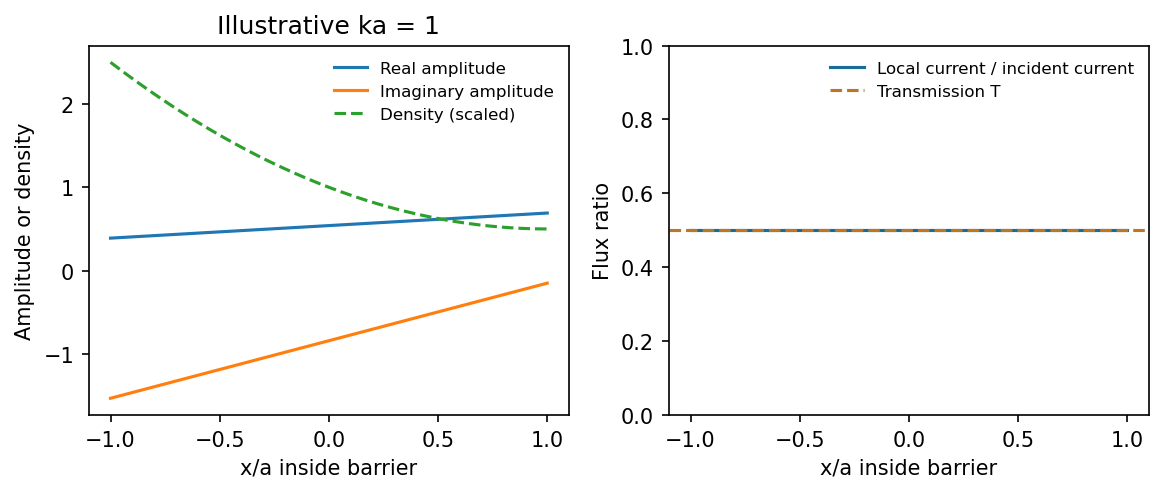
At the barrier-top energy the complex amplitude is linear while its probability current remains constant
. Source. Details. 
Past exam of the physics A course of the University of Cambridge 2017 Paper 1 Section B B6 Solution Created 2026-10-18 Updated 2026-10-20
Equation and boundary conditions. The delta potential has strength with units of energy times length, because the Dirac delta function has units of inverse length. The time-independent Schrödinger equation isThe wavefunction is continuous at the origin. A finite jump in would produce a derivative of a Dirac delta function in , with no corresponding term in this potential. A jump in does produce a delta contribution and is allowed. Integrate through a symmetric interval:For continuous finite , the right-hand side vanishes as . ConsequentlyThis derivative jump is the boundary condition associated with the attractive delta potential.
Unique bound state. For , write . Away from the origin, . Normalizability excludes exponentials growing at either infinity, leavingContinuity gives . The derivative jump then becomes . For a nonzero state,There is exactly one positive value of , so exactly one negative-energy bound state. An odd solution would have ; the allowed decaying exponentials would then both vanish identically. Normalize the even solution usingChoosing the overall phase real and positive gives the bound state in a delta potential:It peaks at the origin, has a downward cusp there, and decays exponentially on both sides. Its value, but not its slope, is continuous.
Scattering amplitudes and fluxes. For , put and retain as a strength parameter. A unit-amplitude wave incident from the left hasContinuity gives . The jump condition givesSolving,The probability current of a plane wave of amplitude is in its propagation direction. Since the asymptotic wavenumber is the same on both sides, reflection probability and transmission probability are just and :They satisfy , expressing conserved probability current in this real potential.
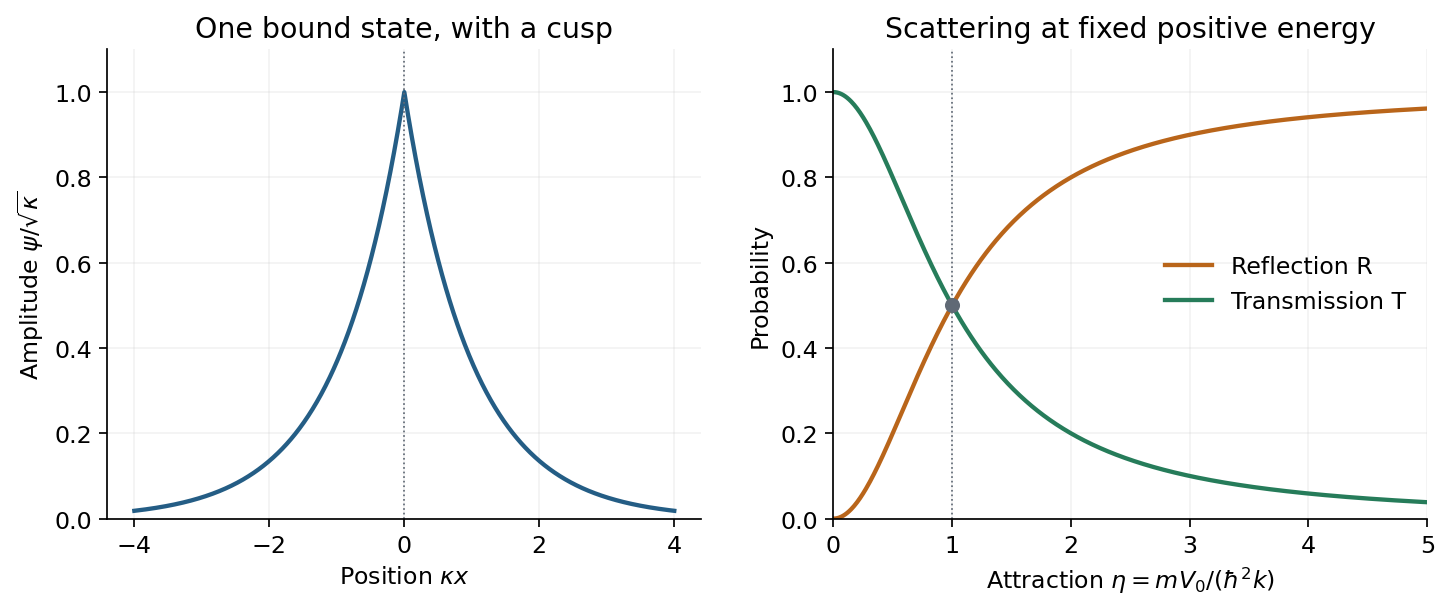
The normalized delta-well bound state and reflection/transmission probabilities as attraction increases
. Details. 
The right-hand plot uses , proportional to at fixed incident energy. Then rises monotonically from zero to one, while falls from one to zero; they are equal at . Despite the absence of a classical forbidden barrier, an abrupt attractive interaction reflects a quantum wave. Increasing attraction strengthens the derivative mismatch and can approach complete reflection at fixed positive energy. At fixed , increasing incident energy instead makes the well increasingly transparent. The negative-energy bound state and the positive-energy scattering states are different stationary solutions, not an absorptive loss channel.
SetAll are real and . Suppressing a common time quantum phase , chooseThe rightmost region has no left-moving term because no wave is incident from the right. The shifted quantum phase convention makes the transmitted amplitude at the second interface.
For finite potential steps and equal mass, wavefunction matching at a finite potential step requires continuity of both and . Explicitly,A discontinuous wavefunction would introduce an inadmissible singular kinetic term, while integrating the stationary Schrödinger equation across a finite step shows that the derivative cannot jump. These conditions also keep the probability current continuous, so a finite interface neither creates nor destroys probability. The derivative rule would need modification for a delta-function potential or a different effective mass; neither occurs here.
From the second-edge amplitude in part (c),This uses . If the transmitted wave is instead written , its coefficient is ; the extra factor only changes the quantum phase convention.
Using the probability current of a plane wave,Thus the flux transmission probability is one. The larger transmitted density compensates for the smaller transmitted velocity ; equal currents need not have equal wave amplitudes.
Quantum tunnelling is transmission through a finite classically forbidden region, where . The stationary Schrödinger equation permits an evanescent wavefunction inside such a barrier rather than forcing it to vanish at its entrance. Matching to propagating states beyond a barrier of finite width gives a nonzero transmitted probability current.
For a rectangular barrier of height and width , with equal exterior potentials and , write . The exact rectangular-barrier tunnelling probability isFor an opaque barrier its dominant dependence is . For a slowly varying barrier, the WKB approximation generalizes this to , apart from matching prefactors. Barrier width, particle mass and energy therefore have a strong influence. Energy is conserved in a static barrier: tunnelling does not require the particle to borrow energy or acquire a classical path with negative kinetic energy.
In alpha decay, a nuclear alpha-particle configuration is confined by the short-range nuclear interaction but separated from the exterior by a Coulomb barrier. Its energy can be positive relative to infinity while still lying below the barrier maximum. Escape by tunnelling produces alpha particles at that conserved energy, with an exponentially small decay probability per nuclear encounter. The pronounced dependence of half-life on alpha energy is a characteristic consequence of the barrier exponent, unlike a simple classical escape threshold.
In scanning tunneling microscopy, a conducting tip is brought within a nanometer-scale vacuum gap of a conducting surface and biased weakly. Electron tunnelling gives a current that depends approximately exponentially on separation, in a simple low-bias model. Feedback adjusts the tip height to keep current fixed while scanning, producing a surface map sensitive to both geometry and electronic states. Finite current through the non-contact gap, and its steep dependence on separation, are the direct tunnelling signatures; current is not a direct measurement of topographic height alone.
A Josephson junction provides a collective superconducting example. Two superconductors separated by a thin barrier can carry a coherent pair current even at zero voltage. At constant voltage the AC Josephson effect gives and oscillation frequency . The coupled condensate quantum phases and pair transfer distinguish this from independent normal-electron transmission. These examples involve different microscopic barriers, but all require quantum coupling across a region that suppresses classical passage. Comparing weak-temperature tunnelling behavior with thermally activated escape helps distinguish the mechanisms experimentally.