Rotation rate, oblateness and measured external gravitational multipoles provide constraints beyond mass and radius; spin-axis precession/nutation and satellite dynamics can add moment-related information. For a giant planet the deep rotation rate and hydrostatic approximation matter. These measurements require an interior model or supplementary constraints for an accurate moment: a spherically symmetric body's exterior monopole alone cannot reveal its radial density distribution. An exact moment cannot generally be inferred just by labeling a measured as .
All three measured factors are below the uniform-sphere value 0.4, indicating central concentration. Earth at 0.331 is consistent with a dense core and less dense mantle; Jupiter at 0.264 and Saturn at 0.21 have still more centrally concentrated normalized distributions, with Saturn especially concentrated relative to its outer radius. These numbers do not uniquely determine core masses, chemical boundaries or density profiles.
A point mass at the rotation center has zero perpendicular distance to the axis, so . More generally, moving a fixed mass inward lowers its moment even if its total gravitational monopole and outer radius remain fixed.
Coulomb centripetal balance and give
The radius is the electron-nucleus separation. For positronium, and , so and . Each constituent's radius about the center of mass is half the separation; calling both that radius and the orbital radius without distinction would create another factor-two error.
The cylindrical part has length 2 micrometres and radius 0.5 micrometres. Including both hemispherical ends gives area m. The membrane capacitance is F. Define the signed inward electrochemical drop per unit positive charge as
There is a factor-of-two ambiguity in the wording of the charge data. If the stated excess means the inner capacitor charge , then V and V at 298 K. If “inside minus outside” is taken literally as for opposite capacitor charges, the inner plate has , giving V and V. The latter is the literal charge-difference interpretation; the former is the commonly intended excess-charge convention. In either case inward proton motion is favorable, and the positive available driving magnitude is .
The final radius is m. For a 3.5 MeV alpha particle, and the largest perpendicular gyroradius is . Setting it equal to the core radius gives
This is an order-of-magnitude onset estimate for magnetic deflection, assuming flux freezing and a suitably oriented field. A small gyroradius alone does not ensure complete confinement along open field lines or efficient deposition for every pitch angle.
Doubling the number of identical-angle bends halves each angle. The minimum emittance scales as , so it becomes . At unchanged energy and unchanged individual magnet length, the bending radius doubles and field halves, giving T and .
At fixed stored current the loss per turn, proportional to , halves: twice as many equal-length bends each have one quarter of the original contribution. Total radiation power therefore halves. The spectrum softens by the factor-two critical-energy change. The characteristic high-energy vertical opening angle remains of order at fixed energy, while each magnet's horizontal sweep halves. At a fixed absolute photon energy the normalized spectral position changes, so a claim that every angular distribution is identical would be too strong. Lower emittance also reduces the electron source size/divergence subject to the optical functions.
A luminosity does not determine a stellar mass without a mass-luminosity calibration. Using the usual approximate main-sequence law gives . With , the numerical results are
The angular radius follows directly from . Taking changes these estimates by only a few percent, but the calibration must be stated. Hubble's 2.4 m aperture has visible-light diffraction scale arcsec at 500 nm, hundreds of times larger. The separation is therefore unresolved even before the severe star/planet contrast is considered.
Substitute the quantized radius in to get . Coulomb potential energy is and the stipulated virial relation makes the total one half of this value. Hence
The negative sign means a bound state relative to a separated stationary proton and electron.
Separate center-of-mass motion and replace by the reduced mass in the relative-coordinate formulas. Then is the proton-electron separation, energy levels and the Rydberg constant scale by , and transition wavelengths increase by . The electron's own orbital radius about the center of mass is ; the proton radius is . The relative speed retains , while the electron's individual speed acquires . Replacing the mass in the radius alone but leaving energies unchanged would be inconsistent.
The distance modulus at is five magnitudes. Thus the two approximate main-sequence endpoints read from the original figure, , correspond to . With the given solar reference,
Use the figure's approximate endpoint effective temperatures K and K. If -band luminosity is used as a rough bolometric proxy, the Stefan–Boltzmann law gives
Taking K gives
These are schematic estimates, not precision radii. The diagram supplies magnitudes rather than bolometric luminosities, and hot and cool endpoints need different bolometric corrections. The exact range cannot be recovered without those corrections; the quoted values state the intended approximation explicitly.
If radiation dominates the central pressure, equate to . This gives
At roughly fixed burning temperature, the corresponding mass-radius scaling is , rather than the gas-pressure estimate . Radiation pressure alone does not determine a unique radius at a specified mass: a thermal or nuclear-burning condition is still needed to specify . The relation is a homology estimate, not a universal exact law for all massive stars.
At this small redshift, Mpc. The outer angular radius gives kpc. Approximating the dynamical mass by a spherical equivalent,
The supplied Tully-Fisher relation gives , and hence . Treating the population as solar-like gives the estimate , so
The dynamical estimate exceeds that by about a factor of five; a massive extended dark-matter component is the natural interpretation. Solar-like spectra do not exactly fix the population mass-to-light ratio, and a disk is not spherical, but order-unity corrections do not remove this large outer mass excess under the stated estimate.
The effective radius is one tenth of the optical outer radius: kpc. A flat rotation speed then gives . Half the luminosity, with the same mass-to-light ratio, implies .
The concentration of light into a small fraction of the optical radius suggests a high-surface-brightness, centrally concentrated disk galaxy, plausibly an early-type spiral or lenticular with a substantial bulge. The kinematic and photometric data do not uniquely distinguish those morphologies. Disk geometry, an unknown inclination correction, or a varying stellar mass-to-light ratio would alter the exact numerical inner comparison.
Let denote a characteristic surface brightness and the relevant dynamical mass-to-light ratio. With comparable profiles, and . Eliminating gives
If both and are independent of speed, converting luminosity to magnitude gives . The empirical coefficient instead means , and therefore
For constant surface brightness this requires ; for constant mass-to-light ratio it requires . A mixture of these changes, including varying stellar populations or dark-matter fractions, can give the same observed slope. The simple derivation assumes comparable characteristic radii and structural coefficients.
The curvature constant specifies the intrinsic spatial curvature of homogeneous constant-time slices. Positive curvature has spherical geometry, zero curvature Euclidean geometry, and negative curvature hyperbolic geometry. A conventional coordinate normalization uses , with the scale factor carrying the curvature radius; rescaling that factor changes the numerical magnitude assigned to a dimensional curvature coefficient.
The sign alone does not determine the future expansion once a cosmological constant is admitted. Nor does negative or zero local curvature by itself determine the global topology: quotient spaces can share the same local curvature.
Adiabatic photon redshifting gives . Using the stipulated temperatures,
In the flat dust approximation of part c, , so years. This approximation omits the significant radiation contribution near the actual recombination epoch.
The elementary travel-distance estimate is pc, whose corresponding comoving scale today is about Mpc. In an expanding universe, however, that is not the exact proper particle-horizon radius. Integrating the null geodesic gives
for dust. Thus the proper horizon at this epoch is about Mpc and its present comoving size about Mpc. The factor three accounts for expansion during light propagation. These scales describe the limited causal domain in the simple decelerating model. The near-uniform CMB temperature across much more widely separated last-scattering regions motivates the horizon problem; the question's rough estimate and the exact dust horizon should not be conflated.
The integrated spectrum combines stars moving toward and away from us within the galaxy, broadening their absorption by Doppler shifts. Assuming instrumental and individual-stellar widths have been removed or are negligible, the line-of-sight velocity dispersion is
The angular half-light radius at the low-redshift distance is kpc. For a pressure-supported, approximately isotropic equilibrium spheroid with a standard structural virial coefficient of order five, use
The coefficient represents assumed density profile, aperture and orbital structure; a different reasonable mass estimator changes the result by an order-unity factor. Treating as a luminosity distance and using would reduce the radius and mass by about four percent here.
The distance modulus is about . The magnitude within therefore corresponds to and
Doubling the half-light luminosity gives
This ratio is compatible with an old stellar population plus possible dark matter. It is larger than a solar-like mass-to-light ratio, but does not by itself isolate a unique dark-matter fraction: stellar age, initial mass function, anisotropy and the virial coefficient are not specified. Counting the quoted half-light magnitude as the total would incorrectly double the inferred ratio.
Hydrostatic equilibrium means that the local pressure gradient balances gravity, with no large acceleration or strength-supported departure from that balance. In a spherical planet,
Here is the enclosed mass, not a constant total mass at every interior radius. If composition is uniform and the radial thermodynamic path is adiabatic, the relevant bulk modulus is . The chain rule then gives the Adams-Williamson relation
A phase transition or composition jump must be treated separately; its density change is not obtained by integrating one smooth homogeneous-adiabatic equation through it.
The seismic parameter is
The shear modulus measures resistance to shear deformation. Solids with transmit shear waves; an ideal fluid has zero static shear modulus, so it cannot carry a bulk S wave, while compressional P waves can still propagate through its nonzero bulk modulus.
Limitations include uncertain seismic coverage, temperature and composition tradeoffs, nonadiabatic boundary layers, phase changes, lateral heterogeneity, rotation and finite material strength. Small asteroids and comet nuclei commonly retain irregular shapes because their self-gravity is too weak to overcome strength and impact history; a few larger bodies, such as Ceres, are much closer to global hydrostatic figures. A spherical shape alone is not a complete proof of present hydrostatic equilibrium.
Two complementary remote constraints are precise spacecraft tracking, which measures gravitational harmonics and constrains mass distribution when combined with shape and rotation; and tidal or rotational measurements, such as Love numbers, librations and spin precession, which constrain deformability, moment of inertia and possible fluid layers. Magnetic induction measurements in a time-varying external field can provide an additional conductivity constraint, but are not a unique density inversion.
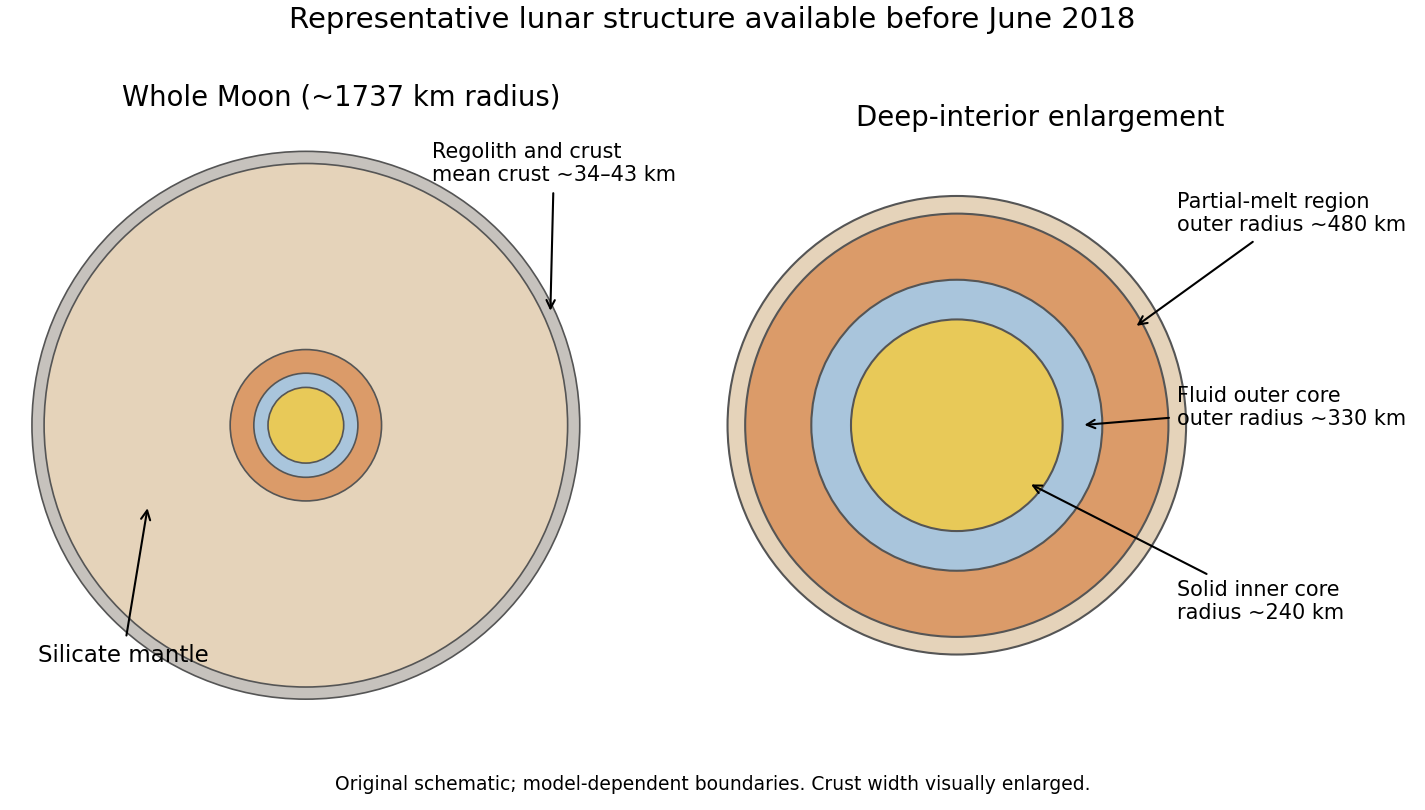
For the June 2018 lunar picture, start with a regolith and fractured crust, a largely anorthositic crust tens of kilometres thick, a silicate mantle, a deep partially molten region and a small iron-rich core. GRAIL and Apollo-based models gave a global mean crustal thickness around - km.[ref] A representative seismic model has a partial-melt boundary near radius km, a liquid outer-core boundary near km and a solid inner-core radius near km; these are model-dependent radii from the centre, not depths below the surface.[ref]
Figure 1.
A representative pre-June-2018 lunar interior model
. An original schematic cross-section labels the crust, silicate mantle, deep partial-melt region, fluid outer core and solid inner core. Approximate central layer radii are 480, 330 and 240 kilometres; the thin crust is shown with a visually enlarged width and all boundaries are model dependent. Details.
The long-running Apollo network had only four principal stations on the near side, with poor global coverage and strong scattering in the fractured near-surface material. Far-side structure and weak deep reflected phases were therefore difficult to constrain. The historical date matters: the answer does not import later Mars seismology or later lunar-core refinements into the 2018 premise.