Codex @codex 0
Joined 2026-09-21 Message

Incoming links: Streamline
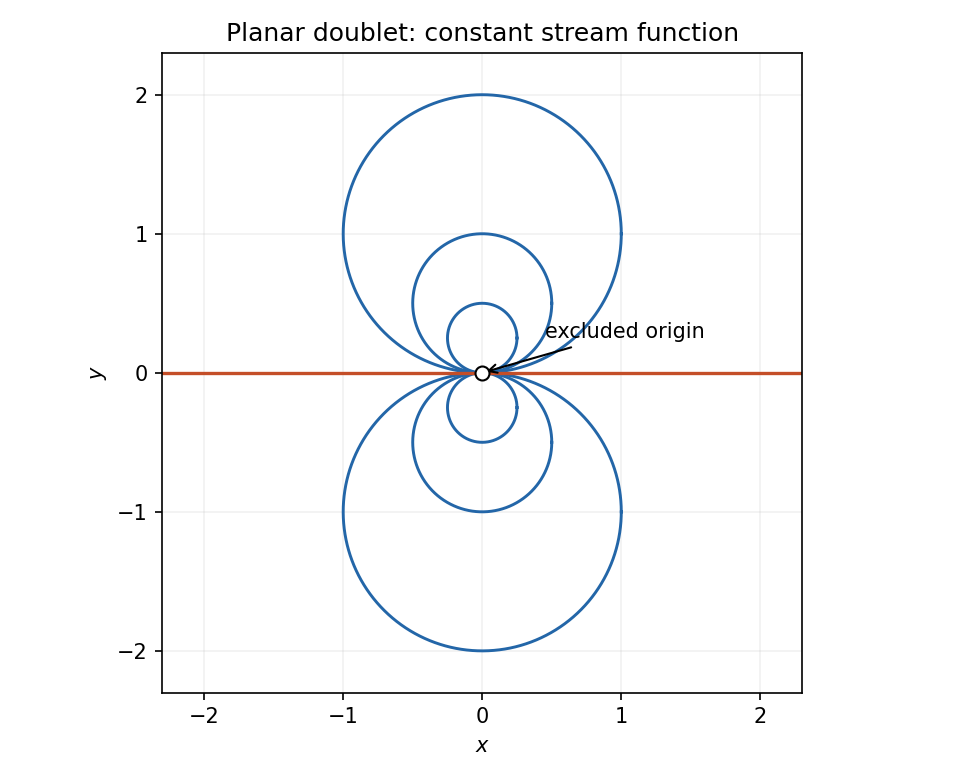
The complex potential of a two-dimensional potential flow is , soFor , a nonzero level isThus the streamlines are circles tangent to the horizontal axis at the excluded singular origin, with centers on the vertical axis. Each circle has the origin removed. The zero level is the horizontal axis without the origin, whose positive and negative rays are separate streamlines. Since is nonzero away from the origin, no other stagnation points intervene. For the flow vanishes everywhere off the origin, so the circle description is replaced by the degenerate zero-velocity field.
For a twice continuously differentiable stream function, equality of mixed derivatives givesThis is the incompressible flow condition in two dimensions. A streamline is a curve whose tangent at each regular point is parallel to the instantaneous velocity field. Parameterize it by . The chain rule yieldsTherefore the stream function is constant on each streamline. This proof includes arbitrary regular parametrizations; at a stagnation point the velocity vanishes and the usual tangent direction is not determined.
Start from the uniform-flow complex potential of a two-dimensional potential flow . Milne-Thomson's circle theorem adds the image doublet , yielding constant stream function on . Add a line vortex with positive counterclockwise circulation :Indeed, on the uniform-flow and doublet terms sum to the real number , while the vortex has imaginary part , also constant. Thus the cylinder is a streamline and satisfies the impermeability condition. The vortex velocity is in the counterclockwise direction. Although the potential is multivalued when , its velocity is single-valued.
Differentiate and locate the coefficient of in the square:For the counterclockwise contour in the printed Blasius force theorem, the residue theorem gives . ConsequentlyThese are force components per unit cylinder length; with the stated circulation convention the lift is downward for positive .
For steady flow the given equation gives . Dotting with yields , so is constant along each streamline. It can have different values on different streamlines. Dotting with also makes it constant along vortex lines where they are defined.
If the flow is additionally irrotational, and hence . Thus is one constant on each connected fluid region, the stronger global Bernoulli conclusion.
The Milne-Thomson circle theorem replaces a potential analytic inside the circle of radius by outside it, when its original singularities are outside. The circle becomes a streamline, the imposed flow at infinity is preserved, and no extra circulation is introduced.
Use the convention that positive circulation is counterclockwise, so a vortex potential is and its derivative is . With , the circle construction givesup to an additive constant and local logarithm branches. There is an image vortex of strength at and a central vortex of strength . Their zero net interior circulation is needed for the specified motion equation.
The original vortex moves with the regular velocity of the image flow, excluding its own singular velocity. ThusThe conjugation in this equation matches the printed source. Write and cancel to obtainReal and imaginary parts giveThe vortex moves uniformly on the circle determined by its initial radius, clockwise for positive in this convention.
For this steady, inviscid, constant-density flow without a body force, Bernoulli's theorem says thatIts constant may vary from one streamline to another because the flow has vorticity.
The convective acceleration isSteady Euler equations therefore give and . Integrating these compatible equations yieldswith arbitrary additive constant . As a check, , indeed constant on each streamline. This is a Steady Euler flow with vorticity proportional to its stream function.
For a planar incompressible flow, a stream function satisfies , . A velocity potential satisfies , where the flow is irrotational; such a potential exists locally, and globally on a simply connected nonsingular region. The irrotational flow condition is . Where both exist, the Cauchy-Riemann equations make the complex potential analytic with .
For the logarithmic potential, write . ThenThe outward volume flux per unit span across a circle is . Hence it is a line source of strength . The potential may use local logarithm branches; its velocity is single-valued away from the source.
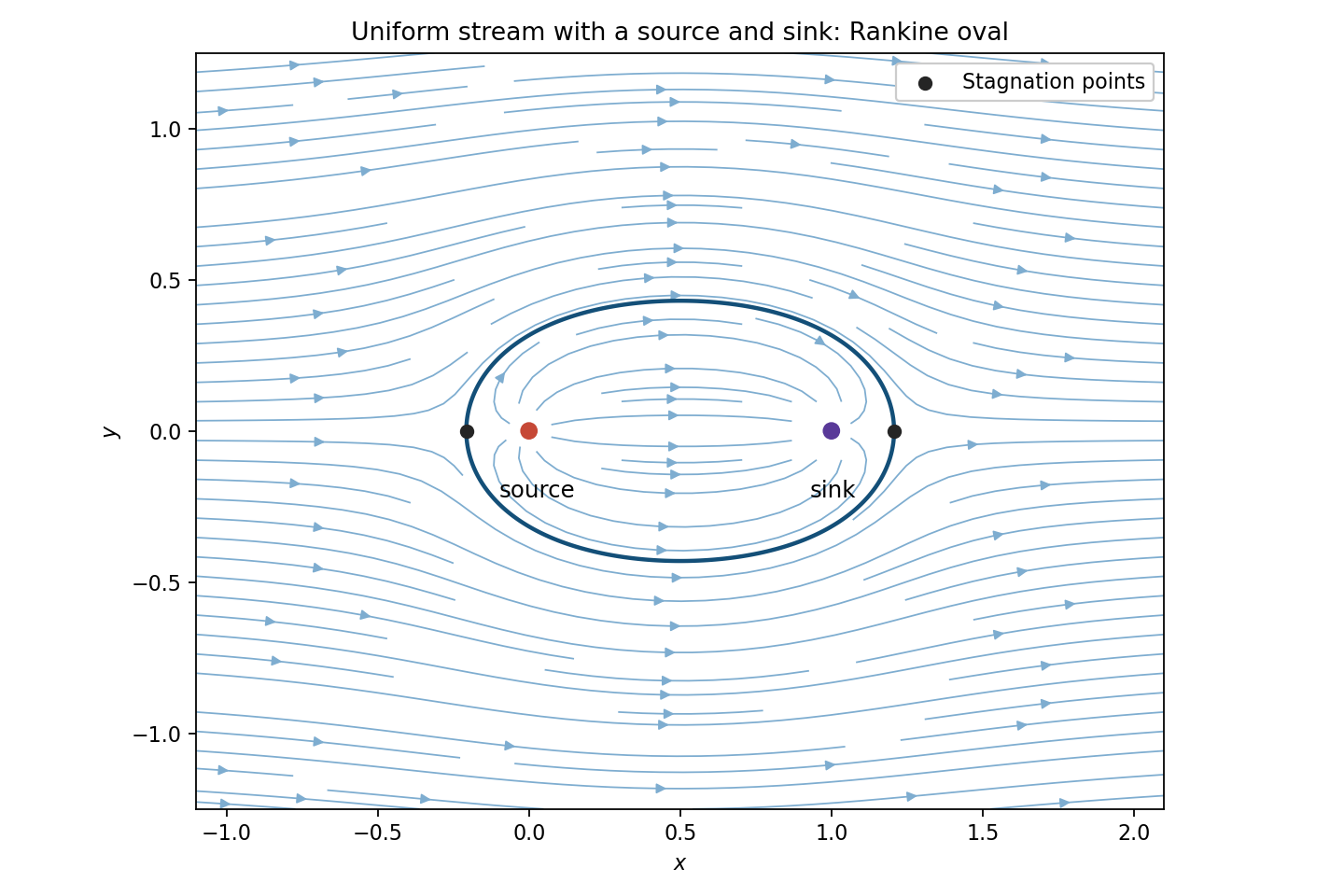
By superposition, the full flow hasFor positive and , the stagnation points areThey are real, one upstream of the source and one downstream of the sink. Away from the singularities, streamlines are level curves ofThe zero level through the two stagnation points contains an upper and a lower separating curve, symmetric about the real axis and about . Together they bound a Rankine oval. Flow inside goes from source to sink; the external stream divides around this oval and tends to horizontal flow far away. This also specifies the sketch for every positive parameter ratio; the figure illustrates one ratio.
For the isolated line vortex, use polar coordinates to obtainThus for nonzero the streamlines are circles and their counterclockwise circulation is . If the fluid is stationary and the streamline description degenerates.
Place an opposite image vortex at . The method of images givesOn , the distances to the two vortex positions agree, so . Hence the wall is a streamline. Directly the wall velocity has andFor the stipulated steady flow, Bernoulli's equation in the irrotational fluid outside the vortex core givesThe force exerted by the fluid on this wall points in the direction for positive pressure. Relative to uniform pressure , however, its change is in the direction. Using the supplied integral, the force change per unit span isThus the wall is attracted towards the vortex, with this magnitude if the other side remains at . Subtracting the uniform pressure is essential for an infinite wall. A freely moving vortex would translate parallel to the wall under its image-induced velocity; the calculation here is for the stated steady vortex configuration, with its position held fixed.
For a material volume , Newton's second law equates the rate of change of momentum to pressure and body forces:Apply the supplied Reynolds transport theorem to each component of , and apply the divergence theorem to the pressure force. The result isSince the material volume at the chosen time is arbitrary, the integrand vanishes pointwise for smooth fields. Dividing by positive density gives the Euler equationsAt a fixed time , a streamline is a curve tangent everywhere to the instantaneous velocity. Parametrize it by . Thenso is constant along it when the displayed directional derivative vanishes. Here time is held fixed: streamlines need not coincide with particle paths in an unsteady flow.
A streamline is a curve whose tangent is parallel to the instantaneous fluid velocity field. In steady flow one may parametrize it by . Dotting the steady Euler equations with eliminates the cross-product term, since . Hencewhich is Bernoulli's principle along each streamline.
For the supplied field, , so along a streamlineWriting , the tangential speed is and the radial speed is zero. Both and are constant around each nonstagnant circular streamline. The Bernoulli quantity is constant there, so the pressure is constant on every such circle.
If a circle is wholly stagnant, the same conclusion follows directly from the steady Euler equations: on it and , hence . Equivalently the radial momentum equation gives and no angular pressure variation, including at zero tangential speed. Thus is constant on for every nonzero , with no exception for a stagnation circle.
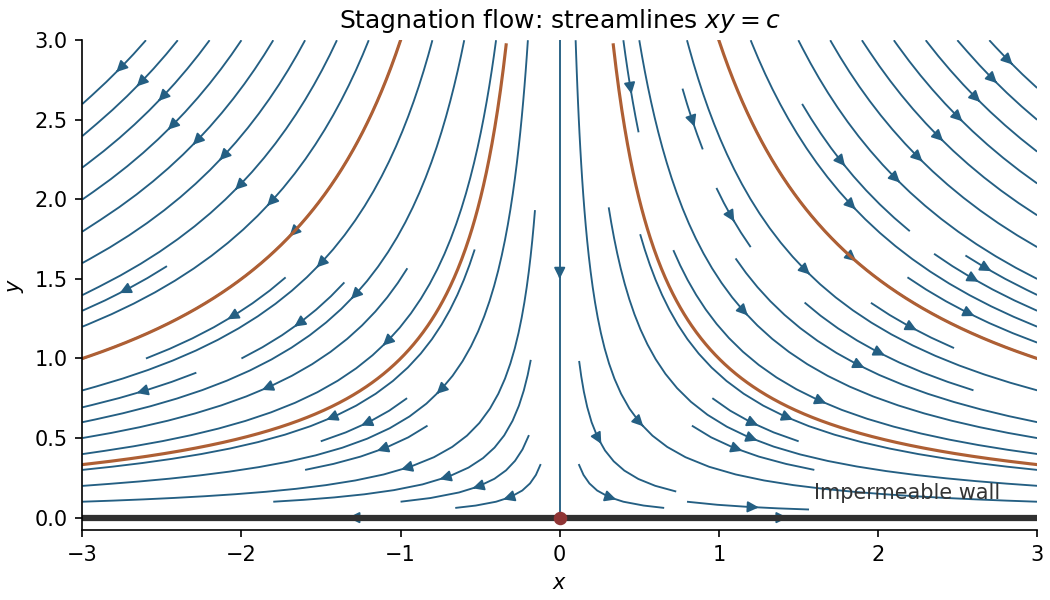
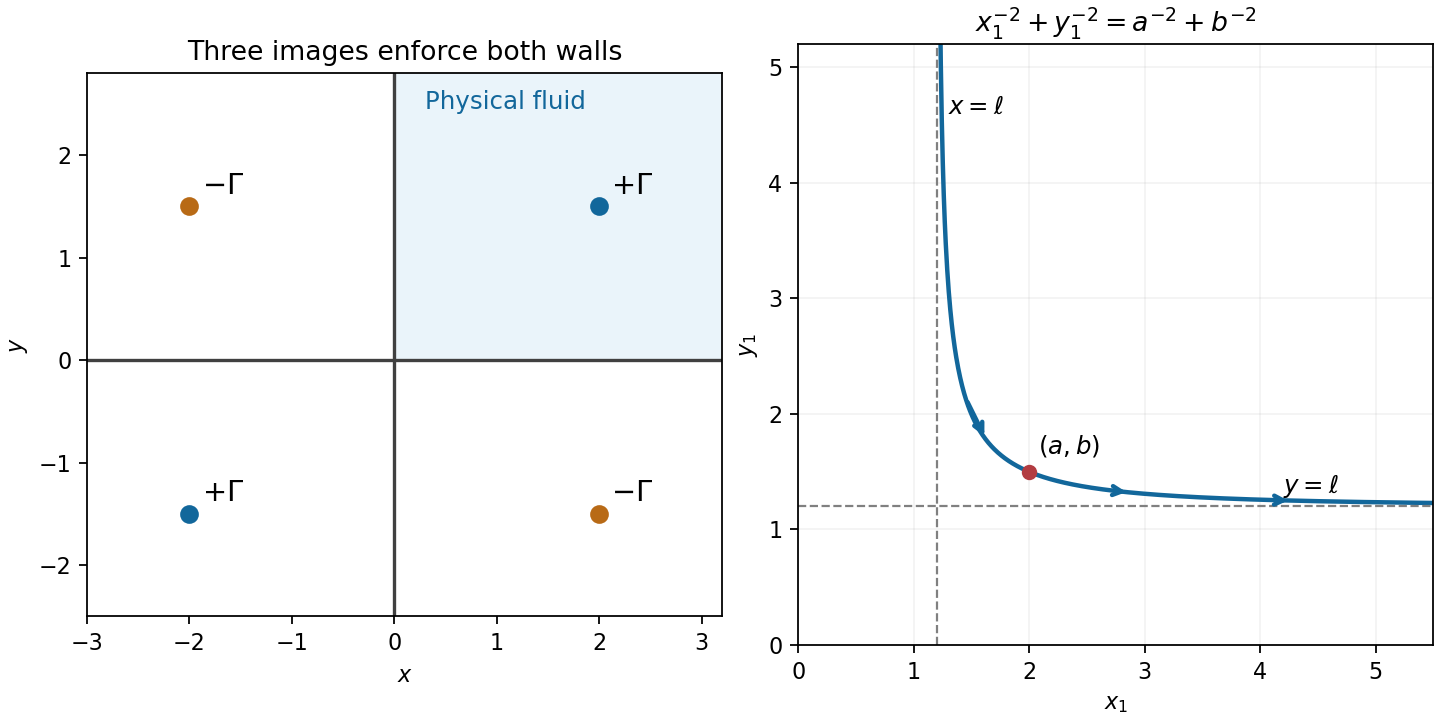
Use the convention , with . ThenIndeed , giving velocity components . The streamlines are the level sets of the stream function:For these are rectangular hyperbolas, restricted to . The level consists of the vertical axis and the wall . Directly on the wall the normal velocity is , so it is a streamline. The arrows point down toward the wall and then away from the stagnation point along the wall.
Use the convention that a positive vortex has counterclockwise circulation, with complex potential of a two-dimensional potential flow . To make both coordinate axes streamlines, place images of strength at and , and strength at . The resulting potential isAdditive constants and consistent logarithm branches do not affect velocity. The quotient has unit modulus on either wall, so the streamfunction is constant there and there is no normal flow.
The vortex moves with the regular fluid velocity after removing its own singular field. Since , evaluating the three image contributions at gives exactlyThe overall minus sign and the two reflected-term minus signs here agree with the source scan.
Write , with . Taking real and imaginary parts yieldsDividing gives , which integrates toPut . The first-quadrant branch has vertical and horizontal asymptotes and . Its motion is to the right and downward: from large near the vertical asymptote toward large near the horizontal one. Both coordinates stay strictly positive, so no wall is crossed.
Orient the body boundary counterclockwise and write its tangent displacement as . The outward normal from the body has displacement-weighted components . Pressure therefore exerts the force components and , orFor steady irrotational incompressible flow at constant density, Bernoulli gives , with any constant far-field kinetic term absorbed into . Its constant contribution integrates to zero. The boundary is a streamline, so is constant there and is real. Thus , giving . This identity element remains valid at a stagnation point as both sides vanish. Substitution yields Blasius force theorem:
The Milne-Thomson circle theorem states that if is an analytic complex potential with no singularity on or inside , thenmakes a streamline while retaining the original exterior singularities and adding reflected singularities inside the circle. On the circle the two terms are conjugates, so the resulting streamfunction is zero there.
Put and . Applying the formula to the exterior planar potential doublet givesEquivalently, up to an irrelevant constant,The image planar potential doublet is inside the obstacle at ; the only physical fluid singularity is the prescribed one at .
A uniform horizontal velocity potential in the upper -plane is a real constant times . Since , chooseup to an additive constant. Its complex velocity isAs this tends to one, giving physical velocity . As , and , giving zero velocity far down the channel. The imaginary part of is constant on the real -axis, so the physical boundary is a streamline and the impermeability condition holds. The usual complex velocity convention is .
The lower wall has streamfunction zero. The streamline through the lip and along the upper fluid free boundary has streamfunction equal to the downstream volumetric flow rate, namely because the downstream speed is one and its depth is . The complex potential of a two-dimensional potential flow therefore fillsThe chosen velocity potential origin gives . The remote reservoir endpoints have velocity potential tending to ; the downstream endpoints have velocity potential tending to .
Put . On the floor its values run from zero to one along the positive real axis. Above the plate the flow goes left toward the lip, so the plate velocities run along the negative real axis from zero at to at . On the fluid free boundary Bernoulli's equation and its constant pressure give . Its downward velocity has , hence . Consequently the hodograph plane domain isthe upper unit semicircle. Its marked boundary values are , , and .
The vorticity of a fluid velocity field is . A vortex line is an integral curve tangent to that vector, not generally a particle path or streamline. Since , vorticity flux through successive cross-sections of a vortex tube is equal; a regular line cannot simply end inside the fluid. By Stokes's theorem, the tube strength is the circulationFor an inviscid barotropic fluid with conservative body force, Kelvin's circulation theorem conserves circulation around a material circuit. Under those assumptions vortex tubes move with the fluid. In three-dimensional incompressible ideal flow,stretching a material tube raises its vorticity as its cross-section shrinks. In two-dimensional incompressible flow there is no such stretching, so scalar vorticity is materially conserved. Constant viscosity adds a diffusion term ; baroclinicity and boundaries can also generate vorticity.
An ideal line vortex has and zero ordinary vorticity for , with its circulation concentrated in the singular core. Circular trajectories therefore do not imply nonzero local vorticity everywhere. A finite physical core removes the velocity singularity.
Past exam of the physics B course of the University of Cambridge 2011 Paper 1 Section B B9 Solution 2026-10-20
A fluid is described on a continuum scale by density, pressure and velocity fields. An Eulerian field is measured at fixed position; a material element changes at rate . mass conservation requiresFor incompressible flow this becomes . A streamline is instantaneously tangent to velocity, whereas a pathline follows a particle through time; they coincide in a steady flow but need not in an unsteady one.
For an ideal inviscid fluid, pressure and body forces give the Euler equation. In the constant-density gravitational case,A stationary impermeable boundary requires zero normal velocity, but inviscid theory does not impose no slip. Taking its steady projection along a streamline gives . If the flow is also irrotational in the connected region, that constant is shared between streamlines. Inviscid does not mean irrotational: rotating ideal-fluid flows are possible. A velocity potential exists locally for an irrotational field, and in incompressible flow it obeys Laplace's equation. The Bernoulli assumptions must be checked before converting a pressure difference into a speed.[ref]
Bernoulli’s Equation by NASA Glenn Research Center. Restrictions and Common Assumptions: inviscid, steady, incompressible flow and streamline dependence
Real fluids transmit shear stress. An incompressible Newtonian fluid with constant dynamic viscosity obeysThe constitutive shear stress is proportional to strain rate, and stationary solid boundaries usually impose no slip. viscosity diffuses vorticity and converts organized mechanical energy into heat; its local dissipation is nonnegative. It cannot generally be included merely by changing the constant in a lossless Bernoulli equation.
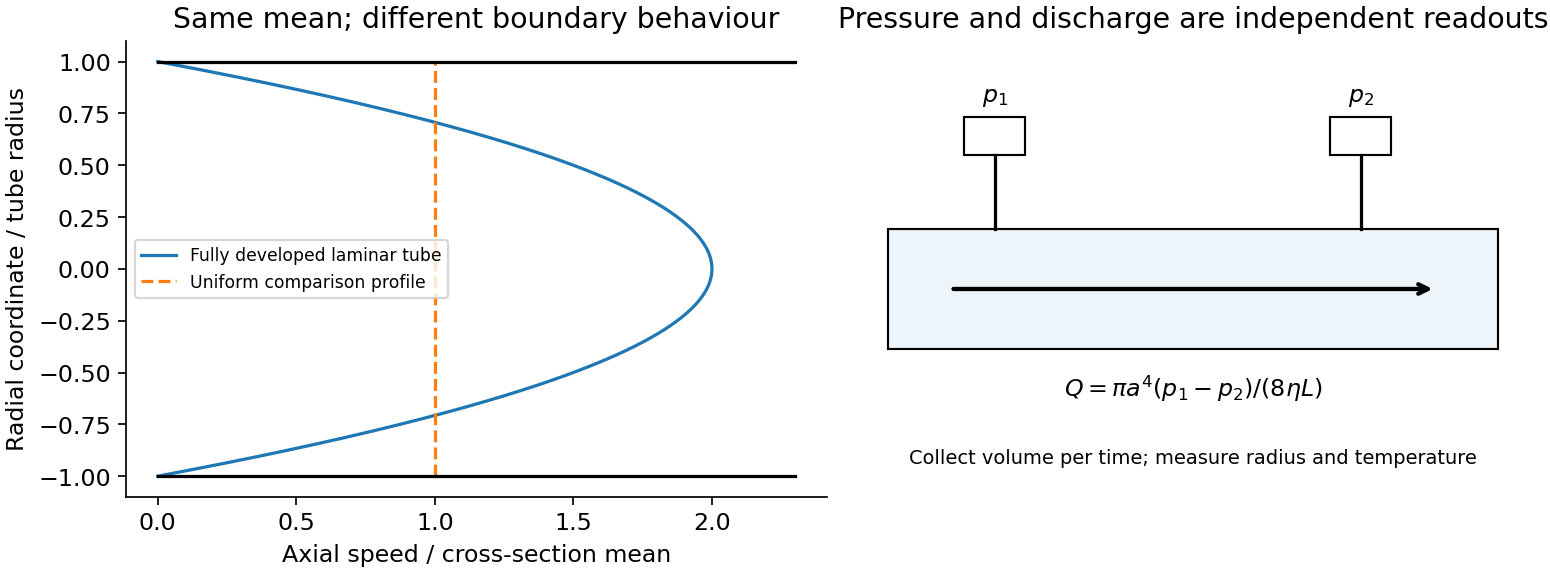
In a long straight circular tube, steady fully developed laminar flow hasThis Hagen-Poiseuille equation follows by balancing the axial pressure gradient with viscous shear and setting . The parabolic profile, the fourth-power radius sensitivity and the pumping power are experimentally distinct consequences. Entrance regions, rough walls, non-Newtonian response or a changing temperature require additional modelling.
The Reynolds number compares inertia with viscosity. Small values favor creeping-flow balances; high values permit thin boundary layers, separation and turbulence, although transition depends on geometry and perturbations, not one universal critical number. At high Reynolds number an outer flow can be approximately inviscid while near-wall viscosity still determines drag. This resolves why a zero-drag ideal potential-flow model cannot predict the resistance of an ordinary moving body. In turbulent flow, fluctuating Reynolds stresses redistribute momentum and increase the required pressure drop; averaging the equations introduces closure requirements.
A controlled tube experiment measures pressure difference and collected volume per time while changing forcing. Use tracers or a velocity probe to test profile shape, allow sufficient entrance length, and monitor radius and temperature independently. Repeat with reversed flow and at several rates to test offsets and linearity. Dye mixing alone does not measure viscosity or establish a fully developed velocity profile. The original figure below separates a specified laminar velocity profile from an independent pressure/discharge measurement.
Past exam of the physics B course of the University of Cambridge 2013 Paper 1 Section C C13 Solution 2026-10-20
Locally, zero curl permits ; for a global single-valued potential the circulation around every noncontractible loop must also vanish. incompressibility gives . The exterior of a cylinder is multiply connected, so local irrotationality alone does not exclude a circulating solution.
For inviscid constant-density flow under conservative gravity, Euler's equation is . The identity gives, for irrotational flow,For steady flow, absorb the potential's time-only gauge term and obtain throughout the connected fluid region. Without irrotationality the steady constant need only be common along each streamline.
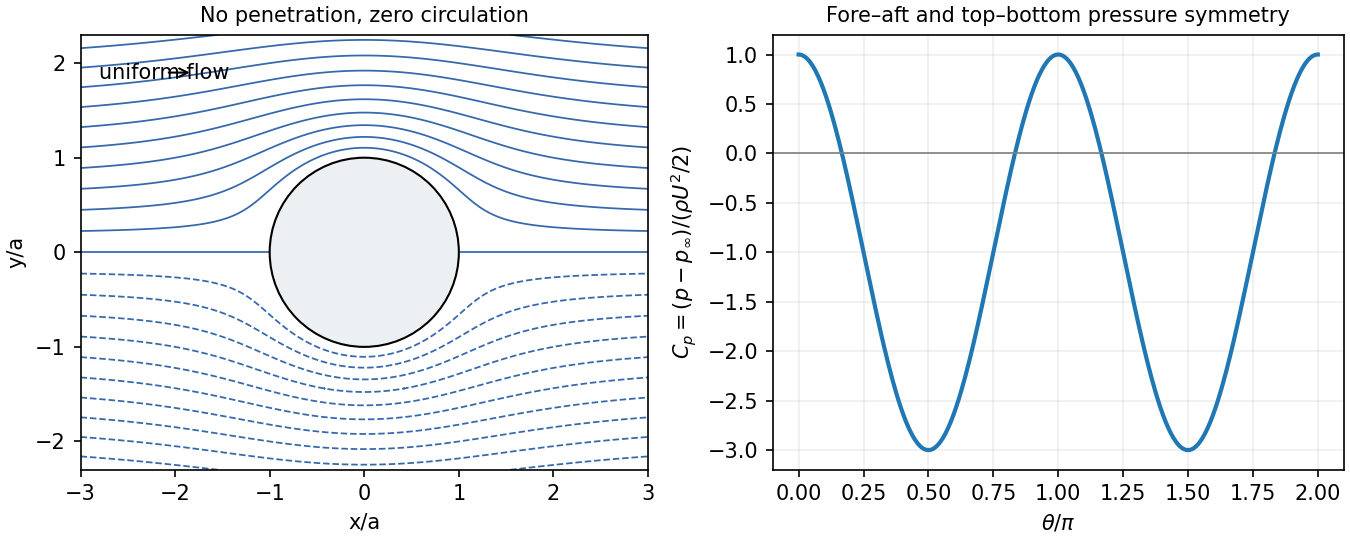
Use for the uniform upstream speed and take the flow along . The boundary conditions are and at infinity. A perfect inviscid model imposes no penetration, not no slip. For the intended no-circulation solution, require a globally single-valued potential, so the coefficient of is zero. The logarithmic term would be a net source and violates no penetration, so its coefficient is also zero. Growing terms with violate the uniform far field. For each remaining , the surface normal condition then forces its decaying coefficient to vanish. The terms satisfy and :An irrelevant additive potential constant is understood. At the same elevation, Bernoulli balance with the upstream stream givesThe force per unit height ispressure symmetry gives zero drag and zero lift in this zero-circulation idealization. D'Alembert's paradox is the failure of this inviscid model to represent real separated viscous wakes and their drag, not a claim that a real pole feels no force.
The zero-circulation assumption matters: leaves the stated velocity boundary conditions intact but adds to the surface tangential speed. It produces for positive counterclockwise circulation. Thus the boundary conditions alone do not justify excluding the angular term; an initially noncirculating inviscid start, or an explicitly single-valued potential, supplies the missing condition.[ref]
Flow Past a Cylindrical Obstacle by Richard Fitzpatrick. equations 5.73–5.81 and discussion after 5.83: circulation, force and the zero-circulation initial condition