A symplectic basis organizes a nondegenerate alternating bilinear form into independent pairs. Let be a finite-dimensional vector space over a field , with a nondegenerate bilinear form satisfying for every vector . Its dimension is even, say , and a symplectic basis is an ordered basis such thatHere is the Kronecker delta. Each is a hyperbolic pair; different pairs have zero mutual pairing. These conventions apply in every characteristic. In characteristic two, , but the condition is still essential: a symmetric bilinear form need not be an alternating bilinear form. The existence theorem and the characteristic caveat are given in Bilinear Forms by Keith Conrad (Keith Conrad, Bilinear Forms, §1, Theorem 1.6; §5, Theorems 5.1 and 5.4 and Definition 5.3).
The benefit is a common coordinate language for every symplectic vector space of the same finite dimension over the same field. The span of all , and separately of all , is a Lagrangian subspace; each paired span is a symplectic subspace. In Hamiltonian mechanics, the corresponding pairing of position and momentum coordinates describes phase space and canonical transformations. On a symplectic manifold, a symplectic basis describes one tangent space; Darboux coordinates additionally describe a whole local neighborhood.[ref]
Symplectic Geometry. §1.1, pp. 82–83: paired bases and Lagrangian spans; §1.5, pp. 90–91: Darboux coordinates
Write vectors in a symplectic basis as and . Their coordinate vectors and the matrix of a bilinear form areHere is the identity matrix, and denotes transpose. The ordering matters: interleaving the basis as instead gives a block diagonal matrix with blocks . Some conventions reverse every , giving instead. Always check the displayed pairing convention.[ref]
Symplectic Geometry. §1.1, p. 83: e-then-f basis and its block matrix; the coordinate formula follows by bilinearity
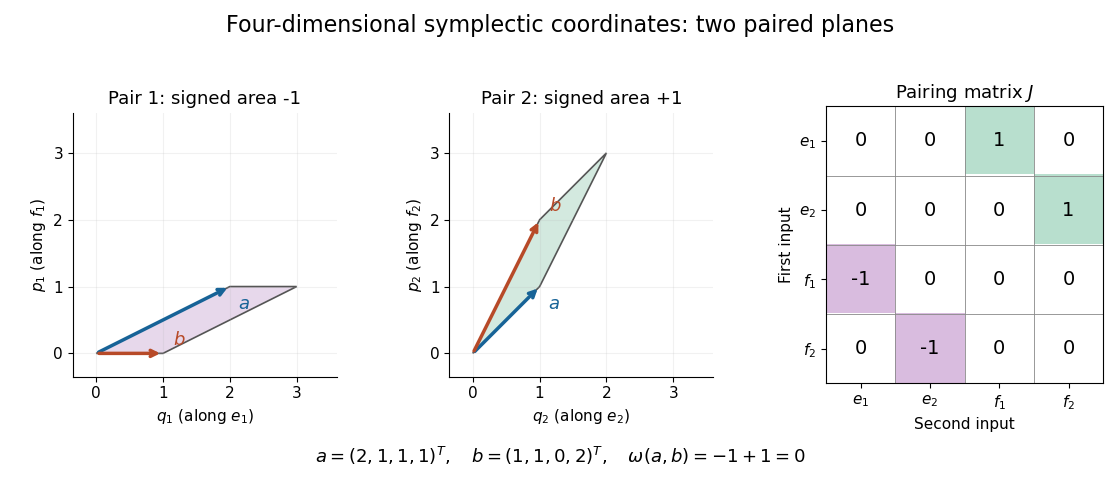
Over the real numbers, each summand is the signed area of a parallelogram in the coordinate plane. For and , the two signed areas are and , so although the vectors are linearly independent. The cancellation concerns the symplectic form; it does not assert that their dot product vanishes. Over a general field, the same determinant formula is algebraic, without a signed geometric interpretation.
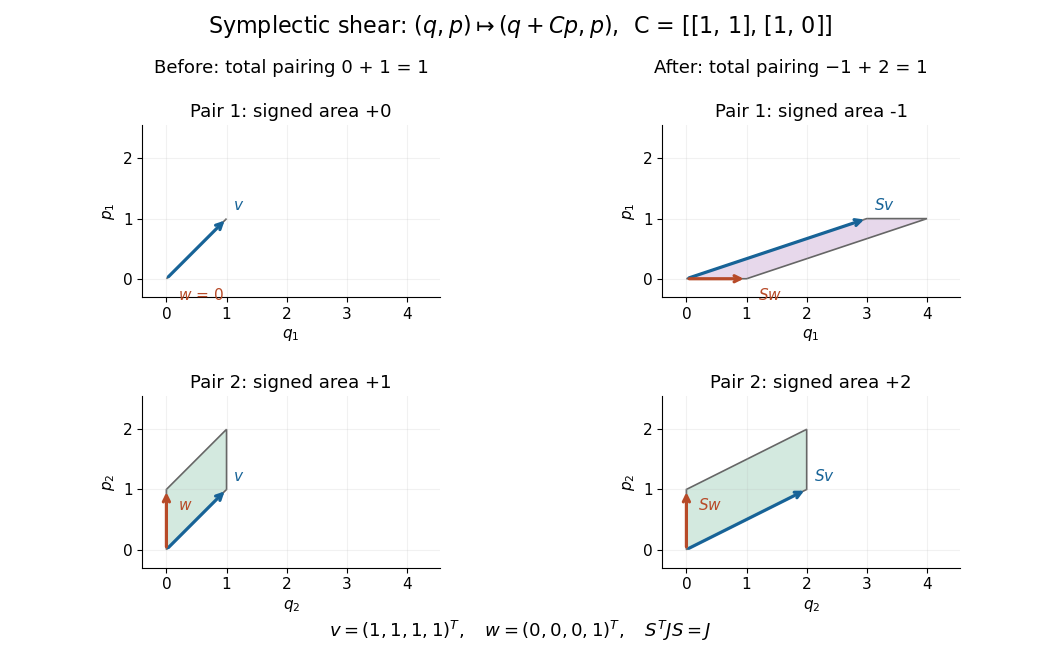
On , use the standard basis and the alternating bilinear form with matrix above for . A second symplectic basis isFor instance, , while and the cross-pairings vanish. The change of basis matrix, whose columns are these new basis vectors in , isThe symmetric matrix makes , so is a symplectic matrix. Explicitly, multiplying the blocks gives a lower-right block ; the other blocks agree with . For a fixed vector, change of basis means , henceTheir symplectic form gives in , and in . The separate coordinate-plane contributions change, but their sum does not.
The same matrix also represents an active symplectic linear map: keeping one basis fixed, it sends to . The following diagram shows this active interpretation over the real numbers. Its preserved total pairing is precisely the test used for linear canonical transformations.
Construct a symplectic basis two vectors at a time. Choose ; the nondegenerate bilinear form supplies with , and set . For any vector , remove its paired components byThen . Thus, for , the symplectic orthogonal complement gives a direct sum ; its restricted bilinear form remains nondegenerate. Repeat there until no vectors remain, then put all before all . This proves even dimension and existence together. Only the nonzero pairing is divided out, so the construction also works in characteristic two. The pair-splitting argument is described in Bilinear Forms by Keith Conrad (Keith Conrad, Bilinear Forms, §5, proof of Theorem 5.1 and Theorem 5.4).
Articles by others on the same topic



A symplectic basis is a particular type of basis for a symplectic vector space, which is a vector space equipped with a non-degenerate, skew-symmetric bilinear form known as the symplectic form.