Topics (119k) Articles (119k) Users (257) Discussions (237) Comments (383) Files (706) New article
This was possible at the time without any login by using a 2010 profile ID dump from originally announced at: blog.skullsecurity.org/2010/return-of-the-facebook-snatchers since profile picture access was not authenticated.
The profile ID dump was downloadable through a BitTorrent named on Ubuntu 20.04 gives:This dump widely reported e.g. on Hacker News at: news.ycombinator.com/item?id=1554558.
fbdata.torrent of about 2.8GB, mostly compressed. Doing:find . -type f | xargs sha256sum | sha256sum2c9a739c9c5495e38ebab81fc67411b7c6562f139dcb8619901a3f01230efdd5At some point however, Facebook finally started to require tokens to view public profile pictures, thus making such further collection impossible, e.g. as of 2021: developers.facebook.com/docs/graph-api/reference/v9.0/user/picture mentions:This is also mentioned e.g. at: stackoverflow.com/questions/11442442/get-user-profile-picture-by-id. This major privacy flaw was therefore finally addressed at some point, making it impossible to reproduce this project.
Ciro downloaded 10 thousand of those pictures, and did facial extraction with: stackoverflow.com/questions/13211745/detect-face-then-autocrop-pictures/37501314#37501314
He then created single a video by joining 10 thousand of those cropped faces which can be uploaded e.g. to YouTube. Ciro later decided it was better to make those videos private however, as sooner later he'd lose his account for it.
Companies like YouTube blocking this kind of content is the type of thing that makes companies take longer to fix such gaping privacy issues, and is a bit like security through obscurity. A video makes it clear to everyone that there is a privacy issue very effectively. But people prefer to hide and look away, and then 99% of people who know nothing about tech get their privacy busted by actual criminals/government spies and never learn about it.
2026-08: buying www.amazon.co.uk/Damaged-Screw-Extractor-Stripped-Hardware/dp/B07BK45198 to try and remove a stuck hex screw.
2026-06: www.amazon.co.uk/dp/B0DQCV9JV6 AMagnetic Torx Screwdriver Set 12pcs: T5x3", T6x3", T7x3", T8x3", T9x3", T10x3", T15x3", T20x3", T25x3", T27x3", T30x4", T40x4". I've had enough of not having those.
2026-02: www.amazon.co.uk/dp/B0FCWSVXM8 "DCA Cordless Drill Set, 40 N.m Torque, 10mm Keyless Chuck, Electric Power Drill with 2.0Ah Battery and Charger,18+1 Position,35-Piece 20V Drill Driver Kit, ADJZ2035". Finally had to buy a drill set for some bloody Ikea furniture that needed drilling. OMG. Then it didn't have the necessary 7,00 mm wood drill bit, they were not documented by seller, but I bought one from Bosch and it was compatible and I managed to put up the bloody Ikea. Drill bit sizes:The included screw bits are:
- Torx: T10, T15, T20, T25, T27, T30
- Philips: PH1, PH2, PH3
- Flat: S5, S6
- Hex: H4, H5
- PZ1, PZ2
2020-01 www.amazon.co.uk/dp/B07D318N7Z BOENFU 12Pcs iPhone Repair Tool Kit Mobile Phone Screwdriver Set with LCD Opening Pliers Cell Phone LCD Screen Opener Suction Opening Pry Tool Kit for iPhone X/5s/6s/6plus iPad Air iPod Samsung Galaxy
2020-01 "Heat Gun, SEEKONE Professional 2000W 50℃- 600℃ Variable Temperature Control Hot Air Gun Kit with 2 Temperature Modes 7 Accessories for D" www.amazon.com/dp/B078S5QMFG Initially for for cell phone repair, but later learnt they are also useful for heat shrink.
2020-11 BOA 13-2612 Strap Wrench, 6-Inch Capacity 8-Inch Long Lever www.amazon.com/dp/B00096JDKS Official: www.boatoolcorp.com/our-products/boa-constrictor-range/boa-constrictor/
2019-09 "Draper Redline 68001 160 mm Heavy Duty Pliers Set with Soft Grip Handles (3-Piece)" web.archive.org/web/20190903191215/https://www.amazon.co.uk/dp/B071JL6LLL (archive)
2019-08: www.amazon.co.uk/dp/B000LFRYG2 (archive) "Silverline SP1236 Combination Spanner, 8-19 mm - 12 Pieces" 8.48 pounds. Because I needed the 15mm for bike pedal, and the price of 1 and the full set were very close.
6 10/11/12/13/14/17 mm Combination Wrench Set WRENCH SET COMBINATION Open-Ended Spanner/Ring Spanner Set www.amazon.co.uk/dp/B07BZLVGX8 (archive) But they sent one wrong, 8 instead of 11. Chrome Vanadium Steel. Markings: "DROP FORGED A". Quality feels crappy, not very smooth.
2017: Teng 621011 Double Open Ended Spanner 10x11mm www.amazon.co.uk/dp/B0001P0VP8 (archive)
2017: Magnusson AMS49 5M TAPE MEASURE 5m retractable flexible rule. www.screwfix.com/p/magnusson-ams49-5m-tape-measure/5315v (archive)
2019-11 www.amazon.co.uk/dp/B00FGOY51A Lakeland Moth Stop Moth Killer Carpet & Fabric Spray, 500ml
2019-10 Mykal Sticky Stuff Remover 250ml. Helped remove sticky tape adhesive from surfaces. Still required a lot of elbow grease, but worked. www.amazon.co.uk/dp/B000TAT4GM (archive).
2022-02: Kiea Barlast floor lamp: www.ikea.com/gb/en/p/barlast-floor-lamp-black-white-50437810 Bulb: LED bulb E27 globe opal white.
Machines used extensively while developing the Linux Kernel Module Cheat will be documented there for reference performance.
For sizing see also: Ciro Santilli's body.
All with olive oil and salt mixed up before roasting.
2021-04-05 180C:
2021-02-06 180C:
2021-01-04:
2020-11-21:
- mixed nuts: 180C, 10 minutes, did not reach the point. Then 7 more minutes on 190C: pecans completely burned out
- almonds: 190C, about 25 minutes, opened several times, in the end had a slight burnt taste, but did not get black, just darker brown. Not as crispy as the ones we buy roasted, but pretty good
- pecans: 180C, 13 minutes, opened 3 times to stir, became great
Ciro was even more stupid than as of 2020, and continued to try and hang out with those evil kids to show them he was cool too or that he was strong, and so continued to get hurt.
Advice to his children: stay away from evil people.
The bullied sometimes feels an almost masochistic desire to overcome the bullies' contempt, and to try and either become friends with the bullies, or to overpower them.
You must never give into those thoughts.
If you come across evil people, smile a fake smile to them, and walk away, but never give your back to them, and always be ready to fight.
If they laugh at you, know that you are shit like everyone else, pretend to laugh with them, take their post and repost it on your public profile, and silently stay away from those idiots.
Never show any weakness.
If a fight is likely, always be ready, always have your friends nearby, be as well armed as the enemy, and never be outnumbered.
On the Internet, never care about e-bully posts, either block them immediately, and anyone that likes their posts, or follow Ciro's reply policy.
Call parents or other authorities as soon as there is risk of physical harm. Better a living free pussy than dead or in youth detention for murder. Similar advice applies if you are going to jail I guess.
If a physical fight is inevitable however, ignore Jesus this once and don't give the other face, but rather follow the Talmud and fight all out on the beaches:References:
If someone comes to kill you, rise and kill first.
The Sikh knife, the Kirpan, which Sikhs must carry at all times as a religious obligation, also comes to mind. The Sikh must have been bullied out of the their minds at some point in history, Ciro understands.
Non-violence only works when you have bodies to spare from your followers.
Perhaps it was good to learn those lessons early, before the stakes were too high. Adults fake it much better, and therefore it is harder to learn those lessons from them, but they are still just as evil on the inside.
These experiences might have contributed to Ciro Santilli's self perceived compassionate personality.
Ciro Santilli's 10 month stay in Coventry, United Kingdom, in the year 2000 by  Ciro Santilli 40 Updated 2025-07-16
Ciro Santilli 40 Updated 2025-07-16In the year 2000, Ciro lived with his parents for 10 months in the Coventry because his father took some courses at the University of Warwick. This was Ciro's most important educational experience, more so than any other inCiro Santilli's formal education, because it taught him the Holy Language of English, which infinitely expanded Ciro's Internet horizons, and shaped Ciro's having more than one natural language is bad for the world philosophy. When he came back to Brazil, Ciro skipped dozens of levels in his English school in Santos, São Paulo, Brazil, a Brazilian chain called Cultura Inglesa, and was put to study with much older teenagers who marveled at Ciro's incredibly cute, but since lost, British accent.
Another huge advantage of Coventry is that the Hearsall Community Primary School where Ciro studied was a regular British primary school but with two classes dedicated to foreign students to learn English before integrating with the British students. There were a several kids from Kosovo there due to the Kosovo War which was just ending, and it was there that Ciro made his first Chinese friend, yet unaware of course of the role the country would later play in his life. One particularly fun memory was that of playing soccer on the school playground with a sponge ball to avoid breaking the windows. Then one day it was raining, british weather of course, but Ciro still went for a header, and the soaked sponge ball was soaked and splashed Ciro with dirty water all over. Good days.
Some other good memories are of reading the first two Harry Potters, playing and mostly watching other kids play Pokemon on their Game Boys and Pokemon trading cards, and going to a nearby commons playing field and woods, as it typical throughout the UK. Ciro also played some rugby with a local boys team TODO name? but for some reason his team was always crushed when they went to nearby towns to play against other teams. And Ciro also went with his family or with school to some nearby attractions, like Stratford-Upon-Avon (Shakespeare's hometown), and some castles.
When Ali G met the Beckhams by Comic Relief (2001)
Source. Ciro's father really liked Ali G. when they were in the UK in the year 2000, and Ciro would watch along, not fully getting all jokes, but still amused by his irreverence. This interview with David and Victoria Beckham is perhaps one of Ali's best performances.Wicked wicked jungle is massive song from Ali G Indahouse (2002)
Source. OK, the last Ali G video, I promise. Maybe. This video illustrate well the main point of Ali G's humour: his cultural appropriation of American black rap/crime culture, despite it being entirely incongruence with his British background.Ciro Santilli participated in a double degree program, so he obtained have engineering degrees in both:
- 2010 - 2014: École PolytechniqueMaster 2 degree in applied mathematics.
- Ciro Santilli's undergrad studies at the University of São Paulo
Despite studying in great institutions with great teachers, Ciro feels that:
- most of what he knows came from the Internet, man pages, books and his parents
- actual projects matter much more than those pieces of paper called Diplomas. You should not do like Ciro who basically did nothing but school mandated work, but instead grow some balls and focus much more or entirely on your projects
This motivated Ciro to work on OurBigBook.com.
Ciro's parents put him to play the piano. This is partly influenced by Ciro's paternal grandfather, an energetic Italian descendant who liked music
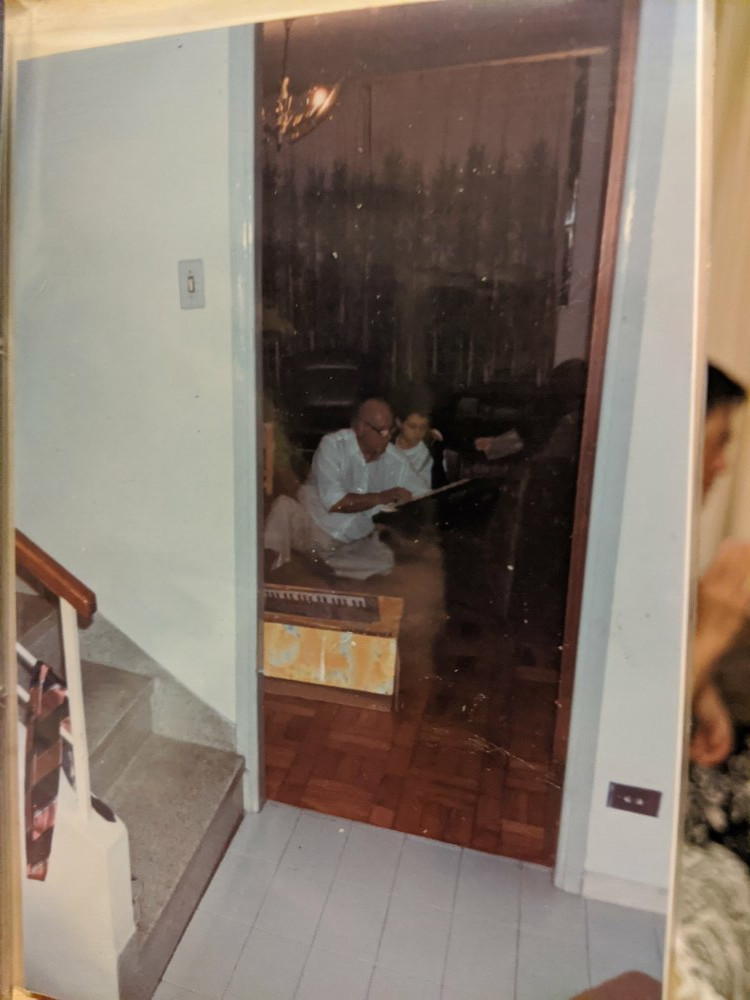
The teachers were nice old ladies who followed a very traditional and methodic approach which was just like regular school, instead of doing what actually needed to be done: inspire kids into becoming creative musical geniuses that can compose their own stuff.
The electric guitar environment was much less formalized in general, and he took courses with an awesome teacher (archive), who actually tried to inspire his students to create their own music and improvisation.
In his early teens, Ciro listened to the usual canned music his friends listened to: music teenager Ciro Santilli liked to listen to, until he started to stumble upon jazz.
Ciro remembers clearly rainy weekend days where he would go to a run down second hand shop near his home in someone's garage (Sebo do Alfaiate, R. Frei Francisco de Sampaio, 183 - Embaré, Santos - SP, 11040-220, Brazil :-)), and buy amazing second hand Jazz CDs. It was just a matter of time until he would start scouring the web for "the best jazz albums of all time" and start listening to all of them, see e.g. the best modern instrumental Western music. digitaldreamdoor.com/index.html was a good resource from those times!
Ciro ultimately decided his bad memory and overwhelming passion for the natural sciences would better suit a scientific carrier.
He also learnt that the computer is also an extremely satisfying artistic instrument.
Also, with a computer, boring dexterity limitations are no more: you can just record perfect played segments or program things note by note to achieve whatever music or action you want!
Although Ciro quit playing musical instruments, his passion for the music has remained, and who knows how it has influenced his life.
Unconditional basic income is Ciro Santilli's ultimate non-transhumanist technological dream: to reach a state of technological advancement and distribution of resources so high that everyone gets money for doing nothing, enough for:
Once a person has that, they can "learn, teach" and create whatever they want. Or play video games all day long if they wish.
Ciro Santilli will not live to see this, and is content with helping it happen faster by increasing the efficiency of the world as. And having at least two well educated kids to carry on the project after he dies :-)
Technologies which would help a lot towards unconditional basic income, and might be strictly required required are:
- artificial general intelligence
- This is even less likely than AGI due to the end of silicon Moore's Law and at the start of the Genome's Moore's law: information doubles, small sizes halve, but macroscopic mechanical artifacts stay the same.brain-computer interfaces are pretty certain to happen however after Ciro Santilli dies.
So in the worst case we can just grow brainless bodies and replace the cavity hole with a computer that controls the body, possibly with high level decisions coming from a remote building-sized genetically engineered biological AGI brain.
Of course, it is all about costs. A human costs about 130k 2010 USD/year. So how cheap can we make the AGI / robot human equivalent / year for a given task?
AGI + humanoid robots likely implies AI takeover though. It would then come down to human loving bots vs human hating bots fighting it out. It will be both terrifying and fun to watch.
AGI alone would be very dangerous, in case it can get control of our nuclear arsenals through software zero days or social engineering. Although some claim that is unlikely.
Humanity's best bet to achieve silicon AGI today is to work on: Ciro's 2D reinforcement learning games.
By Charles Bukowski mentioned e.g. at tatyanany.medium.com/slavery-was-never-abolished-it-was-only-extended-to-include-all-the-colors-6ca21d586e7e:
Slavery was never abolished, it was only extended to include all the colors.
Bibliography:
- www.youtube.com/watch?v=bldeaDRWJYcLecture 24: Unemployment, Re-employment & Income Security by Ian Shapiro (2019)
Easy street by Stan Kenton and June Christy (1945)
Source. TODO exact lyrics for copy paste? There seem to be several variants, and I don't have the patience to transcribe. Close enough: lyricsplayground.com/alpha/songs/e/easystreet.html. Except that with UBI there won't be a:guy that you can hire to plant trees so you can have shade
Natural language diversity is beautiful, but useless.

Tower of Babel by Pieter Bruegel the Elder (1563)
Source. Even the Bible writers already know that multiple languages suck as seen from the Tower of Babel parable
Isn't it incredibly fitting that the building of the European Parliament looks like the Tower of Babel?
The fact that in poor countries a huge number of people do not speak the economically dominating language of the world, the lingua franca, English as of 2020, is a major obstacle to the development of those countries.
Despite us being in the information age, the people in those countries cannot fully benefit from it at all!
Teaching its people English should be the number one priority of any country. Without that, there can be no technological development. Everything else is secondary and can be learnt off the Internet once you know English.
And the most efficient way to do that, is that every country should create amazing free open source English learning material for their own language.
European countries are perhaps the most perfect example of how many languages destroy once powerful countries: Section "European Tower of Babel"
The Sapir–Whorf hypothesis is bullshit outside of poetry, and the ending of Arrival (2016) makes one want to puke, where learning a language changes not only your brain, but also Ciro's precious "laws" of Physics!
Much more likely are To Serve Man/A Small Talent for War events which we have already seen countless times!
Remember that those ideas come from a person who speaks 3.5 languages in 2019, and sees absolutely no practical difference between them.
Of course, like all non-constructed languages, English is not fully optimal in terms of regularity and information density. It could be argued that other languages are better in those aspects.
For example, Ciro does believe that spoken Chinese is a better language than English overall from a purely "ease of learning from scratch point of view" as mentioned at: github.com/cirosantilli/china-dictatorship/tree/6fdeb5aa3826c69f7c058de4e6f652a6924bc08a#does-ciro-santilli-speak-chinese. Chinese writing is completely insane of course, completely out of the question.
However, Ciro just doesn't think that the difference is that great to justify replacing English which is already dominant. How much more efficient can a perfect constructed language be than English? 1.01? 1.001? Such margins don't matter. Once you have learnt it young, it's done, for good.
English-based a posteriori constructed languages that regularize English further are perhaps the only reasonable alternative, like how C++ evolved from C by creating a low cost upgrade path. Although in practice they will never take off unless a dictatorship rules the world:
One interesting anecdote is that Ciro met his wife in French, and talking to her primarily in English feels really weird, so language does matter in love.
Different languages might also good at producing interesting diverse touristic locations, with different diverse and interesting foods. Because that's what tourism is all about. The exotic. The unique. And therefore, also necessarily the inefficient.
People with similar ideas:
- English as a universal language by Dan Dascalescu (2008)
- harmful.cat-v.org/society/cultural_protectionism from cat-v.org
- blog.codinghorror.com/the-ugly-american-programmer/ highlights that the situation is even more critical for software development. But he's a moderate ideology. Newbie.
- Charles Kay Ogden, creator of Basic English, according to the Basic English Wikipedia page:
Ogden's Basic, and the concept of a simplified English, gained its greatest publicity just after the Allied victory in World War II as a means for world peace. Ogden was convinced that the world needed to gradually eradicate minority languages and use as much as possible only one, English in either a simple or complete form.
Pinned article: Introduction to the OurBigBook Project
Welcome to the OurBigBook Project! Our goal is to create the perfect publishing platform for STEM subjects, and get university-level students to write the best free STEM tutorials ever.
Everyone is welcome to create an account and play with the site: ourbigbook.com/go/register. We belive that students themselves can write amazing tutorials, but teachers are welcome too. You can write about anything you want, it doesn't have to be STEM or even educational. Silly test content is very welcome and you won't be penalized in any way. Just keep it legal!
Intro to OurBigBook
. Source. We have two killer features:
- topics: topics group articles by different users with the same title, e.g. here is the topic for the "Fundamental Theorem of Calculus" ourbigbook.com/go/topic/fundamental-theorem-of-calculusArticles of different users are sorted by upvote within each article page. This feature is a bit like:
- a Wikipedia where each user can have their own version of each article
- a Q&A website like Stack Overflow, where multiple people can give their views on a given topic, and the best ones are sorted by upvote. Except you don't need to wait for someone to ask first, and any topic goes, no matter how narrow or broad
This feature makes it possible for readers to find better explanations of any topic created by other writers. And it allows writers to create an explanation in a place that readers might actually find it.
Figure 1. Screenshot of the "Derivative" topic page. View it live at: ourbigbook.com/go/topic/derivativeVideo 2. OurBigBook Web topics demo. Source. - local editing: you can store all your personal knowledge base content locally in a plaintext markup format that can be edited locally and published either:This way you can be sure that even if OurBigBook.com were to go down one day (which we have no plans to do as it is quite cheap to host!), your content will still be perfectly readable as a static site.
- to OurBigBook.com to get awesome multi-user features like topics and likes
- as HTML files to a static website, which you can host yourself for free on many external providers like GitHub Pages, and remain in full control

Figure 3. Visual Studio Code extension installation.
Figure 4. Visual Studio Code extension tree navigation.
Figure 5. Web editor. You can also edit articles on the Web editor without installing anything locally.Video 3. Edit locally and publish demo. Source. This shows editing OurBigBook Markup and publishing it using the Visual Studio Code extension.Video 4. OurBigBook Visual Studio Code extension editing and navigation demo. Source. 
- Infinitely deep tables of contents:



All our software is open source and hosted at: github.com/ourbigbook/ourbigbook
Further documentation can be found at: docs.ourbigbook.com
Feel free to reach our to us for any help or suggestions: docs.ourbigbook.com/#contact