
Metal Updated 2025-07-16
Polymer Updated 2025-07-16
Worms (series) Updated 2025-07-16
Universal Turing machine Updated 2025-07-16
A Turing machine that simulates another Turing machine/input pair that has been encoded as a string.
The concept is fundamental to state several key results in computer science, notably the halting problem.
Turing complete Updated 2025-07-16
Depth-first search Updated 2025-07-16
Breadth-first search Updated 2025-07-16
Transpose of a matrix multiplication Updated 2025-07-16
When it distributes it inverts the order of the matrix multiplication:
Inverse of the transpose Updated 2025-07-16
Point-contact transistor Updated 2025-07-16
As the name suggests, this is not very sturdy, and was quickly replaced by bipolar junction transistor.
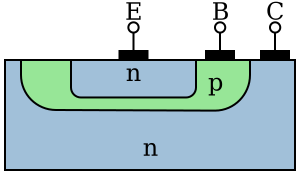
Bipolar junction transistor Updated 2025-07-16
By William Shockley in 1948 also at Bell Labs Murray Hill.
Field-effect transistor Updated 2025-07-16


Bloons Tower Defense 5 Updated 2025-07-16
One of Ciro Santilli's favorites.
Theme music Updated 2025-07-16
Tinker Tailor Soldier Spy (TV series) Updated 2025-07-16
- 1: Jim Prideaux captured. Some ex-colleague invites Smiley to dinner and keeps asking how incompetent people like Alleline climbed to the top of the Circus. Smiley recalled to service to meet Ricki Tarr.
- 2: Ricki Tarr tells his story to Smiley. Peter Guillam starts stealing material from the Circus, find missing page on the communication officer list. Smiley sets up his investigation operation.
- 3: Smiley meets Connie who tells that she was fired for suspecting Poliakov. Flashbacks show the ousting of Control and Smiley.
- 4: Guillam steals more material from the circus. While doing that, he is called by the top officers to inquire about Ricki Tarr being in England, which they suspect because they discovered that his family has come.
- 5: Jim Prideaux tells his story to Smiley, who cannot easily access the Circus reports about it. When he is returned to England, there was basically no debriefing, and Esterhase already knew about the Tinker Tailor codenames, presumably through Merlin.
- 6: Smiley hears the story of yet another ousted man, who heard the Russians knew in advance about Jim Prideaux' coming. Toby Esterhase dismissed him for alcoholism.
Tinker Tailor Soldier Spy (film) Updated 2025-07-16
This is not bad, but some divergences to the better BBC miniseries, which presumably sticks more closely to the novel:
- in the film Jim Prideaux is captured in a cafe in Prague, in the series it's in the woods. It is therefore much more plausible that he would have been shot.
- in the film Peter Guillam is played by Benedict Cumberbatch, who feels a bit young to be Ricki Tarr's boss. Not impossible, but still.
- the series is much less chronological, and more flashback based, as new information becomes available. The film is more chronological, which makes it easier to understand, but less interesting at the same time.
- in the film they shoot the Russian girl Irina in front of Jim, in the series the fact that she was shot is only known through other sources. The film has more eye candy, which weakens it.
- Toby Esterhase is not threatened in an airfield, only in a safe ;house in London.
Simultaneous multithreading Updated 2025-07-16
- superuser.com/questions/133082/what-is-the-difference-between-hyper-threading-and-multiple-cores/995858#995858
- stackoverflow.com/questions/680684/what-are-the-differences-between-multi-cpu-multi-core-and-hyper-thread/73405312#73405312
- unix.stackexchange.com/questions/88283/so-what-are-logical-cpu-cores-as-opposed-to-physical-cpu-cores/739296#739296
Enthalpy Updated 2025-07-16
Adds up chemical energy and kinetic energy.
The sum is of interest when thinking about reactions because chemical reactions can change the number of molecules involved, and therefore the pressure.
To predict if a reaction is spontaneous or not, negative enthalpy is not enough, we must also consider entropy via Gibbs free energy.
Gibbs free energy Updated 2025-07-16
At least from the formula we see that:
- the more exothermic, the more likely it is to occur
- if the entropy increases, the higher the temperature, the more likely it is to occur
- otherwise, the lower the temperature the more likely it is to occur
A prototypical example of reaction that is exothermic but does not happen at any temperature is combustion.
Lab 7 - Gibbs Free Energy by MJ Billman (2020)
Source. Shows the shift of equilibrium due to temperature change with a color change in a HCl CoCl reaction. Unfortunately there are no conclusions because its student's homework. Grand Unified Theory Updated 2025-07-16
Appears to be an unsolved physics problem. TODO why? Don't they all fit into the Standard Model already? So why is strong force less unified with electroweak, than electromagnetic + weak is unified in electroweak?
There are unlisted articles, also show them or only show them.