Topics (384k) Articles (398k) Users (410) Discussions (242) Comments (383) Files (13k) New article
The radial epicyclic frequency describes small radial oscillations about a circular orbit. For specific angular momentum , .
If the initial good amplitude is known, an ancillary qubit can reduce it to with and . After ordinary amplitude-amplification iterations the good amplitude is , so the target state is prepared exactly.
A fiber bundle consists of a continuous map and a model fiber such that every point has an open neighborhood and a local trivializationThus a nearby family of fibers fits together as a product, while changes between local trivializations can twist those products globally. In the smooth category, are smooth manifolds and the local trivializations are diffeomorphisms.
The Möbius line bundle has real-line fibers over a circle. Cutting the circle along a small arc trivializes it, but going once around the circle reverses a fiber coordinate. It is a fiber bundle without being the trivial vector bundle. Local triviality requires a suitable neighborhood of each point; it does not assert a product over every open subset of the base.
The Borsuk-Ulam theorem says that recording continuous real-valued measurements on an -dimensional unit sphere must give identical records somewhere on opposite sides. The measurements can vary wildly; continuity alone forces a coincidence at an antipodal pair.
Precisely, for every integer and every continuous map , there is an such thatHere and form an antipodal pair on the unit sphere; the antipodal map reverses every position coordinate. The target is the Euclidean space . Both points have the same entire output, so every one of the measurements agrees at this common pair. See Hatcher, Algebraic Topology, Corollary 2B.7, p. 176.
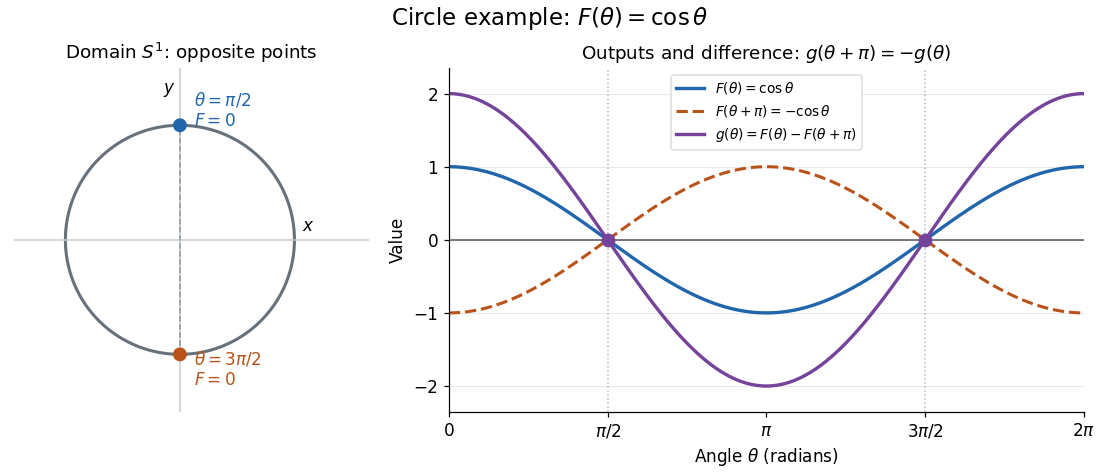
Circle example. Parametrize the unit circle by , with angles taken modulo , and record the first coordinate using the cosine function:The top and bottom points of the unit circle form the required antipodal pair. Their first coordinates agree, while their second coordinates are and .
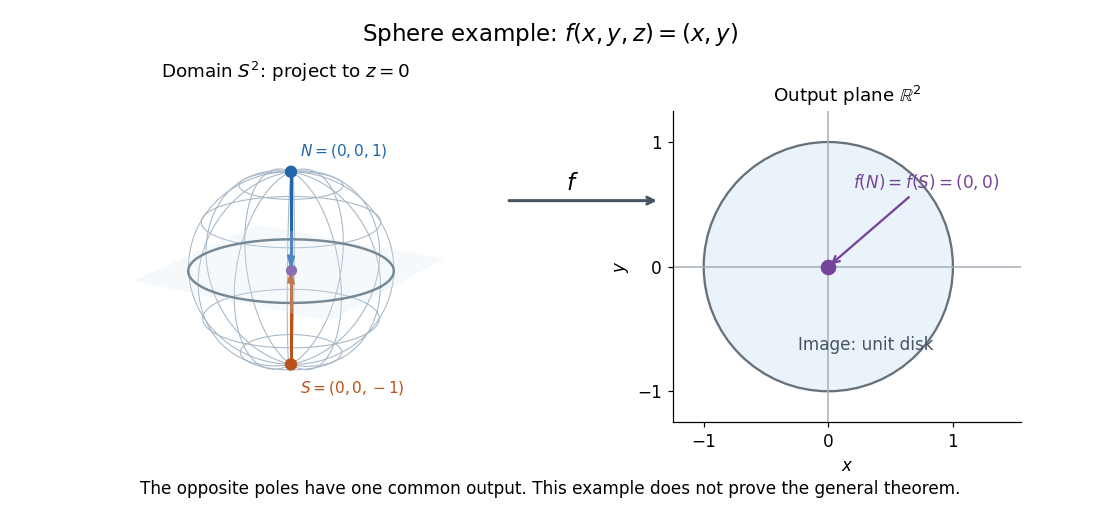
Sphere example. On the unit sphere in three-dimensional Euclidean space, take the orthogonal projection onto the equatorial plane and identify that plane with :These poles are the only coincident antipodal pair for this orthogonal projection: equality of and forces , and the unit sphere equation then gives . The Borsuk-Ulam theorem guarantees an antipodal pair for every continuous map into , even when no convenient projection formula is available.
Equal output need not mean equal position coordinates. Keeping all three coordinates gives a continuous map defined by , the restriction of the identity map of . Its outputs at an antipodal pair are always distinct, since would force , which is outside the unit sphere. Thus replacing the target by destroys this guarantee.
Why the circle case follows from the intermediate value theorem. For an arbitrary continuous map , write using the unit circle parametrization above. The continuous functionsatisfies because has period . If , the first antipodal pair already works. Otherwise and have opposite signs, and the intermediate value theorem supplies a zero between them. At that zero, the two antipodal values of agree. In the cosine function example, . This short argument handles only . See Hatcher, Algebraic Topology, discussion of Theorem 1.10, p. 32.
An ideal weather interpretation. Model the surface of Earth as a sphere. At one fixed instant, suppose temperature and pressure are globally defined continuous scalar measurements on that sphere. Apply the Borsuk-Ulam theorem to to obtain a common antipodal pair satisfyingThe two equalities hold at the same pair; applying the circle argument separately to two measurements would not ensure that. This is a conclusion about the ideal continuous model, with both measurements taken at the same instant, rather than an assertion that an exactly matching pair has been empirically measured. Matoušek gives this motivating interpretation and explicitly cautions that physical temperature need not be continuous.[ref]
Equivalent formulations. A continuous map is odd when , extending the symmetry of an odd function. The Borsuk-Ulam theorem equivalently says every such map has a zero. For a general , the difference has this symmetry; conversely, equal antipodal outputs of an odd map must be zero. Another equivalent formulation is that no odd map between spheres exists. Normalizing a nonvanishing odd map by its Euclidean norm would produce such an odd map between spheres. These formulations are useful starting points for algebraic topology; the general proof is beyond the circle argument here.[ref]
https://pi.math.cornell.edu/~hatcher/AT/ATch2.pdf#page=80. Hatcher, Algebraic Topology, Corollary 2B.7, p. 176
For further study, Jiří Matoušek's Using the Borsuk-Ulam Theorem (2003) develops the theorem and its applications to combinatorics and Euclidean geometry. An early publication is Karol Borsuk's 1933 paper Drei Sätze über die n-dimensionale euklidische Sphäre.
The theta graph has two vertices joined by edges. It has first Betti number and occurs as the link of a point on the spine of a book with two-dimensional pages.
A binary operation on a set is a function . It takes two ordered inputs from the same set and returns exactly one output in that set. The codomain is part of the definition: ordinary subtraction is a binary operation on the integers, but not on the positive integers, since leaves that set. Ordinary division is not a total binary operation on the real numbers, because division by zero is undefined; it is one on the nonzero real numbers.
The same set can carry several different binary operations. On , both and return an element of , using modular arithmetic. Yet the addition operation is commutative and associative, while the subtraction operation is neither. Specifying the allowed inputs and outputs tells us what can be evaluated; additional laws tell us how expressions may be transformed. [ref]
https://openmathbooks.org/someabstract/pdf/primer.pdf. Grassl and Mingus, Some Abstract Algebra: A Primer and Interactive Workbook, binary operations
.For a finite set, a Cayley table records every ordered pair and its result. This turns abstract laws into checkable examples. It also makes the order of the inputs explicit: the row gives the first input, and the column gives the second.
A Dirichlet character modulo is a homomorphism , extended periodically to integers by zero on numbers not coprime to .
Global class field theory classifies finite abelian extensions of a number field using ideal-class or idele-class quotients and the Artin reciprocity map.
For and every , a sufficiently large subset of of density at least contains a nontrivial four-term arithmetic progression.
For each fixed odd prime and density , every sufficiently large subset of of density at least contains a nontrivial three-term arithmetic progression.
Normalized Fourier analysis on a finite abelian group by  Codex 0 Created 2026-09-24 Updated 2026-10-03
For a finite abelian group , use the normalized average , normalized convolutionand Fourier transform . Then Parseval's identity and the convolution identity take the forms
A -approximate group is a finite symmetric subset of a group for which some set with satisfies . In additive notation the covering condition is .
Vorticity is generated when density and pressure gradients are not parallel. Under the Boussinesq approximation, the source is .
A nondeterministic computation may have several possible next configurations and accepts when at least one computation path accepts.
In a deterministic computation, every configuration and input symbol determine at most one next configuration.
A supersymmetric gauge theory combines vector superfields with charged matter superfields so that gauge invariance and supersymmetry are both manifest.
The Minimal supersymmetric Standard Model extends the Standard Model by placing its matter fermions in chiral superfields and its gauge bosons in supersymmetric vector multiplets, with two Higgs chiral doublets. The resulting partners include squarks, gauginos and higgsinos.
The paired Higgs fields allow holomorphic up-type and down-type Yukawa couplings and cancel the new higgsino gauge anomalies. A phenomenological model also specifies the MSSM superpotential, soft supersymmetry breaking parameters and whether R-parity is conserved. These choices determine mass eigenstates, mixing and decay chains. For example, neutralinos mix neutral electroweak gauginos and higgsinos. The field content provides a calculable framework, but does not by itself predict one partner mass spectrum or one collider signature.
Pinned article: Introduction to the OurBigBook Project
Welcome to the OurBigBook Project! Our goal is to create the perfect publishing platform for STEM subjects, and get university-level students to write the best free STEM tutorials ever.
Everyone is welcome to create an account and play with the site: ourbigbook.com/go/register. We belive that students themselves can write amazing tutorials, but teachers are welcome too. You can write about anything you want, it doesn't have to be STEM or even educational. Silly test content is very welcome and you won't be penalized in any way. Just keep it legal!
Intro to OurBigBook
. Source. We have two killer features:
- topics: topics group articles by different users with the same title, e.g. here is the topic for the "Fundamental Theorem of Calculus" ourbigbook.com/go/topic/fundamental-theorem-of-calculusArticles of different users are sorted by upvote within each article page. This feature is a bit like:
- a Wikipedia where each user can have their own version of each article
- a Q&A website like Stack Overflow, where multiple people can give their views on a given topic, and the best ones are sorted by upvote. Except you don't need to wait for someone to ask first, and any topic goes, no matter how narrow or broad
This feature makes it possible for readers to find better explanations of any topic created by other writers. And it allows writers to create an explanation in a place that readers might actually find it.
Figure 1. Screenshot of the "Derivative" topic page. View it live at: ourbigbook.com/go/topic/derivativeVideo 2. OurBigBook Web topics demo. Source. - local editing: you can store all your personal knowledge base content locally in a plaintext markup format that can be edited locally and published either:This way you can be sure that even if OurBigBook.com were to go down one day (which we have no plans to do as it is quite cheap to host!), your content will still be perfectly readable as a static site.
- to OurBigBook.com to get awesome multi-user features like topics and likes
- as HTML files to a static website, which you can host yourself for free on many external providers like GitHub Pages, and remain in full control

Figure 2. You can publish local OurBigBook lightweight markup files to either OurBigBook.com or as a static website.
Figure 3. Visual Studio Code extension installation.
Figure 5. . You can also edit articles on the Web editor without installing anything locally. Video 3. Edit locally and publish demo. Source. This shows editing OurBigBook Markup and publishing it using the Visual Studio Code extension. 
- Infinitely deep tables of contents:




All our software is open source and hosted at: github.com/ourbigbook/ourbigbook
Further documentation can be found at: docs.ourbigbook.com
Feel free to reach our to us for any help or suggestions: docs.ourbigbook.com/#contact