Topics (384k) Articles (398k) Users (410) Discussions (242) Comments (383) Files (13k) New article

A modular form is a holomorphic function on the complex upper half-plane that transforms with a fixed weight under a congruence subgroup and is holomorphic at every cusp.
For integers and , a modular multiplicative inverse is a congruence class satisfying . It exists exactly when . Necessity follows because every common divisor of would divide . Conversely, Bézout's identity gives for coprime integers, making an inverse. This is the basic bridge from greatest common divisor calculations to reversible modular arithmetic.
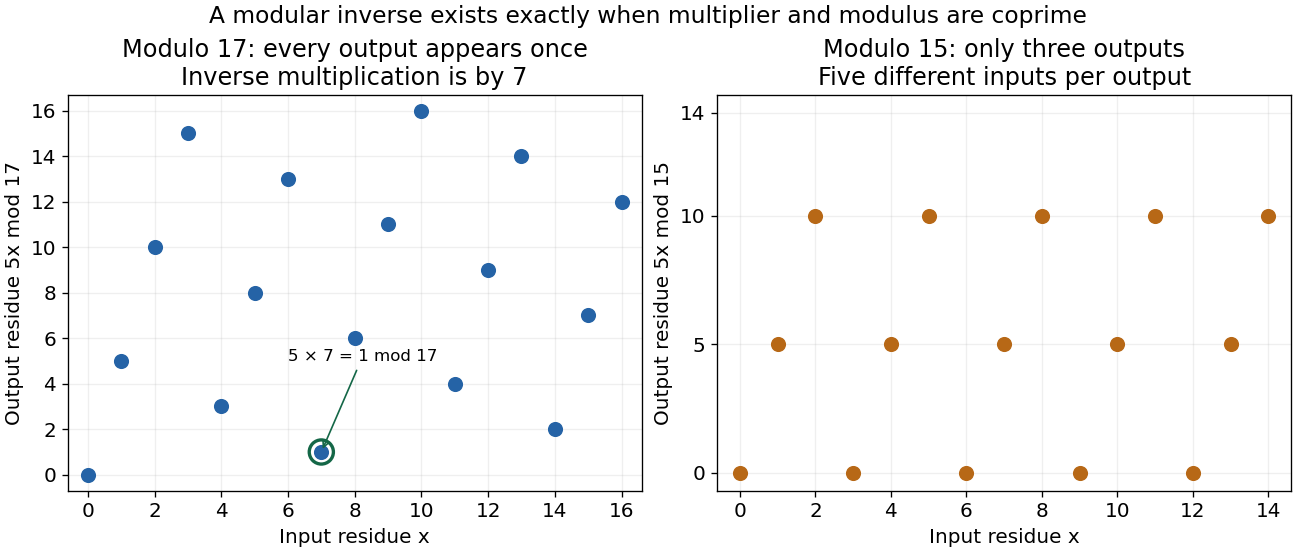
For example, , so . The modular congruence therefore has the unique solution class . Multiplication by sends all seventeen residue classes to different classes; multiplying by reverses it. The inverse criterion and its algorithmic construction are presented in Ankur Moitra, MIT 18.200, 2024, modular inverses and Euclid's algorithm.
By contrast, has no modular inverse modulo . Its products have only residues . Consequently has no solution, while has five solution classes, . Dividing by a noninvertible residue would discard this distinction. In a prime field , every nonzero residue is invertible; a general integer modulus instead gives a quotient ring that can have zero divisors.
Mathematical epidemiology uses mathematical models and statistical inference to study the occurrence, transmission, and control of disease in populations.
For two spheres with positive radii and center separation , putExternally disjoint spheres have ; strictly nested disjoint spheres have . For unoriented spheres, the invariant under Möbius transformations is , provided both images remain finite spheres. The signed expression becomes invariant when the spheres carry consistently transported orientations and signed radii. Some authors use its negative.[ref]
Laguerre geometry in space forms and incircular nets by Alexander I. Bobenko and others. Appendix B.1, Definition B.2 and Proposition B.6, page 66; that source uses the opposite sign
The sign issue is visible without any general theory. Take unit spheres centered at and , so . Under , the first remains the unit sphere, while the second has center and radius , inside it. Substitution now gives . Thus the old positive-radius formula alone cannot be a signed conformal invariant. For disjoint unoriented spheres, is another common distance convention.
An asymptotically flat spacetime approaches Minkowski spacetime sufficiently far from isolated sources. At null infinity this is stated invariantly by requiring a smooth conformal completion whose boundary contains future and past null infinity.
A gravitational wave is a propagating disturbance of spacetime curvature produced by changing mass-energy multipole moments. In general relativity, its two transverse gravitational wave polarizations alternately stretch and squeeze freely falling separations. The leading radiation from a slowly moving source is governed by its mass quadrupole moment, rather than by its total mass alone.
The experimental breakthrough was GW150914: observed on 14 September 2015 and published on 11 February 2016. The LIGO Scientific Collaboration and Virgo Collaboration reported a merging pair of black holes, using the two LIGO detectors at Hanford and Livingston; Virgo was being upgraded and did not observe this event.[ref]
Observation of Gravitational Waves from a Binary Black Hole Merger by B. P. Abbott and others. Abstract; II Observation, pp. 1–3; received and publication dates on p. 1
The 2017 Nobel Prize in Physics recognized Rainer Weiss, Barry C. Barish and Kip S. Thorne for contributions to LIGO and gravitational wave observation. Rainer Weiss developed interferometric detection and its noise analysis; Barry C. Barish led the project into construction and operation; Kip S. Thorne developed its theoretical and astrophysical foundations. The experiment depended on a large collaboration.[ref]
Press release: The Nobel Prize in Physics 2017 by Royal Swedish Academy of Sciences. 3 October 2017 announcement, laureates and account of their complementary contributions
A conformal Killing vector field generates a local flow that preserves the metric up to a position-dependent scale factor.
The spacetime dimension is the dimension of the smooth manifold used to model spacetime. Ordinary general relativity uses one temporal and three spatial dimensions.
Porous-media flow is fluid motion through the interconnected voids of a porous medium, such as a sand bed, a rock or a filter. Individual passages can be tiny and tortuous, yet their combined discharge can be predicted without resolving every passage. Darcy law supplies this bulk description when viscous resistance dominates pore-scale inertia; porosity measures how much space stores fluid, while permeability of a porous medium measures how readily that space transmits it.
The basic fully saturated model assumes one Newtonian fluid fills the connected pore space of a stationary solid framework, with incompressible flow, a small pore-scale Reynolds number, and averaging volumes large compared with individual pores but small compared with macroscopic variations. These are assumptions of the model developed below, rather than a claim that Darcy law describes every porous-media flow. Two-phase porous-media flow and poroelastic aquifers require additional constitutive and storage information.
For a first calculation, see Darcy flow through a homogeneous slab: a pressure drop determines the discharge, but porosity determines the corresponding pore velocity. Layered porous permeability then shows how geometry alone can make the bulk response anisotropic.
Rheology studies how matter deforms and flows under applied stress, including the dependence on loading history and observation time. Its central task is to connect a measured stress to strain, strain rate and relevant internal state through a constitutive equation. A Newtonian fluid has an instantaneous proportional response to strain rate; an elastic solid responds to strain; a viscoelastic material retains information about previous deformation.
These differences can be exposed by changing the experiment rather than only changing the load. Holding stress fixed measures material creep; holding strain fixed measures stress relaxation; small-amplitude oscillatory shear separates storage modulus from loss modulus. A rheometer supplies controlled motion and measures the resulting force or torque. Such measurements help predict whether a paste will remain in place, how much pressure is needed to drive a fluid flow, and whether a material will recover after loading.
The volumetric flow rate measures volume crossing an oriented surface per unit time:For a planar cross-section of area , define the mean normal velocity ; then exactly. The units are . A nonuniform velocity profile changes the mean, rather than invalidating this definition.
In steady incompressible flow without leaks or branches, mass conservation makes the same at every pipe section. In a compressible stream the conserved quantity is mass flow rate, and can change as mass density changes. Collecting discharged liquid for a measured interval gives an elementary flow-rate measurement, provided the collection captures the full flow and the volume is interpreted at the appropriate conditions.
A Lagrangian displacement maps each equilibrium fluid element to its perturbed position. Its time derivative is the velocity perturbation when the equilibrium is static.
The Proca action adds to the Maxwell Lagrangian. It describes a massive spin-one field and explicitly breaks the Abelian gauge symmetry of the massless theory.
Electromagnetic radiation is a propagating disturbance of the electric field and magnetic field that carries energy and momentum away from its source. It can be a sustained electromagnetic wave or a finite wave packet: periodic oscillation is not required. In vacuum the disturbance travels at the speed of light. A receiver responds to fields arriving now from an earlier source event, as expressed by retarded time. This is how electrical activity at one place can deliver energy and information elsewhere without a connecting wire.
Stored electromagnetic energy alone does not establish outgoing electromagnetic radiation. A stationary electric charge in electrostatics, or a steady localized electric current in magnetostatics, can store electromagnetic energy with zero Poynting vector. Static combinations can have circulating energy flux without net outward power. Near a changing source, reactive energy can return later. The near and far field distinction separates these contributions from outgoing radiation zone fields.[ref]
Chapter 27: Field Energy and Field Momentum. §27-5, Fig. 27-6: static fields with circulating energy flux
A single traveling vacuum plane electromagnetic wave obeying the Maxwell equations has . Its Poynting vector gives the energy density and flux of a plane electromagnetic wave:Here is wave intensity; and are vacuum permittivity and vacuum permeability. For a monochromatic wave with linear polarization and peak amplitude , squared cosine averages to . Pulses require the instantaneous Poynting vector; arbitrary incident-and-reflected superpositions need not obey this relation.[ref]
Chapter 27: Field Energy and Field Momentum. §27-5, Eqs. (27.16)–(27.18): traveling-wave energy flux
The electromagnetic momentum density is . Completely absorbing a unidirectional vacuum pulse of energy transfers momentum ; see radiation pressure on a perfectly absorbing surface. A calculated pulse transfers . Symmetric emission can lose energy without net recoil because opposite momenta cancel.[ref]
The direction of emission matters as much as its total power. For an oscillating electric dipole moment along , the angular distribution of electric dipole radiation is strongest across the axis and vanishes along it. Its origin is geometric: the electric dipole radiation field is the transverse projection of the second time derivative of the electric dipole moment, so its magnitude contains . Squaring this electric field to obtain wave intensity gives . The electric-dipole approximation for radiation requires a source much smaller than its wavelength and observation in the radiation zone. [ref]
Chapter 28: Electromagnetic Radiation. Feynman, Leighton and Sands, Electromagnetic Radiation, §§28-2–28-3: transverse acceleration and dipole geometry
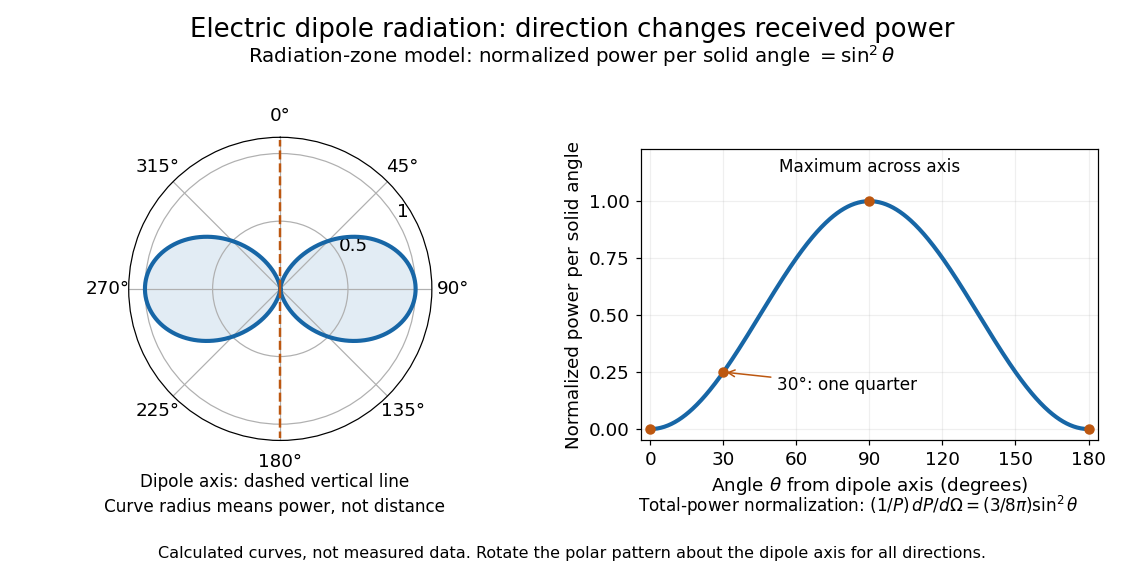
Normalized angular pattern of electric dipole radiation
. Calculated radiation zone model, not measured data. The polar curve's radial coordinate is normalized power per solid angle, , rather than physical distance or a field line. The angle is measured from the dipole axis. Rotating this meridional pattern about that axis gives the three-dimensional angular distribution. Details.For example, the power per solid angle at is one quarter of its equatorial value, while the electric field amplitude is one half. To normalize the angular distribution to total power, use spherical coordinates with :The integral follows by substituting , giving . This is a probability-like normalization over direction, with units of inverse steradian; it does not make the dipole an isotropic radiator. The same angular integral underlies the Larmor formula for nonrelativistic accelerated electric charge.
Detection requires the incident electromagnetic field to do something observable. An antenna develops an electrical response; a thermopile converts absorbed energy into a thermal and then electrical signal; a photodetector can respond through photon absorption. Hertz spark transmission and detection experiment makes this conversion visible as a tiny spark. Detector orientation, sensitivity, and surrounding reflections all matter: failure to see a signal does not prove that no electromagnetic radiation reached the receiver.
Dark energy is a smooth component with sufficiently negative pressure to drive accelerated cosmic expansion. The supernova discovery of accelerating expansion measures an expansion history through luminosity distance; interpreting that history as a component of the stress tensor additionally assumes general relativity. A cosmological constant is one possibility, whereas dynamical dark energy permits a changing equation-of-state parameter.
A granular material is an assembly of macroscopic grains, such as dry sand, whose collective response depends on contacts, friction and rearrangement. A grain is a solid, but the assembly can support a static pile or flow when contacts reorganize. For ordinary sand, grain motion is set mainly by loading and gravity, rather than equilibrium thermal agitation.
Pouring grains slowly through a funnel produces a pile whose free surface approaches an angle of repose. Tilting a prepared layer can instead reveal a threshold for an avalanche; preparation history can make that threshold differ from the final resting slope. Contacts transmit forces through a nonuniform network, and collisions can dissipate mechanical energy. These mechanisms explain why a granular material cannot generally be assigned the same simple constitutive equation as either an elastic block or a Newtonian fluid. Moisture and cohesion introduce further interactions and must be specified in comparisons.
Pinned article: Introduction to the OurBigBook Project
Welcome to the OurBigBook Project! Our goal is to create the perfect publishing platform for STEM subjects, and get university-level students to write the best free STEM tutorials ever.
Everyone is welcome to create an account and play with the site: ourbigbook.com/go/register. We belive that students themselves can write amazing tutorials, but teachers are welcome too. You can write about anything you want, it doesn't have to be STEM or even educational. Silly test content is very welcome and you won't be penalized in any way. Just keep it legal!
Intro to OurBigBook
. Source. We have two killer features:
- topics: topics group articles by different users with the same title, e.g. here is the topic for the "Fundamental Theorem of Calculus" ourbigbook.com/go/topic/fundamental-theorem-of-calculusArticles of different users are sorted by upvote within each article page. This feature is a bit like:
- a Wikipedia where each user can have their own version of each article
- a Q&A website like Stack Overflow, where multiple people can give their views on a given topic, and the best ones are sorted by upvote. Except you don't need to wait for someone to ask first, and any topic goes, no matter how narrow or broad
This feature makes it possible for readers to find better explanations of any topic created by other writers. And it allows writers to create an explanation in a place that readers might actually find it.
Figure 1. Screenshot of the "Derivative" topic page. View it live at: ourbigbook.com/go/topic/derivativeVideo 2. OurBigBook Web topics demo. Source. - local editing: you can store all your personal knowledge base content locally in a plaintext markup format that can be edited locally and published either:This way you can be sure that even if OurBigBook.com were to go down one day (which we have no plans to do as it is quite cheap to host!), your content will still be perfectly readable as a static site.
- to OurBigBook.com to get awesome multi-user features like topics and likes
- as HTML files to a static website, which you can host yourself for free on many external providers like GitHub Pages, and remain in full control

Figure 2. You can publish local OurBigBook lightweight markup files to either OurBigBook.com or as a static website.
Figure 3. Visual Studio Code extension installation.
Figure 5. . You can also edit articles on the Web editor without installing anything locally. Video 3. Edit locally and publish demo. Source. This shows editing OurBigBook Markup and publishing it using the Visual Studio Code extension. 
- Infinitely deep tables of contents:




All our software is open source and hosted at: github.com/ourbigbook/ourbigbook
Further documentation can be found at: docs.ourbigbook.com
Feel free to reach our to us for any help or suggestions: docs.ourbigbook.com/#contact