Topics (384k) Articles (398k) Users (410) Discussions (242) Comments (383) Files (13k) New article

Boundary-layer disturbance amplification is growth of a specified disturbance measure as it develops within a boundary layer. The measure might be a velocity amplitude at one frequency or a spatially integrated fluctuation energy. Those are different observables: amplitude gain and energy gain cannot be interchanged numerically.
A simple spatial model assigns amplitude the spatial growth rate of a boundary-layer disturbance :The growth rate has inverse-length units, whereas and are dimensionless. If a disturbance energy is proportional to with unchanged normalization, its gain is , not .
Consider a constructed disturbance that grows with over and then decays at over another . Its peak amplitude gain is , with energy gain , even though its final amplitude gain returns to one. An endpoint comparison would miss the intermediate growth. If the growing disturbance modifies the underlying flow, the linear model ceases to describe that later evolution automatically.
The flat-plate experiment by G. B. Schubauer and H. K. Skramstad reduced wind-stream disturbances with damping screens, observed oscillations in the laminar layer, and subsequently produced controlled oscillations for study.[ref]
Laminar-Boundary-Layer Oscillations and Transition on a Flat Plate by G. B. Schubauer and H. K. Skramstad. NACA-TR-909, repository abstract: low-disturbance experiment and controlled oscillations
Repeated observations at different positions can therefore address growth, rather than only asking whether a signal exists.A growth estimate requires a consistent frequency band, location relative to the wall and amplitude convention. Detecting growth supports an amplification claim under those measurement conditions; it does not alone establish completed boundary-layer transition or identify a universal breakdown threshold.
Macroscopic quantum self-trapping is a nonlinear regime of a bosonic Josephson junction in which an initial population imbalance does not undergo the full sign-changing tunneling oscillations expected from a simple linear two-state model. Interactions alter the relation between relative phase and population flow.
An experiment with two weakly linked condensates in a double-well potential measured both the density distribution and the relative phase inferred from interference fringes. Their combination distinguished nonlinear self-trapping from merely observing unequal populations at one instant.[ref]
The parity function on bits returns whether an odd number of them are one:For example, , and flipping any single input flips the output. A chain of exclusive or gates computes it with gates and linear depth; a balanced binary tree of such gates has logarithmic depth and still linear size.
Appending a parity bit to make the total even detects every single-bit error in a transmitted binary string. It misses any even number of flipped bits, because their changes cancel modulo two. This simple example separates error detection from error correction: detecting an odd number of changes does not identify which positions changed.
Transmural pressure is the pressure inside a wall-bounded structure minus the pressure immediately outside it:It identifies the pressure difference acting across the wall. For a blood vessel, blood pressure relative to atmosphere is not automatically this difference, because surrounding tissue can exert a nonzero pressure. For an airway, the same distinction explains how surrounding pleural pressure can affect distension or compression.[ref]
Pulmonary Function Testing by Warren M. Gold and Laura L. Koth. Figure 25-1, intrathoracic airway pressure differences
For an original comparison, an internal pressure of 100 and surrounding pressure of 20 in the same units give a transmural pressure of 80. Raising the surrounding pressure to 60 reduces it to 40 even though the internal reading has not changed. Adding the same reference offset to both pressures cancels in the difference. Independently zeroed instruments with different offsets do not obtain that cancellation automatically.
A thin-walled pressure vessel gives a useful mechanical derivation. Cut an ideal cylindrical wall longitudinally through a length . The resultant pressure force on a half-cylinder is , while two cut edges carry total circumferential tensile force . Force balance yields the hoop stressfor radius , thickness and uniform tensile stress. A stipulated kPa, mm and mm gives kPa. This is a thin-wall estimate, not an exact tissue constitutive law.
Pressure difference, wall stress and vascular compliance answer different questions. Pressure and geometry determine the ideal force balance, while material properties determine the resulting deformation. Negative transmural pressure can favor narrowing, but the actual shape and collapse behavior also depend on support and wall mechanics. Keeping both sides of the pressure measurement explicit prevents an atmospheric gauge reading from silently replacing the physical load across the wall.
Thermodilution estimates blood flow from the temperature change produced by introducing fluid at a different temperature. It is a form of indicator dilution: the transported signal is a thermal deficit or excess rather than a dye concentration. An upstream catheter introduces the fluid and downstream temperature measurement records its dilution in flowing blood.
Two arrangements illustrate the principle. A finite injection produces a temperature-versus-time curve; a continuous infusion can produce an approximately steady downstream temperature change. A primary coronary-flow study used room-temperature saline, a 2.8-F infusion catheter and a 0.014-inch pressure/temperature guidewire, testing the method in five instrumented dogs and 35 patients.[ref]
Direct volumetric blood flow measurement in coronary arteries by thermodilution by Wilbert Aarnoudse and others. Abstract, Methods
The quantities observed were infusion rate, infused-fluid temperature at the catheter tip and distal mixed-blood temperature.For an idealized finite-injection model, let be the injected thermal deficit in joules, the volumetric heat capacity of the moving fluid, and the downstream temperature deficit. Assume steady volume blood flow , complete passage of the signal through the detector, representative mixing and negligible heat transfer to other structures. Conservation of energy then givesThe time integral, rather than the maximum temperature change, determines this model's flow estimate. With stipulated J, J/(mL K) and curve area K s, the inferred blood flow is mL/s, or mL/min. These values illustrate the balance, not a clinical protocol.
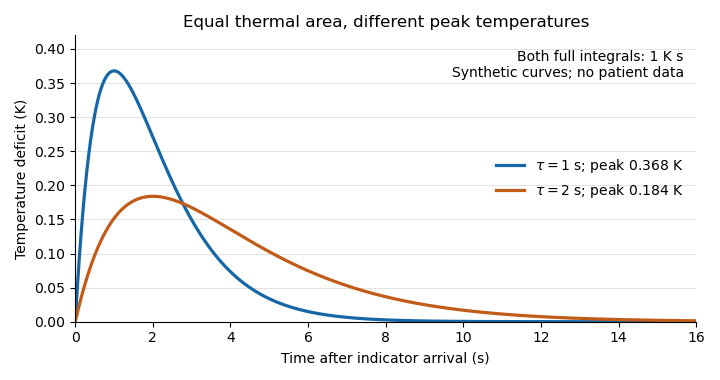
Equal thermal-indicator area with different peak temperatures
. Synthetic deficits , with K s and or s. Both integrals over all time equal ; the plotted window ends at 16 s. Different peak heights therefore give the same ideal flow at fixed thermal input. Details.This ideal calculation exposes measurement assumptions. If only a fraction of the thermal signal reaches the detector, the observed curve area is reduced by that factor and the uncorrected estimate becomes . For example, would cause a overestimate in this model. Coronary thermodilution mixing assumptions similarly determine whether a local sensor reading represents the transported thermal signal. Accurate temperature measurement alone cannot establish those conditions.
Indicator dilution estimates blood flow from the transport of an introduced, measurable indicator. A known input is mixed into flowing blood, and a downstream detector records its changing concentration or an analogous calibrated signal. The inference uses a transported-amount balance, rather than merely equating a low peak with a large flow.
For an original first-pass bolus model, let indicator amount pass a detector in a stream of constant flow , with background-subtracted concentration . If the full indicator amount crosses that location once, no indicator is lost and mixing makes the measured concentration representative,For mg and curve area , flow is . Two curves can have different peak heights and widths yet give this same area and flow. A transit time or peak height alone is insufficient.
Missing 20 percent of the area gives an inferred L/min, a 25 percent overestimate. Including an extra 20 percent through recirculation instead gives L/min. First-pass isolation, background subtraction and the timing window are therefore parts of the measurement model. Incomplete recovery of the injected indicator can invalidate the assumption that the detected amount equals .
Continuous infusion uses a related steady balance. If indicator enters at known amount rate and background-corrected downstream concentration is , the simplest negligible-added-volume model gives . When infusion volume is appreciable, it contributes to total flow and must be retained.
Thermodilution uses a thermal contrast instead of a chemically measured dye concentration. A primary coronary experiment combined continuous saline infusion with an infusion catheter and temperature-sensing guidewire.[ref]
Direct volumetric blood flow measurement in coronary arteries by thermodilution by Wilbert Aarnoudse and others. Abstract, Methods
Thermal capacity, infused-fluid temperature and heat exchange then enter the amount balance. A thermal signal cannot simply be inserted into the dye formula without those conversions.Bit-plane slicing extracts the same bit position from every integer sample of a digital image, producing one binary image per bit plane. For an unsigned -bit sample and ,Equivalently, bitwise AND with the mask isolates that position, and a bit shift or nonzero test converts it to zero or one. Linux's frame-buffer API describes the underlying bit-plane storage convention as plane carrying bit of every sample.[ref]
For an original four-bit sample , the binary digits are : the planes have . Their contributions reconstruct . Displaying each plane as a black-and-white image makes its pattern visible, but does not give every plane equal numerical significance.
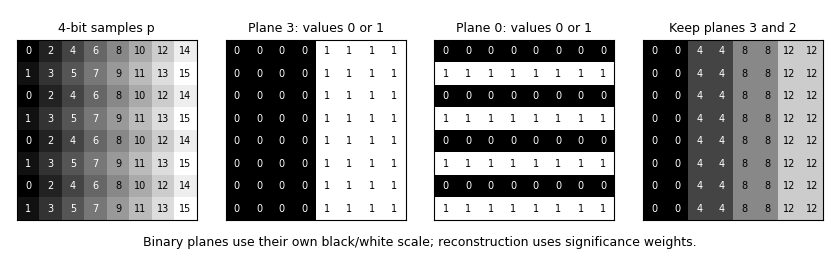
An original four-bit image, two extracted bit planes and reconstruction from the two most significant planes
. Every grid entry shows its integer value. The binary panels map zero to black and one to white; the input and reconstruction use the common zero-to15 grayscale. The alternating row pattern is visible in the least significant plane. Details.Keeping only planes three and two gives . The discarded remainder satisfies , by integer division. A one-unit change from seven to eight nevertheless flips every one of the four bits, so the binary patterns need not vary smoothly as intensity codes change. Nor is a low bit plane automatically noise: it can encode a deliberately structured pattern, as the example shows.
Slicing is an operation on the stated integer encoding. Applying it to a floating-point number's stored bit pattern examines sign, exponent and fraction fields rather than the same unsigned intensity significance. The sample type and pixel format therefore belong in the definition of the operation.
3-hydroxypropionic acid is a three-carbon beta-hydroxy acid with structureIts carboxyl group carbon is numbered 1; the additional hydroxyl group is on carbon 3. The primary ChEBI record identifies the systematic name 3-hydroxypropanoic acid, formula and average molecular mass . The acid and its conjugate base, 3-hydroxypropionate, are distinguished chemical species.[ref]
3-hydroxypropionic acid in ChEBI. CHEBI:33404, structure, Formula, Average Mass, Names and conjugate-base relation
Moving the hydroxyl group by one carbon gives the different connectivity of lactic acid, . The two acids have the same molecular formula but are constitutional isomers. Molecular mass alone cannot decide which one a sample contains. The terminal alcohol and the carboxyl group also provide different sites for chemical transformation; the compound’s name specifies the initial structure rather than guaranteeing one reaction pathway.
An experimentally demonstrated motivation is production as a chemical building block by metabolic engineering. In the 2016 primary study by Chan Woo Song and colleagues, engineered Escherichia coli produced of 3-hydroxypropionic acid in fed-batch culture. The study screened enzyme combinations and altered the strain, so the observation concerns a particular engineered production system rather than a universal property of the species.[ref]
Using the record’s molecular mass, that mass concentration corresponds to approximatelyof acid equivalents. This conversion is an original calculation, not a separate measurement. Product concentration alone gives neither production rate without a time interval nor mass yield without substrate consumption. Chemical identity, accumulated amount and process performance remain different experimental questions.
The periodic Bernoulli function is the periodic extension of the Bernoulli polynomial, where is the fractional part. It has period one. For example, .
For , its Fourier expansion isThe series is absolutely convergent. For the same formula holds away from the integers and describes a sawtooth. At an integer the symmetric Fourier value is zero, whereas the literal fractional-part convention gives ; endpoint conventions must therefore be distinguished.[ref]
Periodic Bernoulli functions occur in the remainder of the Euler-Maclaurin formula, connecting errors in discrete summation with periodic oscillation between successive integers.
A bearing thermal end-stop load is the axial reaction that appears when relative thermal expansion exhausts the free travel of a support arrangement. In a quasistatic one-direction model, let free thermal mismatch be , initial travel to the stop be , shaft compliance be and restraining support compliance be . The engaged reaction magnitude isThe gap first closes; additional mismatch is taken up by elastic deformation of the shaft and support. This explains why the bearing axial displacement allowance matters. The locating/non-locating arrangement is intended to accommodate relative motion rather than create an unintended thermal restraint.[ref]
For hypothetical , , and , the effective stiffness is and the load is1.6kN. The stored elastic energy in this combined linear compliance isThis is stored energy; the frictionless elastic model does not itself predict heat loss during a complete reversible cycle.
If the housing is fixed and free mismatch is , the bearing end-stop engagement temperature increment is . With hypothetical and , the0.10mm gap closes at about16.67K temperature increase. Further heating raises the load according to the engaged stiffness.
The positive-part relation is a simple instance of unilateral contact complementarity: the stop supplies a reaction only when the corresponding clearance is exhausted. Shaft inertia, impact, friction or bearing preload require a more complete model. In particular, this static compatibility calculation does not determine a collision force when a moving assembly first hits the stop.
A bearing axial travel interval states the range of relative shaft/housing positions that must be accommodated, or the range physically available, using an explicit axial reference. It is more informative than one unsigned clearance number when heating, cooling and assembly offsets move the shaft in different directions. A non-locating bearing support accommodates such movement while a locating bearing determines the reference position.[ref]
Rolling bearings by SKF. Section B.2, printed p.70, axial location, relative thermal movement and tolerance accumulation
Suppose thermal operating states give displacement and an independent assembly offset lies in . Adding the endpoint bounds gives required displacement . This is a bound over the permitted combinations, not a standard deviation.
Let available physical travel be and choose bearing nominal axial setting . Requiring every displacement in to remain within the travel givesorIf physical travel is for the preceding displacement range, both endpoints force . Setting would exceed the positive limit by0.03mm despite equal total required and available spans.
The example has no spare endpoint margin: requiring an additional positive margin at both ends makes the nominal-setting interval empty. Correlated thermal inputs can also make a naive independent-range bound conservative; a tighter result requires the permitted joint operating states. The interval must refer to the actual movement mechanism, because reaching its end can introduce a bearing thermal end-stop load.
Pinned article: Introduction to the OurBigBook Project
Welcome to the OurBigBook Project! Our goal is to create the perfect publishing platform for STEM subjects, and get university-level students to write the best free STEM tutorials ever.
Everyone is welcome to create an account and play with the site: ourbigbook.com/go/register. We belive that students themselves can write amazing tutorials, but teachers are welcome too. You can write about anything you want, it doesn't have to be STEM or even educational. Silly test content is very welcome and you won't be penalized in any way. Just keep it legal!
Intro to OurBigBook
. Source. We have two killer features:
- topics: topics group articles by different users with the same title, e.g. here is the topic for the "Fundamental Theorem of Calculus" ourbigbook.com/go/topic/fundamental-theorem-of-calculusArticles of different users are sorted by upvote within each article page. This feature is a bit like:
- a Wikipedia where each user can have their own version of each article
- a Q&A website like Stack Overflow, where multiple people can give their views on a given topic, and the best ones are sorted by upvote. Except you don't need to wait for someone to ask first, and any topic goes, no matter how narrow or broad
This feature makes it possible for readers to find better explanations of any topic created by other writers. And it allows writers to create an explanation in a place that readers might actually find it.
Figure 1. Screenshot of the "Derivative" topic page. View it live at: ourbigbook.com/go/topic/derivativeVideo 2. OurBigBook Web topics demo. Source. - local editing: you can store all your personal knowledge base content locally in a plaintext markup format that can be edited locally and published either:This way you can be sure that even if OurBigBook.com were to go down one day (which we have no plans to do as it is quite cheap to host!), your content will still be perfectly readable as a static site.
- to OurBigBook.com to get awesome multi-user features like topics and likes
- as HTML files to a static website, which you can host yourself for free on many external providers like GitHub Pages, and remain in full control

Figure 2. You can publish local OurBigBook lightweight markup files to either OurBigBook.com or as a static website.
Figure 3. Visual Studio Code extension installation.
Figure 5. . You can also edit articles on the Web editor without installing anything locally. Video 3. Edit locally and publish demo. Source. This shows editing OurBigBook Markup and publishing it using the Visual Studio Code extension. 
- Infinitely deep tables of contents:




All our software is open source and hosted at: github.com/ourbigbook/ourbigbook
Further documentation can be found at: docs.ourbigbook.com
Feel free to reach our to us for any help or suggestions: docs.ourbigbook.com/#contact