Topics (384k) Articles (398k) Users (410) Discussions (242) Comments (383) Files (13k) New article

A smooth automorphic form is an automorphic form whose archimedean variables are infinitely differentiable, without necessarily being holomorphic. Conventions differ over whether compact-group finiteness is included or one takes a larger smooth representation space. In the classical finite-vector convention on , one asks for left invariance under an arithmetic subgroup , moderate growth, finite-dimensional span under right translations by , and finiteness under the centre of the universal enveloping algebra.[ref]
Classical Modular Forms as Automorphic Forms by Matthew Emerton. Definition 5.1 and section 7, general forms versus holomorphic forms
The constant function on is an example: it is smooth, bounded, -invariant and annihilated by positive-order invariant differentiation. More interesting examples come from Maass forms, whose Laplacian eigenfunction condition replaces holomorphy. Smoothness is therefore a regularity requirement, not a claim that the Cauchy-Riemann equations hold.
In the weight-zero convention, a Maass form for a discrete subgroup is a smooth function on the upper half-plane, invariant under , satisfying a hyperbolic Laplacian eigenvalue equation and specified growth conditions at the cusps:Additional conditions specify a cuspidal or square-integrable class. The sign of is a convention and must be stated.[ref]
Shifted polyharmonic Maass forms for PSL(2,Z) by Nickolas Andersen and others. Introduction, depth-one eigenfunction conditions; the paper uses its own Laplacian sign convention
The constant function is an invariant eigenfunction with and moderate growth, but is not cuspidal: its average along a horizontal period is nonzero. A Maass cusp form has zero such constant term at each cusp. The eigenfunction condition allows nonholomorphic automorphic forms, connecting arithmetic symmetries with spectral geometry.
For a finite-index subgroup of , a cusp is a -equivalence class of rational boundary points, including infinity:Geometrically it describes a noncompact end of the quotient of the upper half-plane. Adding these classes compactifies the corresponding modular curve. The added points describe boundary data of the quotient.[ref]
Modular Functions and Modular Forms by James S. Milne. section 2, cusps and the compactification of a finite-index quotient
The full modular group has one cusp: a reduced rational number is the image of infinity under a matrix with determinant one. In contrast, has inequivalent cusps represented by infinity and zero. A matrix sending infinity to zero must have , hence and odd , so it cannot belong to .
At infinity the cusp width is the least positive for which belongs to the effective stabilizer. The local coordinate tends to zero as . Filling in adds one point. At other cusps one first changes coordinates by a matrix carrying infinity to the chosen rational boundary point. Growth and constant term of an automorphic form conditions must be checked at each inequivalent cusp.
The constant term of an automorphic form is its average along the periodic or unipotent direction associated with a cusp. In the basic period-one upper-half-plane setting,It is the zeroth coefficient of the Fourier series in . Despite the name, it may depend on . For a cusp width , use the normalized average after moving the chosen cusp to infinity.[ref]
Modular Functions and Modular Forms by James S. Milne. sections 2 and 4, cusp coordinates and Fourier expansions
For a weight-zero Maass form with and , periodicity makes the averaged -derivative term vanish. ThusIf and , the solutions are . At , the repeated root gives . A constant Fourier mode need not therefore be a constant function on the upper half-plane.
For the constant automorphic function , the constant term is one and . A Maass cusp form instead has identically zero constant term at every cusp. The condition concerns the whole coefficient function, rather than merely its value at one height.
A build system executes declared transformations from source files and other inputs to build outputs, respecting their dependency graph. Common steps include code generation, compilation, linking and packaging. CMake describes builds through targets such as executables and software libraries, with dependencies between them.[ref]
cmake-buildsystem in the CMake documentation. Introduction and Binary Targets
For example,
main.o and math.o must exist before they can be linked into an executable. If only the source for math.o changes, an incremental build can reuse main.o, rebuild math.o and relink. Reuse is valid only when every relevant requirement has been tracked: a changed header, tool option or generated input can invalidate an apparently unchanged output. Correct dependency declarations are part of build correctness.Autocollimation is an optical return-path method: a source pattern is projected through a collimator, reflected back from an external surface, and examined through the same optical system. It is the process used by an autocollimator, rather than the instrument itself. A plane mirror normal to the outgoing collimated light returns the light along the reference direction.[ref]
A typical apparatus uses an illuminated reticle near a focal plane, an objective and a beam splitter that separates the illumination and viewing paths. The outward projection and the return image are compared, making small changes in reflector orientation observable.[ref]
Measurements with autocollimators by TRIOPTICS. Opening shared-path collimator/telescope description
For a small mirror tilt , reflection changes the return direction by . In the ideal paraxial model, return-image displacement is , where is the effective focal length. An original example with and gives . This is displacement in the image plane, not a direct measurement of mirror translation.
The angular interpretation explains why simply moving an ideal plane mirror farther away does not multiply the focal-plane displacement by that distance. In practice, finite aperture, beam walk, alignment and diffraction limit the usable return. Measurement calibration and a stable reference remain necessary to distinguish a genuine angular change from movement of the optical system.
The atrial conduit flow component is blood entering the left atrium through the pulmonary veins during ventricular diastole and leaving through the mitral valve within that same ventricular diastole. The same-phase requirement distinguishes it from the atrial reservoir flow component and atrial delayed-ejection flow component.[ref]
An original two-history example shows why a volume curve alone cannot identify it. During a selected interval, suppose 20 mL enters the left atrium and 20 mL leaves through the mitral valve, leaving chamber volume unchanged. In history A, all 20 mL entering during that interval passes straight onward; it can qualify as atrial conduit flow component if the interval lies within one ventricular diastole. In history B, the 20 mL leaving is entirely older atrial blood, while the newly entering 20 mL stays behind. The same inflow, outflow and chamber volume change are compatible with different parcel identities.
The boundary balancecannot distinguish these histories. Here is net inward volumetric flow rate at the pulmonary veins and is net outward volumetric flow rate at the mitral valve. The additional information is the mapping between entry and exit, represented by pathlines.
This distinction also explains why atrial conduit function, a physiological role, and a particular volume-based proxy need not equal the atrial conduit flow component. A parcel volume collected over an interval need not be contained in the chamber simultaneously, so normalization requires an explicitly stated denominator rather than an assumed fraction of maximum atrial volume. The six histories below are constructed examples, not patient measurements.
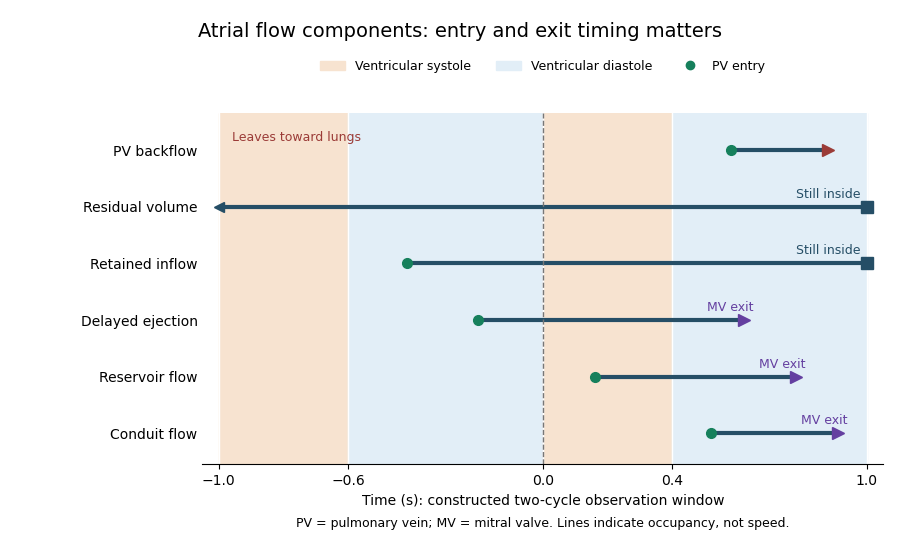
The atrial reservoir flow component is blood entering the left atrium during ventricular systole and leaving through the mitral valve in the following ventricular diastole. This parcel-based category in atrial flow component analysis specifies both arrival and departure phases.[ref]
Its definition explains the storage interpretation of atrial reservoir function. In an idealized closed-outlet interval, the left atrium's volume balance iswhere is total net inflow from the pulmonary veins. A stipulated constant 50 mL/s for 0.3 s increases atrial volume by 15 mL. This balance describes storage during that interval. To label all 15 mL as atrial reservoir flow component, a parcel record must additionally show the prescribed subsequent exit.
For example, imagine that the stored 15 mL comprises 12 mL that leaves in the following ventricular diastole and 3 mL that remains beyond it. The volume increase is still 15 mL, but the qualifying atrial reservoir flow component from those arrivals is 12 mL. Conversely, older blood can leave during the same filling phase without having entered during the immediately preceding ventricular systole.
A maximum-minus-minimum atrial volume is therefore not an automatic census of this category. Chamber volume measures how much is inside at a given time; pathlines identify which represented blood is inside and where it goes. The primary study combined moving anatomy from computed tomography, computational fluid dynamics and numerical pathlines rather than directly measuring each parcel's velocity with the anatomical scanner.[ref]
Comprehensive left atrial flow component analysis reveals abnormal flow patterns in paroxysmal atrial fibrillation by Sophia Bäck and others. Methods, CT Acquisition and Flow Simulation; Flow Component Analysis
These complementary observations connect a visible chamber motion to a specific transport question.The atrial delayed-ejection flow component comprises blood leaving the left atrium during ventricular diastole after entering during the preceding diastole or earlier. The Bäck study calls this delayed outflow. In contrast, the atrial reservoir flow component enters during the intervening ventricular systole.[ref]
This is a transport-history definition, not a statement that ventricular electrical activation was delayed. A constructed timeline illustrates it. Number successive one-second cardiac cycles so the current ventricular systole occupies s and its following diastole occupies s. Suppose a parcel entered in the previous diastole at s and crosses the mitral valve at s. Its 0.8 s passage spans a ventricular systole. A second parcel entering at s and leaving at s instead belongs to the atrial conduit flow component.
For represented parcels with exit times , entry times and volume weights , a volume-weighted transit time within a selected exiting category isTwo hypothetical parcels representing 1 and 3 mL and taking 0.8 and 1.2 s give s, rather than the unweighted mean of 1 s. If an entry occurred before the available record, the exact transit time is unknown: an observed exit can establish a category without recovering an exact entry date.
The atrial delayed-ejection flow component thus complements the atrial retained-inflow component: one identifies an observed exit of older atrial blood, while the other identifies entered blood still present at the specified endpoint.
The atrial retained-inflow component is blood that entered the left atrium during the previous cardiac cycle but has not left by the specified endpoint of the Bäck tracking scheme. Its documented entry distinguishes it from the atrial residual-volume component, whose blood remains throughout both tracked cycles.[ref]
A simple parcel ledger makes the distinction concrete. In a constructed one-second cardiac cycle, let a tracked parcel enter through a pulmonary vein at s during the first of two cycles and remain inside until observation ends at s. Its observed residence time at that endpoint is 1.6 s. If that parcel crosses the mitral valve at s, a later observation reveals an exit; the earlier record was still correctly classified for its own endpoint.
Different amounts of retention need not produce different instantaneous chamber volumes. Consider two ideal histories, each with 40 mL inside the left atrium at the endpoint. In the first, 10 mL has an observed entry during the designated earlier cycle and remains, while 30 mL was present throughout the entire tracking window. In the second, the corresponding volumes are 25 and 15 mL. Both chamber totals are 40 mL, but their atrial retained-inflow component and atrial residual-volume component differ. A chamber outline alone cannot distinguish these histories.
The component is consequently useful for asking about replacement of atrial blood, alongside atrial delayed-ejection flow component and atrial conduit flow component. Its measured or modeled fraction must identify both the tracking interval and denominator. Dividing 10 mL by a 40 mL chamber volume gives ; dividing it by a stipulated 80 mL cycle throughput gives . Those percentages express different comparisons.
The atrial residual-volume component is the represented blood remaining within the left atrium throughout the two tracked cardiac cycles in the Bäck atrial flow component analysis. It differs from the atrial retained-inflow component, for which an entry during the tracked history is identified.[ref]
The observation window is essential. Write for the moving atrial cavity and for a represented parcel's pathline. A mathematical statement of uninterrupted retention over isIf each qualifying marker represents volume , the component volume is . In a constructed example, 250 qualifying markers representing mL each give 2 mL. This is a weighted volume, not a count of anatomical pockets.
The classification supplies a lower bound on observed uninterrupted residence time, rather than an exact entry date. For a hypothetical two-cycle window lasting 1.6 s, a parcel present throughout has spent at least 1.6 s continuously inside by the window's end; it might have entered much earlier. Extending the window can reveal an entry or exit that a shorter window missed. In an ideal trajectory record, the set remaining throughout a longer interval is a subset of the set remaining throughout any contained shorter interval.
Retention also does not require zero velocity. A circulating parcel can remain inside the cavity while moving rapidly around a closed region. Conversely, briefly slow blood can later leave. The atrial residual-volume component, local velocity and residence time are therefore related transport descriptors with different definitions.
The pulmonary-vein backflow component comprises represented blood that leaves the left atrium through a pulmonary vein, toward the lungs. In atrial flow component analysis, the exit boundary distinguishes it from blood delivered through the mitral valve. The Bäck study includes both newly entering blood that returns to a pulmonary vein and previously resident atrial blood taking that exit.[ref]
An original signed-flow example explains why forward and backward transport should be recorded separately. Orient a pulmonary vein's boundary normal toward the left atrium, so positive volumetric flow rate denotes inflow. Define gross entering and leaving volumes over an observation interval byThe net transferred volume is . Constructed values mL and mL give 55 mL net inflow. Reporting only that net value hides the 5 mL reversal. Summing over all pulmonary veins gives a chamber-level boundary balance.
A boundary integral and a parcel history nevertheless answer different questions. If the same represented parcel crosses outward twice after re-entering, a gross boundary integral counts both crossings. A pathline-based component needs an explicit rule for repeated crossings and its observation window before its volume can be equated with that integral. Similarly, this route is not mitral regurgitation: the latter concerns reverse transport across the mitral valve, a different boundary. An outlet direction alone does not establish a diagnosis or the age of the blood taking that route.
Left atrial active emptying fraction is a volumetric descriptor of the relative decrease in left atrium volume during its active emptying phase. With volume immediately before atrial contraction and subsequent minimum volume ,The phase choice distinguishes this quantity from a fraction formed using the maximum atrial volume over the entire cardiac cycle. Atrial contraction normally contributes to late ventricular filling after earlier passive filling.[ref]
An original comparison uses mL and mL. Both chambers lose 10 mL, but their fractions are and . The denominator converts an absolute volume decrease into a relative one; it does not add an independent measurement of forward transport.
Timing is part of the measurement. With the first pair, choosing an earlier or later frame that gives mL instead of 50 mL changes the calculated fraction to , even if is unchanged. Consistent boundaries and phase identification therefore matter alongside image segmentation precision.
The fraction describes chamber-volume change, not all concurrent mitral valve flow. Pulmonary vein inflow during the interval contributes to the balance . Nor does the observed volume decrease isolate the causal effect of contraction from every other changing condition. A primary CT-based atrial flow component analysis compared volumetric indices with modeled transport components, illustrating the separation between volume measurements and parcel histories.[ref]
Comprehensive left atrial flow component analysis reveals abnormal flow patterns in paroxysmal atrial fibrillation by Sophia Bäck and others. Methods; Figure 7
Atrial booster-pump function is the physiological contribution; this fraction is one specified descriptor of its associated volume behavior.The Southern Oscillation is a large-scale variation of tropical atmospheric pressure and circulation, associated with the coupled El Niño–Southern Oscillation. Its pressure pattern is commonly monitored through the contrast between the eastern and western tropical Pacific.
Changes in trade winds affect ocean upwelling and surface temperatures; those temperature changes can feed back on convection and pressure. The atmospheric oscillation and the oceanic El Niño pattern are therefore connected components of a coupled system. A pressure index is an observational summary, not a complete dynamical model of the phenomenon.
A Kirkwood gap is a depletion in the distribution of asteroid semi-major axes near certain mean-motion resonances with Jupiter. It is a deficit of long-lived orbits in orbital-element space, rather than an empty circular lane that every asteroid must avoid. The JPL orbital histogram shows prominent gaps at the , , and resonances.[ref]
https://ssd.jpl.nasa.gov/diagrams/mb_hist.html. Main-Belt Distribution; June 2007 sample of numbered asteroids
At the resonance an asteroid makes three revolutions per Jovian revolution. Kepler's third law gives . Repeated perturbations can drive changes in orbital eccentricity, allowing some initially modest-eccentricity orbits to become planet crossing. Thus depletion need not result from an immediate large change in semi-major axis.
Jack Wisdom tested this mechanism by comparing an efficient approximate mapping with direct numerical integration of the planar elliptic restricted three-body problem. Both produced sudden eccentricity increases and consistent chaotic behavior; the computed chaotic boundary matched the observed gap within orbital uncertainties.[ref]
Chaotic Behavior and the Origin of the 3/1 Kirkwood Gap by Jack Wisdom. 1983, abstract and sections 1–2
This numerical comparison was a test of the mechanism, not just an association between a resonance label and a histogram dip.Ceres is a dwarf planet in the main asteroid belt between Mars and Jupiter. Its comparatively rounded shape distinguishes its self-gravitating structure from many much smaller irregular asteroids; its location and dynamical context distinguish it from a major planet.
The Dawn spacecraft investigated its surface using imaging, spectroscopy and gravity measurements. Water-bearing minerals and bright salt-rich deposits provide evidence of chemical interaction with water. These observations constrain surface and near-surface processes, while any reconstruction of the deeper interior also requires a model; a bright deposit alone is not a complete map of an underground reservoir.[ref]
Vesta, formally numbered 4 Vesta, is a large asteroid in the main asteroid belt with a differentiated interior and basaltic crust. It preserves evidence that a small body could melt and separate into internal layers early in Solar-system history, making it a useful comparison with the larger terrestrial planets.[ref]
The Dawn spacecraft mapped its surface and measured its reflected spectrum and gravitational field. Large impact basins expose material from beneath the original surface, while spectral measurements constrain mineral composition. Changes in the spacecraft's radio-tracked orbit constrain the distribution of mass. The inference of an interior structure combines these observations with physical models; a surface image alone cannot locate a buried core.
Basaltic meteorites provide a complementary laboratory record. Comparing their mineral signatures with remote spectra tests the connection between recovered rock samples and a parent body. Agreement is evidence about composition and origin, whereas reconstructing the body's full cooling and impact history requires additional geological constraints.
Participant influence on a consensus assigned value is the dependence created when a result being assessed also contributes to its benchmark. The deviation from that benchmark is then generally smaller than the deviation from a corresponding consensus formed solely from the other participants. This is a property of the estimator, not evidence that the laboratory improved.
For an original equal-weight calculation with results, writewhere is the leave-one-out interlaboratory consensus computed as the arithmetic mean of the other results. With results , the overall mean is 10. The participant reporting 12 differs from it by 2, but differs from the other three laboratories' mean by . The factor accounts for the difference exactly.
A fixed-weight version makes the effect more general. If normalized weights sum to one, , andthen . A participant with weight 0.8 retains only one fifth of its difference from the remaining weighted consensus. These are fixed-weight identities; robust statistics with data-dependent weights requires analysis of the actual estimator, for example through an influence function.
Dependence also enters uncertainty. For independent results having common mean and variance ,Treating and as independent would instead add their variances and give the wrong result. This is a stated sampling model, not a universal uncertainty formula for every interlaboratory comparison.
The primary guide distinguishes assigned values based on participant consensus, expert laboratories, formulation and certified reference materials. It also requires the assigned value's uncertainty to be evaluated and reported.[ref]
Selection, Use and Interpretation of Proficiency Testing (PT) Schemes by Brian Brookman and Ian Mann. §7.2.2 and Annex D.2, assignment methods; §7.2.6, uncertainty
Using an independent reference or a documented leave-one-out method changes the dependence, but neither is automatically appropriate for every scheme.Finally, reducing self-influence does not resolve shared bias in an interlaboratory consensus. All remaining laboratories can still share the same calibration error. Benchmark independence, robustness to an extreme result and absolute accuracy are separate questions.
A coronary artery is an artery supplying the heart's own tissues, especially the myocardium. The main left coronary artery and right coronary artery arise from the proximal aorta near the aortic valve. Their branches supply the working cardiac muscle rather than merely conveying blood through the heart's chambers.[ref]
Anatomy and Physiology 2e by J. Gordon Betts and others. Section 19.1, Heart Anatomy, Coronary Circulation and Coronary Arteries; Figure 19.15
This arrangement separates two circulations that can otherwise be confused. Blood inside a cardiac chamber is being pumped onward; coronary blood flow brings oxygen and other materials to the living wall doing the pumping. An open chamber and a patent large coronary artery therefore answer different anatomical questions. Distribution through smaller vessels and exchange with tissue also matter.
An original conservation calculation illustrates the supply problem. If coronary volume flow is and arterial oxygen content is , then coronary oxygen delivery isWith chosen values and , delivery is . If a representative venous oxygen content is , a steady-state inflow–outflow balance givesHere is the coronary oxygen extraction fraction. The example assumes matched inflow and outflow from the same represented tissue, with negligible oxygen accumulation; these are illustrative values, not clinical reference limits. Delivery and extraction distinguish a flow measurement from the tissue's oxygen use.
Vascular stenosis can change the supply route, while the observed consequence depends on more than one geometric percentage. Coronary angioplasty targets a narrowed arterial segment. The historical primary study measured both stenosis and the pressure difference across the affected region, making anatomy and a physiological observation available together.[ref]
Nonoperative dilatation of coronary-artery stenosis: percutaneous transluminal coronary angioplasty by A. R. Grüntzig and others. Abstract, paired stenosis and pressure observations
Neither observation by itself supplies all the information in the oxygen balance above.Argon-37 is a radioactive isotope with protons and neutrons. It undergoes electron capture to chlorine-37, with an approximately -day half-life:The mass number is unchanged while the nuclear charge decreases by one. Atomic vacancies left by the captured electron can produce detectable low-energy radiation during atomic relaxation.
Argon-37 made from chlorine was the counted product in the radiochemical solar-neutrino experiment. The method separated rare radioactive argon atoms from a much larger chlorine target, connecting nuclear counting to a very weak astronomical signal.[ref]
Nobel Lecture: A half-century with solar neutrinos by Raymond Davis Jr.. Chlorine–argon experiment: production, extraction and counting of argon-37
Pinned article: Introduction to the OurBigBook Project
Welcome to the OurBigBook Project! Our goal is to create the perfect publishing platform for STEM subjects, and get university-level students to write the best free STEM tutorials ever.
Everyone is welcome to create an account and play with the site: ourbigbook.com/go/register. We belive that students themselves can write amazing tutorials, but teachers are welcome too. You can write about anything you want, it doesn't have to be STEM or even educational. Silly test content is very welcome and you won't be penalized in any way. Just keep it legal!
Intro to OurBigBook
. Source. We have two killer features:
- topics: topics group articles by different users with the same title, e.g. here is the topic for the "Fundamental Theorem of Calculus" ourbigbook.com/go/topic/fundamental-theorem-of-calculusArticles of different users are sorted by upvote within each article page. This feature is a bit like:
- a Wikipedia where each user can have their own version of each article
- a Q&A website like Stack Overflow, where multiple people can give their views on a given topic, and the best ones are sorted by upvote. Except you don't need to wait for someone to ask first, and any topic goes, no matter how narrow or broad
This feature makes it possible for readers to find better explanations of any topic created by other writers. And it allows writers to create an explanation in a place that readers might actually find it.
Figure 1. Screenshot of the "Derivative" topic page. View it live at: ourbigbook.com/go/topic/derivativeVideo 2. OurBigBook Web topics demo. Source. - local editing: you can store all your personal knowledge base content locally in a plaintext markup format that can be edited locally and published either:This way you can be sure that even if OurBigBook.com were to go down one day (which we have no plans to do as it is quite cheap to host!), your content will still be perfectly readable as a static site.
- to OurBigBook.com to get awesome multi-user features like topics and likes
- as HTML files to a static website, which you can host yourself for free on many external providers like GitHub Pages, and remain in full control

Figure 2. You can publish local OurBigBook lightweight markup files to either OurBigBook.com or as a static website.
Figure 3. Visual Studio Code extension installation.
Figure 5. . You can also edit articles on the Web editor without installing anything locally. Video 3. Edit locally and publish demo. Source. This shows editing OurBigBook Markup and publishing it using the Visual Studio Code extension. 
- Infinitely deep tables of contents:



All our software is open source and hosted at: github.com/ourbigbook/ourbigbook
Further documentation can be found at: docs.ourbigbook.com
Feel free to reach our to us for any help or suggestions: docs.ourbigbook.com/#contact