Topics (384k) Articles (398k) Users (410) Discussions (242) Comments (383) Files (13k) New article

Multiplicative uncertainty represents a model error relative to a nominal controlled plant. For a scalar transfer function, one useful form iswhere is nominal, shapes the permitted relative error across frequency, and belongs to a specified bounded uncertainty class. Unlike an additive error, the correction is multiplied by the nominal plant. MathWorks's
ucover reference distinguishes input multiplicative, output multiplicative and additive forms.[ref]ucover documentation in MATLAB. utype input argument
For an original static-error example, take , and a real constant . The allowed family isThe uncertainty changes gain while preserving the pole in this family. A dynamic can instead introduce frequency-dependent magnitude and phase changes; its admissible dynamics must be stated separately.
An omitted actuator lag illustrates a dynamic relative error. If , thenAt , its magnitude is about0.0995; at , it is about0.995. A constant10percent relative-error bound would cover the first frequency but fail badly at the second. A shaping function should reflect that discrepancy rather than extrapolate a low-frequency fit.
For a matrix-valued plant, multiplication order matters. Input uncertainty is placed on the right of , while output uncertainty is placed on the left; the identity matrices and uncertainty dimensions must match the corresponding signal spaces.[ref]
ucover documentation in MATLAB. InputMult and OutputMult equations
These forms generally cannot be interchanged when matrix products do not commute.The scalar ratio also needs care near zeros of . A tiny absolute discrepancy can be a large relative discrepancy there. Choosing multiplicative uncertainty is therefore a modeling decision about which relative errors and frequency ranges a robust control argument is intended to cover.
The entropy method (probability) proves concentration by controlling the entropy of an exponential of a random variable. For , define . If is the quantity of interest and , thenAn entropy bound is therefore a differential inequality for the log moment-generating function. If it gives for all , integration yields . The Chernoff bound then gives for .
For a sum of independent unit Gaussian random variables, the log moment-generating function is exactly , illustrating the scale . The method's real power is that entropy can be controlled coordinate by coordinate for many nonlinear functions of independent inputs.[ref]
On concentration of self-bounding functions by Stéphane Boucheron and others. Entropy method and tensorization argument
A reverted gear train returns the output rotation axis to the input axis, usually through a two-stage compound gear train. The input and output gears can rotate independently on coaxial shafts, while the intermediate gears share another rotating body. Coaxial axes are a layout condition in addition to the desired gear ratio.
For standard unshifted spur gears, let gears1 and2 mesh in the first stage and gears3 and4 in the second, with2 and3 rigidly connected. The common intermediate-axis separation requiresIf both stages use the same gear module, this reduces to . The reduction ratio independently satisfies . Both conditions must be satisfied; multiplying arbitrary stage ratios does not ensure a reverted layout.[ref]
For an original design example, choose counts20,60,16 and64, with module in both stages. Both sums are80, so both separations are . The reduction is , taking an input of1440 revolutions per minute to an output of120. Two external meshes give the same input/output rotation direction.
The gears occupy different axial planes so that coaxial input and output do not require them to be one rigidly joined gear. A practical design still needs independent shaft support, compatible tooth geometry in each stage and adequate clearances. Operating with shifted tooth geometry or another mounting changes the applicable separation equations; the simple tooth-sum condition belongs to the stated standard-gear model.
Yeast extract is the water-soluble material obtained from broken-down yeast cells. In the preparation described by ATCC, Saccharomyces cerevisiae undergoes autolysis: its own enzymes break down cellular material, including proteins into peptides and amino acids. The resulting ingredient can supply nitrogen-containing nutrients, vitamins and other soluble constituents to a culture medium.[ref]
The word extract matters. The ingredient is a mixture of recovered cellular substances, rather than a count of growing yeast cells or one chemically defined nutrient. Adding yeast extract therefore changes several inputs together. Its known total mass does not specify every individual constituent's concentration.[ref]
Mycology Culture Guide by ATCC. printed pages 14–15, Media Ingredients and Note 4, differing preparation compositions
An original accounting example illustrates the distinction. Suppose an analysis of a hypothetical dry extract finds 2 milligrams of nutrient X and 1 milligram of nutrient Y per 100 milligrams of extract. A 5-milligram addition then supplies 0.10 milligrams of X and 0.05 milligrams of Y. Equal additions of total extract would supply different amounts of X if another preparation had a different measured X fraction. These values are invented and do not describe a commercial product.
A defined medium can vary an explicitly specified component while holding the others fixed. With yeast extract, interpreting an observed growth change requires considering the accompanying mixture. Neither the total mass nor one measured constituent establishes that all remaining nutrient inputs were matched. The distinction helps separate a convenient composite ingredient from a chemically isolated experimental variable.
A peptone is a water-soluble protein hydrolysate used as a nutrient ingredient in a culture medium. Partial hydrolysis produces a mixture of peptides, amino acids and related constituents. Sources and treatments vary: animal, plant or microbial material can be digested by enzymes or treated by acid.[ref]
Base Ingredients of Microbiology Media by Merck. Proteins: protein hydrolysates, amino acids and peptones
The chemistry explains why a peptone is not one pure molecular species. An illustrative linear peptide containing ten amino acid residues has nine inter-residue peptide bonds. Hydrolysing three distinct peptide bonds produces four fragments that still contain ten amino acid residues in total. Their mean length is residues. The residue inventory is conserved while its distribution among molecules changes.
The same total amino-acid-residue inventory therefore does not fix the amount of free amino acids or the sizes of the remaining peptides. A description by total nitrogen content would likewise omit information about how nitrogen-containing molecules are distributed. Those are different levels of chemical characterization.
A peptone can supply nitrogen-containing nutrients, but its effect on a particular bacterial culture depends on the preparation and biological context. The presence of an accurately weighed ingredient does not make every constituent concentration known. This is why a culture medium containing peptone is commonly a complex medium, rather than a defined medium.[ref]
Bacteriology Culture Guide by ATCC. Growth Media, Bacterial Culture Media: peptone and chemically incompletely specified ingredients
Matching the name of the ingredient is a starting point for comparison, while matching its relevant measured properties is a more specific experimental requirement.A cDNA library is a collection of Complementary DNA copies made from an RNA population and retained for analysis, commonly as cloned inserts. It samples the transcripts present in the chosen material under the chosen preparation conditions. It is not a complete inventory of an organism's genome.
In a typical mRNA-derived preparation, reverse transcriptase makes the first DNA strand using RNA as template, a complementary strand is synthesized, and DNA copies are introduced into a cloning system. Mature processed transcripts can yield copies with joined exons rather than the original intervening introns. The representation can also depend on tissue, physiological state, RNA integrity, priming and cloning biases. Not every copy must be full length, and not every RNA-derived library is restricted to protein-coding messages.
A primary method by U. Gubler and B. J. Hoffman combined first-strand synthesis with RNase H/DNA-polymerase-I-mediated second-strand synthesis. They used sequencing of a known bovine preproenkephalin mRNA-derived product to test faithful full-length copying, rather than assuming that every recovered insert was complete.[ref]
A simple and very efficient method for generating cDNA libraries by U. Gubler and B. J. Hoffman. Abstract, preparation scheme and full-length sequence comparison
An original sampling calculation explains a limitation. If an independently sampled clone has probability of representing a target transcript, a library of clones contains at least one target with probabilityAt , gives about , while gives about . These are stipulated equal-sampling conditions; amplification and cloning biases can change the effective probability. Failure to find a clone does not establish absence of the gene or even absence of its transcript in the starting material.
A library can be screened by sequence complementarity or by a function expressed from its inserts. Those screens ask different questions: sequence recognition can recover a related fragment, while functional expression additionally requires a suitable insert and expression context. The sampling model, insert completeness and readout therefore belong to the interpretation of a negative screen.
A competitive inhibitor is an enzyme inhibitor that produces competitive inhibition relative to a specified substrate. In the usual single-substrate kinetic description, it reduces the low-substrate response while leaving the limiting rate unchanged. A common molecular model has the inhibitor bind free enzyme and prevent formation of the enzyme-substrate complex; the kinetic classification alone does not prove a particular binding location.[ref]
Symbolism and Terminology in Enzyme Kinetics (Recommendation 1981) by Nomenclature Committee of the International Union of Biochemistry. §§6.1–6.4: reversible inhibition, competitive classification and mechanistic interpretation
For the simple reversible model at fixed free inhibitor concentration ,Here is the inhibition constant for this model and the uninhibited Michaelis constant. Take illustrative values , , and . Then and the apparent Michaelis constant is6micromolar. At , the inhibited rate is3micromolar per minute, compared with6without inhibitor.
As substrate concentration grows, both rates approach the same limiting value in this model. That is a limit, not an assertion that a particular finite substrate addition removes all inhibition. Characterizing a candidate therefore requires rates over suitable substrate and inhibitor ranges with controlled enzyme amount; one reduced rate does not establish that the inhibitor is competitive.[ref]
Symbolism and Terminology in Enzyme Kinetics (Recommendation 1981) by Nomenclature Committee of the International Union of Biochemistry. §4.2, Michaelis-Menten parameters; §6.4, operational inhibition classes
A cometary coma is the extended cloud of gas and dust surrounding an active comet nucleus. Released material expands away from the nucleus and is altered by sunlight, chemistry and interactions with the solar environment.
Different spectral lines can trace different molecules or their dissociation products, while dust scatters sunlight and emits thermally. The resulting image combines source activity, transport and excitation. It is therefore a physical environment around the nucleus rather than a solid extension of its surface.
A comet nucleus is the solid central body of a comet, containing volatile ices mixed with refractory material. Solar heating can release gas and entrain dust, creating the surrounding cometary coma.
Its shape, rotation, surface properties and heat transport influence where activity occurs. Bright coma emission therefore does not directly measure nucleus size: the same nucleus can have very different apparent brightness at different distances from the Sun. A model of gas and dust production is needed to connect the surrounding signal with the body.
Ranking assigns each object in a finite ordered combinatorial family its zero-based position, giving a bijection with consecutive nonnegative integers. Its inverse is unranking. For an -element subset of , its rank in colexicographic order isThis is the combinatorial number system, with when . All ranks from to occur exactly once.
For two-element subsets, colexicographic order begins . Their ranks are . In particular, has rank . The binomial sum counts all preceding subsets by the largest element where they differ. Ranking turns structured objects into compact array indices and permits uniform sampling by drawing a uniform rank and applying unranking.
Misère play is the terminal convention in which the player making the last legal move loses. For finite games without draws, this means a player whose turn begins with no legal move wins. The same move rules with the normal-play convention instead make that player lose.
A one-heap removal game makes the difference immediate. If a single object remains and the only move removes it, the player to move loses under misère play and wins under normal play. With two unit heaps in Nim, the first player removes one heap and forces the other player to take the last object, so the position is misère winning even though its normal-play nim-sum is zero.
Changing the terminal condition changes the recursive winning/losing classification. Normal-play formulas, including unrestricted use of Sprague-Grundy theory, therefore cannot be transferred unchanged. Infinite play requires a separate draw or outcome convention.
Wythoff's game is an impartial game played with two finite heaps. A move removes any positive number of objects from one heap, or removes the same positive number from both heaps. Under the normal-play convention, the player with no legal move loses.
For example, is losing, while with is winning because one move empties both heaps. The position is losing: its possible moves lead to , , or , each of which can be emptied by the next player. This directly checks a first nontrivial losing position.
Collimated light is light whose propagation directions occupy a narrow angular range. In geometrical optics, ideal collimation is represented by parallel light rays. A collimator approximates this by placing a small source at the focal position of a lens. A reticle projected by an autocollimator provides a practical example: the outgoing pattern travels as an approximately collimated beam before reflection from a test mirror.[ref]
Measurements with autocollimators by TRIOPTICS. Autocollimator operating principle; illuminated reticle at the focal plane
A finite beam still undergoes diffraction. For an ideal Gaussian beam in free space, let be its beam waist radius, measured where the intensity has fallen to of its axial value, and let be its wavelength. Its far-field beam divergence half-angle and Rayleigh range areThe radius at distance from the beam waist is . Thus small beam divergence can make a beam nearly constant in width over a useful distance without making it perfectly parallel everywhere.[ref]
For an original example, choose and . Then and . At the radius is , so even this small-divergence beam eventually widens. Collimation describes propagation directions; optical coherence describes phase correlations and is a separate property.
Aperture-dependent diffuse transmission in nail measurements is the change in measured transmittance caused by accepting different outgoing directions from a nail plate. The material can remain unchanged while the collected fraction changes. The relevant quantity is the optical acceptance, not aperture area alone.
For an original geometric model, take a small emitting region with constant diffuse radiance, viewed by a coaxial circular opening of radius at distance . Its limiting angle obeys . Projected-area weighting gives the accepted diffuse fractionIf the direct beam is fully collected, a direct fraction and a total diffuse fraction produce . This assumes geometric propagation and negligible finite-source and diffraction effects. In particular, the direct-beam assumption is not valid for an arbitrarily small physical opening.
At stipulated mm, and , openings of radius 5 and 10 mm collect and 0.50. The respective measured fractions are 0.056 and 0.080, although total transmittance is 0.12 in both cases. Doubling the aperture radius quadruples its area but does not quadruple the collected diffuse fraction.
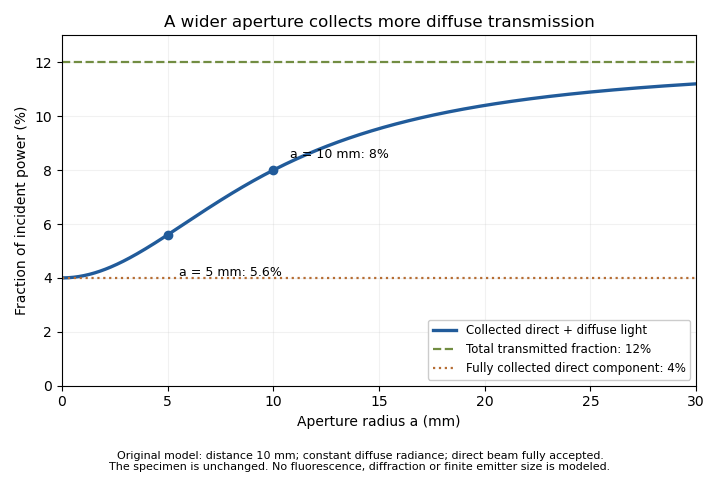
An unchanged hypothetical nail specimen gives different measured transmission as collection radius changes
. Original constant-radiance geometric model at distance 10 mm. The direct fraction is 4 percent and the diffuse fraction is 8 percent. These are stipulated values, not measured human-nail data. Details.An aperture-scan separation of direct and diffuse nail transmission needs distinct acceptances and a stable angular model. In the ideal two-aperture case,For the stated values, the two measurements recover 0.08 and 0.04. Nearly equal acceptances amplify measurement differences by a large factor. Changing distance or source size during the scan would change the model as well as the acceptance.
The primary nail experiment used an integrating sphere with a monochromator and photodiode to measure transmitted radiation.[ref]
The transmission of optical radiation through human nails by S. G. Parker and B. L. Diffey. Abstract, collection apparatus
The sphere provides a different angular collection arrangement from this opening model; it does not establish the assumed diffuse radiance law. A useful comparison characterizes each detector geometry before interpreting a signal difference as a change in the nail plate.A Collagen IV NC1 hexamer is a six-subunit junction formed when the C-terminus ends of two Collagen IV protomers associate. Each three-chain protomer contributes three Collagen IV NC1 domains. The resulting arrangement is therefore two three-subunit ends joined together, one local connection in a basement membrane scaffold.[ref]
A Sulfilimine Bond Identified in Collagen IV by Roberto Vanacore and others. Introduction and Figure 3; trimeric ends and six-subunit junction
Up to six sulfilimine bonds can reinforce the interface between the two ends. Analysis of linked peptides by mass spectrometry and nuclear magnetic resonance, followed by chemical reduction that separated the linked components, established the chemistry of this reinforcement.[ref]
A Sulfilimine Bond Identified in Collagen IV by Roberto Vanacore and others. Table 1 and Figures 1–3; crosslinked peptides, bond identification and reduction
A Collagen IV protomer is a three-chain molecular unit of Collagen IV that assembles with other units to form a basement membrane network. Much of its length has a collagen triple helix, while its C-terminus presents three Collagen IV NC1 domains. Association of two such ends forms a Collagen IV NC1 hexamer.[ref]
A Sulfilimine Bond Identified in Collagen IV by Roberto Vanacore and others. Introduction and Figure 3; triple-helical protomers and end-to-end network assembly
The organizational levels can be counted separately. Ten intact three-chain Collagen IV protomers contain thirty polypeptide chains, but this count does not describe how the ten units are connected. A six-subunit NC1 junction joins two protomers at one end; it does not convert either protomer into a six-chain molecule.
The term is therefore useful when moving between a protein's molecular composition and the architecture of the scaffold it builds. Identifying a three-chain unit answers a different question from identifying the contacts and covalent bonds between neighbouring units.
ColE1 RNA I is a regulatory RNA that inhibits initiation of DNA replication in the Colicin E1 plasmid system by binding the primer-precursor transcript ColE1 RNA II. The binding interferes with the persistent RNA–DNA hybrid required for Ribonuclease H processing into an RNA primer. Its regulatory action therefore uses RNA recognition rather than translation into a repressor protein.[ref]
Control of ColE1 plasmid replication: the process of binding of RNA I to the primer transcript by J. Tomizawa. Abstract: RNA I–RNA II binding and inhibition of hybridization and primer formation.
The names mark opposing roles: ColE1 RNA II can proceed toward primer formation, while ColE1 RNA I can prevent that productive route. This is not equivalent to cutting an already completed DNA molecule. It changes whether a new replication round can start.
The 1984 binding experiments identified the interacting RNA product, providing physical evidence for the regulatory encounter. A change in plasmid copy number alone would be less specific evidence, since many later replication steps also affect that endpoint.[ref]
Control of ColE1 plasmid replication: the process of binding of RNA I to the primer transcript by J. Tomizawa. Binding demonstrated through identification of the RNA product.
For a qualitative competition example, consider a newly produced ColE1 RNA II transcript that can either form the productive DNA hybrid or be intercepted by ColE1 RNA I. Increasing the frequency of inhibitory encounters can lower the fraction entering the primer route even if the rate of precursor production is unchanged. The outcome depends on competing reaction rates and structures; it is not specified by a simple count of the two transcript names.
ColE1 RNA II is the primer-precursor transcript used to initiate DNA replication of the Colicin E1 plasmid. Part of the nascent RNA forms a persistent hybrid with the template DNA near the replication start. Ribonuclease H processes the hybridized transcript to generate an RNA primer, from which DNA synthesis can proceed. Thus a transcript can help start replication without encoding a protein.[ref]
Control of ColE1 plasmid replication: the process of binding of RNA I to the primer transcript by J. Tomizawa. Abstract: primer-promoter transcript, persistent RNA–DNA hybrid and RNAase H processing.
The regulatory transcript ColE1 RNA I binds ColE1 RNA II and can prevent the hybrid needed for primer formation. The important distinction is between making an RNA molecule and making a usable primer: a transcript can be present but take a pairing or folding pathway that blocks productive initiation.[ref]
Control of ColE1 plasmid replication: the process of binding of RNA I to the primer transcript by J. Tomizawa. RNA I binding inhibits RNA II hybridization; identification of the RNA-binding product.
An idealized bookkeeping example separates the steps. If 100 precursor transcripts are made but only 30 reach the primer-producing state, the number of transcripts is 100 while the number of productive primer events is 30. This is not a measured efficiency or a complete kinetic model; it illustrates why total transcript abundance does not directly count successful DNA replication initiations. Changes in RNA production, RNA pairing or processing can have different mechanisms even if they all reduce final plasmid yield.
A cochain differential is a degree-one map in a cochain complex:The square-zero identity makes every coboundary a cocycle, so the quotient defining cohomology is meaningful. The maps are homomorphisms of the abelian groups, or module-linear maps, used in the complex.
For , , , and all other groups zero, the identity is automatic. The degree-zero cohomology is zero, while the degree-one cohomology is : every degree-one element is closed, but only the even ones are exact.
The exterior derivative on differential forms is another cochain differential, with . In contrast, a chain differential lowers degree. The word differential records this graded square-zero structure, not necessarily differentiation of scalar functions.
Pinned article: Introduction to the OurBigBook Project
Welcome to the OurBigBook Project! Our goal is to create the perfect publishing platform for STEM subjects, and get university-level students to write the best free STEM tutorials ever.
Everyone is welcome to create an account and play with the site: ourbigbook.com/go/register. We belive that students themselves can write amazing tutorials, but teachers are welcome too. You can write about anything you want, it doesn't have to be STEM or even educational. Silly test content is very welcome and you won't be penalized in any way. Just keep it legal!
Intro to OurBigBook
. Source. We have two killer features:
- topics: topics group articles by different users with the same title, e.g. here is the topic for the "Fundamental Theorem of Calculus" ourbigbook.com/go/topic/fundamental-theorem-of-calculusArticles of different users are sorted by upvote within each article page. This feature is a bit like:
- a Wikipedia where each user can have their own version of each article
- a Q&A website like Stack Overflow, where multiple people can give their views on a given topic, and the best ones are sorted by upvote. Except you don't need to wait for someone to ask first, and any topic goes, no matter how narrow or broad
This feature makes it possible for readers to find better explanations of any topic created by other writers. And it allows writers to create an explanation in a place that readers might actually find it.
Figure 1. Screenshot of the "Derivative" topic page. View it live at: ourbigbook.com/go/topic/derivativeVideo 2. OurBigBook Web topics demo. Source. - local editing: you can store all your personal knowledge base content locally in a plaintext markup format that can be edited locally and published either:This way you can be sure that even if OurBigBook.com were to go down one day (which we have no plans to do as it is quite cheap to host!), your content will still be perfectly readable as a static site.
- to OurBigBook.com to get awesome multi-user features like topics and likes
- as HTML files to a static website, which you can host yourself for free on many external providers like GitHub Pages, and remain in full control

Figure 2. You can publish local OurBigBook lightweight markup files to either OurBigBook.com or as a static website.
Figure 3. Visual Studio Code extension installation.
Figure 5. . You can also edit articles on the Web editor without installing anything locally. Video 3. Edit locally and publish demo. Source. This shows editing OurBigBook Markup and publishing it using the Visual Studio Code extension. 
- Infinitely deep tables of contents:



All our software is open source and hosted at: github.com/ourbigbook/ourbigbook
Further documentation can be found at: docs.ourbigbook.com
Feel free to reach our to us for any help or suggestions: docs.ourbigbook.com/#contact