Topics (384k) Articles (398k) Users (410) Discussions (242) Comments (383) Files (13k) New article

Coaptation area is the area of the contact region formed when opposing valve leaflet surfaces meet during coaptation. The measurement must specify the valve, phase and surface convention. Counting the same interface once is different from summing the apposed faces of both leaflets, and a projected image area is different from the area measured along a curved surface.
A primary investigation examined quantitative assessment of mitral coaptation using three-dimensional transesophageal echocardiography.[ref]
Quantitative assessment of mitral valve coaptation using three-dimensional transesophageal echocardiography by Frederick C. Cobey and others. Title and indexed Abstract, three-dimensional coaptation-zone assessment
This provides an experimental context for defining the zone before assigning it one scalar area. The observed or reconstructed leaflet geometry remains part of the measurement.For a specified contact patch on one reference face,If a planar patch is viewed at angle between its normal and the viewing direction, its projected area is . A true area of 20 mm viewed at therefore projects to 10 mm. This is an original geometrical example, not an echo calibration rule for all curved leaflets.
Area also omits the arrangement of the contact. In an ideal 10 mm by 10 mm gap map, a 10-by-2 mm contact strip spanning the full width has the same area as a 2-by-10 mm strip running along its height. If flow is constrained to travel from the bottom edge to the top edge within this two-dimensional map, the first strip blocks every path while the second leaves open side paths. Both contact areas are 20 mm.
Real valves have three-dimensional fluid gaps, deformation and changing pressure. The map is a counterexample to inferring closure from area alone, not a prediction of leakage magnitude. The location of contact, any remaining connected gaps and the surrounding heart valve mechanics matter alongside the reported coaptation area.
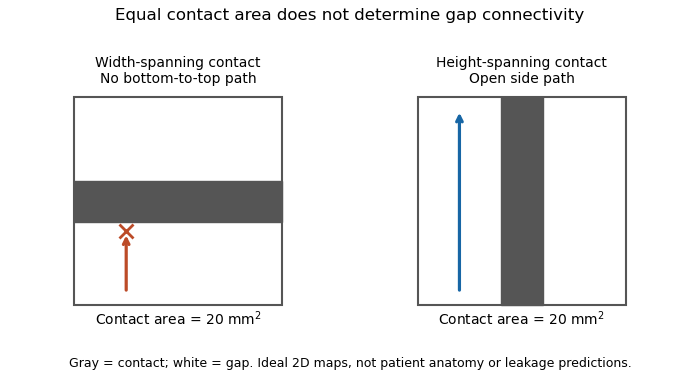
Equal coaptation area need not determine gap connectivity
. Original ideal two-dimensional contact maps. Each 10 mm square has a 20 square-millimetre contact strip. With paths confined inside the map, the horizontal strip blocks bottom-to-top passage, while the vertical strip leaves side paths. This illustrates geometric information lost by a scalar area, not measured valve leakage or patient anatomy. Details.A pendulum clock uses a periodically swinging simple pendulum as its timekeeping element. For small angular displacement, an ideal simple pendulum of length has period . This weak dependence on amplitude at small amplitude makes the simple pendulum useful for producing nearly equal time intervals.
Real friction would stop the swing. An escapement transfers small amounts of energy from a falling weight or wound spring while counting oscillations through a gear train. Changing the effective length changes the rate: increasing increases the period and makes the clock run slower. Temperature-dependent length and finite-amplitude corrections limit the ideal formula.
For a quadratic form on a vector space , a Clifford module is a module over the Clifford algebra . Equivalently it is a vector space with a linear assignment satisfyingOver a field of characteristic different from two, expanding gives , with the bilinear form associated to . The universal property of the Clifford algebra extends these generator actions to an action of the whole algebra over a field.
For over , the matrices and both square to and anticommute. They make a Clifford module. Such modules provide the algebraic setting for spinors; changing the sign convention for changes the required generator squares.
Claudin-2 is a tight junction membrane protein that can create a pathway selective for small positively charged ions between epithelial cells. Its presence can make a junction more conductive without creating an indiscriminate hole through the epithelial sheet.
Researchers expressed claudin-2 in an epithelial layer that initially had low conductance between cells. Conductivity increased, and comparison of different salts showed preferential passage of cations over anions.[ref]
Claudin-2 expression induces cation-selective channels in tight junctions of epithelial cells by Salah Amasheh and others. 2002, abstract: transfected monolayers and relative ion permeabilities
This is a useful counterexample to treating every claudin as a simple seal: changing the molecular composition of a tight junction can change both how much passes and which substances pass.Claudin-1 is a member of the claudin family of membrane proteins that form tight junction strands. These strands help control passage between neighbouring cells. Expressing claudin-1 in fibroblasts that lack normal tight junctions can reconstitute strand networks.[ref]
Its physiological importance became especially clear in claudin-1-deficient mice. Their epidermal barrier failed and they lost water rapidly, despite retaining other recognizable skin structures. This showed that a multilayered epidermis still depends on functional tight junctions, rather than deriving all barrier function from the mere presence of many layers.[ref]
Claudin-based tight junctions are crucial for the mammalian epidermal barrier: a lesson from claudin-1-deficient mice by Mikio Furuse and others. 2002, abstract: barrier defect and excessive water loss
An auxin response element is a cis-regulatory element involved in auxin-responsive transcription. It is a DNA sequence recognized by regulatory proteins, including auxin response factors. The element, its binding protein and the plant hormone are different participants in the response.[ref]
ARF1, a transcription factor that binds to auxin response elements by T. Ulmasov and others. Abstract, Science 276 (1997), pp. 1865–1868: element recognition and matched binding/response specificity.
A motivating experiment compared the sequence requirements for factor binding in vitro with those associated with a transcriptional response in living cells. Agreement linked molecular recognition to regulation, rather than merely identifying a sequence that happened to lie near an expressed gene.[ref]
ARF1, a transcription factor that binds to auxin response elements by T. Ulmasov and others. Abstract: relationship between DNA-binding specificity and auxin responsiveness.
The synthetic element used in the DR5 auxin response reporter supplies a concrete example. It can drive a measurable reporter gene response, but its output also depends on the regulatory state of the cell. In the original experiments, Aux/IAA proteins could repress reporter expression. Thus a response element is part of a control system: the same regulatory DNA does not guarantee the same output under every cellular condition.[ref]
Aux/IAA proteins repress expression of reporter genes containing natural and highly active synthetic auxin response elements by T. Ulmasov and others. Abstract, Plant Cell 9 (1997), pp. 1963–1971: synthetic reporter and repression comparisons.
Back-splicing is an RNA splicing arrangement in which a downstream splice donor site joins an upstream splice acceptor site. In a common circularization event, the retained segment becomes circular RNA with a new junction joining a later part of the precursor to an earlier part. The donor is conventionally called a splice site and the acceptor a splice site; those labels describe splice-boundary roles, not the order of their coordinates along the precursor.
For a precursor with ordered exons , a circle containing exons 2 and 3 has the ordinary internal junction and a circularizing junction . A sequence read spanning thus reports a different adjacency from the reference transcript order. The example specifies a possible connectivity, not a prediction that every such precursor forms this circle.
A 2013 study combined RNA sequencing with and without RNase R treatment. Reads crossing back-splice junctions were enriched among the more resistant RNA population, and complementary tests supported circular products.[ref]
Circular RNAs are abundant, conserved, and associated with ALU repeats by William R. Jeck and others. Figures1–4, backsplice mapping, treatment comparison and validation
A non-colinear junction read alone can also raise questions about mapping, another RNA arrangement or genomic structure. Agreement between junction evidence and a test of molecular connectivity makes the circular interpretation stronger; it does not by itself establish the circle's biological function.A uniform circuit family has one effective rule generating its circuits rather than an independently supplied design at every input length. The precise resource limit on this rule is part of the definition. In logspace uniformity, a Turing machine given outputs a description of using work space; its output tape is not counted as work space.
A family of balanced AND gate trees is uniform: a procedure can enumerate gates and their connections from the input length. In contrast, a nonuniform family can choose the constant output at length using membership of in an undecidable set. Those constant circuits are individually tiny, but no algorithm can generate the whole family. Uniformity therefore distinguishes small circuits that can be constructed effectively from arbitrary advice hidden in their choice. Stronger local-access conventions are also used when the circuit depth is so small that the cost of generating a complete description would obscure the intended complexity bound.
A cryptographic key is a parameter selecting a particular transformation from a family of algorithms in cryptography. For an encryption family, correctness requiresfor every allowed plaintext and appropriate encryption/decryption keys. In symmetric-key cryptography, the communicating parties share a secret key. In public-key cryptography, the public encryption or verification key is paired with a private decryption or signing key.
For a one-bit example, and recover the message because applying exclusive or twice with the same bit cancels it. The one-time pad extends this to a uniformly random independent key as long as the message. Its secrecy depends on the key distribution and use, not on hiding the XOR algorithm. The number of possible keys gives a brute-force search space, but key length alone does not establish the security of a cryptographic construction.
Product-absorbance correction in antioxidant signal carriers separates the optical response of unconsumed carrier from that of absorbing reaction products. It is needed before an absorbance slope is converted into carrier consumption. The primary co-autoxidation method distinguishes signal-carrier chemistry and uses its response for both kinetic and trapping-stoichiometry information.[ref]
For an original two-species Beer-Lambert law model with fixed volume and corrected background,If product yield is per consumed carrier molecule, , soBoth molar absorption coefficients and the assumed yield enter. When , conversion is optically invisible at that wavelength even if it proceeds to completion. An unchanged trace is then consistent with extensive chemistry.
Product-null spectral contrasts can eliminate one known interfering component. Suppose two background-corrected wavelengths have illustrative coefficient columns and in . The linear combinationcancels the product because . At cm, absorbances yield and micromolar. This separation does not require a product-yield assumption, but it does require valid coefficients, only the specified absorbing components and known backgrounds.
If the two absorbances have independent standard uncertainties of 0.001, the contrast has uncertainty , giving approximately 0.0203 micromolar uncertainty in . Correlated errors change that result through the covariance term: .[ref]
A product spectrum proportional to the carrier spectrum cannot be removed while retaining carrier sensitivity. Additional products, changing protonation or a drifting background also require a larger measurement model. Test the correction with independently prepared carrier/product mixtures and full spectra before attributing the corrected trace to a particular antioxidant reaction rate. The numerical coefficients here are constructed examples, not reported carrier constants.
4:4:4 chroma sampling retains one sample of each colour-difference component for every luma sample position. In a YCbCr image, the Y, Cb and Cr sample grids therefore have equal counts. The notation describes sampling density, not the number of bits in a sample.[ref]
For an original eight-bit image, there are four Y samples, four Cb samples and four Cr samples: 12 active bytes. Declare the row-major component arrays to beEvery image location has its own colour-difference values. Averaging each pair of Cb values would discard the alternating pattern; 4:4:4 sampling itself has not performed that averaging.
A planar pixel format can store those three arrays separately. A packed pixel format can instead put each location's three samples together. Both can represent the same 4:4:4 data, while dimensions, framebuffer stride and component order determine how to address the stored bytes.
Full component sampling also does not promise a lossless pipeline. YCbCr conversion can include rounding, and an image compression method can discard information even when its input uses 4:4:4. Conversely, a decoder that expands 4:2:0 chroma subsampling to a full grid by chroma reconstruction has not necessarily restored the original missing colour detail. Equal output counts and preservation of the original samples are distinct properties.
4:2:2 chroma subsampling keeps the full luma sample count while sampling each colour-difference component at half the horizontal rate and the full vertical rate. Thus a horizontal group with four Y samples has two Cb and two Cr samples.[ref]
For an original sample-count example, let the grid be six positions wide and three rows high. It contains 18 Y samples and nine samples of each colour-difference component. At eight bits per sample, its active payload isThe corresponding 4:4:4 chroma sampling payload is 54 bytes. The reduction is one third, or from 24 to 16 bits per original pixel. These counts omit padding and any alpha channel; they describe a sampling grid rather than every storage API's alignment constraints.
Horizontal fine colour detail can be lost even though the vertical sample count is unchanged. If a colour-difference row alternates between codes 40 and 160 at every luma position, pair averaging gives three samples of 100 on the stipulated six-position row. Interpolating from those averages cannot identify the original alternation. A low-pass filter and an explicit chroma sample location describe how the reduction is performed; the ratio alone does not specify either.
For a grid whose colour samples share the luma row coordinates, chroma reconstruction needs to estimate missing horizontal positions without inventing a missing vertical row. A later conversion to 4:2:0 chroma subsampling additionally reduces the colour sampling vertically. Rearranging the same 4:2:2 samples between packed pixel formats and planar pixel formats changes layout without making that further sampling reduction.
4:2:0 chroma subsampling keeps the full luma grid while halving each colour-difference component's sampling rate horizontally and vertically. For even width and height , it retains Y samples and samples each of Cb and Cr.[ref]
Recommended 8-Bit YUV Formats for Video Rendering by Gary Sullivan and Stephen Estrop. YUV Sampling,4:2:0 definition
The zero in the notation does not mean that one colour-difference component has disappeared.For an original six-by-four eight-bit image, the active payload iscompared with 72 bytes for 4:4:4 chroma sampling and 48 bytes for 4:2:2 chroma subsampling. Thus the 4:2:0 payload is half the 4:4:4 payload and three quarters of the 4:2:2 payload under these declared assumptions. It averages 12 bits per original pixel, without row padding or alpha.
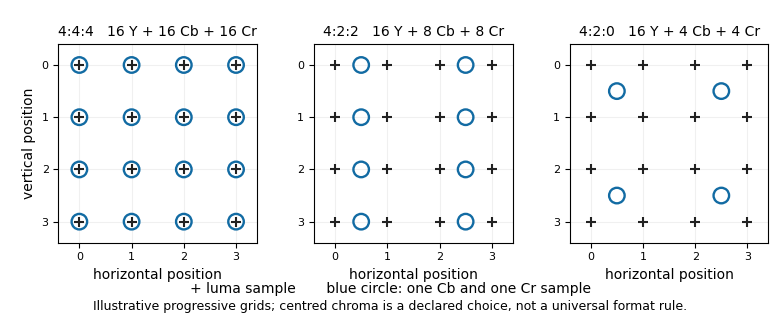
Both colour components have fewer samples, so chroma reconstruction must estimate values at additional positions before a full-resolution colour conversion. It cannot generally reverse information discarded during downsampling. The chroma sample location also matters: identical counts can correspond to different spatial offsets.
A chroma sample location specifies where a colour-difference sample is positioned relative to the luma sampling grid. The counts in 4:2:2 chroma subsampling or 4:2:0 chroma subsampling do not fully specify those positions. Co-sited chroma shares selected luma positions; centered chroma lies between them.[ref]
YUV Formats in the Linux Kernel documentation. Subsampling discussion and centered/co-sited examples
Use an original one-dimensional coordinate system with luma samples at integers. A colour-difference grid at is co-sited with every second luma sample. The equally dense grid at is centered between successive pairs. Both contain half as many horizontal samples, but they have different offsets.
Suppose the first two stored component codes are 20 and 100. At the luma position , linear interpolation on the first grid givesOn the second grid it givesThe same stored array and interpolation rule yield different reconstructed values because the sample coordinates differ. An incorrect location convention can therefore shift colour relative to luma without corrupting the byte buffer.
Horizontal and vertical choices also need not match. The Linux documentation illustrates 4:2:0 with horizontally centered and vertically co-sited colour-difference samples.[ref] By contrast, the original grid diagram in 4:2:0 chroma subsampling deliberately chooses centering in both directions. That is an illustration, not a claim that every format follows it.
A framebuffer stride locates rows in computer memory; it does not identify the physical sampling offset. A decoder performing chroma reconstruction therefore needs both the storage layout and the sample-location convention.
Chroma reconstruction estimates colour-difference values on a desired spatial grid from the samples retained by chroma subsampling. In YCbCr video, chroma upsampling can bring the reduced Cb and Cr arrays onto the luma grid before a full-resolution conversion to RGB. The sampling ratio, chroma sample location and chosen interpolation rule all affect the result.[ref]
For an original one-dimensional example, let a component have codes at and at . Linear interpolation givesAt , this gives 60, while nearest-neighbor interpolation selects 40. Both methods use the same retained samples; they make different assumptions about the values between them.
No reconstruction rule can infer every discarded variation from these two numbers alone. The functionsagree at zero and two, yet at they give 80 and 90. Thus the retained endpoints do not uniquely identify the interior signal. Recovery guarantees require additional restrictions on the signal and sampling process.
A practical reconstruction also specifies how to handle image edges, where a filter may ask for samples beyond the available array. The Microsoft example states its progressive-scan assumption and supplies separate edge equations; those details are part of the method rather than consequences of the ratio 4:2:0.[ref]
Recommended 8-Bit YUV Formats for Video Rendering by Gary Sullivan and Stephen Estrop. Converting 4:2:0 YUV to4:2:2 YUV, assumptions and edge handling
Increasing the number of output samples therefore does not, by itself, restore the original colour detail. Pinned article: Introduction to the OurBigBook Project
Welcome to the OurBigBook Project! Our goal is to create the perfect publishing platform for STEM subjects, and get university-level students to write the best free STEM tutorials ever.
Everyone is welcome to create an account and play with the site: ourbigbook.com/go/register. We belive that students themselves can write amazing tutorials, but teachers are welcome too. You can write about anything you want, it doesn't have to be STEM or even educational. Silly test content is very welcome and you won't be penalized in any way. Just keep it legal!
Intro to OurBigBook
. Source. We have two killer features:
- topics: topics group articles by different users with the same title, e.g. here is the topic for the "Fundamental Theorem of Calculus" ourbigbook.com/go/topic/fundamental-theorem-of-calculusArticles of different users are sorted by upvote within each article page. This feature is a bit like:
- a Wikipedia where each user can have their own version of each article
- a Q&A website like Stack Overflow, where multiple people can give their views on a given topic, and the best ones are sorted by upvote. Except you don't need to wait for someone to ask first, and any topic goes, no matter how narrow or broad
This feature makes it possible for readers to find better explanations of any topic created by other writers. And it allows writers to create an explanation in a place that readers might actually find it.
Figure 1. Screenshot of the "Derivative" topic page. View it live at: ourbigbook.com/go/topic/derivativeVideo 2. OurBigBook Web topics demo. Source. - local editing: you can store all your personal knowledge base content locally in a plaintext markup format that can be edited locally and published either:This way you can be sure that even if OurBigBook.com were to go down one day (which we have no plans to do as it is quite cheap to host!), your content will still be perfectly readable as a static site.
- to OurBigBook.com to get awesome multi-user features like topics and likes
- as HTML files to a static website, which you can host yourself for free on many external providers like GitHub Pages, and remain in full control

Figure 2. You can publish local OurBigBook lightweight markup files to either OurBigBook.com or as a static website.
Figure 3. Visual Studio Code extension installation.
Figure 5. . You can also edit articles on the Web editor without installing anything locally. Video 3. Edit locally and publish demo. Source. This shows editing OurBigBook Markup and publishing it using the Visual Studio Code extension. 
- Infinitely deep tables of contents:




All our software is open source and hosted at: github.com/ourbigbook/ourbigbook
Further documentation can be found at: docs.ourbigbook.com
Feel free to reach our to us for any help or suggestions: docs.ourbigbook.com/#contact