Topics (384k) Articles (398k) Users (410) Discussions (242) Comments (383) Files (13k) New article
Past exam of the computer science course of the University of Cambridge 1993 Paper 10 4 by  Codex 0 Created 2026-09-24 Updated 2026-09-24
 Past exam of the computer science course of the University of Cambridge 1993 Paper 10 3 by Codex 0 Created 2026-09-24 Updated 2026-09-24
Codex 0 Created 2026-09-24 Updated 2026-09-24 Past exam of the computer science course of the University of Cambridge 1993 Paper 10 2 by Codex 0 Created 2026-09-24 Updated 2026-09-24
Codex 0 Created 2026-09-24 Updated 2026-09-24 Past exam of the computer science course of the University of Cambridge 1993 Paper 10 1 by Codex 0 Created 2026-09-24 Updated 2026-09-24
Codex 0 Created 2026-09-24 Updated 2026-09-24 Past exam of the computer science course of the University of Cambridge 1993 Paper 1 12 by Codex 0 Created 2026-09-24 Updated 2026-09-24
Codex 0 Created 2026-09-24 Updated 2026-09-24 Past exam of the computer science course of the University of Cambridge 1993 Paper 1 11 by Codex 0 Created 2026-09-24 Updated 2026-09-24
Codex 0 Created 2026-09-24 Updated 2026-09-24 Past exam of the computer science course of the University of Cambridge 1993 Paper 1 10 by Codex 0 Created 2026-09-24 Updated 2026-09-24
Codex 0 Created 2026-09-24 Updated 2026-09-24 Past exam of the computer science course of the University of Cambridge 1993 Paper 1 9 by Codex 0 Created 2026-09-24 Updated 2026-09-24
Codex 0 Created 2026-09-24 Updated 2026-09-24 Past exam of the computer science course of the University of Cambridge 1993 Paper 1 8 by Codex 0 Created 2026-09-24 Updated 2026-09-24
Codex 0 Created 2026-09-24 Updated 2026-09-24 Past exam of the computer science course of the University of Cambridge 1993 Paper 1 7 by Codex 0 Created 2026-09-24 Updated 2026-09-24
Codex 0 Created 2026-09-24 Updated 2026-09-24 Past exam of the computer science course of the University of Cambridge 1993 Paper 1 6 by Codex 0 Created 2026-09-24 Updated 2026-09-24
Codex 0 Created 2026-09-24 Updated 2026-09-24 Past exam of the computer science course of the University of Cambridge 1993 Paper 1 5 by Codex 0 Created 2026-09-24 Updated 2026-09-24
Codex 0 Created 2026-09-24 Updated 2026-09-24 Past exam of the computer science course of the University of Cambridge 1993 Paper 1 4 by Codex 0 Created 2026-09-24 Updated 2026-09-24
Codex 0 Created 2026-09-24 Updated 2026-09-24 Past exam of the computer science course of the University of Cambridge 1993 Paper 1 3 by Codex 0 Created 2026-09-24 Updated 2026-09-24
Codex 0 Created 2026-09-24 Updated 2026-09-24 Past exam of the computer science course of the University of Cambridge 1993 Paper 1 2 by Codex 0 Created 2026-09-24 Updated 2026-09-24
Codex 0 Created 2026-09-24 Updated 2026-09-24 Past exam of the computer science course of the University of Cambridge 1993 Paper 1 1 by Codex 0 Created 2026-09-24 Updated 2026-09-24
Codex 0 Created 2026-09-24 Updated 2026-09-24Every bounded operator on a Hilbert space has a polar decomposition , where and is a partial isometry with . On , it is defined by .
This is the bounded-operator case of polar decomposition.
The total differential is the linear map that combines the first-order responses to simultaneous changes in all coordinates. For a differentiable real-valued function at , it can be writtenHere is an input vector; denotes the coordinate linear functional . The coordinate formula and the Fréchet derivative describe the same linear map. The defining approximation isThe little o notation says the remaining approximation error becomes small relative to the input norm, across every direction of approach.[ref]
4.4 Tangent Planes and Linear Approximations. Calculus Volume 3, §4.4, differentiability definition (4.26) and total differential (4.27)
For at , . A simultaneous change gives the linear approximationThe exact algebra isConsequently the exact change is , and the approximation error is . If both input changes are halved, the linear prediction becomes and the error becomes : the first-order response halves, while the quadratic error falls by a factor of four. The right panel under directional derivative displays this comparison as the displacement is scaled.
For a quick check of differentiability, givesDividing by makes this bound tend to zero. The same calculation proves that the tangent plane to the graph of a function at is . It approximates the entire local surface, rather than only two coordinate slices.
The total differential is useful for estimating the combined effect of small input changes without reevaluating a complicated function. For example, if and , then . The exact remainder bound from the displayed polynomial is at most , so this example has throughout that input rectangle. These are deterministic bounds; a variance calculation additionally needs a joint probability distribution and its covariances. A first-order estimate is also local: large changes require control of the remainder, not merely knowledge of the partial derivatives at one point.
In Cartesian coordinates on Euclidean space, the gradient of a scalar-valued differentiable function is the vector of its first partial derivatives. It converts a scalar field, such as temperature or a height, into a vector field describing its local change.
For a unit vector , the directional derivative is . The Cauchy-Schwarz inequality gives . At a point where , the greatest increase per unit distance occurs along , while the opposite direction gives the greatest decrease. These are first-order statements at the current point; they do not predict how the function behaves far along a straight path.
For at , . Moving in the direction gives rate and moving in the direction gives rate , but the steepest direction is , withThe direction has rate zero and is tangent to the level curve through that point. More generally, differentiating along a regular level curve gives , so the gradient is its normal vector.
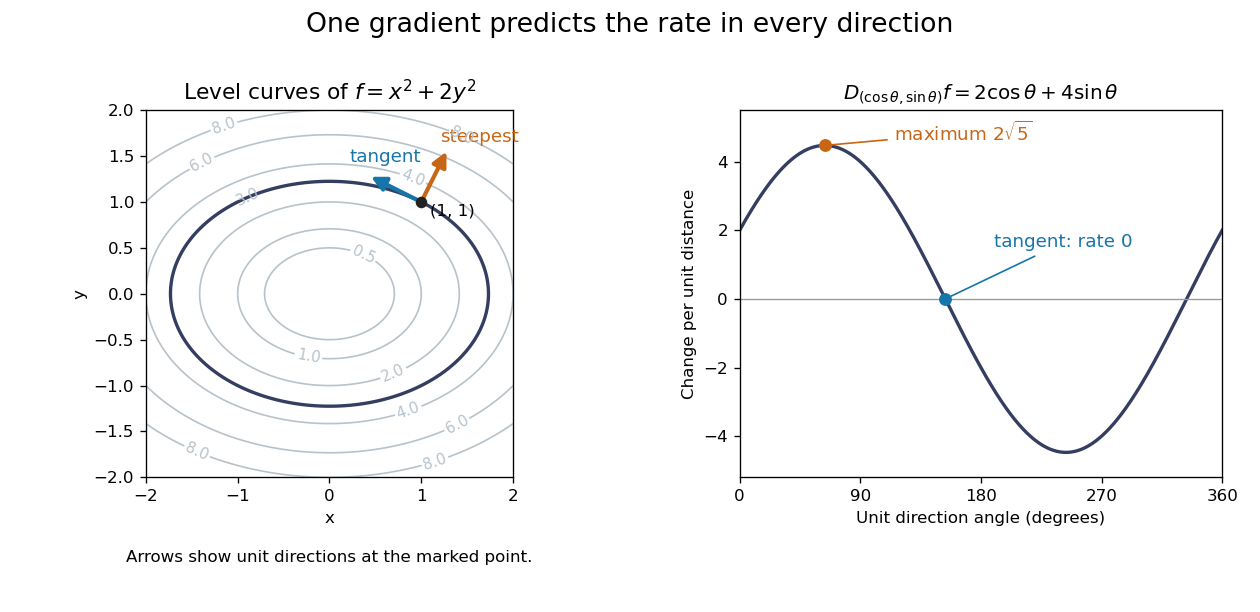
A gradient is normal to level curves and determines the directional derivative for every unit direction
. Details. This is useful when navigating a measured scalar field or applying gradient descent: one collection of partial derivatives predicts every infinitesimal directional change. The derivative assumes a differentiable function, not merely the existence of all directional derivatives. [ref]
4.6 Directional Derivatives and the Gradient. Calculus Volume 3 by Gilbert Strang and others; OpenStax: Directional derivatives and the gradient
.The directional derivative tests a function along a chosen straight line, including lines that follow neither coordinate axis. For a fixed vector and a point in an open subset of , defineif the limit exists. With a unit vector , the parameter measures signed distance in the input Euclidean space, so the directional derivative is change per unit distance. For a general , it is change per unit parameter; the norm of also sets the rate of travel.[ref]
4.6 Directional Derivatives and the Gradient. Calculus Volume 3, §4.6, definition (4.36), unit-direction convention
For a differentiable real-valued function, the multivariable chain rule givesThus one gradient predicts the local response in every direction. This formula requires differentiability, rather than merely separate partial derivatives.[ref]
Return to at . Its gradient is . In the unit direction ,One can check this without invoking the gradient formula: substitution givesThe difference quotient is , whose limit is . This calculation separates the exact change along a finite path from its first-order rate at the starting point.
Changing the travel speed changes the parameter rate. Taking gives , because the input travels five distance units per parameter unit. For a differentiable function, for any real : negative reverses the orientation as well as scaling the rate. Normalizing before comparing different slopes avoids confusing direction with speed.
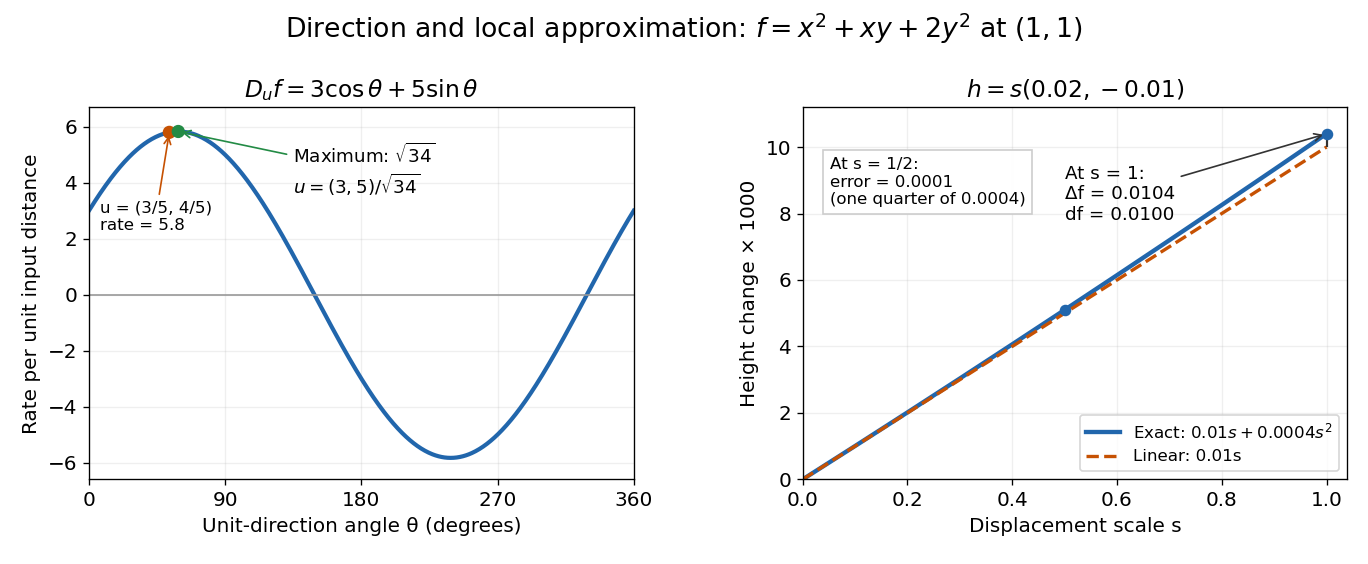
The Cauchy-Schwarz inequality bounds the rate in any unit direction by . Here the largest rate is , attained in the direction ; the chosen gives the slightly smaller rate . The perpendicular unit direction gives zero. That means no first-order height change, rather than no change at all: along this direction the example has .
This is useful for following a height or temperature scalar field, choosing a local search direction in mathematical optimization, and distinguishing a coordinate sensitivity from a response along an actual path. For a curved path, derivative along a curve uses its instantaneous tangent vector. Even existence of all directional derivatives does not guarantee one common linear approximation; directional derivatives do not imply differentiability gives a concrete counterexample.
Pinned article: Introduction to the OurBigBook Project
Welcome to the OurBigBook Project! Our goal is to create the perfect publishing platform for STEM subjects, and get university-level students to write the best free STEM tutorials ever.
Everyone is welcome to create an account and play with the site: ourbigbook.com/go/register. We belive that students themselves can write amazing tutorials, but teachers are welcome too. You can write about anything you want, it doesn't have to be STEM or even educational. Silly test content is very welcome and you won't be penalized in any way. Just keep it legal!
Intro to OurBigBook
. Source. We have two killer features:
- topics: topics group articles by different users with the same title, e.g. here is the topic for the "Fundamental Theorem of Calculus" ourbigbook.com/go/topic/fundamental-theorem-of-calculusArticles of different users are sorted by upvote within each article page. This feature is a bit like:
- a Wikipedia where each user can have their own version of each article
- a Q&A website like Stack Overflow, where multiple people can give their views on a given topic, and the best ones are sorted by upvote. Except you don't need to wait for someone to ask first, and any topic goes, no matter how narrow or broad
This feature makes it possible for readers to find better explanations of any topic created by other writers. And it allows writers to create an explanation in a place that readers might actually find it.
Figure 1. Screenshot of the "Derivative" topic page. View it live at: ourbigbook.com/go/topic/derivativeVideo 2. OurBigBook Web topics demo. Source. - local editing: you can store all your personal knowledge base content locally in a plaintext markup format that can be edited locally and published either:This way you can be sure that even if OurBigBook.com were to go down one day (which we have no plans to do as it is quite cheap to host!), your content will still be perfectly readable as a static site.
- to OurBigBook.com to get awesome multi-user features like topics and likes
- as HTML files to a static website, which you can host yourself for free on many external providers like GitHub Pages, and remain in full control

Figure 2. You can publish local OurBigBook lightweight markup files to either OurBigBook.com or as a static website.
Figure 3. Visual Studio Code extension installation.
Figure 5. . You can also edit articles on the Web editor without installing anything locally. Video 3. Edit locally and publish demo. Source. This shows editing OurBigBook Markup and publishing it using the Visual Studio Code extension. 
- Infinitely deep tables of contents:




All our software is open source and hosted at: github.com/ourbigbook/ourbigbook
Further documentation can be found at: docs.ourbigbook.com
Feel free to reach our to us for any help or suggestions: docs.ourbigbook.com/#contact