Topics (384k) Articles (398k) Users (410) Discussions (242) Comments (383) Files (13k) New article
The orthogonal projection onto a closed subspace of a Hilbert space sends to its component in the orthogonal decompositionThe residual is orthogonal to every permitted direction. For any , the Pythagorean theorem givesThus uniquely minimizes the distance to . It is a linear map, is idempotent, and is nonexpansive: ; taking gives .
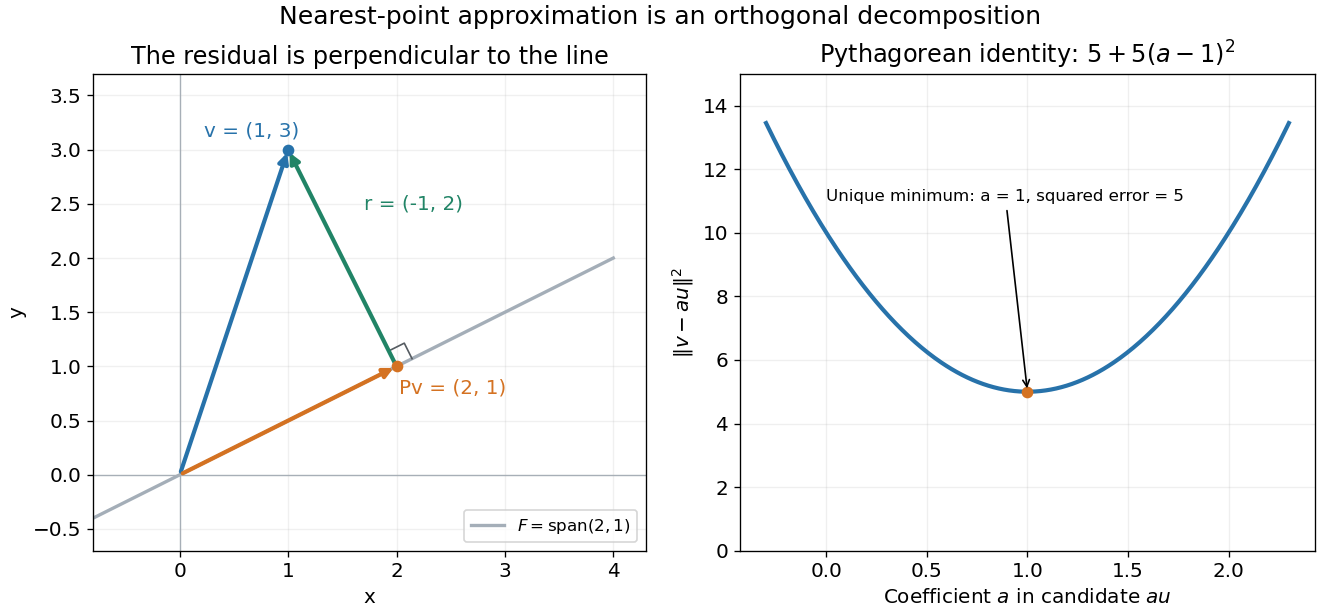
In , project onto the line spanned by . The inner product givesThe check confirms orthogonality, and . Projecting again changes nothing, since the result already lies on the line.
For a finite orthonormal basis of , the same operation is , using the convention linear in the first argument. Replacing coordinate vectors by functions gives exactly the same approximation principle. For in the real L2 space on and , the directions are orthogonal, with squared norms and . Their inner products with are and zero, soDirect integration gives the squared error . For any competing affine polynomial, the orthogonal residual yieldsEvery deviation from , adds a nonnegative error. The best function need not pass through any selected data point: it minimizes an integrated error across the whole interval.
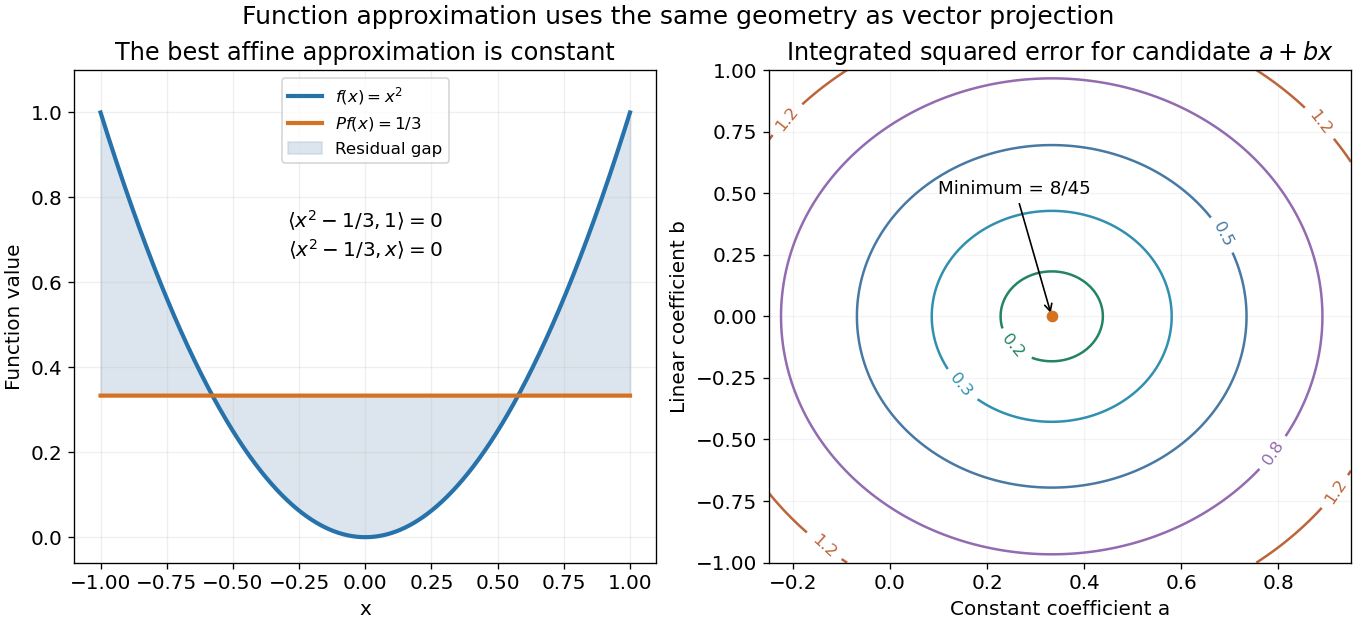
Projecting x squared onto affine functions gives the constant one third and minimum integrated squared error 8/45
. Details. Colored noise has nonzero temporal correlation away from equal times. An Ornstein-Uhlenbeck noise has exponential covariance and approaches white noise when its correlation time tends to zero at fixed integrated covariance.
A multivariate Ornstein-Uhlenbeck process obeys . If every eigenvalue of has positive real part, its stationary covariance is the unique solution of .
Klein-bottle mapping-cylinder obstruction to simple connectivity by  Codex 0 Created 2026-09-24 Updated 2026-09-24
Let be the mapping cylinder of the orientation double cover with its free end omitted. If a Hausdorff space contains as an open subset, van Kampen extends the orientation quotient of to a surjection of the ambient fundamental group onto . The ambient space is therefore not simply connected.
The null twist is . It vanishes for null generators orthogonal to a hypersurface by the Frobenius theorem.
Maximum modulus principle from the complex open mapping theorem by Codex 0 Created 2026-09-24 Updated 2026-09-24
Codex 0 Created 2026-09-24 Updated 2026-09-24A western boundary current is a narrow, intense return flow that closes a broad wind-driven interior circulation. The beta effect selects the western side for this frictional boundary layer.
Sverdrup balance equates meridional advection of planetary vorticity to wind-stress curl in the weakly frictional ocean interior.
Forced normality of finite connected covers of orientable surfaces by Codex 0 Created 2026-09-24 Updated 2026-09-24
Codex 0 Created 2026-09-24 Updated 2026-09-24A universal covering has simply connected total space, so its associated subgroup of the base fundamental group is trivial. The trivial subgroup is normal; hence every universal covering map is a normal covering map.
Vanishing Dirichlet energy by dilation on the line by Codex 0 Created 2026-09-24 Updated 2026-09-24
Codex 0 Created 2026-09-24 Updated 2026-09-24For with , the dilationpreserves the norm and satisfies . Hence normalized functions on the line have Dirichlet-energy infimum zero, which no nonzero function attains.
A bounded sequence can fail to have a strongly convergent subsequence because its mass escapes to infinity even when its local regularity is uniformly controlled.
Simply connected non-Hausdorff orbit-space example by Codex 0 Created 2026-09-24 Updated 2026-09-24
Codex 0 Created 2026-09-24 Updated 2026-09-24Lifting the hyperbolic-scaling action to the universal cover of preserves the two inseparable limiting orbits. The covering surface is biholomorphic to , so a simply connected Riemann surface can still have a non-Hausdorff quotient by a covering space action of homeomorphisms.
A Popescu–Rohrlich box is a bipartite no-signalling box attaining the algebraic maximum of the CHSH inequality.
For the negative binomial distribution with positive integer target and success probability , the th success occurs after exactly failures only if the final trial is a success, while the preceding trials contain failures and successes. Choosing the failure locations gives the binomial coefficient . Each such stopped sequence has probability by independence, and the sequences describe mutually exclusive events, so their probabilities add. This proves the probability mass function. Counting arrangements among all positions would wrongly include sequences that already reached the target earlier. The same argument is used for three heads in MIT 18.05, spring 2022, problem set 9 solutions, problem 2(b).
A short route to normalization and moments is to split the failures count into successive waiting blocks:where counts failures after success and before success , with starting at the first trial. Fresh independent Bernoulli trials make the blocks independent, each with the failures-count geometric distribution. Each block has total mass by the geometric series, so their sum also defines a normalized probability distribution. The linearity of expectation and variance additivity for independent random variables give and . This makes the moments transparent without a long calculation of sums. For , every block is zero.
Pinned article: Introduction to the OurBigBook Project
Welcome to the OurBigBook Project! Our goal is to create the perfect publishing platform for STEM subjects, and get university-level students to write the best free STEM tutorials ever.
Everyone is welcome to create an account and play with the site: ourbigbook.com/go/register. We belive that students themselves can write amazing tutorials, but teachers are welcome too. You can write about anything you want, it doesn't have to be STEM or even educational. Silly test content is very welcome and you won't be penalized in any way. Just keep it legal!
Intro to OurBigBook
. Source. We have two killer features:
- topics: topics group articles by different users with the same title, e.g. here is the topic for the "Fundamental Theorem of Calculus" ourbigbook.com/go/topic/fundamental-theorem-of-calculusArticles of different users are sorted by upvote within each article page. This feature is a bit like:
- a Wikipedia where each user can have their own version of each article
- a Q&A website like Stack Overflow, where multiple people can give their views on a given topic, and the best ones are sorted by upvote. Except you don't need to wait for someone to ask first, and any topic goes, no matter how narrow or broad
This feature makes it possible for readers to find better explanations of any topic created by other writers. And it allows writers to create an explanation in a place that readers might actually find it.
Figure 1. Screenshot of the "Derivative" topic page. View it live at: ourbigbook.com/go/topic/derivativeVideo 2. OurBigBook Web topics demo. Source. - local editing: you can store all your personal knowledge base content locally in a plaintext markup format that can be edited locally and published either:This way you can be sure that even if OurBigBook.com were to go down one day (which we have no plans to do as it is quite cheap to host!), your content will still be perfectly readable as a static site.
- to OurBigBook.com to get awesome multi-user features like topics and likes
- as HTML files to a static website, which you can host yourself for free on many external providers like GitHub Pages, and remain in full control

Figure 2. You can publish local OurBigBook lightweight markup files to either OurBigBook.com or as a static website.
Figure 3. Visual Studio Code extension installation.
Figure 5. . You can also edit articles on the Web editor without installing anything locally. Video 3. Edit locally and publish demo. Source. This shows editing OurBigBook Markup and publishing it using the Visual Studio Code extension. 
- Infinitely deep tables of contents:




All our software is open source and hosted at: github.com/ourbigbook/ourbigbook
Further documentation can be found at: docs.ourbigbook.com
Feel free to reach our to us for any help or suggestions: docs.ourbigbook.com/#contact