Topics (384k) Articles (398k) Users (410) Discussions (242) Comments (383) Files (13k) New article
Critical damping is the repeated-root case of the viscous damping model: its two characteristic roots coincide at . The solution with arbitrary initial conditions isThe extra factor is essential: one exponential function alone cannot fit arbitrary initial displacement and velocity when the characteristic equation has a double polynomial root. Substitution, or taking the limit of the underdamped formula as its angular frequency tends to zero, gives the displayed expression.
The precise fastest-return statement is this: hold , , and fixed, and compare all . Every response decreases positively toward equilibrium; the critically damped responseis smaller than every overdamped response at each . It therefore reaches and stays within any specified band , , sooner than those responses. Exact arrival at rest takes infinite time. This is a comparison among nonoscillatory regimes for these particular initial conditions, not a universal minimum of every possible settling-time criterion.
One short comparison argument uses . Its initial conditions are zero and . For release from rest, at ; the causal Green function of a damped oscillator is positive at positive time for . Its convolution with gives : increasing damping beyond the critical value increases the remaining displacement.
There is no repeated oscillation at critical damping, but there can be overshoot once. For , the factor in square brackets crosses zero precisely when , atFor example, gives , crossing equilibrium at as shown above. An overdamped response can also cross once for suitable initial conditions. Conversely, specially chosen initial conditions can remove its slow exponential decay entirely. Thus the generic slow-root argument must not be applied to a response whose slow-root coefficient is zero.
For a homogeneous system , its state transition matrix maps the state at time to the state at time :For continuous coefficients on an interval, uniqueness gives and . If is any fundamental matrix, then , independent of that choice. A forced system has the variation of constants formulaFor constant , . Generally it is not , since matrices at different times need not commute. For piecewise constant on and on , chronological propagation gives . With and , this product is , while has both diagonal entries . This exhibits the importance of time order.[ref]
Ordinary Differential Equations and Dynamical Systems by Gerald Teschl. §3.4, general linear first-order systems
For with constant matrix , an eigenvector with eigenvalue gives . If has an eigenbasis, every solution is the linear combination , with constants fixed by the initial condition. For a real matrix, complex conjugate eigenpairs combine into real oscillatory solutions.
For , the eigenvectors and have eigenvalues . Data giveSubstitution verifies both equations and the data. A defective matrix needs generalized eigenvectors and polynomial-exponential Jordan chains, as in the defective repeated eigenvalue in a cyclic conversion model; eigenvectors alone then do not span all solutions.[ref]
Ordinary Differential Equations and Dynamical Systems by Gerald Teschl. §3.2, linear autonomous first-order systems
Linear operators and on the same finite-dimensional vector space are conjugate when for some linear isomorphism . Their matrices in any fixed basis are similar.
A unitary operator is a surjective linear isometry between complex inner product spaces. It preserves every inner product, not just the norm of a selected vector:Its adjoint operator is its inverse function, soFor an operator on one space, both identities have the same identity operator on the right. In finite-dimensional orthonormal bases, its matrix is a unitary matrix; the real counterpart is an orthogonal transformation.
Surjectivity matters in infinite dimension. An isometric embedding can satisfy without satisfying : a proper image leaves some vectors outside its range. A unitary operator instead gives a reversible change of orthonormal coordinates, preserving all lengths and orthogonality.
Mapping matter and halos from their initial positions adds the matter displacement contribution, giving . Mass conservation requires the mass-weighted consistency relation .
A connected noncompact manifold is disconnected at infinity if removing some compact subset leaves at least two connected components that are not relatively compact in the manifold. Equivalently, the manifold has at least two ends: there are distinct ways to leave every compact subset.
The real line has two ends, while Euclidean space for has one. The circular cylinder also has two, corresponding to the two axial directions. In a proper metric space, components are not relatively compact exactly when they are unbounded, so the familiar unbounded-component formulation applies to complete connected Riemannian manifolds by the Hopf-Rinow theorem. Relative compactness gives the intrinsic definition in topology without imposing a particular metric: an open Euclidean ball is bounded in its inherited distance but still has an end.
The Jacobi identity is the compatibility condition on a Lie bracketTogether with an Alternating Lie bracket, it defines a Lie algebra. Unlike associativity, it relates three cyclic bracketings rather than equating two bracketings. Equivalently, using antisymmetry of a Lie bracket,Thus the linear map is a derivation of a Lie algebra: acting on a bracket is the sum of acting on each argument. This makes infinitesimal symmetries act consistently on each other's products. It also gives , the identity that makes the Adjoint representation of a Lie algebra a Lie algebra representation.
For the commutator in an associative algebra, the cancellation is directly visible:Each word occurs once with each sign. This proves the Jacobi identity without a restriction on the characteristic of a field.
For a computed check in the sl2 matrix commutator example,Here the last two terms are individually nonzero over characteristic zero; the identity records their cancellation. In the cross-product Lie algebra, the same cyclic cancellation is the vector triple product identity.
The historical connection is unusually concrete: Lie and Engel's volume I expands nested commutators of differential operators into twelve terms and cancels them cyclically, in Chapter 5, §26, equation (7). See Lie and Engel, §26, in Merker's translation, pp. 105–106.
The commutator of two elements of an associative algebra over a field isIt measures how much the order of multiplication matters: exactly when . It is a bilinear map, it is alternating since , and associativity makes it satisfy the Jacobi identity. Hence every associative algebra becomes a Lie algebra on the same vector space when equipped with this product. This holds in every characteristic of a field.
For square matrices, this is the matrix commutator, and it is defined even for singular matrices. The group commutator of invertible matrices is instead : it equals the identity element when the matrices commute, whereas equals the zero matrix. The Lie bracket from local group commutators explains how differentiation connects the two constructions.
Every subset of a Lebesgue null set is a Lebesgue measurable set and is itself a null set. In fact the same conclusion follows directly from , without assuming measurability in advance. For any , monotonicity of Lebesgue outer measure gives and . ThereforeThe reverse inequality follows from countable subadditivity of Lebesgue outer measure, applied to the union . This is Carathéodory's criterion, proving measurability. If is a subset of an outer-null , its outer measure is zero by the same monotonicity. Thus the restriction of outer measure to measurable sets is a complete measure.
Differentiation of an indefinite Lebesgue integral by  Codex 0 Created 2026-09-24 Updated 2026-09-24
A point is a Lebesgue point of a locally Lebesgue integrable function whenThe Lebesgue differentiation theorem says that almost every point is a Lebesgue point.
Let nonzero ordinals have leading exponents . If is finite, then has leading exponent . If is infinite, so that , then has leading exponent . This follows by multiplying the leading terms in Cantor normal form and using continuity of ordinal multiplication at limit ordinals.
A distributive lattice is a lattice in which meet distributes over join and, equivalently, join distributes over meet.
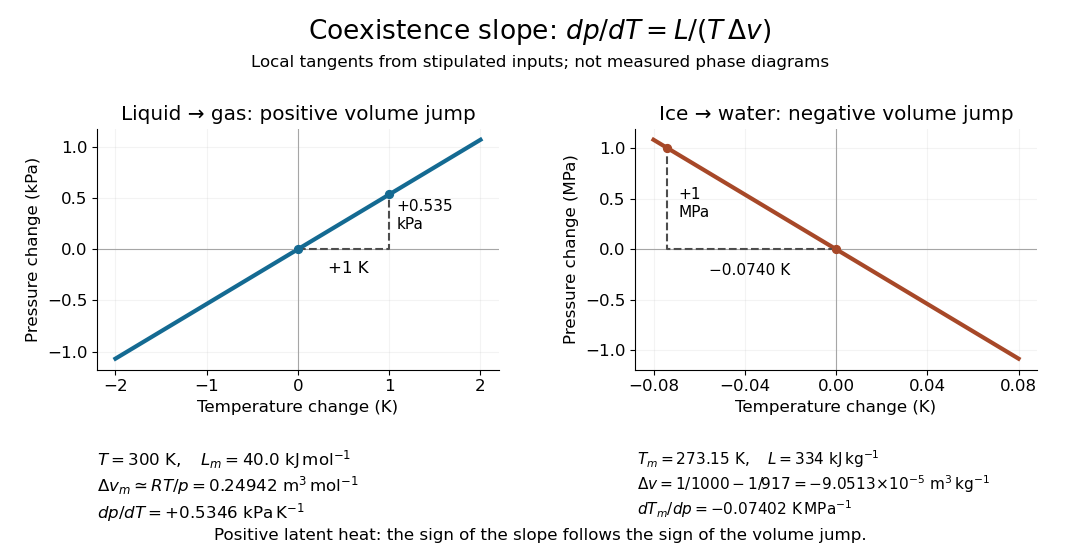
The Clapeyron equation connects the slope of a phase coexistence curve to the latent heat and the change in volume during a first-order phase transition. A steep boundary can indicate a large latent heat, a small change in volume, or both. This lets a measured boundary constrain caloric properties and predicts how changing pressure shifts a melting temperature.
For a pure substance in bulk phase coexistence, label the initial and final thermodynamic phases and . Both have the same absolute temperature , pressure , and chemical potential. With , , and denoting entropy, enthalpy, and volume on one common basis, define , , and . ThenThe derivative follows the phase coexistence curve; it is not a partial derivative within one thermodynamic phase. Use molar volume with molar latent heat in , or specific volume with latent heat in . Both give in . For molar mass , and , so the predicted slope is independent of the chosen basis. This formulation assumes a simple compressible system, fixed composition, and negligible interface contributions; a curved interface can instead require the Young–Laplace equation.
For positive latent heat in the stated conversion direction, the sign of the slope is the sign of . Converting liquid to gas normally increases volume and gives a positive slope. The negative melting-point slope of water illustrates the opposite sign. At a thermodynamic critical point, the coexisting gas and liquid merge: both and vanish, so their ratio needs a limiting analysis rather than substitution of zero into the Clapeyron equation.[ref]
Statistical Physics by David Tong. §5.1.2, equation (5.185) and the discussion of the critical endpoint
A short derivation uses the molar Gibbs free energy , equal to the chemical potential for a pure substance. Equality persists along the boundary, so with . Therefore . Equality of also gives . Eliminating yields the Clapeyron equation.
Pinned article: Introduction to the OurBigBook Project
Welcome to the OurBigBook Project! Our goal is to create the perfect publishing platform for STEM subjects, and get university-level students to write the best free STEM tutorials ever.
Everyone is welcome to create an account and play with the site: ourbigbook.com/go/register. We belive that students themselves can write amazing tutorials, but teachers are welcome too. You can write about anything you want, it doesn't have to be STEM or even educational. Silly test content is very welcome and you won't be penalized in any way. Just keep it legal!
Intro to OurBigBook
. Source. We have two killer features:
- topics: topics group articles by different users with the same title, e.g. here is the topic for the "Fundamental Theorem of Calculus" ourbigbook.com/go/topic/fundamental-theorem-of-calculusArticles of different users are sorted by upvote within each article page. This feature is a bit like:
- a Wikipedia where each user can have their own version of each article
- a Q&A website like Stack Overflow, where multiple people can give their views on a given topic, and the best ones are sorted by upvote. Except you don't need to wait for someone to ask first, and any topic goes, no matter how narrow or broad
This feature makes it possible for readers to find better explanations of any topic created by other writers. And it allows writers to create an explanation in a place that readers might actually find it.
Figure 1. Screenshot of the "Derivative" topic page. View it live at: ourbigbook.com/go/topic/derivativeVideo 2. OurBigBook Web topics demo. Source. - local editing: you can store all your personal knowledge base content locally in a plaintext markup format that can be edited locally and published either:This way you can be sure that even if OurBigBook.com were to go down one day (which we have no plans to do as it is quite cheap to host!), your content will still be perfectly readable as a static site.
- to OurBigBook.com to get awesome multi-user features like topics and likes
- as HTML files to a static website, which you can host yourself for free on many external providers like GitHub Pages, and remain in full control

Figure 2. You can publish local OurBigBook lightweight markup files to either OurBigBook.com or as a static website.
Figure 3. Visual Studio Code extension installation.
Figure 5. . You can also edit articles on the Web editor without installing anything locally. Video 3. Edit locally and publish demo. Source. This shows editing OurBigBook Markup and publishing it using the Visual Studio Code extension. 
- Infinitely deep tables of contents:



All our software is open source and hosted at: github.com/ourbigbook/ourbigbook
Further documentation can be found at: docs.ourbigbook.com
Feel free to reach our to us for any help or suggestions: docs.ourbigbook.com/#contact