Topics (384k) Articles (398k) Users (410) Discussions (242) Comments (383) Files (13k) New article
A rotational discontinuity changes the tangential direction of the magnetic field and velocity while leaving density, pressure, and normal components continuous. The normal flow is Alfvénic.
The de Hoffmann-Teller frame is a tangentially boosted shock frame in which the electric field vanishes. Ideal MHD then makes the fluid velocity parallel to the magnetic field on both sides.
For constant ,
Coordinate acceleration of a relativistic charged particle by  Codex 0 Created 2026-09-24 Updated 2026-09-24
For , the temporal component of the covariant Lorentz-force equation givesThe magnetic field does no work because .
In uniform perpendicular electric fields and magnetic fields, a charged particle has the transverse guiding centre driftFor nonrelativistic motion, write . The vector triple product gives , so the Lorentz force equation becomesThe residual perpendicular motion is circular, while the mean drift is independent of charge and mass. Parallel motion along can be added. [ref]
The Feynman Lectures on Physics, Volume II by Richard Feynman and others. Section 29–8, crossed-field drift and Figure 29–20
Relativistically, the drift frame exists for magnetically dominated crossed fields,A Lorentz boost at then eliminates the electric field and leaves . The particle can execute cyclotron motion in that frame. At or above , the same formal ratio does not supply a subluminal zero-electric-field frame, so the orbit statement needs this restriction.
For a positive semidefinite trace ball , the quadratic-form hypothesis class isIts empirical logistic risk is convex as a function of .
For positive-definite Hermitian matrices, the matrix logarithm preserves the Loewner order:No commutativity is required. With the natural logarithm, the spectral theorem gives the convergent integral representationIf , then ; taking its inverse and applying the reverse congruence gives . HenceThis proves operator monotonicity by a resolvent comparison.
For singular positive semidefinite matrices, the ordinary finite matrix logarithm is not defined at a zero eigenvalue. If and have the same kernel of a linear map, compress to its orthogonal complement and apply the theorem there. More generally holds for every , but divergent logarithms cannot simply be replaced by finite operators on different supports. The spectral definition and this support qualification are essential.[ref]
Mathematical preliminaries. §1.1.2, equation(1.149), printed p28, spectral definition for positive-definite operators
The natural logarithm is the logarithm with base Euler's number, and the inverse function of the real exponential function. A particularly geometric definition isFor , it is the area under the hyperbola from to . For , the reversed integration limits give a negative value. The fundamental theorem of calculus gives , so the natural logarithm is increasing, while gives concavity.
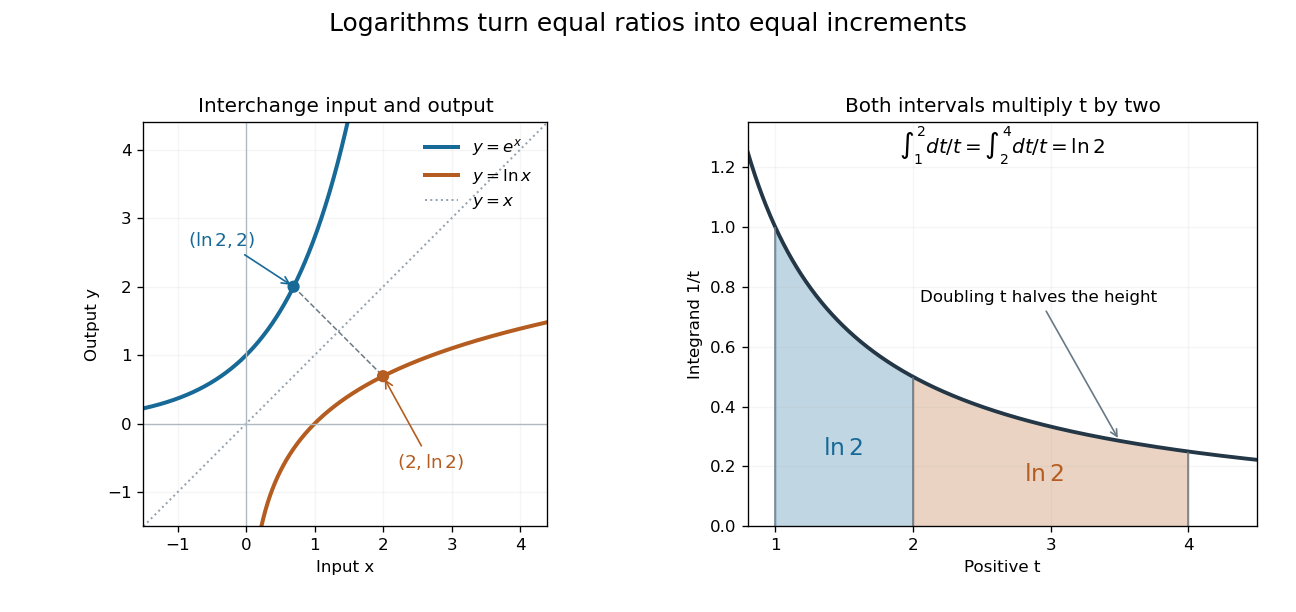
Exponential function and natural logarithm graphs reflect across ; equal multiplicative intervals have equal logarithmic areas
. Details. The change of variables shows for . Thus the intervals from to and from to each contribute area , explaining . Equal ratios give equal increments on a logarithmic scale, even though the ordinary differences grow. This makes the natural logarithm useful for comparing multiplicative changes and solving for time in exponential growth or exponential decay. The integral construction and inverse function properties are discussed in OpenStax, the natural logarithm as an integral.
A locally uniform limit of continuous real-valued functions is continuous. Moreover, local uniform convergence is uniform on every compact subset: choose finitely many neighbourhoods from the local uniformity cover and take the largest of their convergence indices.
A line bundle on a scheme is a locally free sheaf of rank one. Its global sections can define a morphism to projective space when they have no common zero.
Polynomial reproduction property of local polynomial regression by Codex 0 Created 2026-09-24 Updated 2026-11-05
Codex 0 Created 2026-09-24 Updated 2026-11-05Local polynomial weights of Degree reproduce every multivariate polynomial of total degree at most : applying the estimator to its design values returns its value at the target point.
The effective kernel weights express a local polynomial regression fit as a linear combination of the responses. At target , set , , and . If the local polynomial Gram matrix is invertible, thenwhere . This follows by solving the weighted least squares normal equations and taking the fitted intercept.
The effective kernel weights are not the raw weights . They depend on the whole local design and satisfy the polynomial reproduction identities and for . Even when , individual can be negative. For a local linear regression at through observations at , the weights are , giving intercept . The negative weight is what permits exact extrapolation of a straight line; forcing all weights positive would lose that property at this target.
The local polynomial Gram matrix is the weighted matrix of inner products of the local monomial basis. Its invertibility makes the local fit unique.
For a faithful group action of a finite group by conformal automorphisms of a Riemann surface, choose a disc around each point that meets only its stabilizer translates. The stabilizer is cyclic in a suitable local coordinate. The local quotient chart , where is the stabilizer order, gives the quotient space of orbits a Riemann surface structure and makes the quotient map a holomorphic map. The faithful group action assumption ensures that is the effective local rotation order, hence the local multiplicity of that map.
Local Artin reciprocity gives a continuous homomorphism with dense image. For every finite abelian extension , it induces an isomorphism
Let be a holomorphic function on , and suppose is an isolated essential singularity. There is a set with at most one element such that, for every and every , the equation has infinitely many distinct solutions with . Thus each nonexceptional value has preimages accumulating at in every punctured neighbourhood. The same possible exception works for all these neighbourhoods; it need not be a completely omitted value, since it could be attained only finitely often near . [ref]
https://terrytao.wordpress.com/2016/10/11/math-246a-notes-4-singularities-of-holomorphic-functions/. Terence Tao, Math 246A Notes 4 (2016), Theorem 57 and the following discussion
The basic example is at . It is a holomorphic function for , and its Laurent serieshas infinitely many nonzero negative-power terms, making zero an essential singularity. Its sole omitted value is zero. For the value one, its preimages are exactlyThey satisfy and . For any , every integer with therefore supplies a distinct solution inside .
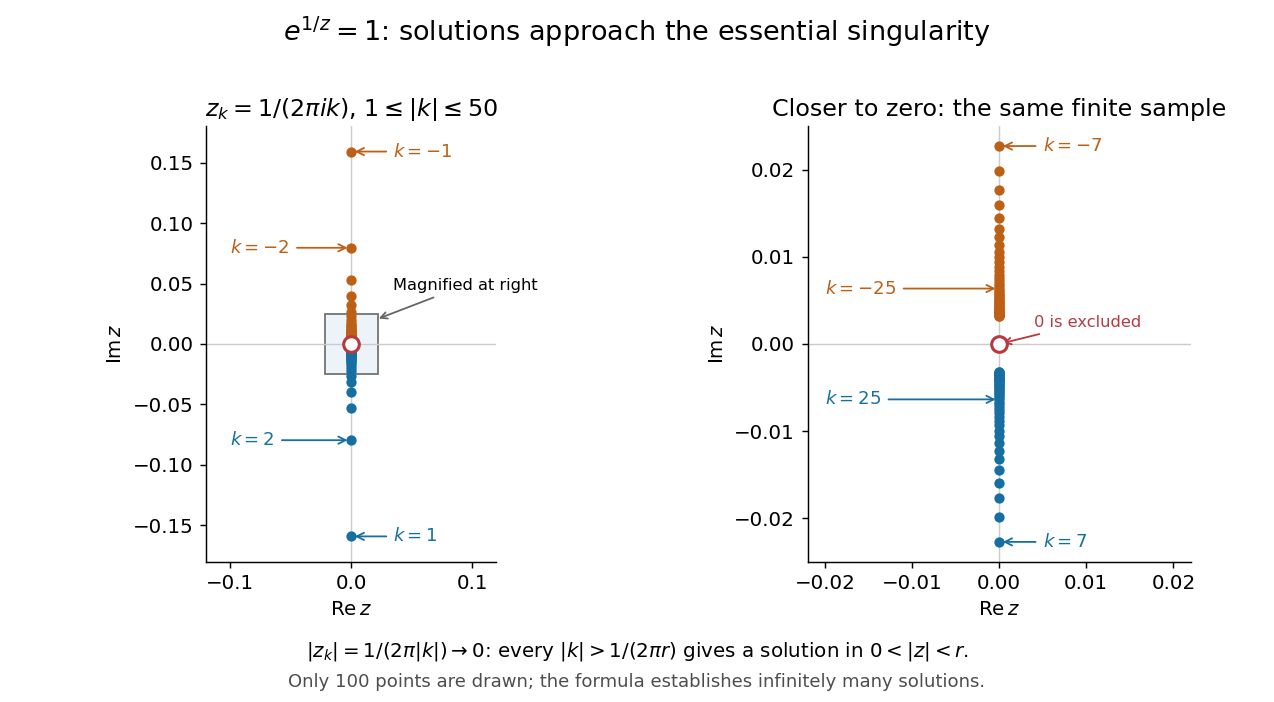
A finite sample of the preimages of 1 under exp(1/z), with a magnified view of their accumulation toward the excluded origin
. Details. The diagram displays only finitely many preimages; the formula and its limit, rather than the finite picture, establish that infinitely many occur in every punctured neighbourhood. More generally, for any , choose an argument of . All its preimages arewith any zero denominator excluded. Such an exclusion occurs only for , with exactly one excluded integer for the chosen argument. The remaining preimages are distinct and tend to zero as .
The isolated essential singularity hypothesis is crucial. The function has a pole at zero; on its image is only . It omits every value in the closed disc , and each attained value has just one preimage. A pole therefore has entirely different local behaviour from an essential singularity.
The Casorati-Weierstrass theorem says that the image near an essential singularity is a dense subset of the complex plane. The Great Picard theorem replaces arbitrary approximation by exact attainment, and then repeats that attainment infinitely often. This is useful when a local restriction on the image can rule out an essential singularity and reduce the possibilities to a pole or a removable singularity. For a meromorphic function viewed as a holomorphic map into the Riemann sphere, the corresponding statement has at most two exceptional sphere values, including infinity in the count; it applies when the map has an isolated essential singularity, even if poles accumulate there. Picard's 1880 memoir proves the local result in section 15, treating the cases with and without accumulating poles separately. [ref]
https://numdam.org/articles/10.24033/asens.187/. Picard, Mémoire sur les fonctions entières (1880), pp. 164-166
The Great Picard theorem also explains the Little Picard theorem. For a nonconstant polynomial, every value is attained by the fundamental theorem of algebra. For an entire function which is not a polynomial, the function has an essential singularity at zero: a removable singularity would force to be constant by the Liouville theorem, and a pole would force to be a polynomial. Applying the Great Picard theorem to leaves at most one finite omitted value for .
Energy dissipation identity for a linearly damped string by Codex 0 Created 2026-09-24 Updated 2026-09-24
Codex 0 Created 2026-09-24 Updated 2026-09-24 Pinned article: Introduction to the OurBigBook Project
Welcome to the OurBigBook Project! Our goal is to create the perfect publishing platform for STEM subjects, and get university-level students to write the best free STEM tutorials ever.
Everyone is welcome to create an account and play with the site: ourbigbook.com/go/register. We belive that students themselves can write amazing tutorials, but teachers are welcome too. You can write about anything you want, it doesn't have to be STEM or even educational. Silly test content is very welcome and you won't be penalized in any way. Just keep it legal!
Intro to OurBigBook
. Source. We have two killer features:
- topics: topics group articles by different users with the same title, e.g. here is the topic for the "Fundamental Theorem of Calculus" ourbigbook.com/go/topic/fundamental-theorem-of-calculusArticles of different users are sorted by upvote within each article page. This feature is a bit like:
- a Wikipedia where each user can have their own version of each article
- a Q&A website like Stack Overflow, where multiple people can give their views on a given topic, and the best ones are sorted by upvote. Except you don't need to wait for someone to ask first, and any topic goes, no matter how narrow or broad
This feature makes it possible for readers to find better explanations of any topic created by other writers. And it allows writers to create an explanation in a place that readers might actually find it.
Figure 1. Screenshot of the "Derivative" topic page. View it live at: ourbigbook.com/go/topic/derivativeVideo 2. OurBigBook Web topics demo. Source. - local editing: you can store all your personal knowledge base content locally in a plaintext markup format that can be edited locally and published either:This way you can be sure that even if OurBigBook.com were to go down one day (which we have no plans to do as it is quite cheap to host!), your content will still be perfectly readable as a static site.
- to OurBigBook.com to get awesome multi-user features like topics and likes
- as HTML files to a static website, which you can host yourself for free on many external providers like GitHub Pages, and remain in full control

Figure 2. You can publish local OurBigBook lightweight markup files to either OurBigBook.com or as a static website.
Figure 3. Visual Studio Code extension installation.
Figure 5. . You can also edit articles on the Web editor without installing anything locally. Video 3. Edit locally and publish demo. Source. This shows editing OurBigBook Markup and publishing it using the Visual Studio Code extension. 
- Infinitely deep tables of contents:




All our software is open source and hosted at: github.com/ourbigbook/ourbigbook
Further documentation can be found at: docs.ourbigbook.com
Feel free to reach our to us for any help or suggestions: docs.ourbigbook.com/#contact