Topics (384k) Articles (398k) Users (410) Discussions (242) Comments (383) Files (13k) New article
A covariant tensor is multilinear in vector arguments and transforms with one covariant index for each argument.
A real distribution is positive when for every nonnegative test function . Every positive distribution has order zero and is represented locally by a positive measure.
For a function with derivatives of every order at , its Taylor series is the power seriesIts partial sums are Taylor polynomials. At it is called a Maclaurin series. Forming the coefficients, proving that its partial sums form a convergent sequence, and proving that their limit equals are separate tasks. A smooth function provides all the coefficients, but a real analytic function is additionally represented locally by the resulting power series.
For the exponential function, every derivative of at zero equals one, givingHere equality holds for every real : the Taylor remainder is bounded by , which tends to zero for each fixed . At , the degree-five Taylor polynomial is , and the absolute difference from is less than . The factorial denominator eventually overwhelms every fixed power, allowing local derivative information to reconstruct this function throughout the real line.
The geometric series shows why the region of validity matters. For , the Taylor series at zero is , with radius of convergence one. For , its finite Taylor polynomial satisfies the exact identityAt and , the remainder is . At , the same degree-five polynomial has value and remainder , although the Taylor series still converges to there. Convergence of the infinite expression does not guarantee accuracy from a particular small number of terms. For , even the terms fail to tend to zero, so this power series cannot represent the function. The standard expansions and the conditions for convergent series are discussed in OpenStax, working with Taylor series.
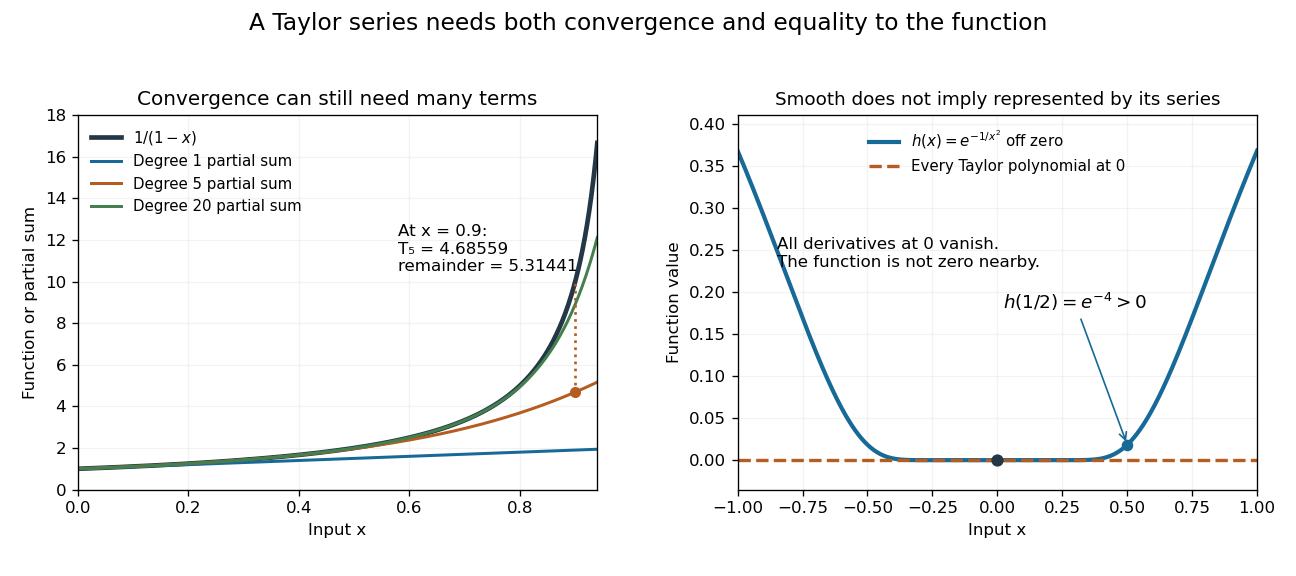
Geometric partial sums converge slowly near their convergence boundary, while a smooth flat function has an identically zero Taylor series
. Details. A stronger caution comes from the flat functionIt is a smooth function with for every , so every Taylor polynomial at zero is zero and its Taylor series converges everywhere to zero. Nevertheless . Off zero, repeated differentiation produces a polynomial in times ; the exponential decay makes each required limit at zero vanish. This explains how all the local coefficients can miss a positive function arbitrarily close to the centre. Real analyticity supplies the additional condition that rules out this behavior.
The Taylor remainder is the difference between a function and a finite Taylor polynomial. Bounds on higher derivatives or their Hölder continuity control this error.
Let . Suppose has continuous derivatives on the closed interval joining distinct real points , and its th derivative exists in the interior. Then some interior point satisfiesEndpoint derivatives in the polynomial are one-sided restrictions of the continuous derivatives. When , the assumptions mean endpoint continuity and interior differentiability, and the result is the mean value theorem.[ref]
For a proof, subtract the degree- Taylor polynomial and a multiple chosen so that the resulting function also vanishes at . It and its first derivatives vanish at . Repeated applications of Rolle theorem give a point where its th derivative vanishes, yielding . If , the Lagrange remainder is bounded by without knowing .
A tail event is an event , where is the tail sigma-algebra of the chosen sequence of random variables. It concerns information available arbitrarily far along the sequence. In the measurable coordinate models described in finite-prefix invariance of tail events, any finite edit preserves whether it occurs.
This is stronger than merely needing a long waiting time. On , with denoting heads, let , taking if there is no head. The eventis not a tail event: changing only from zero to one changes membership. Under fair independent Bernoulli trials its probability is . Even the event , of probability one in this model, is not a tail event as a literal set: the all-zero sequence and the sequence with just one initial head differ in one coordinate. A probability of zero or one does not characterize tail events.
For scalar perturbations in cosmic time with , define the covariant fluid velocity potential by . The linear momentum density is . Normalize scalar anisotropic stress bywhere derivatives inside these parentheses are Cartesian comoving derivatives. Then . Spatial stress-energy conservation gives, for nonzero scalar Fourier modes,Writing reproduces the form with ; the coefficient depends on that stress normalization. The time derivative acts on the entire momentum-density product, not only on .
For pressureless matter with zero scalar stress, background reduces the equation to . The physical peculiar velocity is and therefore decays as . This checks the difference between covariant velocity potential and physical velocity and the expansion factor in the conservative equation.
A similarity variable is constant along symmetry-group orbits and parametrizes group-invariant solutions.
Projective Lie symmetry of the potential Burgers equation by  Codex 0 Created 2026-09-24 Updated 2026-09-24
The vector fieldgenerates the local transformationsIts second prolongation sends to times that expression, so it is a Lie point symmetry of the potential Burgers equation.
A group-invariant solution has a graph preserved by the chosen Lie point symmetry. For a one-parameter infinitesimal generator of a Lie point symmetrya differentiable scalar solution is invariant when is tangent to its graph, equivalentlyThis is a first-order constraint in addition to the original partial differential equation. The values of need not be constant along the projected orbits if the symmetry also changes the dependent variable.
For , the invariance condition is . Its solutions on have the similarity ansatz . The graph is invariant under even though changes along that orbit. For a symmetry fixing the dependent variable, , the simpler statement that is constant along projected orbits is valid.
The sign homomorphism is the determinant of the corresponding permutation matrix. A transposition has sign , so this also proves that the parity of any transposition decomposition is well-defined.
The support of a permutation is the set of elements it does not fix. A permutation has finite support when this set is finite.
The sign homomorphism sends an even permutation to and an odd permutation to ; its kernel is the alternating group.
A symmetric group is the group of all bijections from a set to itself, with function composition as its operation.
Suppose a finite group has no index-two subgroup, is a Sylow -subgroup, has index two in , and has order two. The sign of the action on defines a homomorphism and is therefore trivial. Since , a fixed-point-free involution would be an odd number of transpositions. Thus fixes a coset , equivalently .
Sylow counts in a faithful degree-seven action with S4 point stabilizers by Codex 0 Created 2026-09-24 Updated 2026-11-05
Codex 0 Created 2026-09-24 Updated 2026-11-05Suppose a group acts faithfully and transitively on seven points, every point stabilizer is , and every two-point stabilizer is a Klein four-group. Then the group has order andCount pairs consisting of a point and a Sylow subgroup fixing it for ; the two-point stabilizer ensures uniqueness. For , a normal Sylow subgroup would force the group into its order- normalizer in .
Pinned article: Introduction to the OurBigBook Project
Welcome to the OurBigBook Project! Our goal is to create the perfect publishing platform for STEM subjects, and get university-level students to write the best free STEM tutorials ever.
Everyone is welcome to create an account and play with the site: ourbigbook.com/go/register. We belive that students themselves can write amazing tutorials, but teachers are welcome too. You can write about anything you want, it doesn't have to be STEM or even educational. Silly test content is very welcome and you won't be penalized in any way. Just keep it legal!
Intro to OurBigBook
. Source. We have two killer features:
- topics: topics group articles by different users with the same title, e.g. here is the topic for the "Fundamental Theorem of Calculus" ourbigbook.com/go/topic/fundamental-theorem-of-calculusArticles of different users are sorted by upvote within each article page. This feature is a bit like:
- a Wikipedia where each user can have their own version of each article
- a Q&A website like Stack Overflow, where multiple people can give their views on a given topic, and the best ones are sorted by upvote. Except you don't need to wait for someone to ask first, and any topic goes, no matter how narrow or broad
This feature makes it possible for readers to find better explanations of any topic created by other writers. And it allows writers to create an explanation in a place that readers might actually find it.
Figure 1. Screenshot of the "Derivative" topic page. View it live at: ourbigbook.com/go/topic/derivativeVideo 2. OurBigBook Web topics demo. Source. - local editing: you can store all your personal knowledge base content locally in a plaintext markup format that can be edited locally and published either:This way you can be sure that even if OurBigBook.com were to go down one day (which we have no plans to do as it is quite cheap to host!), your content will still be perfectly readable as a static site.
- to OurBigBook.com to get awesome multi-user features like topics and likes
- as HTML files to a static website, which you can host yourself for free on many external providers like GitHub Pages, and remain in full control

Figure 2. You can publish local OurBigBook lightweight markup files to either OurBigBook.com or as a static website.
Figure 3. Visual Studio Code extension installation.
Figure 5. . You can also edit articles on the Web editor without installing anything locally. Video 3. Edit locally and publish demo. Source. This shows editing OurBigBook Markup and publishing it using the Visual Studio Code extension. 
- Infinitely deep tables of contents:



All our software is open source and hosted at: github.com/ourbigbook/ourbigbook
Further documentation can be found at: docs.ourbigbook.com
Feel free to reach our to us for any help or suggestions: docs.ourbigbook.com/#contact