Topics (384k) Articles (398k) Users (410) Discussions (242) Comments (383) Files (13k) New article
A module over an integral domain is torsion-free when with implies , equivalently when its torsion submodule is zero. Every free module over an integral domain is torsion-free, as one can check in each coefficient. Every vector space is torsion-free over its scalar field.
The converse requires hypotheses. A finitely generated module over a principal ideal domain is free if it is torsion-free, but the module over is torsion-free and not free. Any two nonzero rational numbers have a nontrivial integer relation, so a possible basis of a module could have at most one element; no single generates all rational numbers, since for . The finite-generation hypothesis cannot be dropped. See Keith Conrad's Modules over a PID, Corollary 2.6.
A free module is a module with a basis of a module : every element has exactly one expression with and only finitely many nonzero. Equivalently, the coefficient map is a module isomorphism. Existence means generation; uniqueness means linear independence in a module. For finite of size , this says , a finite free module. See Neil Strickland's Rings, Modules and Linear Algebra, section 11.
The integer lattice in the opening diagram is a free module over with basis of a module , . For example, , and comparing the two coordinates makes the coefficients unique. A different basis of a module is , , because ; in particular .
By contrast, and are linearly independent in a module, but generate only the submodule . They miss because has no integer solution. They would form a basis over the rational numbers. Even generation need not let one extract a basis of a module: the elements generate , since , but neither singleton generates it, and is a nontrivial linear relation between them. These are concrete failures of the usual vector space argument that divides by any nonzero coefficient.
The cyclic module has no basis of a module over : every element has the nontrivial relation , so no nonempty subset is linearly independent in a module, while the empty subset cannot generate this nonzero module. Specifying the scalar ring is essential: over , the same additive object is a free module with the one-element basis of a module , since each coefficient is itself a unique class in .
Primary decomposition theorem for finitely generated modules over a principal ideal domain by  Codex 0 Created 2026-09-24 Updated 2026-11-05
A finitely generated module over a principal ideal domain decomposes aswith finitely many irreducibles . The free rank and primary cyclic factors are unique up to associates and ordering.
A module has finite length when it admits a composition series of a module, and its length is the number of simple modules among the successive quotients. The Krull–Schmidt theorem concerns decompositions into indecomposable summands; the independence of composition length instead follows from the Jordan–Hölder theorem. A module without a finite composition series is assigned infinite length.
An -module is flat when tensoring with it preserves injections, equivalently when is an exact functor.
For a right module and a left module , their tensor product of modules is the abelian group generated by symbols , modulo additivity in each variable andThe universal property of the tensor product of modules identifies additive maps from it with balanced maps on .
When is a commutative ring, two left modules can be used by viewing the first as a right module. The tensor product is then an -module with . For example, : the generator is killed by both and , and the universal property identifies exactly those relations. For a noncommutative ring, the left and right input actions must be specified.
Laplace integral method for a differential equation by Codex 0 Created 2026-09-24 Updated 2026-11-05
Codex 0 Created 2026-09-24 Updated 2026-11-05The Laplace integral method for a differential equation seeks a solution of the formUnder sufficient convergence and regularity, differentiating in multiplies the amplitude by powers of . Multiplication by can be transferred to a derivative in by integration by parts; for example,Choosing a suitable contour and amplitude makes the boundary term vanish and turns the original differential equation into an equation for .
The amplitude equation is first order for many equations whose coefficients are linear in , as in the Laplace integral solution of a singular third-order equation. More general polynomial coefficients can produce higher amplitude derivatives, so first-order reduction is not automatic. Boundary terms, branch choices and justification of differentiating under the integral are part of the construction; merely writing a formal amplitude equation does not prove that the integral exists or solves the original problem.
The Mertens function is the summatory function of the Möbius function:For example, , , and . On nonnegative real inputs it is constant between consecutive integers, with . Its jump at a positive integer is , so there is no jump at a nonsquarefree integer.
The Mertens function measures cancellation between square-free integers with an even number and an odd number of distinct prime factors. The estimate says that their signed excess is negligible compared with the total length of the counting interval; through prime number asymptotic from Mertens cancellation, this cancellation implies the Prime number theorem.
Möbius inversion recovers an arithmetic function from its divisor sum. For arithmetic functions , the following statements are equivalent, with each equality required for every positive integer :Here ranges over positive integer divisors of and is the Möbius function. No multiplicativity assumption is needed, and both sums are finite. The right side can also be written by exchanging complementary integer divisors. [ref]
Floor and arithmetic functions by Darij Grinberg. Darij Grinberg, MIT 18.781 lecture notes, Theorem 2.5.1 and Proposition 2.5.2
The divisor sum bundles together with values at smaller integer divisors. Möbius inversion subtracts aggregates indexed by one distinct prime factor, adds those indexed by two, and continues with the alternating signs of inclusion-exclusion. A divisor containing a squared prime factor receives weight zero. The Möbius divisor-sum identity ensures that every unwanted contribution cancels exactly.
In Dirichlet convolution notation, and , where is the constant-one arithmetic function and is the Identity for Dirichlet convolution. Associativity and commutativity give the short proof:Convolving with proves the reverse implication. At , the formula reduces to because .
For a worked example, take , Euler's totient function. The totient divisor-sum identity says that , the identity arithmetic function:This identity comes from classifying the integers by their greatest common divisor with : the group with has members, since and are coprime integers. Summing the group sizes gives , as detailed under totient divisor-sum identity.
Now undo this aggregation with the Möbius function:The nonzero terms use ; vanish because they contain the square of the prime number . The four surviving integers coprime to are .
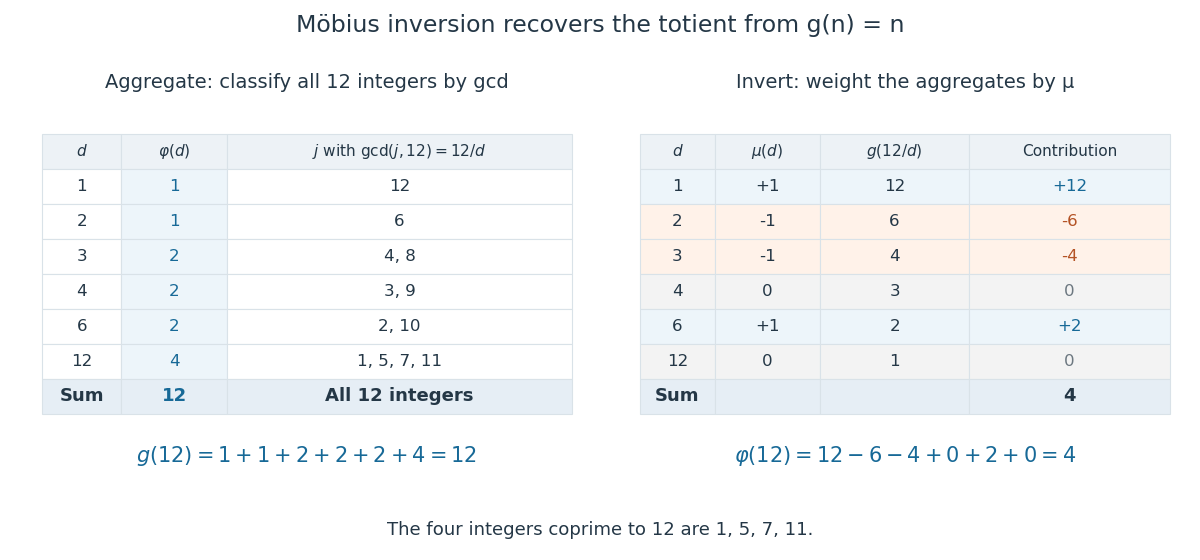
A divisor sum aggregates Euler's totient function values to 12, while Möbius inversion recovers the four integers coprime to 12
. Details. This example also reveals why Möbius inversion is useful: it turns an easy count of all objects into a count satisfying a coprimality restriction. Expanding over subsets of distinct prime factors givesThe product is inclusion-exclusion over multiples of the prime factors. For , it gives . More generally, whenever a counting problem produces a divisor sum, Möbius inversion lets that aggregate be reversed without solving a new system of equations.
The light cone of a spacetime event consists of together with the spacetime events having null separation from it. In the coordinates of an inertial frame centered on , it obeysFor it traces an expanding spherical flash of light, with radius at time ; for it describes possible incoming light rays. A spacetime diagram with one spatial coordinate shows the two lines . The apparent angle uses equal scales for and and is not a separate physical angle.
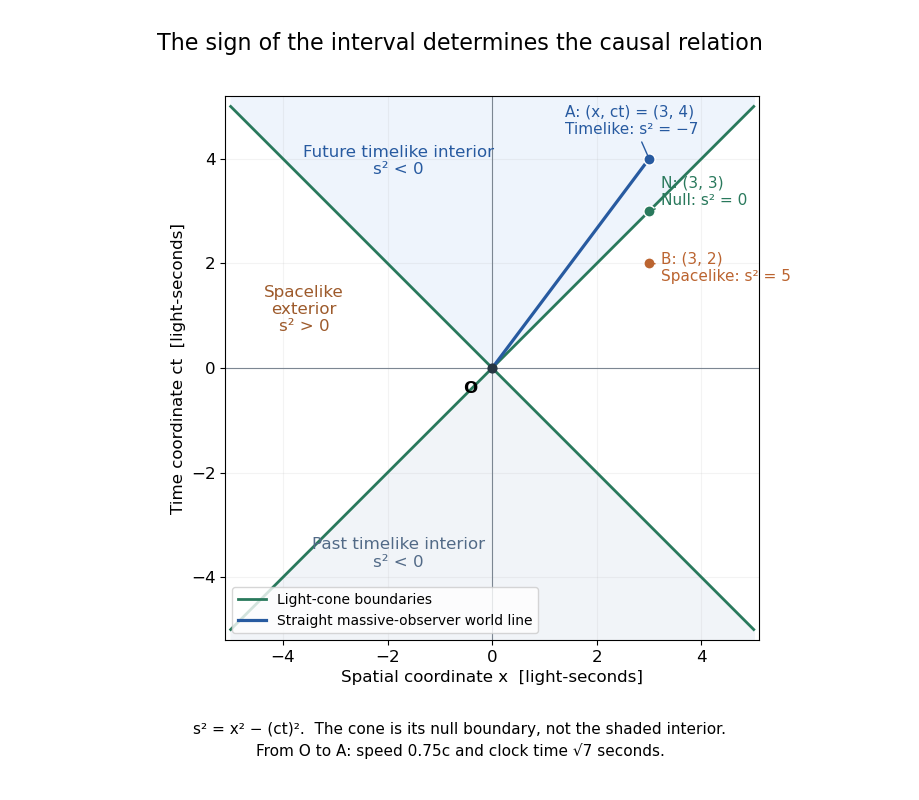
Light-cone boundaries separate timelike, null and spacelike events relative to the origin
. Details. The light cone is the boundary, while its interior has timelike separation from . An outgoing light ray follows the boundary; a future-directed massive observer's world line remains inside it. The exterior has spacelike separation: no signal travelling at or below the speed of light can connect its spacetime events directly to . This separates possible causal influence from merely being assigned a later coordinate time.
In the diagram, is inside the future boundary, is on it, and is outside. Their squared Minkowski intervals are respectively in . Thus occurs later than in the displayed inertial frame while still being unable to receive a light-speed-or-slower signal sent from .
The usefulness is immediate for an experiment: a detector's reading can depend on a source event only if a causal influence can reach it. A Lorentz boost changes coordinates but preserves this classification. For a boost with and Lorentz factor , applying the Lorentz transformation gives, in light-second length units,The corresponding squared Minkowski intervals remain . In particular is now earlier than , which is allowed for spacelike separation; remains later.
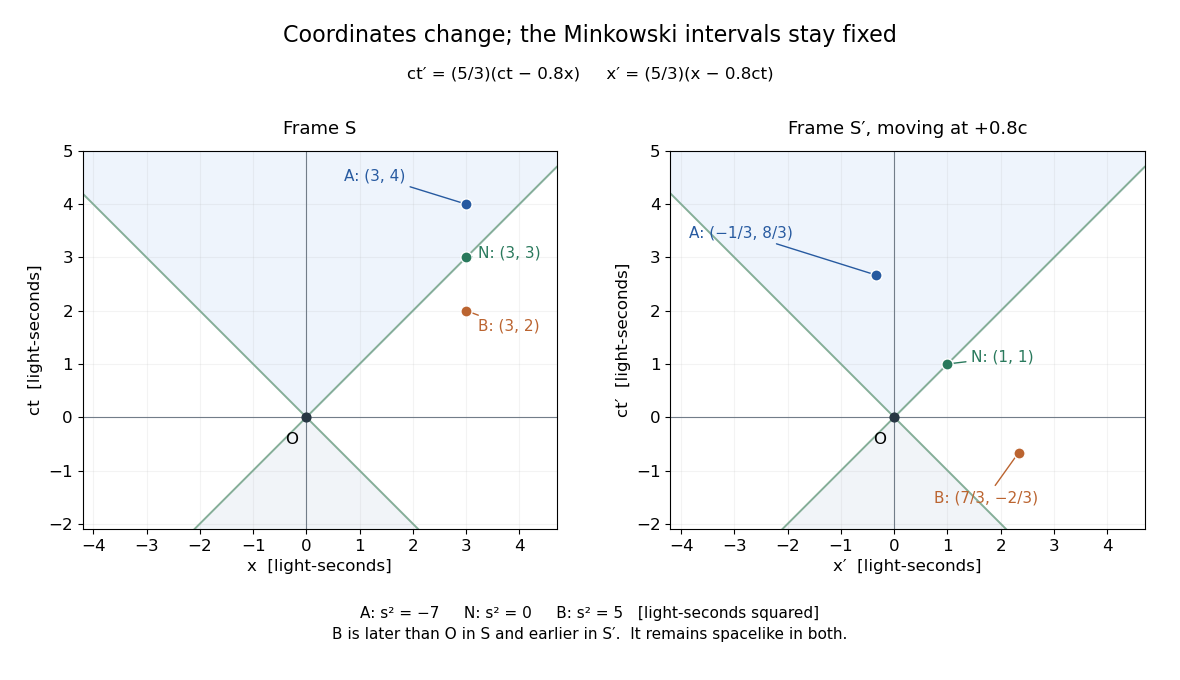
This quadratic form belongs to the geometry of Minkowski spacetime; the spacetime itself is a broader concept than this squared norm.
For a real quadratic field with embeddings , the imageis a lattice in of covolume , and the product of the two coordinates is the field norm.
Likelihood-ratio criterion for minimal sufficiency by Codex 0 Created 2026-09-24 Updated 2026-10-06
Codex 0 Created 2026-09-24 Updated 2026-10-06The Galactic bar is the elongated central stellar structure of the Milky Way. Extinction-corrected near-infrared standard candles and gas position--velocity maps constrain its distance, orientation, and three-dimensional shape.
Pinned article: Introduction to the OurBigBook Project
Welcome to the OurBigBook Project! Our goal is to create the perfect publishing platform for STEM subjects, and get university-level students to write the best free STEM tutorials ever.
Everyone is welcome to create an account and play with the site: ourbigbook.com/go/register. We belive that students themselves can write amazing tutorials, but teachers are welcome too. You can write about anything you want, it doesn't have to be STEM or even educational. Silly test content is very welcome and you won't be penalized in any way. Just keep it legal!
Intro to OurBigBook
. Source. We have two killer features:
- topics: topics group articles by different users with the same title, e.g. here is the topic for the "Fundamental Theorem of Calculus" ourbigbook.com/go/topic/fundamental-theorem-of-calculusArticles of different users are sorted by upvote within each article page. This feature is a bit like:
- a Wikipedia where each user can have their own version of each article
- a Q&A website like Stack Overflow, where multiple people can give their views on a given topic, and the best ones are sorted by upvote. Except you don't need to wait for someone to ask first, and any topic goes, no matter how narrow or broad
This feature makes it possible for readers to find better explanations of any topic created by other writers. And it allows writers to create an explanation in a place that readers might actually find it.
Figure 1. Screenshot of the "Derivative" topic page. View it live at: ourbigbook.com/go/topic/derivativeVideo 2. OurBigBook Web topics demo. Source. - local editing: you can store all your personal knowledge base content locally in a plaintext markup format that can be edited locally and published either:This way you can be sure that even if OurBigBook.com were to go down one day (which we have no plans to do as it is quite cheap to host!), your content will still be perfectly readable as a static site.
- to OurBigBook.com to get awesome multi-user features like topics and likes
- as HTML files to a static website, which you can host yourself for free on many external providers like GitHub Pages, and remain in full control

Figure 2. You can publish local OurBigBook lightweight markup files to either OurBigBook.com or as a static website.
Figure 3. Visual Studio Code extension installation.
Figure 5. . You can also edit articles on the Web editor without installing anything locally. Video 3. Edit locally and publish demo. Source. This shows editing OurBigBook Markup and publishing it using the Visual Studio Code extension. 
- Infinitely deep tables of contents:




All our software is open source and hosted at: github.com/ourbigbook/ourbigbook
Further documentation can be found at: docs.ourbigbook.com
Feel free to reach our to us for any help or suggestions: docs.ourbigbook.com/#contact