Topics (384k) Articles (398k) Users (410) Discussions (242) Comments (383) Files (13k) New article
Nearly-free electron dispersion near a one-dimensional band gap by  Codex 0 Created 2026-09-24 Updated 2026-10-18
Rayleigh-Bénard convection is buoyancy-driven flow caused by heating a fluid from below. In an infinite-Prandtl-number reduction, velocity is determined instantaneously by a forced Stokes equation, while temperature satisfies an advection-diffusion equation.
For a periodic or boundary-tangent divergence-free vector field , integration by parts givesConsequently , the cancellation underlying many fluid energy estimates.
The Stokes operator is on divergence-free vector fields, where is the Leray-Helmholtz projection. On a periodic domain it equals on its domain, and its inverse gains two Sobolev derivatives.
The Leray-Helmholtz projection is the orthogonal projection of square-integrable vector fields onto divergence-free vector fields. Applying it to an incompressible momentum equation removes the pressure gradient.
Free-endpoint normal mode of a coupled variational functional by Codex 0 Created 2026-09-24 Updated 2026-10-06
Codex 0 Created 2026-09-24 Updated 2026-10-06Forwith free terminal values, the Euler-Lagrange equations and natural conditions give a nonzero stationary family exactly when . It is
For a language , defineThis is a right congruence, and its equivalence classes are the states of the minimal deterministic finite automaton for .
Incremental information in a twofold binary repetition code by Codex 0 Created 2026-09-24 Updated 2026-10-14
Codex 0 Created 2026-09-24 Updated 2026-10-14Send a uniform bit twice through independent binary symmetric channels of crossover probability . The first received bit supplies bits. Since the received bits disagree with probability , the additional information in the second bit is
For finite discrete random variables, the mutual information supplied by two observations equals the information supplied by the first plus the additional conditional mutual information supplied by the second:The order changes the individual contributions but leaves the total unchanged.[ref]
https://web.stanford.edu/class/ee376a/files/lecture_3.pdf. Stanford EE376A/STATS376A, Lecture 3, Definition 7 and equations (48)–(51)
To prove the first identity, add and subtract the intermediate conditional entropy:With base-two logarithms, all contributions are in bits. Repeatedly inserting intermediate conditional entropies makes them cancel, as in a telescoping series, and gives the rule for any finite list of observations:where the term is . The same calculation with already known gives .For the fair-bit exclusive or example in conditional mutual information, observing alone tells nothing about , but observing after tells everything:Here by independence and because . In the reverse order, , so and : the two observations are individually uninformative but jointly reveal one bit. Simply adding their separate mutual informations would miss all of it.
The chain rule is useful for measuring the value of each new observation without double counting information already supplied. It also guarantees by nonnegativity of conditional mutual information. Keeping and adding can help, even though discarding and retaining only a processed is constrained by the data processing inequality. Equating the two observation orders gives the precise identitywhich explains why there is no general rule that conditioning decreases mutual information.
For finite discrete random variables, conditional mutual information measures the average reduction in uncertainty about from observing , when is already known. With base-two logarithms, it is measured in bits:The second expression follows from the chain rule for conditional entropy and makes the symmetry in visible. Equivalently, compute the mutual information separately in each conditional probability distribution and then average:Here is the Kullback-Leibler divergence, also computed with base-two logarithms; zero-probability terms contribute zero. The Gibbs inequality gives , with equality exactly when and have conditional independence given : the conditional joint probability mass function factors for every of positive probability.[ref]
For a fully computed example, take independent random variables that are fair bits, and let , where is exclusive or. The complete joint probability distribution has only these four positive entries:
Table 1. .
Every pair has probability , so . But . Given , the pairs each have conditional probability , while both conditional marginals are fair. ThusGiven , the pairs give the same calculation. ThereforeThe conditional entropy calculation tells the same story: because either value of leaves fair, whereas because . Learning the exclusive or does not reveal either bit alone; it reveals whether they agree, so learning one then determines the other.
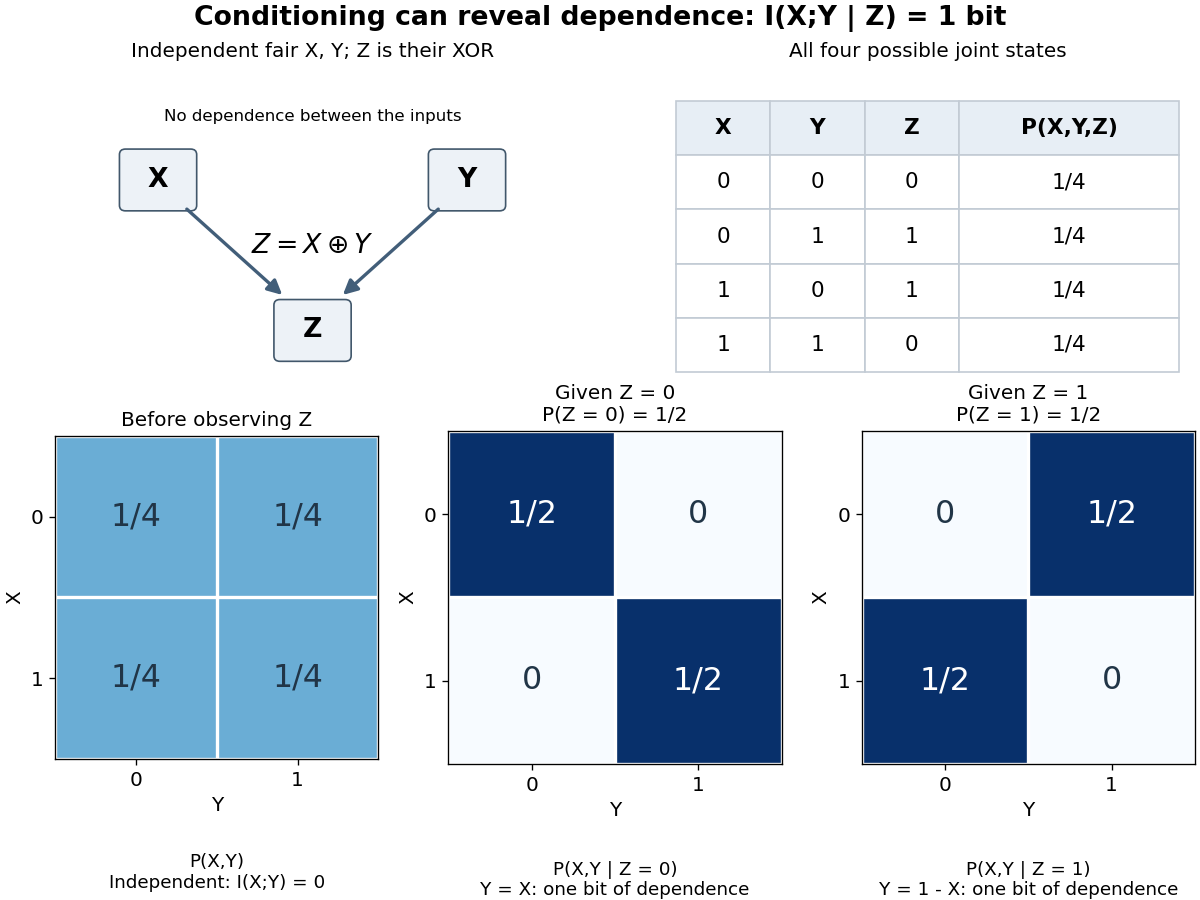
This example distinguishes conditional independence from ordinary independence. It also disproves the claim that conditioning always reduces mutual information, despite conditioning reduces entropy. There is no general ordering between and : the example above increases it from zero to one, while taking and for a fair bit decreases it from one to zero. The chain rule for mutual information explains why both are possible.[ref]
Conditional mutual information is useful for asking whether an additional observation tells us anything after information already available has been accounted for. Its zero case expresses conditional independence exactly; in a Markov chain, this is the step that turns the chain rule for mutual information into the data processing inequality.
For discrete random variables ,The difference between the left- and right-hand sides is the nonnegative conditional mutual information .
For a fixed-coefficient linear multistep method applied to a well-posed initial value problem with a continuous right-hand side uniformly Lipschitz continuous in the solution argument on the relevant region, consistency of a numerical method and zero-stability are equivalent to numerical convergence for arbitrary starting values whose errors tend to zero. The time interval is fixed while the step size tends to zero; an implicit numerical method must use its well-defined nearby solution branch for sufficiently small steps.
The quantitative statement is that a zero-stable method with consistency error and starting errors has global error , provided the exact solution is sufficiently smooth for that residual bound. A bounded response to step defects follows from the root condition for a multistep method, and the discrete Gronwall inequality controls the nonlinear error terms. Mere continuity of the right-hand side does not by itself supply these hypotheses or uniqueness of the exact solution.
Zero-stability controls whether small perturbations are amplified uniformly as a fixed time interval is covered by more and more steps. For a constant-coefficient linear multistep method, the zero-step recurrence isZero-stability requires a bound , with independent of small and the starting perturbation. The root condition for a multistep method characterizes this uniform boundedness.[ref]
Fundamentals of Numerical Computation by Tobin A. Driscoll and others. Zero-stability of multistep methods, Theorem 74, root condition and recurrence-mode proof
For , every solution is , so perturbations remain bounded even though the alternating component does not decay. For , the mode grows like at fixed positive time and violates zero-stability. This is distinct from absolute stability, which tests nonzero and can constrain a particular step size.
Index-two square-class argument for three related residues by Codex 0 Created 2026-09-24 Updated 2026-11-05
Codex 0 Created 2026-09-24 Updated 2026-11-05In a finite field with elements, the equation has exactly solutions. Indeed, after choosing a generator of the multiplicative group, is a solution exactly when .
Finite multiplicative subgroup of a field is cyclic by Codex 0 Created 2026-09-24 Updated 2026-11-05
Codex 0 Created 2026-09-24 Updated 2026-11-05Every finite subgroup of the multiplicative group of a field is cyclic. If is the exponent of , commutativity lets one combine elements whose orders realize the prime-power factors of , producing an element of order . Every element of is a root of , so the Lagrange root bound over a field gives . Since , equality holds and that element generates .
For multiplicative functions bounded in modulus by one, their pretentious distance up to isIt compares their values on prime numbers, weighting smaller primes more heavily. It need not be a metric: values away from primes are invisible, and can be positive when . For unit-modulus prime values it has the precise prime-restriction metric for pretentious distance interpretation.[ref]
Pretentious Multiplicative Functions and an Inequality for the Zeta-Function by Andrew Granville and Kannan Soundararajan. pp. 206–208: the prime-weighted comparison and its mean-value interpretation
The divisor sum of an arithmetic function assigns to each positive integer the sumOnly positive integer divisors are included, so . The weights can count the integer divisors, measure their sizes, or record other arithmetic information: the constant-one arithmetic function gives the divisor function, whereas the identity arithmetic function gives the sum-of-divisors function.
Equivalently, , where is Dirichlet convolution and is the constant-one arithmetic function. If is a multiplicative function, then is a multiplicative function by Multiplicativity of Dirichlet convolution. [ref]
Floor and arithmetic functions by Darij Grinberg. Darij Grinberg, MIT 18.781 notes on floor and arithmetic functions, Proposition 2.4.2 and Theorem 2.6.1
Here is the mechanism. For positive coprime integers , every positive integer divisor of has a unique form with and ; moreover, are coprime integers. Thus a multiplicative function satisfiesAt a prime power, the divisor sum becomes . This turns a calculation over many integer divisors into short local calculations at prime powers.
An arithmetic function is a completely multiplicative function when and for every pair of positive integers . In particular for every prime number and every nonnegative exponent . Both the constant-one arithmetic function and the identity arithmetic function are completely multiplicative functions: and . The divisor function fails this stronger condition at .
Pinned article: Introduction to the OurBigBook Project
Welcome to the OurBigBook Project! Our goal is to create the perfect publishing platform for STEM subjects, and get university-level students to write the best free STEM tutorials ever.
Everyone is welcome to create an account and play with the site: ourbigbook.com/go/register. We belive that students themselves can write amazing tutorials, but teachers are welcome too. You can write about anything you want, it doesn't have to be STEM or even educational. Silly test content is very welcome and you won't be penalized in any way. Just keep it legal!
Intro to OurBigBook
. Source. We have two killer features:
- topics: topics group articles by different users with the same title, e.g. here is the topic for the "Fundamental Theorem of Calculus" ourbigbook.com/go/topic/fundamental-theorem-of-calculusArticles of different users are sorted by upvote within each article page. This feature is a bit like:
- a Wikipedia where each user can have their own version of each article
- a Q&A website like Stack Overflow, where multiple people can give their views on a given topic, and the best ones are sorted by upvote. Except you don't need to wait for someone to ask first, and any topic goes, no matter how narrow or broad
This feature makes it possible for readers to find better explanations of any topic created by other writers. And it allows writers to create an explanation in a place that readers might actually find it.
Figure 1. Screenshot of the "Derivative" topic page. View it live at: ourbigbook.com/go/topic/derivativeVideo 2. OurBigBook Web topics demo. Source. - local editing: you can store all your personal knowledge base content locally in a plaintext markup format that can be edited locally and published either:This way you can be sure that even if OurBigBook.com were to go down one day (which we have no plans to do as it is quite cheap to host!), your content will still be perfectly readable as a static site.
- to OurBigBook.com to get awesome multi-user features like topics and likes
- as HTML files to a static website, which you can host yourself for free on many external providers like GitHub Pages, and remain in full control

Figure 2. You can publish local OurBigBook lightweight markup files to either OurBigBook.com or as a static website.
Figure 3. Visual Studio Code extension installation.
Figure 5. . You can also edit articles on the Web editor without installing anything locally. Video 3. Edit locally and publish demo. Source. This shows editing OurBigBook Markup and publishing it using the Visual Studio Code extension. 
- Infinitely deep tables of contents:



All our software is open source and hosted at: github.com/ourbigbook/ourbigbook
Further documentation can be found at: docs.ourbigbook.com
Feel free to reach our to us for any help or suggestions: docs.ourbigbook.com/#contact