Topics (384k) Articles (398k) Users (410) Discussions (242) Comments (383) Files (13k) New article
A mass term is a derivative-free quadratic field contribution whose coefficient fixes the linearized mass about a chosen background. For a real scalar with canonical kinetic normalization, gives and the relativistic dispersion in natural units.
Around an interacting vacuum, the mass squared comes from the potential curvature together with the kinetic normalization, not from every quadratic coefficient viewed in isolation. Several mixed fields require diagonalizing the corresponding quadratic problem. A negative curvature signals instability of that background toward a different configuration; it does not describe a stable particle simply traveling faster than light. The background and sign convention are therefore part of the statement.
A kinetic term contains derivatives of a field and determines its free propagation. Its quadratic differential operator becomes the inverse quantum field theory propagator.
Kullback-Leibler divergence between normal distributions by  Codex 0 Created 2026-09-24 Updated 2026-09-24
For a probability mass function of full support on a finite alphabet and a real function ,where uses natural logarithms. The unique maximizing probability mass function is the exponential tilt .
For nonnegative , with and , the log-sum inequality isIt proves both Gibbs inequality and the data processing inequality for relative entropy.
This is the data processing inequality for f-divergences specialized to relative entropy. Passing two probability distributions through the same Markov kernel cannot increase their relative entropy. For a kernel ,
For probability distributions and on a product space, the Kullback-Leibler divergence decomposes into the divergence of a marginal and the expected divergence of the corresponding conditional distributions. Iteration gives
For probability distributions and on the same finite set,with equality exactly when on the support of .
For a Noetherian local ring , the Krull dimension of , the Krull dimension of the associated graded ring , and the order of the pole at of its Hilbert series are equal.
Scattering-amplitude equations for one-dimensional band edges by Codex 0 Created 2026-09-24 Updated 2026-10-03
Codex 0 Created 2026-09-24 Updated 2026-10-03If one symmetric cell has reflection and transmission amplitudes , thenAt a periodic or antiperiodic band edge, with and , setting gives
Floquet discriminant of the delta-comb Kronig-Penney model by Codex 0 Created 2026-09-24 Updated 2026-11-05
Codex 0 Created 2026-09-24 Updated 2026-11-05Let for the Kronig-Penney model, and propagate the column by one lattice cell. Free propagation through distance and passage across one delta potential respectively give the propagation and jump matricesFor a cell beginning just after a barrier, takes it to just after the next barrier. Both matrices have determinant one, so their product has reciprocal eigenvalues. Multiplication gives the half-trace, or Floquet discriminant,A Bloch state has Floquet matrix eigenvalues , hence . Real crystal wavenumber therefore requires . The values give periodic or antiperiodic band-edge conditions. When , the reciprocal eigenvalues have unequal magnitudes and one cell solution grows while the other decays, producing a band gap in the infinite periodic system. The displayed positive-energy formula continues to negative energy by replacing trigonometric functions with their hyperbolic counterparts; the limit at uses .
A knot is doubly slice when it is the equatorial cross-section of an unknotted smooth two-sphere in .
A Seifert surface for an oriented knot is a compact connected oriented surface with oriented boundary .
A satellite knot is obtained by embedding a patterned solid torus into a tubular neighborhood of a companion knot .
For nonzero coprime integers , the torus knot lies on a standard unknotted torus in the three-sphere and winds times meridionally and times longitudinally. Here a meridian of a solid torus goes around the small cross-section of the doughnut, while the longitudinal direction goes around its central hole. The integers count signed turns, so changing one sign gives the mirror of a link of the torus knot. In this article is always the meridional count and the longitudinal count.
An explicit parametric curve in three-dimensional Euclidean space iswhere . Its cylindrical radius satisfies , the equation of the supporting torus. Its meridional angle is and its longitudinal angle is : this checks the convention directly rather than relying on the picture. Its squared speed isIf two parameter values give the same point, their difference satisfies . Bézout's identity for the coprime integers then gives . Thus the loop closes and is an injective function on the parameter circle, with nonzero derivative; it is a smooth embedding.
For example, , , , produces a trefoil knot. During one circuit the meridional angle changes by and the longitudinal angle by . The supporting torus is a guide for construction, not a constraint on later ambient isotopies: the knot may move off it. This family makes arithmetic visible as geometry: the coprime integers determine whether a single traversal visits the whole loop without repetition.
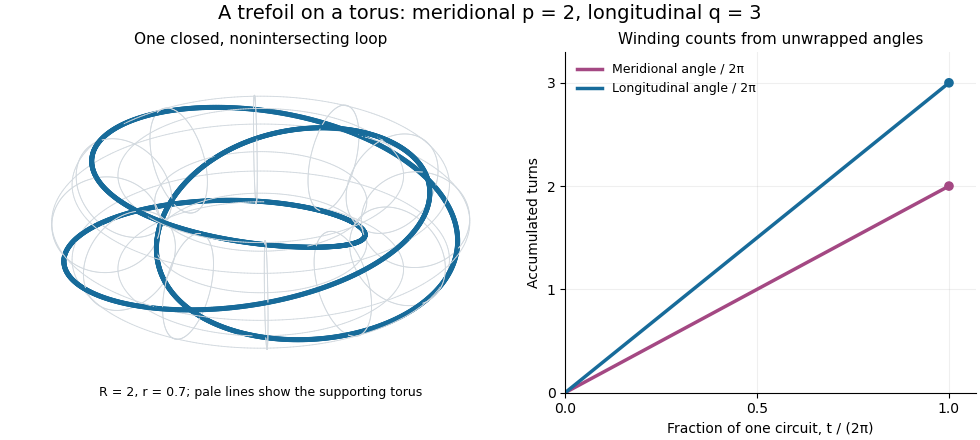
The coprime integers hypothesis matters. If the greatest common divisor is , the same parametric curve retraces a single component times; it does not automatically draw different components. The corresponding torus link is instead the full set of points on the torus whose angles satisfy , with meridional angle and longitudinal angle . It has disjoint components, each with winding counts . For instance, the torus link consists of two parallel loops and is a Hopf link, whereas substituting into simply traces one of those loops twice.
The connected sum removes a short unknotted arc from each of two oriented knots and joins the four endpoints by an orientation-compatible pair of arcs.
The unknot is the knot type represented by the planar circleEquivalently, an unknot is a knot that bounds a smoothly embedded disk in the three-sphere. The disk must itself be embedded; merely filling a loop with a map that is allowed to intersect itself does not establish that the knot is an unknot. Flattening a neighborhood of an embedded spanning disk explains why this criterion recovers the planar circle.
A complicated drawing can still represent an unknot. Starting with a crossing-free knot diagram of , insert a small kink by a type I Reidemeister move. The resulting knot diagram has one crossing, but removing the kink exhibits the same unknot. Repeating in separate small regions gives knot diagrams of the unknot with arbitrarily many crossings, although the crossing number of a knot is . A drawing's apparent complexity is therefore not a certificate of knotting.
The normalized Alexander polynomial of a knot and Jones polynomial of the unknot are both , and its knot group is the infinite cyclic group , because the knot exterior is a solid torus. These are useful comparison values. In particular, a nonconstant Alexander polynomial of a knot certifies that a knot is not an unknot, but the converse fails: nontrivial untwisted Whitehead doubles also have Alexander polynomial of a knot .
Pinned article: Introduction to the OurBigBook Project
Welcome to the OurBigBook Project! Our goal is to create the perfect publishing platform for STEM subjects, and get university-level students to write the best free STEM tutorials ever.
Everyone is welcome to create an account and play with the site: ourbigbook.com/go/register. We belive that students themselves can write amazing tutorials, but teachers are welcome too. You can write about anything you want, it doesn't have to be STEM or even educational. Silly test content is very welcome and you won't be penalized in any way. Just keep it legal!
Intro to OurBigBook
. Source. We have two killer features:
- topics: topics group articles by different users with the same title, e.g. here is the topic for the "Fundamental Theorem of Calculus" ourbigbook.com/go/topic/fundamental-theorem-of-calculusArticles of different users are sorted by upvote within each article page. This feature is a bit like:
- a Wikipedia where each user can have their own version of each article
- a Q&A website like Stack Overflow, where multiple people can give their views on a given topic, and the best ones are sorted by upvote. Except you don't need to wait for someone to ask first, and any topic goes, no matter how narrow or broad
This feature makes it possible for readers to find better explanations of any topic created by other writers. And it allows writers to create an explanation in a place that readers might actually find it.
Figure 1. Screenshot of the "Derivative" topic page. View it live at: ourbigbook.com/go/topic/derivativeVideo 2. OurBigBook Web topics demo. Source. - local editing: you can store all your personal knowledge base content locally in a plaintext markup format that can be edited locally and published either:This way you can be sure that even if OurBigBook.com were to go down one day (which we have no plans to do as it is quite cheap to host!), your content will still be perfectly readable as a static site.
- to OurBigBook.com to get awesome multi-user features like topics and likes
- as HTML files to a static website, which you can host yourself for free on many external providers like GitHub Pages, and remain in full control

Figure 2. You can publish local OurBigBook lightweight markup files to either OurBigBook.com or as a static website.
Figure 3. Visual Studio Code extension installation.
Figure 5. . You can also edit articles on the Web editor without installing anything locally. Video 3. Edit locally and publish demo. Source. This shows editing OurBigBook Markup and publishing it using the Visual Studio Code extension. 
- Infinitely deep tables of contents:



All our software is open source and hosted at: github.com/ourbigbook/ourbigbook
Further documentation can be found at: docs.ourbigbook.com
Feel free to reach our to us for any help or suggestions: docs.ourbigbook.com/#contact