Topics (384k) Articles (398k) Users (410) Discussions (242) Comments (383) Files (13k) New article

For a body lying above an obstacle with height , its normal displacement graph must obey the displayed inequality. Equality allows contact and strict inequality means separation. This is a unilateral mechanical constraint: motion away from the obstacle is allowed, but motion through it is forbidden. In nonadhesive frictionless contact the associated normal contact force can push the body outwards but cannot pull it into the obstacle.
For a nonadhesive obstacle, is the signed separation and its outward normal contact force. Nonpenetration gives , absence of adhesion gives , and reaction is possible only at contact, giving . In a small-slope taut-string model, and force balance gives for downward applied load . The three conditions then become , , . Multiplication by admissible displacement differences and integration gives the associated variational inequality, connecting a local contact law to constrained energy minimization.
A toric contact lens has different optical powers along different principal meridians, allowing correction of astigmatism. Its orientation matters because rotating those meridians changes the direction of correction. Optical power and rotational stability are therefore separate design requirements.
For smooth equality constraints and inequality constraints , this condition requires linear independence of all equality gradients and active inequality gradients at the feasible point. It ensures existence of Lagrange multipliers at a local optimum and uniqueness of their values for a fixed objective gradient. It implies the Mangasarian–Fromovitz constraint qualification by solving the independent gradient equations with zero equality derivatives and positive active inequality derivatives.
At a feasible point for smooth , , the equality gradients must be independent and there must be a direction with and for every active inequality. It supplies a first-order direction strictly into all active inequality constraints while respecting the equality tangent space. This constraint qualification ensures the usual Karush-Kuhn-Tucker conditions are necessary for local optimality. For a strictly convex quadratic inequality restricted to an affine equality space, it holds at every feasible point exactly when a strictly feasible point exists; moving from a boundary point toward a strictly feasible point supplies the required direction.
Retention of a mass of faeces, commonly in the rectum. An enema is one possible treatment following assessment. [ref]
Constipation by the NHS. Complications of long-term constipation
Every real interval is connected. Otherwise a separation into two nonempty relatively open sets defines a continuous real function equal to zero on one side and one on the other. Choose one point of each set. The intermediate value theorem on the closed segment between them requires the value , a contradiction. The converse also holds: a connected subset of the real line contains every point between two of its points, since omitting an intermediate point separates it into its intersections with the two open half-lines.
Suppose are nonempty connected spaces, and , are proper subsets. Then , with its subspace topology from the product topology, is a connected space. No closed set or open set hypothesis on is needed.
Choose , . The two topological subspaces and are homeomorphic to the factors, intersect at , and lie in . Their union is a connected subset . Every has or . In the first case its entire vertical copy lies in and meets ; in the second case the horizontal copy does so. Thus is a connected union with a connected hub.
Both properness assumptions are needed for this general result. Taking , and gives the two disjoint open half-planes and , a separation of a topological space of the complement.
Let be a compact Hausdorff space and let be compact subsets such that all finite intersections are nonempty and connected. Their total intersection is nonempty by the finite intersection characterization of compactness, and compact because it is closed in .
If were not connected, its separation of a topological space would divide it into two nonempty compact subsets. Separation of disjoint compact subsets gives disjoint ambient open sets containing the two pieces. The family consisting of and all has empty total intersection, so some finite subfamily has empty intersection. Hence a finite intersection of the lies in . Since meets both open sets, they disconnect , a contradiction. The hypothesis on all finite intersections is stronger than requiring each individual to be connected.
A subset of a topological space is a connected set when its subspace topology is connected. Thus connectedness is tested using relatively open sets, not only subsets open in the ambient space.
A topological space is disconnected space if it can be written as the union of two disjoint nonempty open subsets. Such a pair is a separation of a topological space. Each of the subsets is also closed, and conversely a nontrivial subset that is both open and closed gives a separation of a topological space with its complement.
Compose the lens-to-quadrant Möbius map with the logarithm having argument in on the first quadrant. Polar coordinates show that the latter maps bijectively to the horizontal strip . Its inverse is the exponential function, so the combined inverse is . Both derivatives are nonzero, proving conformality. The logarithm's branch fixes the strip's vertical position; adding shifts that position without changing the exponential inverse.
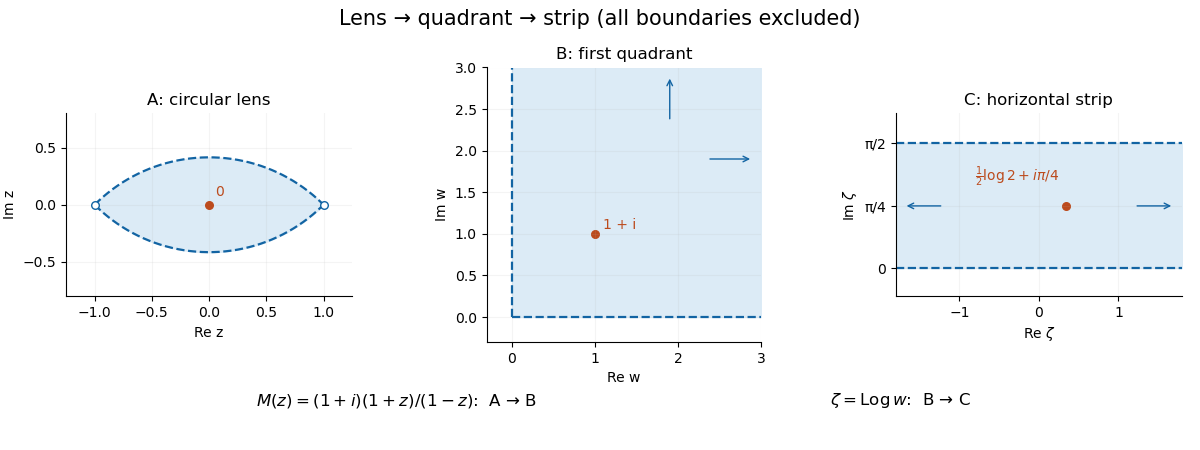
The map is a bijective conformal map from the open first quadrant to the complex upper half-plane. In polar coordinates it doubles arguments from to , and its derivative never vanishes inside the quadrant. Its inverse is the branch of the square root with argument in . By conformal invariance of harmonicity, a harmonic function on the half-plane pulls back to . The two boundary rays map to the positive and negative real axes, respectively.
For , this conformal map takes , bijectively onto the upper half-plane. Its imaginary part is , and its derivative is nonzero in the interior. The end wall maps to and the two long walls to the complementary real rays. To prove the map is onto and injective, first put , which maps onto , . The equation has exactly one root outside the unit circle when : the roots have product one and neither has unit modulus. The identity puts that root in the correct half-plane. This permits planar potential flow problems in a closed-end channel to be solved by the method of images.
On , let and write with . The exponential function is a conformal map from the strip bijectively onto the upper half-plane, sending to . The affine map is an automorphism of the half-plane sending to . Conjugate it by , using the principal complex logarithm as the inverse. The displayed formula is a conformal automorphism of the strip and satisfies . The branch range is what prevents an unwanted vertical period in this inverse.
A researcher who studied how nacre's layered structure produces structural coloration. In a study with Chunhui Zhou and Elina Myagkaya, Fan performed the theoretical analysis and computational simulation and designed the experiments. Modeling interference between reflected light from successive layers made the color pattern a probe of layer thickness.[ref]
A researcher who coauthored a study of structural coloration in nacre. Zhou investigated the origin of pearl iridescence and arranged and supervised the experiments. The study compared the spatial color pattern with a layered optical model, using interference to infer structural information that ordinary color matching alone can obscure.[ref]
Investigation of Nacre Nanostructure by Analyzing Its Structural Color Pattern by Nicole Fan and others. Author contributions and introduction on color-pattern analysis
A coauthor of a study connecting nacre's structural coloration with its layered internal structure. Myagkaya performed the scanning electron microscopy analysis, providing a direct structural measurement to accompany the optical model. The work illustrates how measurements of reflected light can constrain layer thickness, while microscopy checks the structure responsible for the color.[ref]
Mass concentration is the mass of a specified constituent divided by the final sample volume, . Its SI unit is ; laboratory data also commonly use mass per litre.[ref]
For example, of a solute in a final solution volume of gives . The denominator is the solution volume after mixing, not necessarily the volume of solvent initially added.
If is mass fraction and the mixture mass density, then . Heating or compressing the sample can change the mass concentration through a change of volume while leaving the mass fraction unchanged.
Pinned article: Introduction to the OurBigBook Project
Welcome to the OurBigBook Project! Our goal is to create the perfect publishing platform for STEM subjects, and get university-level students to write the best free STEM tutorials ever.
Everyone is welcome to create an account and play with the site: ourbigbook.com/go/register. We belive that students themselves can write amazing tutorials, but teachers are welcome too. You can write about anything you want, it doesn't have to be STEM or even educational. Silly test content is very welcome and you won't be penalized in any way. Just keep it legal!
Intro to OurBigBook
. Source. We have two killer features:
- topics: topics group articles by different users with the same title, e.g. here is the topic for the "Fundamental Theorem of Calculus" ourbigbook.com/go/topic/fundamental-theorem-of-calculusArticles of different users are sorted by upvote within each article page. This feature is a bit like:
- a Wikipedia where each user can have their own version of each article
- a Q&A website like Stack Overflow, where multiple people can give their views on a given topic, and the best ones are sorted by upvote. Except you don't need to wait for someone to ask first, and any topic goes, no matter how narrow or broad
This feature makes it possible for readers to find better explanations of any topic created by other writers. And it allows writers to create an explanation in a place that readers might actually find it.
Figure 1. Screenshot of the "Derivative" topic page. View it live at: ourbigbook.com/go/topic/derivativeVideo 2. OurBigBook Web topics demo. Source. - local editing: you can store all your personal knowledge base content locally in a plaintext markup format that can be edited locally and published either:This way you can be sure that even if OurBigBook.com were to go down one day (which we have no plans to do as it is quite cheap to host!), your content will still be perfectly readable as a static site.
- to OurBigBook.com to get awesome multi-user features like topics and likes
- as HTML files to a static website, which you can host yourself for free on many external providers like GitHub Pages, and remain in full control

Figure 2. You can publish local OurBigBook lightweight markup files to either OurBigBook.com or as a static website.
Figure 3. Visual Studio Code extension installation.
Figure 5. . You can also edit articles on the Web editor without installing anything locally. Video 3. Edit locally and publish demo. Source. This shows editing OurBigBook Markup and publishing it using the Visual Studio Code extension. 
- Infinitely deep tables of contents:



All our software is open source and hosted at: github.com/ourbigbook/ourbigbook
Further documentation can be found at: docs.ourbigbook.com
Feel free to reach our to us for any help or suggestions: docs.ourbigbook.com/#contact