Impact cratering begins with contact and compression, in which a shock rapidly heats and compresses target and impactor. During excavation, material moves outward and upward, producing a transient cavity and ejecta. Modification then involves gravitational collapse, wall slumping, fallback and, for large structures, rebound and central features. The stages overlap in time; crater size and morphology depend on gravity, impact conditions and target strength, not just the projectile's geometric hole size.
Io's volcanic structures and young resurfaced regions indicate strong ongoing geological activity, despite a low sunlight-set equilibrium temperature. Tidal dissipation forced by its orbital interactions supplies interior energy. Europa's fractured relatively lightly cratered ice indicates resurfacing and a mechanically active ice shell on geological timescales, with tidal heating a plausible contributor; surface appearance alone does not prove every fracture is currently opening. Ganymede has both older cratered regions and grooved younger terrain, indicating a more varied resurfacing history; primordial/radiogenic heat and past tides can matter. Callisto's heavily cratered surface suggests much less extensive recent resurfacing, without proving that all interior activity or subsurface liquid is absent.
The comparison is between surface ages and possible energy sources, not simply “warmer means active.” Surface irradiation is too cold to explain silicate volcanism, while internal heat, tidal work and material-dependent melting temperatures can sustain processes below a cold surface. The NASA images in the source are evidence to interpret; no exam illustration is reproduced.
For W m and emissivity one, the estimates are
These are effective fourth-power averages set by absorbed sunlight, not automatic surface thermometer readings. Uncertainty in actual albedo, emissivity and redistribution changes a more detailed model.
The formula assumes spherical geometry, an effective uniform emission temperature, steady balance, specified bolometric emissivity, no important internal heating and appropriate redistribution or averaging. An atmosphere is not mathematically required: for any surface-temperature pattern the same global balance holds with if emissivity is uniform. Without redistribution on an ideal airless surface, local dayside equilibrium instead gives and the instantaneous night side would approach zero in the no-storage limit. Atmospheric absence alone does not justify replacing the factor four by one for a global temperature.
Radiative equilibrium balances absorbed solar power against emitted thermal power, with no net energy accumulation. A spherical body's projected area absorbs ; its full area emits . Hence
Here is bolometric Bond albedo, not a geometric albedo measured at one phase or wavelength. The radius cancels because the absorption and emission areas scale together.
Use an explicit Tully-Fisher-type scaling for comparable spiral populations and photometric band. Relative to the preceding galaxy,
The exponent and normalization are empirical and have scatter; one galaxy alone does not establish the relation. Different stellar populations, inclination errors and extinction change the photometric inference.
The low-redshift distance gives modulus about 36.28, so and . A stellar mass-to-light ratio of order one to a few would imply only –several in stars, below the dynamical estimate. Gas and a dark component can supply additional mass; the precise stellar estimate requires a population-dependent mass-to-light ratio and extinction correction.
An exponential luminous disk has most of its mass within a few scale lengths. Outside that concentration a mass-traces-light model tends toward a declining, approximately Keplerian speed, not an extended flat curve. Adding a spatially extended mass distribution explains the mismatch more naturally than merely rescaling the same concentrated light profile.
The 21.1 cm line is neutral hydrogen's hyperfine spin-flip transition, observed with radio telescopes and interferometers in the cool/warm neutral gas disk, often beyond the bright stellar disk. The mean wavelength gives and, using the stated low-redshift Hubble approximation, Mpc. A 16-arcsecond angular radius gives kpc. For a thin circular disk, , so from face-on.
The original spectrum reaches roughly 21.98 and 22.02 cm: km s. Deprojecting gives . A spherical dynamical estimate gives . A thin massive disk is not spherical: its exact rotation-to-total-mass coefficient depends on radial mass profile. The no-exterior-matter assumption does not uniquely fix that coefficient, so the quoted result is the conventional order-of-magnitude dynamical estimate. Cosmological luminosity and angular-diameter distances differ at this redshift; the source's simple Hubble-distance convention is being used consistently.
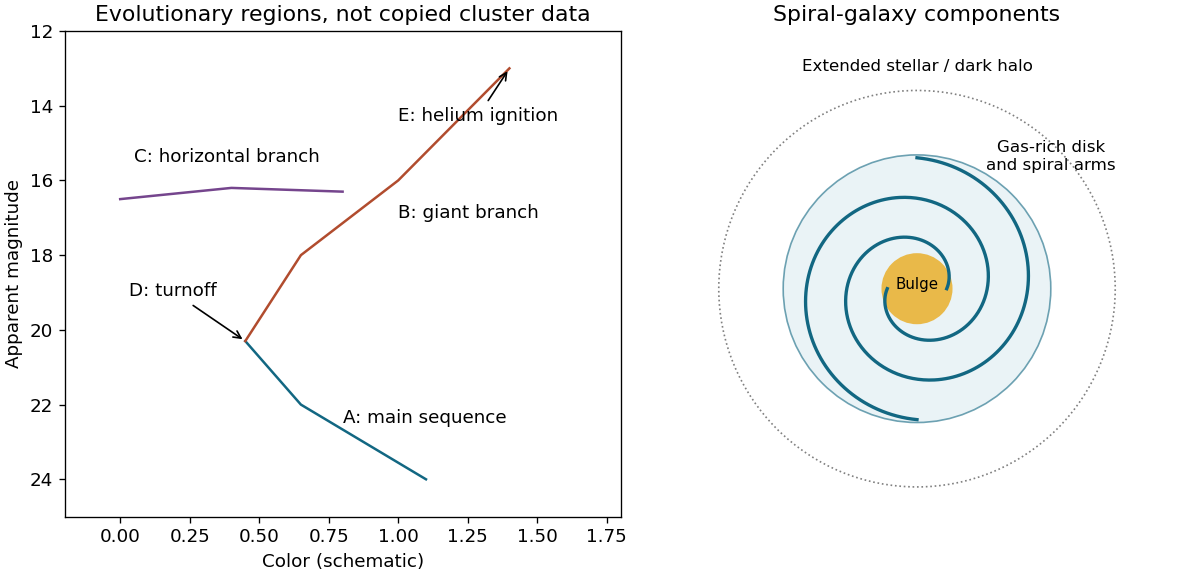
A spiral galaxy has a rotating stellar/gas disk with spiral structure, central bulge, extended halo and globular clusters, embedded in a still larger dark-matter distribution. For the Milky Way useful rough scales are a stellar-disk diameter of a few tens of kiloparsecs, a thin-disk thickness of a few hundred parsecs, a bulge scale of kiloparsecs and a halo extending tens to hundreds of kiloparsecs depending on tracer. Young stars follow gas-rich star-forming disk regions and spiral arms. Very old stars are prominent in globular clusters, halo and bulge, though the disk also contains old populations. These are distributions with overlapping ages, not disjoint bins.
Figure 1.
Schematic stellar evolutionary regions and spiral-galaxy components used in the solutions
. Details.
The given cooling law yields K. Combine it with the ion thermal energy to obtain
For this is about years; the exact value is retained in the independent numerical check. At approximately fixed radius, , giving . The required cooling time is comparable to the cosmic age and leaves little time for progenitor evolution. Such objects would also be very faint. This explains scarcity in the toy model, rather than a universal prohibition on observing ultracool white dwarfs. The source's categorical absence claim is too strong; detailed cooling histories can differ. The ideal-ion heat capacity and luminosity law are being extrapolated into regimes where crystallization, atmosphere physics and other corrections matter, so this is not a precision cooling age.
A concrete observational counterexample to a categorical absence in this temperature regime is the observed ultracool population including LHS 1402, LHS 3250 and SDSS J1337+00, with published atmosphere fits spanning about 3240–3480 K. [ref]
Degenerate electrons conduct heat efficiently, making most of the interior nearly isothermal while an outer nondegenerate insulating envelope sustains a large temperature gradient. Nuclei have much larger masses and much smaller thermal de Broglie wavelengths than electrons, so their quantum degeneracy is weak at these temperatures/densities, although Coulomb coupling and crystallization can matter. Under the stipulated classical ideal-carbon-ion approximation,
This excludes crystallization, latent heat and low-temperature heat-capacity changes; nondegenerate does not automatically mean weakly interacting.
A white dwarf is a compact stellar remnant supported primarily by electron degeneracy pressure, radiating stored thermal energy rather than sustained main-sequence fusion. At zero-temperature leading order, filling electron momentum states gives and . Fully ionized hydrogen mass fraction , with other nuclei approximately one electron per two nucleons, implies . Therefore
This is an polytrope. Solving hydrostatic structure with a zero-pressure surface gives ; the numerical factor uses and of that Lane-Emden solution. Thus . For , , is about km. A uniform-density scaling gives the same mass dependence but a different order-one coefficient and should be identified as such.
Independently, , or about km. Agreement is good at this level; relativistic degeneracy becomes relevant for accurate modeling near one solar mass and eventually invalidates an unlimited nonrelativistic mass-radius law.
For a thin spherical shell, outward pressure force is and inward weight is . Balance gives . This assumes approximately spherical, slowly evolving structure without important rotational or magnetic support.
At D, . Ignoring differential bolometric corrections, , and gives . If accessible fuel fraction is similar, lifetime scales as . Normalizing to a solar main-sequence lifetime about 10 Gyr gives an age near .
This is much older than the Sun's current approximately 4.6 Gyr and close to the cosmological age scale. The approximate estimate is not evidence for a cluster older than the Universe: bolometric corrections, abundance, accessible hydrogen fraction and the crude mass-luminosity law limit precision. The stated 26.7 MeV conversion and an assumed core fuel fraction can supply the order-of-magnitude solar lifetime; they do not by themselves specify the burned fraction or composition precisely.
An isochrone is the locus of stars of a common age and composition over a range of initial masses. A real cluster diagram approximates it, with scatter from binaries, measurement errors, composition spread and differential reddening. Region A is the hydrogen-core-burning main sequence. Region B contains evolved subgiant/red-giant stars, typically with hydrogen-shell burning around an increasingly helium-rich core. Region C is the horizontal branch, occupied by core-helium-burning stars; RR Lyrae lie in its instability strip.
Point D is the main-sequence turnoff: core hydrogen exhaustion drives structural readjustment toward shell burning and expansion. Point E is the tip of the red-giant branch, where a low-mass star ignites helium in its degenerate core, the helium flash, and subsequently moves toward horizontal-branch conditions. The two labeled events are different evolutionary transitions, not merely changes in apparent color from dust.
The color excess is mag, hence mag. The observed modulus is 15.4, while the extinction-corrected modulus is . Thus . Distinguishing the apparent and true moduli avoids treating extinction as extra distance.

Pinned article: Introduction to the OurBigBook Project

Welcome to the OurBigBook Project! Our goal is to create the perfect publishing platform for STEM subjects, and get university-level students to write the best free STEM tutorials ever.
Everyone is welcome to create an account and play with the site: ourbigbook.com/go/register. We belive that students themselves can write amazing tutorials, but teachers are welcome too. You can write about anything you want, it doesn't have to be STEM or even educational. Silly test content is very welcome and you won't be penalized in any way. Just keep it legal!
We have two killer features:
  1. topics: topics group articles by different users with the same title, e.g. here is the topic for the "Fundamental Theorem of Calculus" ourbigbook.com/go/topic/fundamental-theorem-of-calculus
    Articles of different users are sorted by upvote within each article page. This feature is a bit like:
    • a Wikipedia where each user can have their own version of each article
    • a Q&A website like Stack Overflow, where multiple people can give their views on a given topic, and the best ones are sorted by upvote. Except you don't need to wait for someone to ask first, and any topic goes, no matter how narrow or broad
    This feature makes it possible for readers to find better explanations of any topic created by other writers. And it allows writers to create an explanation in a place that readers might actually find it.

    Figure 1.
    Screenshot of the "Derivative" topic page
    . View it live at: ourbigbook.com/go/topic/derivative
  2. local editing: you can store all your personal knowledge base content locally in a plaintext markup format that can be edited locally and published either:
    This way you can be sure that even if OurBigBook.com were to go down one day (which we have no plans to do as it is quite cheap to host!), your content will still be perfectly readable as a static site.
    Figure 5. . You can also edit articles on the Web editor without installing anything locally.
    Video 3.
    Edit locally and publish demo
    . Source. This shows editing OurBigBook Markup and publishing it using the Visual Studio Code extension.

  3. https://raw.githubusercontent.com/ourbigbook/ourbigbook-media/master/feature/x/hilbert-space-arrow.png
  4. Infinitely deep tables of contents:
    Figure 6.
    Dynamic article tree with infinitely deep table of contents
    .
    Descendant pages can also show up as toplevel e.g.: ourbigbook.com/cirosantilli/chordate-subclade
All our software is open source and hosted at: github.com/ourbigbook/ourbigbook
Further documentation can be found at: docs.ourbigbook.com
Feel free to reach our to us for any help or suggestions: docs.ourbigbook.com/#contact