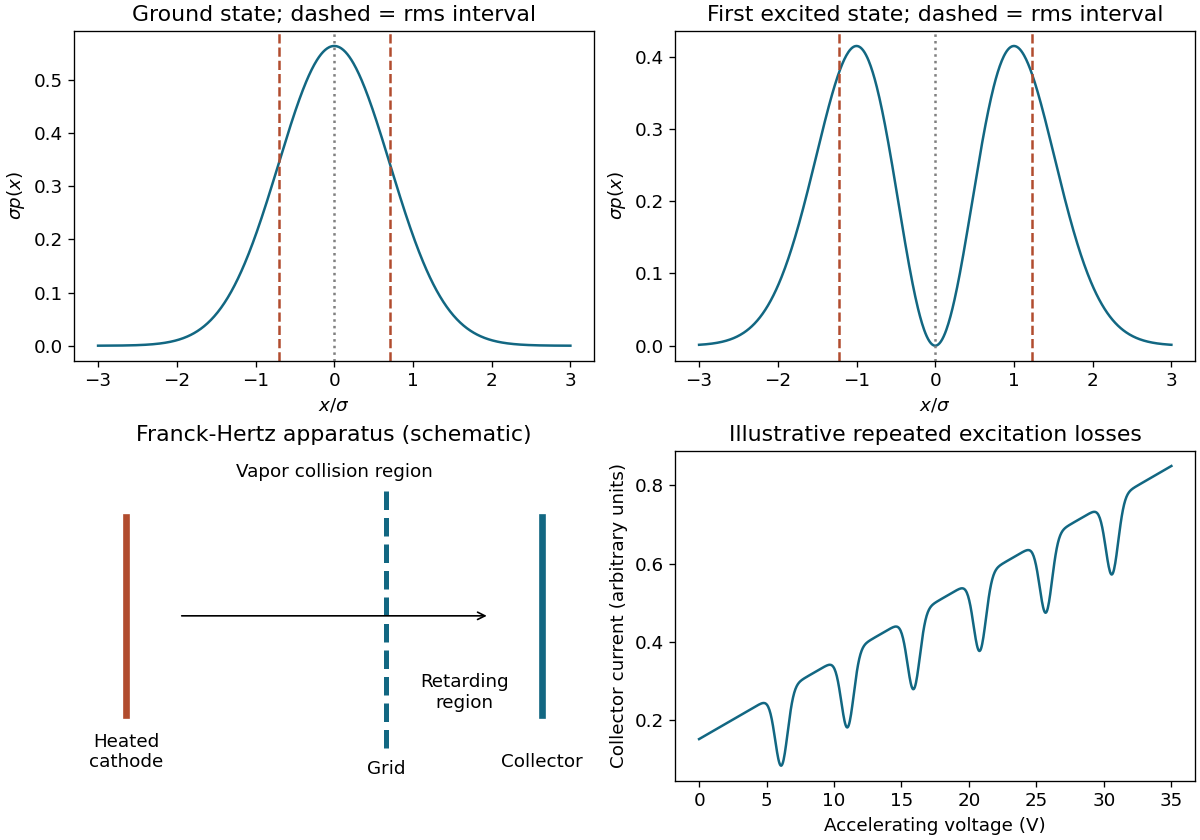
Squaring the states gives . The first peaks at zero; the second has a node there and peaks at . For a centered interval of width , , whereas . Its leading linear term vanishes, but the probability in a finite interval is not exactly zero.
Figure 1.
Ground and first-excited oscillator distributions, and an original Franck-Hertz apparatus and signal schematic
. Details.
For the Gaussian, . Using , the terms cancel and leave . For , differentiation gives , and the same cancellation gives . The normalization constants do not affect these eigenvalue equations.
Integrating gives up to a constant. Thus , with . The potential is a symmetric upward parabola and tends to infinity in both directions; normalizable states decay at large .
The equation is . The generator of time evolution is the sum of kinetic and potential energy operators. For a sharp stationary energy, insert to obtain . The probability in is , normalized to one; hence a normalized one-dimensional wavefunction has dimensions length. Its overall phase is unobservable, but relative phase affects interference.
To distinguish equal transverse bins across width , . Six bits gives one-nanometre pixels; ten gives 0.0625 nm, below the helium wavelength. In the stipulated fixed-energy freely propagating beam, the latter entails transverse diffraction momenta comparable to or exceeding the available total momentum and lies outside the paraxial aperture model. Six-bit localization is less demanding, although fine detector resolution and losses remain practical constraints. This is not a universal theorem that an atom can carry at most six bits in every encoding: accessible modes, energy, aperture, measurements and success probabilities define the channel.
For an aligned narrower slit placed immediately after the first, uniform illumination gives transmission probability . Conditional on passage the same normalized formula applies with replaced by and central-lobe momentum scale . Position rms is , while the exact hard-edge rms is infinite. Thus the source's finite “uncertainty” can only mean a characteristic diffraction width; the rigorous Heisenberg inequality is not violated, and smoothing the edges restores finite rms moments satisfying it.
A 10 keV X-ray has nm. The ideal position-filter probability and momentum formula at fixed aperture widths are unchanged, since the Fourier transform involves and the aperture geometry. Its larger total momentum makes the angular diffraction width smaller, approximately . Real slit-material transmission and absorption are additional experimental issues.
Immediately after a uniformly illuminated hard slit, the normalized transmitted state is for , zero elsewhere. With Fourier convention ,
The supplied sinc integral verifies unit normalization. The first zeros occur at , but this finite central-lobe width is not the rms uncertainty: fails to have a convergent integral.
Approximate helium mass by kg. Nonrelativistic momentum is , giving . A transverse width of one micrometre implies a characteristic position uncertainty of that order and a minimum momentum uncertainty of order kg m s, with factors depending on profile convention. For a uniform interval , but an exactly abrupt rectangular wavefunction actually has infinite rms momentum spread. Width alone does not uniquely specify both rms uncertainties; a smooth near-minimum-uncertainty beam is needed for a finite order-of-magnitude estimate.
Blackbody radiation defeated classical equipartition because it predicts excessive short-wavelength emission. Quantized oscillator energy exchange , and ultimately the photon occupation law, gives the Planck spectrum. In the photoelectric effect, electron energy follows light frequency with a threshold, rather than simply increasing with beam intensity; individual photons supply and the maximum kinetic energy is . Intensity chiefly changes the event rate at a fixed frequency. These explain two distinct failures of a purely continuous classical wave-plus-matter model, while retaining wave propagation and interference.
A point mass at the rotation center has zero perpendicular distance to the axis, so . More generally, moving a fixed mass inward lowers its moment even if its total gravitational monopole and outer radius remain fixed.
Build a solid uniform sphere from thin shells: . Integration gives , while . Hence . This is a spherical uniform-density model; planetary flattening modifies the exact relation.
For a thin uniform spherical shell, and angular averaging gives . Thus . The printed formula requires a negligibly thin outer shell. For a finite-thickness hollow sphere of uniform density between and ,
For example gives , not . The thin-shell limit restores the printed result. A uniform outer layer of unspecified thickness does not by itself establish it.
Helium becoming partially immiscible in dense hydrogen can form helium-rich droplets that settle inward. Gravitational energy release and associated thermal evolution can supply extra luminosity, while the upper hydrogen envelope becomes helium depleted. Different interior temperature-pressure histories can make separation stronger in Saturn than in Jupiter.
The source's ratio is reversed for this intended explanation. Depleting helium lowers He/H and raises H/He. For a concrete example, keeping ten hydrogen units while reducing one helium unit to one half changes H/He from ten to twenty, not to a lower value. Thus the literal statement that Saturn has lower H/He cannot simultaneously be used as evidence for the stated upper-envelope helium-depletion mechanism. If the intended comparison is lower He/H, the observations and extra heat are mutually consistent with helium rain. Composition measurements and interior modeling are still needed; excess heat alone does not uniquely prove that process.[ref]
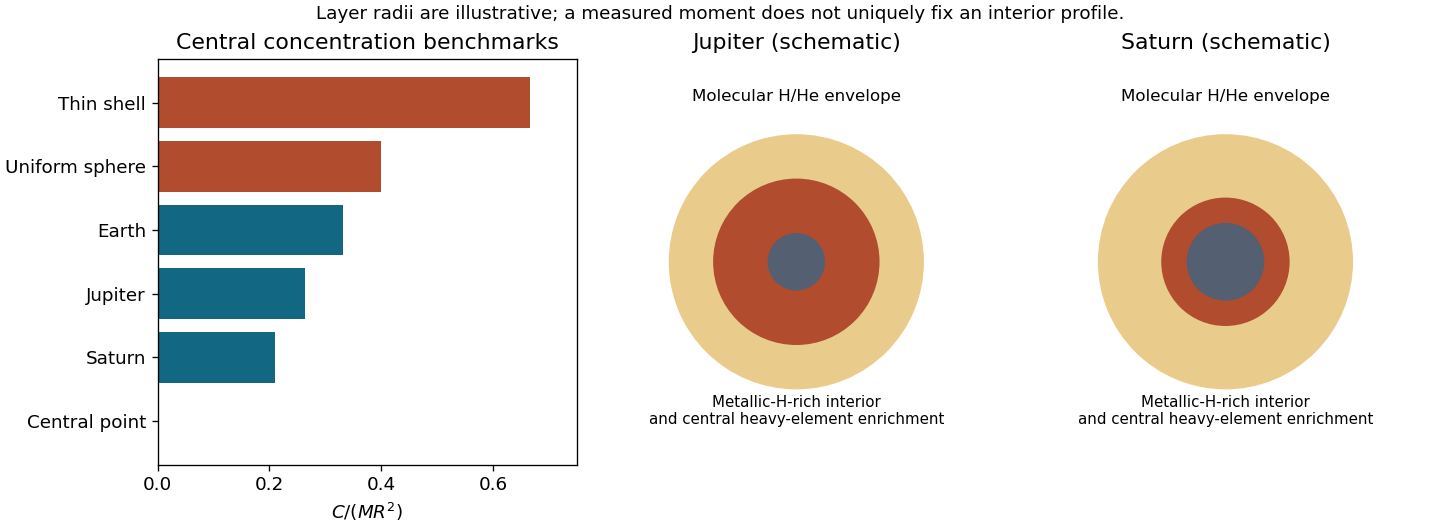
A qualitative sketch has molecular hydrogen/helium outside, increasing pressure into a conducting metallic-hydrogen-rich interior, and centrally enhanced heavy elements, possibly distributed rather than confined to a sharp solid core. Saturn's lower mass produces different pressure/temperature transitions and a larger relative role for central concentration. Both can have compositional gradients and helium separation; the moment alone does not decide whether any boundary is sharp.
Figure 1.
Moment-of-inertia benchmarks and qualitative giant-planet interior structures
. Details.
All three measured factors are below the uniform-sphere value 0.4, indicating central concentration. Earth at 0.331 is consistent with a dense core and less dense mantle; Jupiter at 0.264 and Saturn at 0.21 have still more centrally concentrated normalized distributions, with Saturn especially concentrated relative to its outer radius. These numbers do not uniquely determine core masses, chemical boundaries or density profiles.
Rotation rate, oblateness and measured external gravitational multipoles provide constraints beyond mass and radius; spin-axis precession/nutation and satellite dynamics can add moment-related information. For a giant planet the deep rotation rate and hydrostatic approximation matter. These measurements require an interior model or supplementary constraints for an accurate moment: a spherically symmetric body's exterior monopole alone cannot reveal its radial density distribution. An exact moment cannot generally be inferred just by labeling a measured as .
Permanently shadowed polar craters can remain cold enough to trap water ice and other volatiles for long periods. LCROSS used an impact plume to expose and spectroscopically sample material from such a cold trap, testing the interpretation of polar hydrogen signatures and the availability/history of lunar volatiles. Shadow was therefore a physical target-selection criterion, not merely an observational inconvenience.[ref]
At fixed projectile mass and the assumed common quarter-power law, changing diameter from 30 to 75 m increases energy by and speed by . The corresponding primary impact speed is about 15.6 km s. Five percent transferred to secondary-forming ejecta gives m s. Therefore
This assumes a 45-degree launch and similar target properties/coupling, as well as the source's fixed mass and velocity-transfer rules. Such a range is a noticeable fraction of the lunar radius, so curvature would produce a correction; the supplied flat-surface formula is an estimate rather than exact lunar orbit dynamics.
In a gravity-dominated excavation model, displaced mass scales as and lifting it through a distance of order costs order . If a comparable fraction of impact energy supplies this work across similar impacts, . This is a scaling justification, not a universal crater law: strength-dominated small craters or varying coupling efficiencies can have different exponents.
For a locally flat airless surface, constant gravity and equal launch/landing heights, and . The positive flight time is . Thus
Neglected effects include curvature, varying gravity, rotation and terrain. At ranges comparable to the body's radius a spherical ballistic calculation is necessary.

Pinned article: Introduction to the OurBigBook Project

Welcome to the OurBigBook Project! Our goal is to create the perfect publishing platform for STEM subjects, and get university-level students to write the best free STEM tutorials ever.
Everyone is welcome to create an account and play with the site: ourbigbook.com/go/register. We belive that students themselves can write amazing tutorials, but teachers are welcome too. You can write about anything you want, it doesn't have to be STEM or even educational. Silly test content is very welcome and you won't be penalized in any way. Just keep it legal!
We have two killer features:
  1. topics: topics group articles by different users with the same title, e.g. here is the topic for the "Fundamental Theorem of Calculus" ourbigbook.com/go/topic/fundamental-theorem-of-calculus
    Articles of different users are sorted by upvote within each article page. This feature is a bit like:
    • a Wikipedia where each user can have their own version of each article
    • a Q&A website like Stack Overflow, where multiple people can give their views on a given topic, and the best ones are sorted by upvote. Except you don't need to wait for someone to ask first, and any topic goes, no matter how narrow or broad
    This feature makes it possible for readers to find better explanations of any topic created by other writers. And it allows writers to create an explanation in a place that readers might actually find it.

    Figure 1.
    Screenshot of the "Derivative" topic page
    . View it live at: ourbigbook.com/go/topic/derivative
  2. local editing: you can store all your personal knowledge base content locally in a plaintext markup format that can be edited locally and published either:
    This way you can be sure that even if OurBigBook.com were to go down one day (which we have no plans to do as it is quite cheap to host!), your content will still be perfectly readable as a static site.
    Figure 5. . You can also edit articles on the Web editor without installing anything locally.
    Video 3.
    Edit locally and publish demo
    . Source. This shows editing OurBigBook Markup and publishing it using the Visual Studio Code extension.

  3. https://raw.githubusercontent.com/ourbigbook/ourbigbook-media/master/feature/x/hilbert-space-arrow.png
  4. Infinitely deep tables of contents:
    Figure 6.
    Dynamic article tree with infinitely deep table of contents
    .
    Descendant pages can also show up as toplevel e.g.: ourbigbook.com/cirosantilli/chordate-subclade
All our software is open source and hosted at: github.com/ourbigbook/ourbigbook
Further documentation can be found at: docs.ourbigbook.com
Feel free to reach our to us for any help or suggestions: docs.ourbigbook.com/#contact