The large circle contributes and the small circle contributes , so both disappear. The enclosed simple poles are and , with logarithms and . Their residues are and . The positive orientation of the keyhole therefore gives
The upper bank runs outward and the lower bank inward. Their logarithms differ by ; keeping that orientation is essential for the sign.
A branch point obstructs a single-valued analytic continuation around a closed circuit. Continuing once around zero increases its value by . A branch cut removes a curve joining branch points or extending to infinity so that a continuous argument can be chosen on the remainder. Zero and infinity are logarithmic branch points; the positive-axis cut used here selects . The cut is a choice of representation, not a line of poles of the multivalued logarithm.
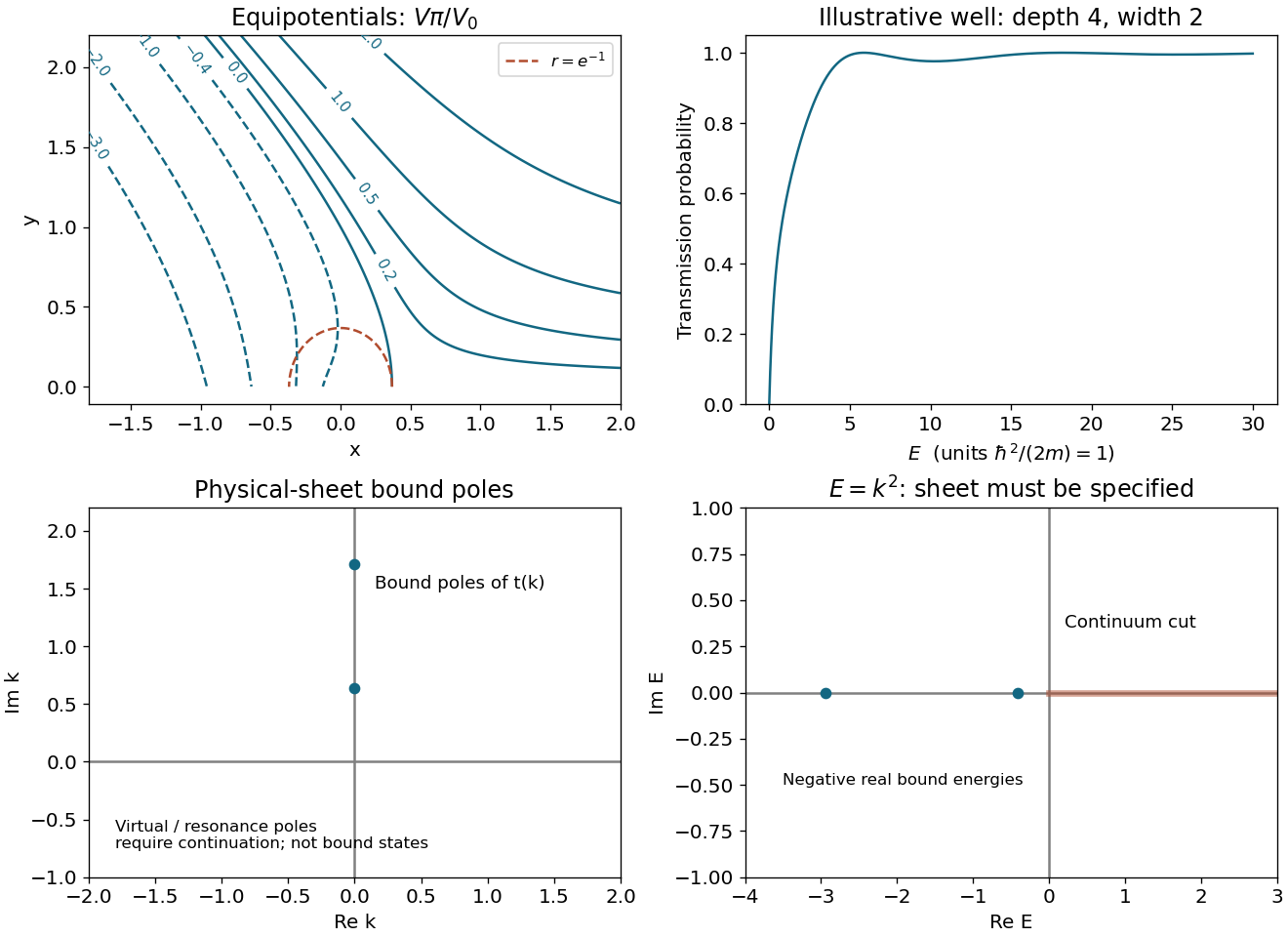
Along a level curve, , with and . Therefore
In the intended upper half-plane , the slope is positive for , vertical at , and negative for . At the positive real boundary the slope is zero except at the stationary point , where both derivatives vanish and the quotient is indeterminate. More generally, outside the chosen half-plane its sign is the sign of , with the argument branch held fixed. A convenient parametric description of the curves to sketch is .
Figure 1.
Equipotentials for the upper-half-plane logarithm branch and illustrative square-well transmission
. Details.
For the upper half-plane use , and interpret the source's arctangent as this argument. Then is harmonic, so has zero curl and divergence where there is no charge. On the positive boundary and ; on the negative boundary . Hence the two boundary values are respectively zero and .
Branch qualification: the principal real arctangent alone gives zero on both sides of , contradicting the stated negative-axis boundary condition, for example at . The continuous upper-half-plane argument repairs this notation; it is not an optional additive constant.
Choose a continuous argument on a simply connected domain avoiding zero, and put . With , direct differentiation gives
Here , ; these identities specify the branch needed in the written arctangent. Integrating the Cauchy-Riemann equations gives
The literal principal works only separately on suitable half-planes. It cannot stand for a single continuous argument across the imaginary axis.
Complex differentiability gives , . Differentiating once more, for continuously differentiable first derivatives with the needed second derivatives, yields and . Thus both components satisfy Laplace's equation. The result is local on the domain of holomorphy; it makes no assertion across a branch cut.
Lossless Hamiltonian focusing can reduce a beam's transverse position width at the expense of momentum spread, but cannot reduce its occupied canonical phase volume. Coupling to the longitudinal direction can redistribute projected emittance without reducing total emittance. True cooling requires exporting entropy to additional degrees of freedom or discarding particles: stochastic feedback, electron cooling or radiative damping coupled to an external environment provide possible mechanisms, with very different efficiency for high-energy protons. Collimation shrinks the accepted distribution at the cost of intensity. Acceleration also reduces angular divergence at fixed normalized emittance, an apparent geometrical cooling rather than a violation of Liouville's theorem. The apparatus and radiation cannot be omitted from the accounting when the bunch is no longer an isolated Hamiltonian subsystem.
The oscillator flow is
Its determinant is , explicitly preserving area. The orbits are energy ellipses; stretching one coordinate during transport is compensated by the conjugate direction.
Phase space combines all independent canonical coordinates and momenta. Its Hamiltonian velocity has divergence by equality of mixed derivatives. Thus an infinitesimal material phase volume has zero fractional rate of change. This is Liouville's theorem, valid also for explicitly time-dependent Hamiltonians. It preserves fine-grained volume, not necessarily the area of any projected coordinate pair.
Vary with fixed endpoints. Integration by parts gives , hence the Euler-Lagrange equations. Define and, assuming an invertible velocity-momentum relation, . The equivalent action is . Independent variations of and yield
Boundary terms vanish for fixed endpoint coordinates; constraining momenta independently at the same endpoints is unnecessary. Singular Lagrangians require constraint analysis instead of this unconstrained Legendre transform.
For equal masses , the newly conserved relative energy is
It is kinetic energy relative to the free center of mass plus the two interactions. Adding its constant center kinetic energy and the already conserved energies gives the total Hamiltonian. The equal-mass oscillator rotations simplify to , but are not new: for unequal masses their conserved predecessors contain the mass-weight factors. As a concrete check, independent transformations of rotate an isotropic oscillator at any positive masses. Complete mass equality does not magically make generic invariant under rotations of physical space.
When , the cosine becomes one and the previously driven relative subsystem becomes autonomous. Its energy is one new generic independent time-independent integral; equivalently total energy becomes conserved because the remaining subsystem energies already were. Making equal as well introduces no further generic continuous symmetry in the printed model. The arbitrary and distinguish particle labels and directions, so equal masses alone do not create a permutation or physical-rotation invariance.
A finite “number of conserved quantities” must mean independent generators/integrals: arbitrary functions of any integral give infinitely many. Mass-weighted rotations and free-coordinate symmetries identified in part a already exist at unequal masses. Thus the justified generic increment is one at , and zero further at complete equality. Special potentials or can change the count, but were not stipulated.
The separability of the printed Lagrangian is important. Every is an independent oscillator of the same frequency, irrespective of mass. Define , . Then the complete constant matrix , and angular quantities , include each oscillator energy and the rotational symmetries of this mass-weighted oscillator space. Alternatively its explicitly time-dependent constants are and .
Translations in all give conserved . Translation of together gives ; is free and gives . Their center-of-mass positions minus the associated constant velocities times are boost constants. The decoupled relative motion conserves , where . In mass-weighted versions, the three free center coordinates also have conserved mutual angular momenta. These families are not all functionally independent.
The relative subsystem alone is driven through . For generic nonzero its energy, and hence the total energy, is not conserved. Omitting the mass-weighted oscillator symmetries simply because the physical masses differ would miss genuine symmetries of this particular model.
A constant of motion has zero total derivative on every solution, and may explicitly depend on time. For an infinitesimal transformation with , the on-shell first variation is . Therefore is conserved. Including a time shift gives the corresponding . This proves Noether's theorem in its usual point-transformation form. A symmetry of the action up to a boundary term is sufficient; exact invariance of the displayed Lagrangian is stronger than necessary. Discrete transformations by themselves do not give this continuous-charge construction.
For , and . The equations are , . For ,
At resonance the forced terms are and . Constants depend on the marble's initial position and velocity. A general cup orientation is obtained by multiplying the vector solution by ; the physical inertial solution is unchanged by relabeling the cup axes. Resonant growth eventually invalidates the small-horizontal-motion/neglected-vertical-speed approximation.
The floor contributes gravitational potential . Neglecting vertical velocity as specified, for the nonrotating cup orientation the Lagrangian is
For general , replace the velocity components by and . The potential remains the same because the paraboloid is axisymmetric.
The cup's rotation relative to the radial basis has angular speed , so its absolute orientation has speed . With the planar rotation matrix,
At , : the cup translates on a circle while its axes remain parallel to fixed inertial axes. Thus , . Cancellation of orientation rotation does not remove acceleration of the cup's center.
In a frame rotating with angular velocity , the Coriolis force is . In the northern hemisphere horizontal flow is deflected to the right: balanced circulation is counterclockwise about a low-pressure center and clockwise about a high-pressure center. The deflection reverses in the southern hemisphere. Jupiter's counterclockwise southern Great Red Spot is consequently anticyclonic, a high-pressure system. These statements assume a large-scale rotating atmosphere; they do not explain tiny vortices dominated by local boundary conditions.
Fission power combines dense fuel and low direct carbon emissions with high capital commitments, long build schedules, financing risk and expensive decommissioning. Environmental assessment must include mining, enrichment and fabrication, cooling-water demands, normal releases, severe-accident risk and comparison with avoided fossil pollution. None of these is captured by operational carbon emissions alone.
Waste requires containment and isolation appropriate to activity, heat production and decay times. Short-lived operational waste and spent fuel have different handling needs, while geological disposal depends on engineered and natural barriers plus credible institutions. Recycling changes inventories and resource use but does not remove all waste or proliferation concerns. Public consent, transparent regulation, security and intergenerational responsibility are part of the challenge. Quantitative comparisons should specify reactor type, financing and waste policy rather than treating either zero risk or inevitable catastrophe as a physical law.
Storage has multiple performance measures: energy and power density, efficiency, cycle/calendar life, duration, cost, materials, safety and siting. Lithium-ion batteries offer high round-trip efficiency, fast response and compactness, making them useful for vehicles and short-duration grid services. That does not make them optimal for every duty. Pumped hydro can suit large stationary energy stores where geography permits; thermal stores can serve heat directly; chemical fuels or other long-duration systems can trade efficiency for cheap energy capacity. A technology that is excellent per kilogram may be poor for seasonal storage. “Best” requires a specified service and life-cycle comparison.

Pinned article: Introduction to the OurBigBook Project

Welcome to the OurBigBook Project! Our goal is to create the perfect publishing platform for STEM subjects, and get university-level students to write the best free STEM tutorials ever.
Everyone is welcome to create an account and play with the site: ourbigbook.com/go/register. We belive that students themselves can write amazing tutorials, but teachers are welcome too. You can write about anything you want, it doesn't have to be STEM or even educational. Silly test content is very welcome and you won't be penalized in any way. Just keep it legal!
We have two killer features:
  1. topics: topics group articles by different users with the same title, e.g. here is the topic for the "Fundamental Theorem of Calculus" ourbigbook.com/go/topic/fundamental-theorem-of-calculus
    Articles of different users are sorted by upvote within each article page. This feature is a bit like:
    • a Wikipedia where each user can have their own version of each article
    • a Q&A website like Stack Overflow, where multiple people can give their views on a given topic, and the best ones are sorted by upvote. Except you don't need to wait for someone to ask first, and any topic goes, no matter how narrow or broad
    This feature makes it possible for readers to find better explanations of any topic created by other writers. And it allows writers to create an explanation in a place that readers might actually find it.

    Figure 1.
    Screenshot of the "Derivative" topic page
    . View it live at: ourbigbook.com/go/topic/derivative
  2. local editing: you can store all your personal knowledge base content locally in a plaintext markup format that can be edited locally and published either:
    This way you can be sure that even if OurBigBook.com were to go down one day (which we have no plans to do as it is quite cheap to host!), your content will still be perfectly readable as a static site.
    Figure 5. . You can also edit articles on the Web editor without installing anything locally.
    Video 3.
    Edit locally and publish demo
    . Source. This shows editing OurBigBook Markup and publishing it using the Visual Studio Code extension.

  3. https://raw.githubusercontent.com/ourbigbook/ourbigbook-media/master/feature/x/hilbert-space-arrow.png
  4. Infinitely deep tables of contents:
    Figure 6.
    Dynamic article tree with infinitely deep table of contents
    .
    Descendant pages can also show up as toplevel e.g.: ourbigbook.com/cirosantilli/chordate-subclade
All our software is open source and hosted at: github.com/ourbigbook/ourbigbook
Further documentation can be found at: docs.ourbigbook.com
Feel free to reach our to us for any help or suggestions: docs.ourbigbook.com/#contact