Dust condenses in cool stellar outflows and ejecta and is processed and grown in interstellar clouds. It absorbs and scatters starlight, usually more efficiently at blue wavelengths, making a background star fainter and redder. RR Lyrae variables are old horizontal-branch pulsators with approximately calibrated absolute luminosities, so their recognizable light curves and standard-candle relation provide distances after metallicity and extinction corrections. They are not exactly identical-luminosity objects in every population.
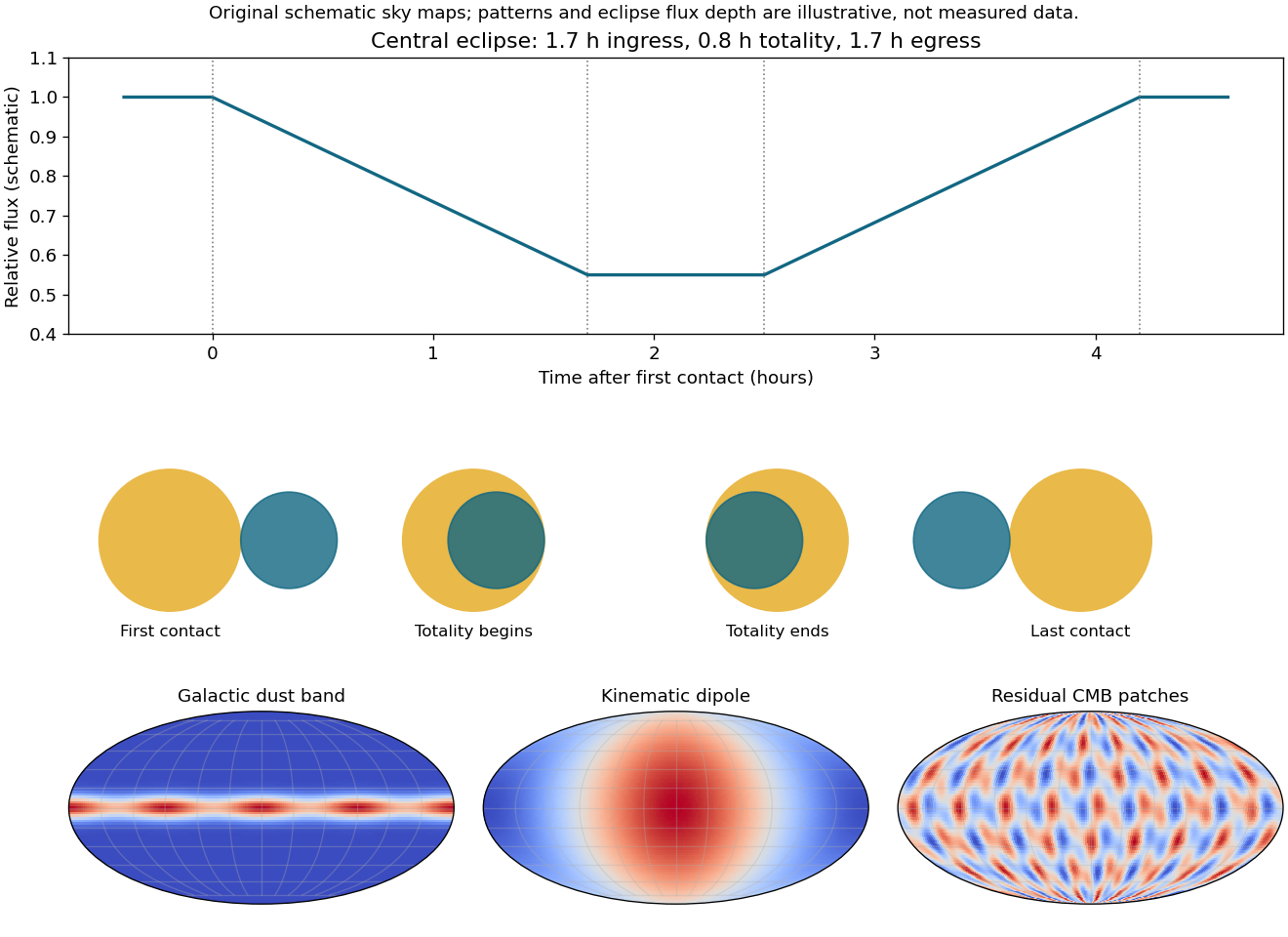
After foreground and dipole removal, primordial CMB anisotropies are small hot and cold patches across the sky, with characteristic correlated angular scales and amplitudes of order of the mean temperature. They trace perturbations at photon decoupling and subsequent propagation, not simply the current distribution of Milky Way dust.
Motion relative to an isotropic radiation field produces a dipole: one broad hot hemisphere and an opposite cool hemisphere. To first order , where is the forward direction. This is not a narrow Galactic-plane feature and is not the intrinsic small-scale CMB pattern.
Galactic dust emission is concentrated in a bright band along the Galactic plane, with clumps associated with dust-rich regions. It is a foreground with a spectrum different from a 2.7 K blackbody, so multi-frequency observations can help separate it from the CMB. The schematic below illustrates its geometry rather than reproducing observed sky data.
The given calibration yields . The distance modulus is , giving if extinction is negligible. Hubble's law predicts km s, compared with 1150 km s observed. The approximately km s difference can be a line-of-sight peculiar velocity of the cluster and observer, together with distance-calibration uncertainties. The local flow need not follow a perfectly smooth expansion law.
Expansion redshifts photon energies and preserves a blackbody spectrum, so a comoving observer at sees K. A one-sided dipole excess of 0.105% means , hence . Motion is toward the hotter region. The peak-to-peak contrast is twice this, so using 0.210% for would double the inferred speed incorrectly.
Using the supplied atomic masses consistently includes the net electron bookkeeping after positron annihilation. The released fraction is , corresponding to about 26.7 MeV per helium nucleus. If 10% of the solar mass is processed and luminosity stays constant, years.
At separation one femtometre the proton Coulomb energy is 1.44 MeV. At K, mean thermal kinetic energy keV, making their ratio about . Classical over-barrier collisions are therefore extremely improbable. Quantum tunnelling through the Coulomb barrier and the high-energy distribution tail allow fusion, with the slow weak-interaction step regulating the proton-proton chain. The reaction summary is a net energy/matter balance, not one simultaneous four-proton collision.
Hydrostatic balance is . A free-fall estimate gives s; a test particle falling in a fixed point-mass field adds factor , giving about 30 minutes.
For an ideal nonrelativistic gas with negligible boundary pressure, the virial theorem is , so total energy is . Since and , . This is a minimum magnitude, not a lower bound on the negative energy: unrestricted central concentration can make the latter arbitrarily negative. A uniform-density estimate gives and available contraction energy . Its release at present solar luminosity lasts (order – years for alternative structural estimates), much less than a nuclear-burning lifetime.
Assume a central eclipse and nearly uniform projected speed during it. Let be the smaller radius and the larger. First-to-second contact requires travel , whereas the totality interval requires . With relative speed 200 km s,
The light curve has ingress, flat minimum and egress lasting 1.7, 0.8 and 1.7 hours. At the four contacts the projected center separations are . A noncentral chord would require an impact parameter and changes the inferred radii; the data alone do not fix that geometry exactly. For comparable masses in an ordinary coeval system, a component larger than its main sequence companion suggests expansion away from the main sequence, conventionally toward a subgiant/early giant track. That is a conditional evolutionary interpretation: neither effective temperature nor a bolometric flux is supplied, so a unique position on the Hertzsprung-Russell diagram cannot be inferred from these radii alone. Binary interactions and the assumed central chord also matter; these numbers do not establish an ordinary single-star evolutionary model.
Figure 1.
Central-eclipse contact geometry and schematic microwave sky components
. Details.
Eclipses justify an approximately edge-on orbit, and equal velocity amplitudes imply equal masses. The relative speed is 200 km s, so m, or . Substitution in the binary period law gives , hence . Inclination corrections scale the dynamical masses as if exact edge-on viewing is relaxed.
The first law gives elliptical relative orbits with the center of force at a focus; the second gives equal swept areas in equal times, expressing angular-momentum conservation. For circular binary motion, let and . The force equation gives
The corresponding relation for ellipses uses the relative semimajor axis rather than instantaneous separation.
For a 1 micrometre laser, m and a cold underdense wave has . At peak wave scale , optimal passage through an accelerating half-cycle gives ideal stage gain ; crest-to-zero injection gives half that. With the illustrative m, the optimal ideal gain is about 32 GeV and a 9.9 TeV increment needs order 300 stages, or order 600 with the crest convention.
TODO — no unique stage count follows without the missing density and laser/wake amplitude assumptions. Depletion, diffraction, guiding, beam loading, injection, energy spread, driver evolution and interstage losses can all increase or otherwise alter the requirement. The parametric count is , with the phase and field conventions explicitly retained.
Propagation through an already formed cold plasma requires , hence . For the illustrative density above, that is a cutoff near 126 micrometres. It is a propagation ceiling, not a sufficient condition for producing ionization.
TODO — the unique cutoff inherits the unspecified density, and a literal maximum wavelength for gas ionization also needs gas species, laser intensity and the ionization mechanism. A single-photon threshold would impose ; strong-field or multiphoton ionization is a different criterion. None of those data is supplied. The density-dependent propagation condition is the part determined symbolically.
The required energy increment is 9.9 TeV. If the usable longitudinal gradient is , with , the channel length is
Under the illustrative preceding m and choices, GV m and m. TODO — a unique numerical length inherits the missing compression/density specification and additionally requires a usable wake amplitude/loading factor or driver information. A driver energy per proton alone does not fix its bunch population or accelerating gradient.
TODO — the source does not supply the longitudinal position-energy correlation, imposed chirp, or chicane dispersion/geometry needed for a unique compressed bunch length. A four-bend drawing and an uncorrelated energy spread are insufficient. In linear optics,
If the given spread is uncorrelated, the minimum is the unchanged 0.2 m, not a compressed submillimetre bunch. If a chirp is supplied, optimal depends on it and on the uncorrelated residual spread.
A sometimes intended phase-space lower-bound estimate conserves longitudinal emittance and permits final relative energy spread of order unity, giving m. This is an additional extreme energy-spread allowance, not a consequence of an unspecified magnetic chicane. If one illustratively matches a plasma scale , then m. Matching to a whole wavelength instead changes this by . The parametric density relation is valid; the unique requested numerical compression is not established by the source.
Lower energy changes the source spectrum as well as emittance. At fixed bending geometry, bending-radiation critical energy scales as , so it falls by ; for fixed undulator period and deflection parameter the fundamental wavelength grows as , by ten. A smaller electron emittance therefore does not automatically improve brightness at the original 10 nm wavelength: the device may no longer radiate there on its fundamental, flux and harmonic operation change, and diffraction remains. Lattice redesign can retain beam energy and target spectrum while reducing emittance, which is why energy reduction alone is not a generally satisfactory substitute.
For the same lattice radiation-integral ratio, natural geometric emittance scales as . A factor-ten decrease therefore requires . Keeping coupling ratio fixed reduces the vertical emittance by the same factor, within that ideal scaling model.
Emittance reduction has little effect when radiation dominates every source width and divergence. At fixed m, the strongest condition is , or . The divergence condition only requires nm. There is no sharp “negligible” cutoff without an allowed percentage. If the optics were reoptimized to match diffraction instead, the weaker comparison would set the relevant scale; it is not the same fixed-beta problem.
At fixed flux and bandwidth, brightness is inversely proportional to . Lowering both geometric emittances by ten makes the electron rms widths and divergences smaller by . Add the unchanged radiation widths in quadrature again and divide the old phase-space product by the new one. The resulting brightness factor is approximately , an increase of about , rather than the factor 100 that would follow if diffraction were negligible in both planes. The exact value under the adopted width convention is given by the accompanying check and plot.
State a radiation-width convention. For rms Gaussian-equivalent single-electron undulator radiation take and , so the diffraction emittance is . These give 11.3 micrometres and 70.7 microradians. Convolve independent electron and radiation widths in quadrature. The total photon source is then
Some approximate undulator width conventions differ by order-one factors; these must be kept consistent in the following brightness comparison.

Pinned article: Introduction to the OurBigBook Project

Welcome to the OurBigBook Project! Our goal is to create the perfect publishing platform for STEM subjects, and get university-level students to write the best free STEM tutorials ever.
Everyone is welcome to create an account and play with the site: ourbigbook.com/go/register. We belive that students themselves can write amazing tutorials, but teachers are welcome too. You can write about anything you want, it doesn't have to be STEM or even educational. Silly test content is very welcome and you won't be penalized in any way. Just keep it legal!
We have two killer features:
  1. topics: topics group articles by different users with the same title, e.g. here is the topic for the "Fundamental Theorem of Calculus" ourbigbook.com/go/topic/fundamental-theorem-of-calculus
    Articles of different users are sorted by upvote within each article page. This feature is a bit like:
    • a Wikipedia where each user can have their own version of each article
    • a Q&A website like Stack Overflow, where multiple people can give their views on a given topic, and the best ones are sorted by upvote. Except you don't need to wait for someone to ask first, and any topic goes, no matter how narrow or broad
    This feature makes it possible for readers to find better explanations of any topic created by other writers. And it allows writers to create an explanation in a place that readers might actually find it.

    Figure 1.
    Screenshot of the "Derivative" topic page
    . View it live at: ourbigbook.com/go/topic/derivative
  2. local editing: you can store all your personal knowledge base content locally in a plaintext markup format that can be edited locally and published either:
    This way you can be sure that even if OurBigBook.com were to go down one day (which we have no plans to do as it is quite cheap to host!), your content will still be perfectly readable as a static site.
    Figure 5. . You can also edit articles on the Web editor without installing anything locally.
    Video 3.
    Edit locally and publish demo
    . Source. This shows editing OurBigBook Markup and publishing it using the Visual Studio Code extension.

  3. https://raw.githubusercontent.com/ourbigbook/ourbigbook-media/master/feature/x/hilbert-space-arrow.png
  4. Infinitely deep tables of contents:
    Figure 6.
    Dynamic article tree with infinitely deep table of contents
    .
    Descendant pages can also show up as toplevel e.g.: ourbigbook.com/cirosantilli/chordate-subclade
All our software is open source and hosted at: github.com/ourbigbook/ourbigbook
Further documentation can be found at: docs.ourbigbook.com
Feel free to reach our to us for any help or suggestions: docs.ourbigbook.com/#contact