The measured ratio is ten, so . Taking eV gives eV or K. Substitute into Saha's equation:
Higher density favors recombination and reduces the entropy advantage of free electrons at a fixed ionized fraction, so a higher temperature is required. The ratio 8.5 means half ionization does not require to equal the ionization energy: translational phase space and the exponential tail are important.
At half ionization, electron and neutral densities are each , so the left side of Saha's equation is . Its logarithm changes by . To first order,
This holds for small fractional changes and the supplied ground-state partition approximation, not an exact finite-difference identity.
The inferred parameters give m and , or without the spherical factor. Neither is much larger than one. Thus a good classical weakly coupled plasma approximation is not justified. Correlations, collisions and potentially degeneracy matter at this density; treating the preceding 18.7 eV as a reliable temperature measurement would overstate what this simple model establishes.
The ion density is and double ionization gives m. Therefore eV. The photon energy loss gives eV, while momentum conservation gives
Inverting the stipulated dispersion law gives
An angular frequency expressed “in eV” means , not the frequency itself. The temperature is a formal inference conditional on the dispersion model, whose validity is tested next.
Rapid longitudinal oscillations in a weakly collisional plasma compress the velocity distribution primarily along one direction. There is insufficient time for collisions to redistribute that energy among three directions; the effective one-dimensional adiabatic exponent is . Ordinary monatomic-gas sound with local collisional equilibrium has three translational degrees of freedom, giving . Thus belongs to the stated kinetic/time-scale limit, not to every thermodynamic process involving ionized gas.
Define the plasma parameter as the number in a Debye sphere, ; some conventions omit . A good classical plasma has many particles in a screening volume, , and a system size much larger than , so collective fields dominate individual encounters.
A collision here means cumulative Coulomb deflection that significantly changes a particle's velocity, not necessarily a literal hard-sphere impact. A collisionless description requires the phenomenon's timescale to be short compared with the appropriate collision time, and its length scale short compared with the mean free path. Parametrically up to convention-dependent constants, with Coulomb logarithm representing the range of impact parameters. Many oscillations can then occur before collisional relaxation. The formula itself presupposes the weak-coupling regime.
A weak positive potential perturbs Boltzmann electrons as against nearly fixed ions. Poisson's equation outside the test charge becomes , with
The resulting potential is proportional to . The Debye length is the screening distance over which charge imbalance is suppressed, within this classical weak-perturbation model.
An electron-transport chain couples favorable redox transfers to pumping protons outward, producing the voltage and concentration terms of the protonmotive force. The membrane's low proton permeability prevents immediate equilibration. The membrane-embedded part of ATP synthase provides a controlled return pathway: protonation and deprotonation of rotor sites couple proton flow to rotation of the c-ring and central shaft. The soluble catalytic head has sites that change affinity and conformation as this shaft turns. ADP and phosphate bind, ATP forms, and the conformational cycle permits ATP release; the mechanical coupling is essential because ATP synthesis is thermodynamically uphill under cellular concentrations.
If protons traverse the machine per ATP, reversibly available work requires , with extra dissipation and transport costs in a real cell. Ring stoichiometry makes organism dependent, rather than a universal integer inferred from the membrane voltage alone. ATP synthase is reversible: sufficient ATP chemical potential can drive reverse rotation and proton pumping. Uncoupling agents dissipate the gradient without corresponding ATP production, illustrating that respiration alone does not guarantee phosphorylation.[ref]
The cylindrical part has length 2 micrometres and radius 0.5 micrometres. Including both hemispherical ends gives area m. The membrane capacitance is F. Define the signed inward electrochemical drop per unit positive charge as
There is a factor-of-two ambiguity in the wording of the charge data. If the stated excess means the inner capacitor charge , then V and V at 298 K. If “inside minus outside” is taken literally as for opposite capacitor charges, the inner plate has , giving V and V. The latter is the literal charge-difference interpretation; the former is the commonly intended excess-charge convention. In either case inward proton motion is favorable, and the positive available driving magnitude is .
Cells store usable free energy in chemical disequilibria: reduced carbon compounds, redox carriers such as NADH, ATP relative to ADP and inorganic phosphate, ion concentration gradients and membrane voltage. These reservoirs are maintained away from equilibrium; the useful quantity is the chemical or electrochemical potential difference, not simply a bond's isolated energy. Some ATP-consuming reactions can be driven because a coupled overall reaction decreases Gibbs free energy, even when the uncoupled synthesis would not.
Oxidation of nutrients transfers reducing equivalents to electron carriers and then to an electron-transport chain. Coupled proton pumping converts part of the redox free-energy drop into a protonmotive force. ATP synthase can convert that force into ATP chemical potential, and ATP hydrolysis drives biosynthesis, transport and mechanical motion. Substrate-level phosphorylation is another ATP source; photosynthetic cells can initially supply the disequilibrium with absorbed light. These are flows with unavoidable dissipation and heat release, not independent energy-creation processes. A reservoir is depleted unless metabolism replenishes it.
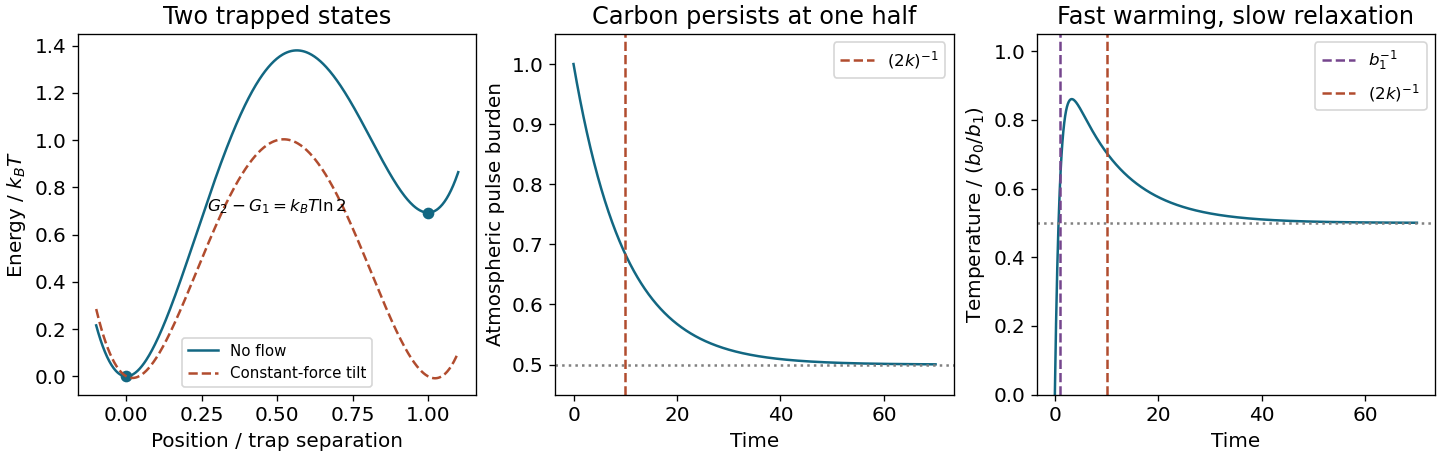
In a sufficiently uniform flow the Stokes force is toward trap 2. Its work over separation lowers the second effective well by . Equal effective free energies require . Hence
at 298 K. The temperature was not specified, so the numerical result scales as . This approximation treats a weak uniform drag as a constant tilt and neglects changes in barrier shape and hydrodynamic interactions with boundaries.
The stationary occupation ratio is . Balance of the two probability currents gives , and Boltzmann occupation of the trapped macrostates gives . Therefore
The sketch has two wells separated by 1 micrometre, with the second free-energy level higher by and an intervening escape barrier. Free energy includes the volume of each trapped basin; equal minimum potential heights alone would not ensure equal occupations if basin shapes differed.
Figure 1.
Two-state free-energy tilt and the distinct fast and slow timescales of a carbon-pulse response
. Details.
Write the displacement after independent isotropic zero-mean steps as . Cross terms vanish, giving when . Isotropy makes each Cartesian variance one third of this. Since and , . If “step size” were instead defined as a single-coordinate mean square, the corresponding expression would be ; the factor of three is purely the stated three-dimensional convention.
Let be the static potential and the drag coefficient, so terminal Genetic drift under force is . The probability current is only after imposing the desired relation; instead start independently from . At thermal equilibrium and detailed balance requires . Substitution yields
At 298 K with m, this gives approximately m s. The argument assumes an overdamped particle in an equilibrium thermal bath, rather than arbitrary driven diffusion.
Split the sine into exponentials. The term closes in the upper half-plane and picks up the pole , giving ; the term closes clockwise below and encloses no pole. Jordan's lemma applies to these separate contours. Hence
To pass to without an invalid dominated-convergence argument on an infinite interval, pair positive and negative first: the imaginary part is odd and the real part is . On a bounded interval the limit is harmless, while integration by parts bounds the oscillatory tail uniformly for . This gives the convergent improper Dirichlet integral .
First remove the removable singularities introduced by tangent and secant: the integrand is . The denominator stays positive since . With the contour integrand is
Its interior poles are zero and ; the other quadratic root is and lies outside. The residues are and , whose sum is . Consequently
Assigning arbitrary finite values at the isolated removable points does not change the integral.
Put , so , and . Rational expressions in these trigonometric functions become rational contour integrands on the unit circle. The method is especially useful when the resulting denominator has a small number of identifiable poles. A pole on the integration circle requires a separately specified principal value or indentation; the residue theorem does not automatically assign an ordinary integral there.
At the bank difference is , while the residue result is . Substitution of yields .
At , the odd moments vanish and the remaining relation is
Thus
As an independent generating-function check, for . Differentiating twice and four times at zero gives the same moments.
Taking the difference of the two bank integrals at gives
The are real and convergent. Comparing real and imaginary parts proves . Independently, changes the sign of each odd logarithmic moment and preserves the measure, so every odd vanishes.

Pinned article: Introduction to the OurBigBook Project

Welcome to the OurBigBook Project! Our goal is to create the perfect publishing platform for STEM subjects, and get university-level students to write the best free STEM tutorials ever.
Everyone is welcome to create an account and play with the site: ourbigbook.com/go/register. We belive that students themselves can write amazing tutorials, but teachers are welcome too. You can write about anything you want, it doesn't have to be STEM or even educational. Silly test content is very welcome and you won't be penalized in any way. Just keep it legal!
We have two killer features:
  1. topics: topics group articles by different users with the same title, e.g. here is the topic for the "Fundamental Theorem of Calculus" ourbigbook.com/go/topic/fundamental-theorem-of-calculus
    Articles of different users are sorted by upvote within each article page. This feature is a bit like:
    • a Wikipedia where each user can have their own version of each article
    • a Q&A website like Stack Overflow, where multiple people can give their views on a given topic, and the best ones are sorted by upvote. Except you don't need to wait for someone to ask first, and any topic goes, no matter how narrow or broad
    This feature makes it possible for readers to find better explanations of any topic created by other writers. And it allows writers to create an explanation in a place that readers might actually find it.

    Figure 1.
    Screenshot of the "Derivative" topic page
    . View it live at: ourbigbook.com/go/topic/derivative
  2. local editing: you can store all your personal knowledge base content locally in a plaintext markup format that can be edited locally and published either:
    This way you can be sure that even if OurBigBook.com were to go down one day (which we have no plans to do as it is quite cheap to host!), your content will still be perfectly readable as a static site.
    Figure 5. . You can also edit articles on the Web editor without installing anything locally.
    Video 3.
    Edit locally and publish demo
    . Source. This shows editing OurBigBook Markup and publishing it using the Visual Studio Code extension.

  3. https://raw.githubusercontent.com/ourbigbook/ourbigbook-media/master/feature/x/hilbert-space-arrow.png
  4. Infinitely deep tables of contents:
    Figure 6.
    Dynamic article tree with infinitely deep table of contents
    .
    Descendant pages can also show up as toplevel e.g.: ourbigbook.com/cirosantilli/chordate-subclade
All our software is open source and hosted at: github.com/ourbigbook/ourbigbook
Further documentation can be found at: docs.ourbigbook.com
Feel free to reach our to us for any help or suggestions: docs.ourbigbook.com/#contact