At zero dispersion and , and . The results are
The repeated entries in the source are interpreted as intended vanishing dispersion and its slope. If dispersion slopes were not zero, energy spread would contribute to divergence and further data would be needed.
A uniform nonrelativistic electron column has radial electric field inside its radius. A relativistic proton therefore has focusing strength per unit length. Electron-current magnetic effects are small under the stated nonrelativistic assumption. To change the nominal doublet strength by requires
One illustrative choice is a one-metre lens with m; other density-length combinations work. The electron beam must cover the proton beam and have a sufficiently uniform profile. Its placement changes the detailed transfer-map correction; the estimate treats the required additional integrated focusing at the entrance and does not claim a uniquely specified electron-lens engineering design.
The beam rigidity is T m. Equal opposing strengths have , and weak separated-doublet net power is . Taking m gives the design family
There is not a unique pair without a spacing/layout choice. A compact estimate gives about 18 m for each, showing immediately that neither is extremely small compared with 50 m and the advertised asymptotic approximation is only rough. For example m gives m in the same estimate.
An equal-strength doublet also has exact parallel-input focal distances and : it is astigmatic, so a single exact common 50 m focus cannot be imposed without specifying incoming optical functions or allowing unequal strengths. The family above is a scale estimate of net focusing, not a complete collider final-focus design.
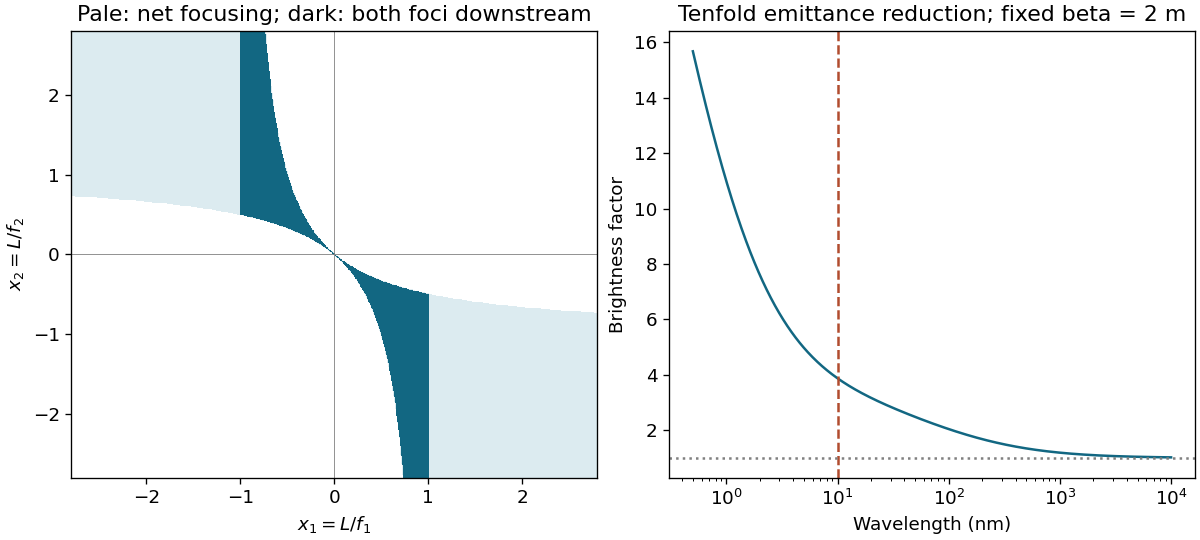
Let , with positive focusing in the first transverse plane. The doublet matrix is , with . Its lower-left entry is . In the other plane both quadrupole signs reverse, giving . Thus positive effective focusing power in both planes requires
For a parallel incident ray bundle, actual downstream focal distances are and . Requiring both foci downstream adds . Positive effective power alone need not imply a real image after the final element. The original schematic below distinguishes these conditions.
Figure 1.
Doublet focusing region and wavelength-dependent emittance benefit under fixed source optics
. Details.
Differentiate the approximate dispersion: , while . Therefore . In the high-phase-speed regime that justified the approximation, the group speed is correspondingly small. Trying to make much larger than would put the phase speed into the thermally populated distribution, where resonant Landau damping is strong and the undamped-fluid estimate becomes unreliable. This explains the stated tendency for these electron electrostatic waves, not a universal prohibition on fast electromagnetic waves in plasma.
When over the populated velocities, expand the denominator in powers of . Odd Gaussian moments vanish. The first two nonzero terms use and , yielding . Solving consistently to order gives
This is a long-wavelength/high-phase-speed approximation, not an exact Maxwellian dispersion relation at arbitrary .
Take electrostatic perturbations proportional to , with ions immobile on the fast electron time scale. Linearized Vlasov gives . Integrating over transverse velocities gives . Combine the perturbed charge density with Poisson's equation:
Since , this is precisely
The pole selects particles moving at phase speed. A causal initial-value prescription specifies how the contour passes it and produces resonant energy exchange, including Landau damping for a decreasing Maxwellian. A bare real improper integral without that prescription is incomplete. The unclosed brace in the printed Maxwellian exponent is typographical; the normalized Gaussian above fixes its meaning.
Room temperature corresponds to about 0.026 eV, or keV. Read the left-hand branch there and draw a horizontal line to the rising hot branch. The original graph gives a return temperature of order , with graph-reading uncertainty, not the temperature of minimum conductivity.
At full ionization m. Inserting the inferred temperature into gives a Debye-sphere occupancy of order –. This is much greater than one and supports a collective weak-coupling description more than the conductivity-minimum region does. The approximate collision-time formula and omitted Coulomb logarithm do not warrant forcing the entire plotted conductivity curve to have its exact prefactor.
In the cold solid, phonon scattering makes and therefore conductivity falls as temperature rises, at roughly fixed carrier density. After melting and ionization, the character of scattering changes; a hot Coulomb plasma eventually follows an increasing branch. A minimum in the crossover region is natural, but a weakly coupled plasma formula is not quantitatively justified throughout the warm dense regime.
Choose . The stipulated estimate then gives
Thus density cancels and conductivity grows as at fixed ion charge. Physically faster electrons are less effectively deflected by Coulomb encounters. Numerical factors depend on the Debye-volume convention, and a realistic collision calculation introduces a Coulomb logarithm and evolving ionization; the cancellation is approximate rather than exact for every real plasma.
For weak potentials, Boltzmann electrons give against fixed ions. Poisson's equation becomes outside a test charge, giving a Yukawa potential with . For a small electron displacement relative to fixed ions, charge separation produces restoring field , so . Hence . The two formulas respectively encode thermal screening and electron inertia.
Write . Then , giving local slope . At 5000–6000 K its magnitude is about K. The low-ionization tail in the original graph drops roughly one decade per K, consistent with this value.
At K, the graph gives K and . Invert the full equation to get , yielding . The neighboring tail markers give the same order; plotting precision and the squared dependence on the read ionization fraction preclude claiming many significant digits.
For total nuclear density , and . Saha's equation becomes . At ,
The factor two in the exponent follows from taking a square root; using the full ionization temperature would double the predicted logarithmic slope.
Assume dilute, nondegenerate ideal electrons, protons and neutral atoms in thermal and chemical equilibrium, with charge neutrality . Set , using each ideal species' translational factor and hydrogen ground-state binding energy . Neglect excited states and take the heavy proton/atom thermal-wavelength ratio as one. With electron spin and neutral-atom degeneracies treated in the convention of the source, the remaining factor is
Different partition-degeneracy conventions must be propagated consistently. Screening, dense-plasma level dissolution and departures from local thermodynamic equilibrium lie outside this derivation.
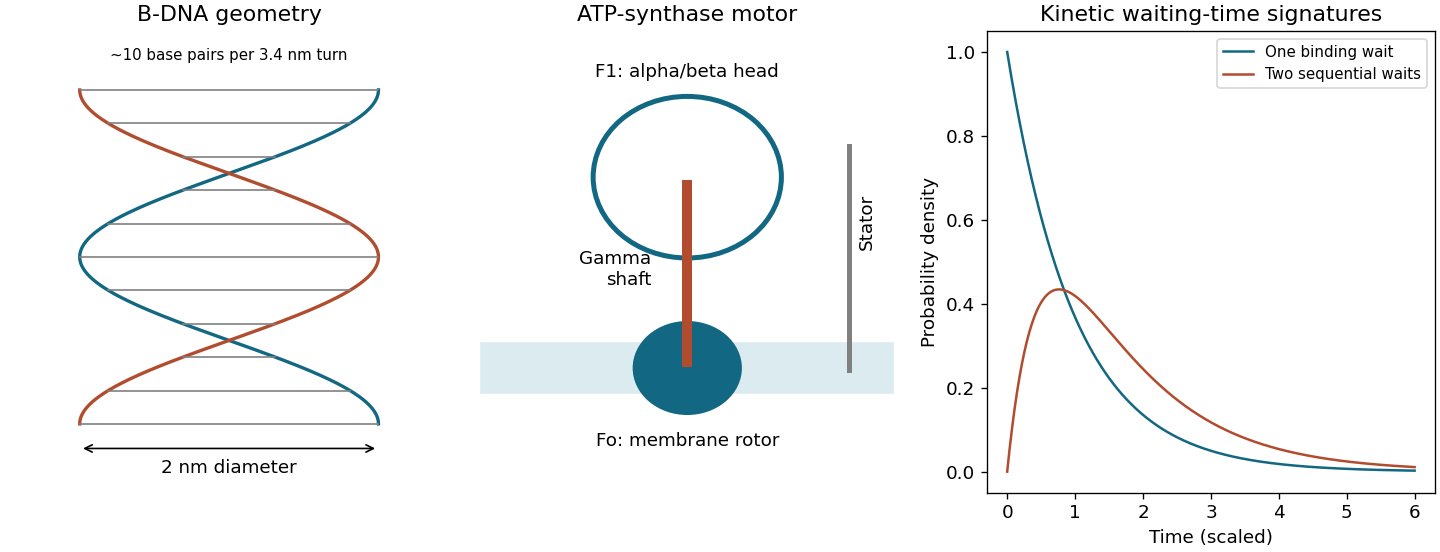
An ATP-binding step with pseudo-first-order rate has survival probability and waiting density . It decreases from a finite value at zero, integrates to one and has mean . Its concentration dependence suggests binding-limited waiting before the large 80-degree substep.
Two independent sequential exponential steps of rates give the convolution
It begins at zero, rises to a maximum at and decays; its mean is . At equal rates it becomes . This supports at least two kinetic events during the waiting associated with the 40-degree substep, plausibly chemical transformation/product release and conformational changes. It does not uniquely identify which rate belongs to hydrolysis or a particular product: different hidden-state networks can have the same waiting distribution. Three 120-degree catalytic cycles per revolution, partitioned into 80 and 40 degrees in the assay, are consistent with three catalytic sites.
ATP synthase combines a membrane proton-conducting rotor with an catalytic head. The c-ring and central gamma shaft rotate relative to a stator and the alpha/beta head. Proton flow down its electrochemical potential can drive conformational changes in three beta catalytic sites to bind substrates, form and release ATP. Reverse operation uses ATP hydrolysis to turn the shaft and pump protons. The immobilized assay isolates this latter rotation; it does not require the membrane proton motor to be present.
For independent equiprobable bases there are codons, three of them stops, so . In a fixed reading frame, and conditional on starting translation, surviving at least successive non-stop codons has probability . For 300 it is about . Strictly “exceeding 300” requires 301 non-stop codons, giving . A specified start codon, codon bias, correlations or looking for a long sequence anywhere in a large genome changes the sampling problem and cannot be silently folded into this single-frame probability.
A base pair has four possible sequence identities, hence two bits, not four bits from treating complementary strands as independent. B-DNA has diameter approximately 2 nm, axial rise 0.34 nm per base pair and about ten base pairs per helical turn. The tightly packed-cylinder upper density is therefore
A haploid human genome has about raw bits; in a nucleus of several hundred cubic micrometres its bulk density is order bits m, far lower. Cellular DNA must allow hydration, packaging, regulatory access and copying/repair machinery, and cannot fill a cell as parallel bare cylinders. Diploidy and repeated or constrained sequence also reduce independent functional information compared with the raw four-letter capacity; those concepts should not be confused with geometric storage density.
The original molecular figure in question 3 shows the approximate helical dimensions.
The chemical mismatch types are A–C and G–T, with either strand acting as template. In the fixed ring alignment shown, A–C has no correct hydrogen bonds while G–T retains one. Relative probabilities must specify the template: template A loses two bonds versus A–T, giving ; template G loses two versus G–C, giving ; template C loses three versus C–G, giving ; template T loses one versus T–A, giving . Equal incoming activities and per bond give approximate relative weights respectively.
For roughly equal template frequencies the mean error probability is order , or several million errors across copied base pairs. Restricting the estimate to purine templates instead gives order errors; neither is an accurate replication model. Both greatly exceed the source's order-one surviving mutation input. Polymerase kinetic discrimination, proofreading and mismatch repair suppress errors, and a transient mismatch need not become an inherited mutation. Ring relaxation, stacking, solvent and rare tautomers are missing from this simple hydrogen-bond calculation. Real G–T wobble geometry can form additional bonds. The source's mutation rate is illustrative, not a universal measured human rate.[ref]
Natural selection requires variation among individuals, heritable contributions to that variation, and differences in reproductive success associated with it. Given those conditions, variant frequencies can change across generations. Competition and finite resources help make reproductive success unequal, but selection does not require every interaction to be direct combat. Mutation and recombination supply variation; they do not generally arise because an organism needs a particular adaptation. Drift also changes frequencies, and common ancestry and branching descent connect population changes to the evolution of species. Selection is a mechanism within evolution, not a synonym for every evolutionary change.[ref]

Pinned article: Introduction to the OurBigBook Project

Welcome to the OurBigBook Project! Our goal is to create the perfect publishing platform for STEM subjects, and get university-level students to write the best free STEM tutorials ever.
Everyone is welcome to create an account and play with the site: ourbigbook.com/go/register. We belive that students themselves can write amazing tutorials, but teachers are welcome too. You can write about anything you want, it doesn't have to be STEM or even educational. Silly test content is very welcome and you won't be penalized in any way. Just keep it legal!
We have two killer features:
  1. topics: topics group articles by different users with the same title, e.g. here is the topic for the "Fundamental Theorem of Calculus" ourbigbook.com/go/topic/fundamental-theorem-of-calculus
    Articles of different users are sorted by upvote within each article page. This feature is a bit like:
    • a Wikipedia where each user can have their own version of each article
    • a Q&A website like Stack Overflow, where multiple people can give their views on a given topic, and the best ones are sorted by upvote. Except you don't need to wait for someone to ask first, and any topic goes, no matter how narrow or broad
    This feature makes it possible for readers to find better explanations of any topic created by other writers. And it allows writers to create an explanation in a place that readers might actually find it.

    Figure 1.
    Screenshot of the "Derivative" topic page
    . View it live at: ourbigbook.com/go/topic/derivative
  2. local editing: you can store all your personal knowledge base content locally in a plaintext markup format that can be edited locally and published either:
    This way you can be sure that even if OurBigBook.com were to go down one day (which we have no plans to do as it is quite cheap to host!), your content will still be perfectly readable as a static site.
    Figure 5. . You can also edit articles on the Web editor without installing anything locally.
    Video 3.
    Edit locally and publish demo
    . Source. This shows editing OurBigBook Markup and publishing it using the Visual Studio Code extension.

  3. https://raw.githubusercontent.com/ourbigbook/ourbigbook-media/master/feature/x/hilbert-space-arrow.png
  4. Infinitely deep tables of contents:
    Figure 6.
    Dynamic article tree with infinitely deep table of contents
    .
    Descendant pages can also show up as toplevel e.g.: ourbigbook.com/cirosantilli/chordate-subclade
All our software is open source and hosted at: github.com/ourbigbook/ourbigbook
Further documentation can be found at: docs.ourbigbook.com
Feel free to reach our to us for any help or suggestions: docs.ourbigbook.com/#contact