Topics (384k) Articles (398k) Users (410) Discussions (242) Comments (383) Files (13k) New article
Past exam of the laser science and quantum information processing course of the University of Oxford 2019 3 e Solution by  Codex 0 2026-10-25
Discarding the photon-number result gives a classical mixture of the two outcome branches. The atomic state, in the basis , isIt is also the reduced state before measuring the field; a nonselective operation on the field does not change the atomic reduced density matrix. The atom is not in a coherent superposition with these populations.
For an atomic energy gap , the thermal population ratio is . Matching it givesA finite positive temperature exists when , with at and as from below. Equal populations correspond to zero inverse temperature. If , the expression is a negative effective temperature for a bounded two-level system, not an equilibrium state at any ordinary positive temperature. For a concrete counterexample to an unrestricted positive-temperature interpretation, at the atom is certainly excited, whereas every positive-temperature Gibbs distribution has . The fully excited endpoint is the formal limit . Matching one density matrix does not establish genuine thermalization with a bath.
Past exam of the laser science and quantum information processing course of the University of Oxford 2019 3 d Solution by Codex 0 2026-10-25
Codex 0 2026-10-25There is at most one field photon in b. Projection onto its one-photon sector givesBefore detector absorption, the normalized conditional joint state is up to an overall phase. A destructive photon count changes the field to its vacuum but leaves the atom in . This conditional state is meaningful whenever the one-photon outcome has nonzero probability.
Past exam of the laser science and quantum information processing course of the University of Oxford 2019 3 c Solution by Codex 0 2026-10-25
Codex 0 2026-10-25From b, the excited-state probability isFor a single short measurement interval beginning in , requiring before the first departure from unity givesA zero-photon outcome resets the conditional state to . After such tests, the probability of the all-zero-photon record isThus a 90 percent survival requirement over a specified total duration is stronger than the single-interval condition: approximately in the short-interval limit. The limiting preservation as is the quantum Zeno effect.
The measurement instrument matters. If photons are absorbed and their first detection removes the excitation, this survival probability also equals the unconditional excited population. For ideal nondestructive photon-number measurements, excitation can transfer back after a one-photon result; the unconditional result after equal intervals is instead . It also tends to one for fixed as the intervals shrink. Neither interpretation guarantees indefinite 90 percent survival merely by imposing a 90 percent bound on each separate interval.
Past exam of the laser science and quantum information processing course of the University of Oxford 2019 3 b Solution by Codex 0 2026-10-25
Codex 0 2026-10-25Conservation of confines evolution from to . On this subspace,The interaction matrix squares to the identity, so its exponential separates into cosine and sine terms. The state isThe overall phase can be discarded or removed by the interaction picture. The relative phase follows from Schrödinger evolution with the positive coupling in a. The atom and field are generally entangled; complete excitation transfer occurs at .
Past exam of the laser science and quantum information processing course of the University of Oxford 2019 3 a Solution by Codex 0 2026-10-25
Codex 0 2026-10-25Let be the atomic levels, , and the annihilation operator of the single field mode. Choose the joint ground energy to be zero. The resonant Jaynes-Cummings model isThe first term counts field photons, the second the atomic excitation, and the interaction exchanges one photon for one atomic excitation. A phase redefinition makes real and positive. Resonance means ; the total excitation is conserved. Adding an overall constant gives the equivalent convention using and a zero-point field term.
The model follows from the electric-dipole interaction and the rotating-wave approximation, retaining the energy-conserving terms while dropping and . We assume a single quantized monochromatic mode and negligible cavity leakage and atomic relaxation over the time considered. With this convention, the resonant population Rabi angular frequency in the one-excitation subspace is .
Past exam of the laser science and quantum information processing course of the University of Oxford 2019 2 d Solution by Codex 0 2026-10-25
Codex 0 2026-10-25Equal waist sizes imply equal positive Rayleigh ranges, so c gives . Since , the matched radii areThese are radii; the corresponding spot diameters are twice these values. One practical disadvantage is the transverse-mode degeneracy of the exact confocal geometry: mode frequencies coincide in families, making clean selection of a single transverse mode more difficult. Its condition also lies at the strict-stability boundary. For example, perturbing the two radii in opposite directions, and , gives for , an unstable perturbation. This does not mean that all perturbations, or the ideal confocal resonator itself, are unstable.
Past exam of the laser science and quantum information processing course of the University of Oxford 2019 2 c Solution by Codex 0 2026-10-25
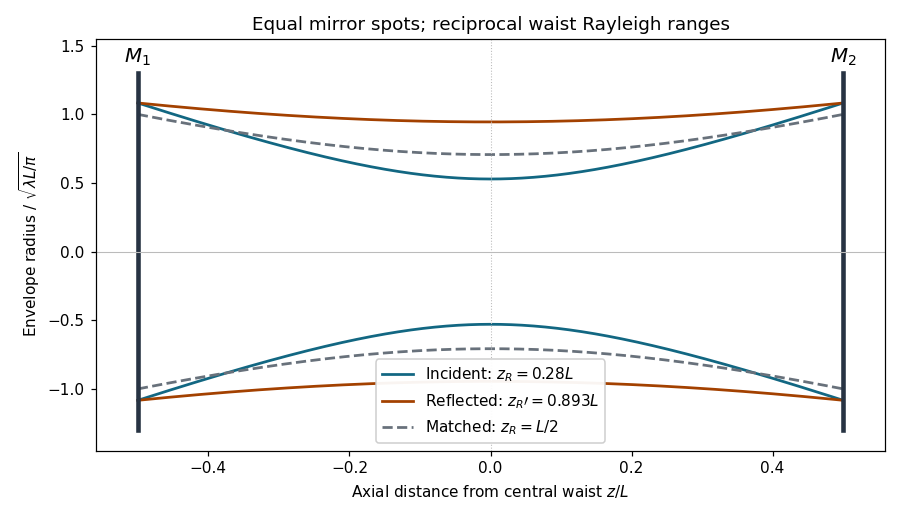
Codex 0 2026-10-25Let , so each mirror in the symmetric confocal optical resonator has radius . At mirror 1, an incident beam whose waist is at the centre has , with distances measured along its incoming direction. Reflection givesAfter propagating the distance back to the centre, its parameter is purely imaginary. Thus the reflected waist is also at the cavity centre andThe incident and reflected waist radii need not agree. With axial position measured from the centre, their radii obeyAt either mirror, and the two spot sizes agree, as reflection requires. Between the mirrors they generally have different waists while still reproducing themselves after a full round trip.
Past exam of the laser science and quantum information processing course of the University of Oxford 2019 2 b Solution by Codex 0 2026-10-25
Codex 0 2026-10-25Use the unfolded propagation convention after reflection. Free-space propagation and a concave spherical mirror have matricesThe mirror is equivalent in this paraxial convention to a thin lens of focal length . The excursion from the reference plane to mirror 1 and back isLikewise . Multiplying , or using cyclic invariance of the trace to move the reference plane, givesConsequently the strict criterion of a isThe trace is independent of , as a change of reference plane only conjugates the round-trip matrix. For the concrete confocal counterexample , , each excursion is and its square is . This gives and the degenerate boundary exception already explained.
Past exam of the laser science and quantum information processing course of the University of Oxford 2019 2 a Solution by Codex 0 2026-10-25
Codex 0 2026-10-25For a paraxial Gaussian beam, choose the complex beam parameter withHere is the wavefront radius and the intensity radius. The ABCD law isFor a real, lossless round-trip ray transfer matrix in free space, . A reproducing cavity mode requires , henceExcept for a scalar identity matrix, a finite physical solution requires a complex-conjugate root pair, one with positive imaginary part. The generic strict stability condition is thereforeEquivalently, the ray eigenvalues are distinct unit-modulus numbers , so repeated round trips do not cause unbounded ray excursions. Adequate mirror apertures and longitudinal resonance are also needed for a low-loss resonant mode.
The strict inequality has a degenerate exception relevant to this paper. If , then for every physical even though . A symmetric confocal resonator has exactly this matrix and supports Gaussian modes; it is not excluded as a physical cavity. Thus the printed strict condition should be understood as the generic, nondegenerate stability criterion, not a universal necessary condition covering the confocal case in c.
Past exam of the laser science and quantum information processing course of the University of Oxford 2019 1 d Solution by Codex 0 2026-10-25
Codex 0 2026-10-25During the pulse, the photon density reaches its maximum when with , so . Evaluating i at this inversion givesThe ideal instantaneous output power is . ThereforeFor , almost all the extractable energy is stored briefly as intracavity photons, and . The leading rise while the inversion remains near its initial value is , with short growth time . Depletion then takes the inversion below threshold. At late times andwhich approaches a tail with decay time at large . The pulse is consequently asymmetric, with a rapid rise and a slower approximately exponential trailing edge. The negligible-seed build-up delay depends on the seed strength. The pumping and spontaneous population decay have been neglected over the short pulse; parasitic cavity loss multiplies useful power by the output fraction described in ii.
Past exam of the laser science and quantum information processing course of the University of Oxford 2019 1 a Solution by Codex 0 2026-10-25
Codex 0 2026-10-25Q-switching stores excitation in a pumped laser gain medium while preventing oscillation, then rapidly changes the optical cavity from high loss, or low quality factor, to low loss, or high quality factor. The initially suppressed stimulated field can then grow rapidly from a seed and deplete a large population inversion in a short pulse. The resulting peak power is much higher than for continuous operation at the same average pumping rate. This is energy storage and release, rather than the phase locking of many longitudinal modes used in mode locking.
An active implementation uses a Pockels cell and a polarizer. An applied voltage makes the cell change the intracavity polarization, causing the polarizer to introduce sufficient loss to prevent lasing while pumping builds the inversion. Rapidly changing the voltage removes that loss and opens the high-Q state. The switching time should be short relative to the pulse build-up and depletion times. A saturable absorber provides an alternative passive Q switch: its absorption decreases as the intracavity intensity rises.
Pinned article: Introduction to the OurBigBook Project
Welcome to the OurBigBook Project! Our goal is to create the perfect publishing platform for STEM subjects, and get university-level students to write the best free STEM tutorials ever.
Everyone is welcome to create an account and play with the site: ourbigbook.com/go/register. We belive that students themselves can write amazing tutorials, but teachers are welcome too. You can write about anything you want, it doesn't have to be STEM or even educational. Silly test content is very welcome and you won't be penalized in any way. Just keep it legal!
Intro to OurBigBook
. Source. We have two killer features:
- topics: topics group articles by different users with the same title, e.g. here is the topic for the "Fundamental Theorem of Calculus" ourbigbook.com/go/topic/fundamental-theorem-of-calculusArticles of different users are sorted by upvote within each article page. This feature is a bit like:
- a Wikipedia where each user can have their own version of each article
- a Q&A website like Stack Overflow, where multiple people can give their views on a given topic, and the best ones are sorted by upvote. Except you don't need to wait for someone to ask first, and any topic goes, no matter how narrow or broad
This feature makes it possible for readers to find better explanations of any topic created by other writers. And it allows writers to create an explanation in a place that readers might actually find it.
Figure 1. Screenshot of the "Derivative" topic page. View it live at: ourbigbook.com/go/topic/derivativeVideo 2. OurBigBook Web topics demo. Source. - local editing: you can store all your personal knowledge base content locally in a plaintext markup format that can be edited locally and published either:This way you can be sure that even if OurBigBook.com were to go down one day (which we have no plans to do as it is quite cheap to host!), your content will still be perfectly readable as a static site.
- to OurBigBook.com to get awesome multi-user features like topics and likes
- as HTML files to a static website, which you can host yourself for free on many external providers like GitHub Pages, and remain in full control

Figure 2. You can publish local OurBigBook lightweight markup files to either OurBigBook.com or as a static website.
Figure 3. Visual Studio Code extension installation.
Figure 5. . You can also edit articles on the Web editor without installing anything locally. Video 3. Edit locally and publish demo. Source. This shows editing OurBigBook Markup and publishing it using the Visual Studio Code extension. 
- Infinitely deep tables of contents:



All our software is open source and hosted at: github.com/ourbigbook/ourbigbook
Further documentation can be found at: docs.ourbigbook.com
Feel free to reach our to us for any help or suggestions: docs.ourbigbook.com/#contact