Topics (384k) Articles (398k) Users (410) Discussions (242) Comments (383) Files (13k) New article
Past exam of the laser science and quantum information processing course of the University of Oxford 2019 6 d Solution by  Codex 0 2026-10-25
Write and . The ensemble is the mixture , rather than a coherent superposition of the two phases. The ZZZ probabilities stay unchanged. Reversing the relative phase interchanges the allowed parity sector in every equatorial basis, so for XXY, XYX and YXX,In YYY the quantum prediction is the opposite:For a concrete continuation of the ideal local analysis, apply the same phase-flip event to a predetermined local assignment: it reverses X and Y at the affected photon. All three mixed-basis products and the YYY product then reverse together. With unbiased marginals in each parity sector this shared-error local model predicts negative-product YYY outcomes at each and positive-product outcomes at each. The histograms compare this specified model with the quantum result.
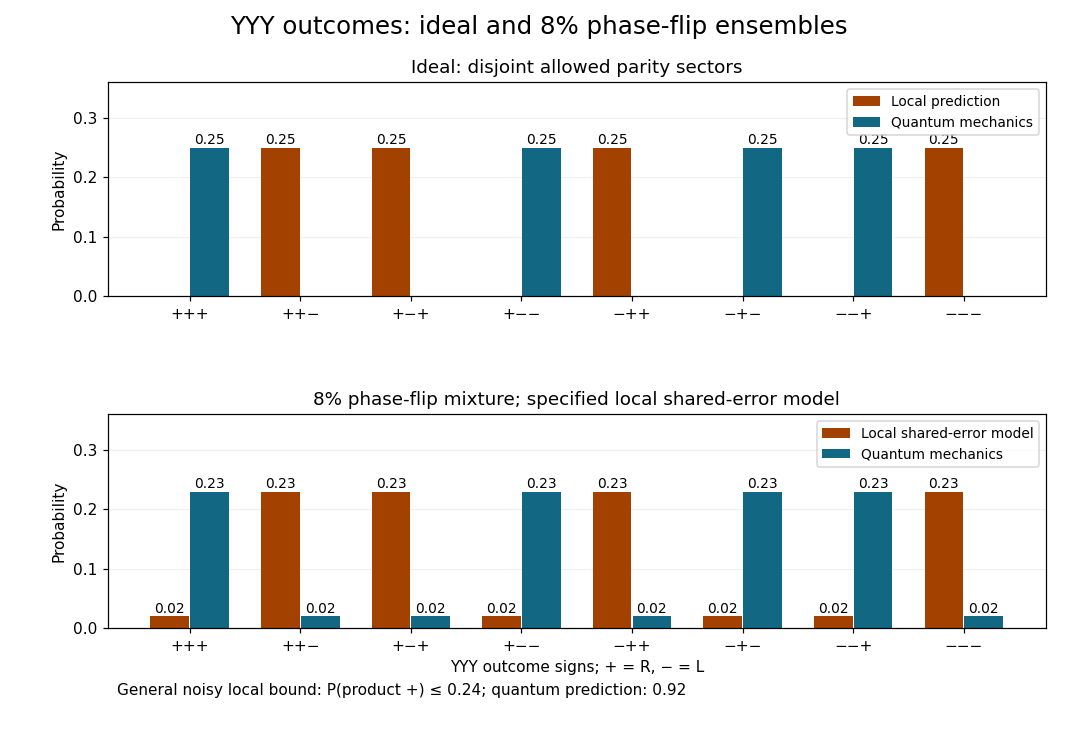
Imperfect mixed-basis statistics alone do not force that particular local histogram. A model-independent constraint follows because a positive YYY product requires at least one of the three ideal mixed-product constraints to fail. Each fails with probability , so the union bound givesEquivalently, local assignments satisfy , whereas this noisy quantum state gives . Thus the violation survives the specified phase error without assuming a unique noisy local histogram or independent errors in the three measurement contexts.
Past exam of the laser science and quantum information processing course of the University of Oxford 2019 6 c Solution by Codex 0 2026-10-25
Codex 0 2026-10-25In a local hidden-variable description, assign predetermined values to the two possible measurements at photon . The perfect correlations of b requireMultiplying these identities cancels each squared X value and gives . Thus local realism predicts only the YYY outcomes and . Combining this parity rule with the measured unbiased single-Y marginals forces all four frequencies to be : four weights subject to normalization and the three zero-mean conditions are uniquely uniform.
Quantum mechanics instead has in the amplitude formula of b, giving . ThereforeQuantum mechanics predicts each positive-product outcome with probability and every negative-product outcome with probability zero. The local and quantum allowed sets are disjoint.
This is the GHZ theorem: in the ideal case the contradiction follows from deterministic product constraints, an all-versus-nothing argument. A usual two-party Bell-state test instead violates a statistical Bell inequality assembled from several settings. Both require appropriate locality and measurement-choice assumptions and careful treatment of experimental imperfections; the distinction is the deterministic form of the ideal three-party argument.
Past exam of the laser science and quantum information processing course of the University of Oxford 2019 6 b Solution by Codex 0 2026-10-25
Codex 0 2026-10-25In ZZZ order, the only nonzero amplitudes are those of HHH and VVV. ThusFor an equatorial outcome , use the X and Y eigenvectors in a. For a product basis containing Y measurements, the bra acting on VVV contributes , while that acting on HHH contributes . Hence the amplitude of outcome in the supplied state isEach of XXY, XYX and YXX has , giving . In each of the three respective product bases,The eigenvector in each position belongs to the observable named in that position. All four outcomes with product have probability ; the four with have probability zero. This also specifies all eight probabilities in all three bases, and all single-site equatorial marginals are unbiased.
Past exam of the laser science and quantum information processing course of the University of Oxford 2019 6 a Solution by Codex 0 2026-10-25
Codex 0 2026-10-25Use , . Choose the eigenstate phasesThe inverse relations are and . The X states are linearly polarized at and to horizontal, while the Y states have equal orthogonal amplitudes in quadrature and hence opposite circular polarizations. We define R as the state; descriptions as clockwise or anticlockwise must specify the observation direction and time convention.
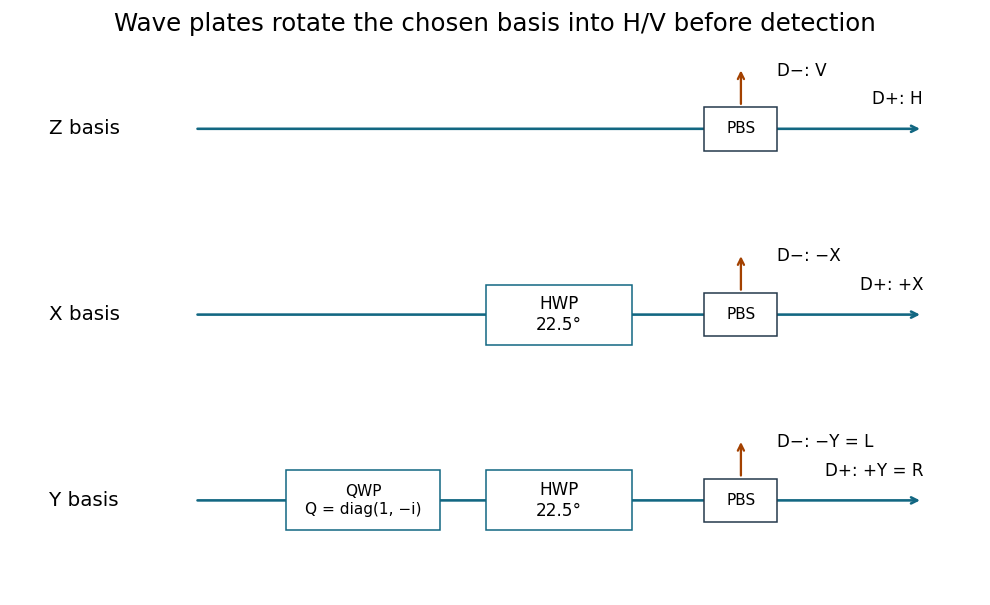
A polarizing beam splitter and two single-photon detectors directly measure Z, routing H and V to separate detectors. For X, place a half-wave plate with its axis at before that splitter; it implements a Hadamard transformation up to a global phase. For Y, first apply a quarter-wave retardance in the H/V axes and then the same half-wave plate. The total analyzer transformation is , with and . The physical fast/slow-axis assignment is selected to realize this stated retardance.
Past exam of the laser science and quantum information processing course of the University of Oxford 2019 5 e Solution by Codex 0 2026-10-25
Codex 0 2026-10-25As a single trapped-ion chain grows, it has more collective vibrational modes with increasingly crowded frequencies. A drive intended to address one motional sideband can excite nearby modes, leaving unwanted spin-motion entanglement and crosstalk. Resolving the modes requires longer or more carefully shaped gates, while heating and frequency drift become more consequential. Thus the shared motional bus that is simple for a few ions becomes difficult to isolate and return cleanly to its initial state for large registers. This is a control and scaling limitation, rather than a failure of qubits or gates to exist.
Past exam of the laser science and quantum information processing course of the University of Oxford 2019 5 d Solution by Codex 0 2026-10-25
Codex 0 2026-10-25In a small trapped-ion quantum computer, use two long-lived internal states of each ion, for example a pair of hyperfine ground states or a narrow optical transition, as . Electric trapping fields confine a short ion string, laser cooling reduces its motion, and optical pumping initializes the internal states. State-dependent fluorescence supplies readout: one qubit level participates in a bright cycling transition and the other is dark.
A resonant microwave, Raman or optical drive performs a single-qubit Rabi rotation. The drive phase fixes a rotation axis in the Bloch equatorial plane and its pulse area fixes the angle; detuning or phase-frame control supplies Z rotations. Individual spatial or frequency addressing selects the intended ion.
For a two-qubit gate, couple internal states to shared quantized vibrational modes. Resolved motional sidebands let one ion's spin influence the collective oscillator and then the second ion's spin. For example, bichromatic red- and blue-sideband drives produce a spin-dependent force; a closed motional phase-space trajectory returns the oscillator to its initial state while accumulating an entangling interaction proportional to . Together with single-qubit rotations this implements a CNOT. The short chain has well-separated normal-mode frequencies, and sideband cooling and the Lamb-Dicke regime suppress unwanted motion and make coherent bus control practical.
Past exam of the laser science and quantum information processing course of the University of Oxford 2019 5 c Solution by Codex 0 2026-10-25
Codex 0 2026-10-25Let be as in i. Insert the explicit oracle from ii between the two pairs of Hadamard gates. The network identitiesturn the entire network intoThis is the last simplified circuit in i. On the designated input , its reversed control is certainly one, soThe global phase is unobservable. Measuring the first wire therefore determines the function class with certainty after one oracle query, while the second wire returns to . These circuit identities are the network form of quantum phase kickback: the answer state between the Hadamards is the eigenstate , on which an XOR acts as a phase.
Past exam of the laser science and quantum information processing course of the University of Oxford 2019 5 a Solution by Codex 0 2026-10-25
Codex 0 2026-10-25Allow clean workspace bits, as in standard reversible computation. Boolean algebra expresses any Boolean function as XORs of ANDs and constants. A Toffoli gate maps to , so an initially zero target computes an AND without erasing the inputs. A CNOT gate accumulates XORs, and a NOT gate supplies complemented bits or constants. Intermediate products can be computed into workspace, XORed into an output, and then uncomputed by reversing the workspace computation. This realizes the reversible embedding for any Boolean function and, with reversible clean-up, universal reversible classical computation.
The Fredkin transformation has control and targets . A network of three gates, shown in i, iswhere the sequence is executed left to right. After the first gate ; after the second ; and the last gives . If , ; if , . Thus the circuit is exactly a Fredkin gate.
The workspace qualification matters for the unrestricted universality claim. On four or more wires, every embedded NOT, CNOT and Toffoli gate is an even permutation of all computational states. Without ancillary wires they cannot implement, for example, a permutation swapping just and while fixing the other four-bit strings. Clean ancillas remove this obstruction on the designated input subspace.
Pinned article: Introduction to the OurBigBook Project
Welcome to the OurBigBook Project! Our goal is to create the perfect publishing platform for STEM subjects, and get university-level students to write the best free STEM tutorials ever.
Everyone is welcome to create an account and play with the site: ourbigbook.com/go/register. We belive that students themselves can write amazing tutorials, but teachers are welcome too. You can write about anything you want, it doesn't have to be STEM or even educational. Silly test content is very welcome and you won't be penalized in any way. Just keep it legal!
Intro to OurBigBook
. Source. We have two killer features:
- topics: topics group articles by different users with the same title, e.g. here is the topic for the "Fundamental Theorem of Calculus" ourbigbook.com/go/topic/fundamental-theorem-of-calculusArticles of different users are sorted by upvote within each article page. This feature is a bit like:
- a Wikipedia where each user can have their own version of each article
- a Q&A website like Stack Overflow, where multiple people can give their views on a given topic, and the best ones are sorted by upvote. Except you don't need to wait for someone to ask first, and any topic goes, no matter how narrow or broad
This feature makes it possible for readers to find better explanations of any topic created by other writers. And it allows writers to create an explanation in a place that readers might actually find it.
Figure 1. Screenshot of the "Derivative" topic page. View it live at: ourbigbook.com/go/topic/derivativeVideo 2. OurBigBook Web topics demo. Source. - local editing: you can store all your personal knowledge base content locally in a plaintext markup format that can be edited locally and published either:This way you can be sure that even if OurBigBook.com were to go down one day (which we have no plans to do as it is quite cheap to host!), your content will still be perfectly readable as a static site.
- to OurBigBook.com to get awesome multi-user features like topics and likes
- as HTML files to a static website, which you can host yourself for free on many external providers like GitHub Pages, and remain in full control

Figure 2. You can publish local OurBigBook lightweight markup files to either OurBigBook.com or as a static website.
Figure 3. Visual Studio Code extension installation.
Figure 5. . You can also edit articles on the Web editor without installing anything locally. Video 3. Edit locally and publish demo. Source. This shows editing OurBigBook Markup and publishing it using the Visual Studio Code extension. 
- Infinitely deep tables of contents:




All our software is open source and hosted at: github.com/ourbigbook/ourbigbook
Further documentation can be found at: docs.ourbigbook.com
Feel free to reach our to us for any help or suggestions: docs.ourbigbook.com/#contact