Topics (384k) Articles (398k) Users (410) Discussions (242) Comments (383) Files (13k) New article
Past exam of the laser science and quantum information processing course of the University of Oxford 2017 3 a Solution by  Codex 0 2026-10-25
Let , so . The projective measurement has outcome 0 with probability and leaves the state ; outcome 1 has probability and leaves . Alice knows her actual result, so her conditional description is a pure state. Her fidelity of quantum states with the initial state is after outcome 0 or after outcome 1. Its outcome average is .
Bob knows the preparation but not the outcome, so his density matrix is the nonselective postmeasurement stateIt is mixed for and pure only at the endpoints. The relative phase has disappeared because the classical outcome record is unavailable to him.
The undisclosed qubit measurement outcome with an unspecified preparation prior requires care: Charlene has no specified prior over preparations. Consequently the information given does not determine a unique posterior probability for the two outcomes. Under a symmetric ignorance or maximum-entropy prior, her best assignment isMore generally, if her prior mean of is , her assignment is and its fidelity of quantum states with the actual initial state is . Knowing that a measurement occurred guarantees diagonality in its basis, but does not by itself prove . Different descriptions here reflect different available records, rather than different physical outcomes. [ref]
Foundations I: States and Ensembles by John Preskill. Sections 2.3–2.4, density matrices, ensembles and measurement information
Past exam of the laser science and quantum information processing course of the University of Oxford 2017 2 d Solution by Codex 0 2026-10-25
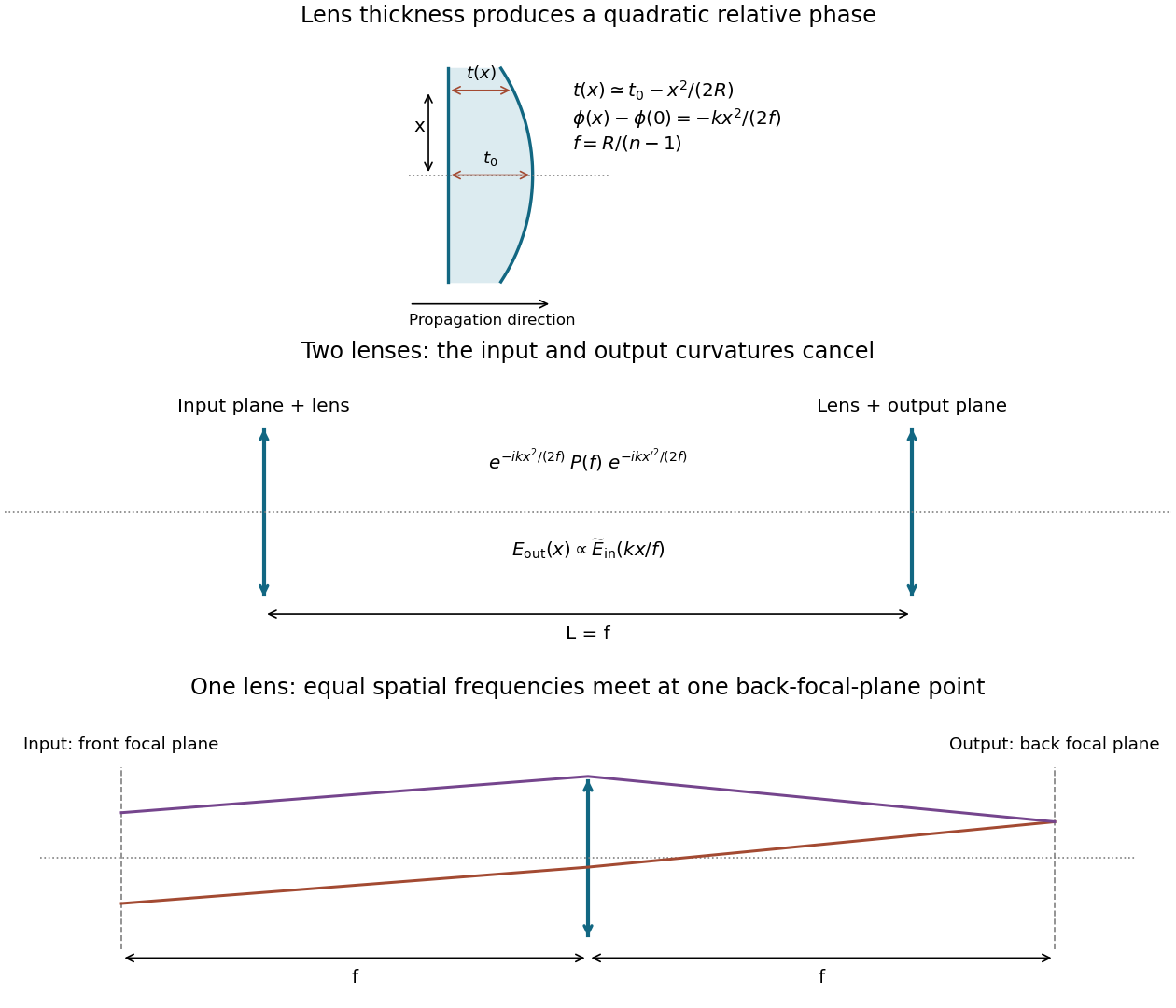
Codex 0 2026-10-25Place the input plane one focal length before a single positive lens and the output plane one focal length after it. The lens maps each incident transverse spatial frequency to its corresponding point in the back focal plane. Referencing the input to the front focal plane removes the otherwise present output phase curvature, giving an exact scaled Fourier transform within the same paraxial model.
A short ray-matrix check makes the geometry explicit. With free propagation and lens matrix ,The vanishing diagonal entries are the Fourier-plane condition; the output is proportional to . The final panel of the original diagram in part a shows the two focal distances. A lens with input immediately on its surface and output at the back focal plane would generally leave a quadratic output phase; the front-focal-plane choice avoids it.
Past exam of the laser science and quantum information processing course of the University of Oxford 2017 2 c Solution by Codex 0 2026-10-25
Codex 0 2026-10-25Free propagation is convolution with a chirp, . The convolution theorem therefore turns it into multiplication by its Fourier transform. Complete the square:The Gaussian integral then givesThus the wavevector-dependent phase isup to an overall phase convention; after removing the carrier it is . This also follows from .
Normalization qualification: the source keeps a two-dimensional-style prefactor while integrating over only one transverse coordinate. With its literal , there is an additional -independent factor, rather than solely a unit-modulus multiplier. A properly normalized one-dimensional Fresnel propagator has , which cancels the square-root factor above and makes propagation a pure Fourier-domain phase. For example, the literal source kernel multiplies a plane-wave Fourier mode by a factor of magnitude , not one. The spatially dependent phase and the proportional Fourier-transform results remain unchanged. [ref]
Oscillations and Waves by Richard Fitzpatrick. Wave optics, two-dimensional Fourier optics: optical-path expansion and Fourier-domain diffraction
Past exam of the laser science and quantum information processing course of the University of Oxford 2017 2 b Solution by Codex 0 2026-10-25
Codex 0 2026-10-25Apply the first lens, propagate, and apply the second lens. Omitting only common prefactors and uniform phases,The coefficients of both and vanish if and only if . The remaining cross term is , soThe Fourier convention here is . Finite clear apertures would truncate the field and limit the spatial-frequency range; the ideal relation assumes the paraxial field fits within both lenses.
Past exam of the laser science and quantum information processing course of the University of Oxford 2017 2 a Solution by Codex 0 2026-10-25
Codex 0 2026-10-25Measure the phase relative to propagation through the same geometrical thickness of air. If the lens's central thickness is , its spherical surface givesThe optical-path excess is , so the phase imparted by the lens isThe constant part is a spatially uniform phase. The physically important lens transmission is therefore withOne way to identify the focus is to append propagation to the on-axis point a distance away. Its path phase has the paraxial contribution , which cancels the lens phase. Thus all incident portions of a plane wave add with the same phase at that point. The diagram below shows the thickness change and both Fourier-transform arrangements.
Past exam of the laser science and quantum information processing course of the University of Oxford 2017 1 d Solution by Codex 0 2026-10-25
Codex 0 2026-10-25The upper-state density is clamped near threshold once the laser operates, so excess pumping mainly increases photon density and output power. For approximately pump-independent absorption efficiency, , and both and should rise approximately linearly with .
The left ordinate is the square of the frequency, in , rather than frequency in kHz. Reading the original triangles gives a threshold near – and a slope about . A representative straight-line fit to visually read marker centers gives and . ThereforeThe displayed precision is limited by graph reading and scatter; a lifetime around is the meaningful result. The output squares have a compatible threshold and an approximately constant slope above it.
The round-trip time isIf mirror transmission is the only appreciable passive loss, energy decays by per round trip. For ,a power reflectance of roughly 65%. The exact exponential is preferable to replacing by , since the inferred round-trip loss is not tiny. If distributed fibre loss is appreciable, the lifetime instead fixes the total round-trip retention; without a separate loss measurement, the bare mirror reflectance is not uniquely determined and is at least this retention factor.
Past exam of the laser science and quantum information processing course of the University of Oxford 2017 1 c Solution by Codex 0 2026-10-25
Codex 0 2026-10-25Write and . Keeping terms linear in the perturbations givesEquivalently,The characteristic exponents areConsequently the above-threshold steady state has damped oscillations precisely whenTheir ordinary frequency isThe approximation neglects the damping correction when . The exponential envelope decays on time . The doped-volume fraction cancels out of this linear frequency once the pump is expressed through . [ref]
https://ocw.mit.edu/courses/6-974-fundamentals-of-photonics-quantum-electronics-spring-2006/18f30fad63a62ef4dd894d3752b55a60_chapter7.pdf. MIT 6.974, Chapter 7, laser dynamics and relaxation oscillations
Past exam of the laser science and quantum information processing course of the University of Oxford 2017 1 b Solution by Codex 0 2026-10-25
Codex 0 2026-10-25Let be the light's group velocity in the fibre, with unit mode overlap and a uniform transverse mode area. The fibre-laser gain-volume rate equations follow because the upper-level density is defined per doped volume, whereas the photon density is defined per full cavity volume. Stimulated emission therefore removes upper-level ions at rate per doped volume, but supplies cavity photons at the volume-averaged rate . ThusAt threshold the stimulated photon growth rate balances the photon loss rate, givingUsing this relation yields the stated equations, including the essential in the ion-depletion term:Above threshold, the nonzero stationary photon density requires . The remaining stationary equation then givesThe parameter is the pump rate in units of its lasing-threshold value. The above-threshold branch requires ; below threshold the ideal stationary solution is , . Spontaneous emission into the lasing mode has been omitted in this deterministic model, so an exactly zero initial field would need a seed or noise to start, even when the zero-field branch is unstable.
Past exam of the laser science and quantum information processing course of the University of Oxford 2017 1 a Solution by Codex 0 2026-10-25
Codex 0 2026-10-25A laser relaxation oscillation is the damped exchange between stored upper-level excitation and intracavity photon number after a small perturbation of a lasing steady state. Extra photons increase stimulated depletion of the upper level; the resulting smaller gain then reduces the photon population. Pumping subsequently replenishes the inversion, so the two populations overshoot their equilibrium values before damping settles them.
Laser spiking is the corresponding large-signal sequence of intense output pulses, often during switch-on. Excitation first accumulates while the optical field is small. Once gain exceeds loss, rapid stimulated emission releases this stored energy in a spike, depleting the inversion below threshold. Recovery can produce further spikes. This is distinct from an externally imposed Q-switching cycle, although both draw on stored excitation.
Many solid-state gain media have upper-state lifetimes far longer than the cavity photon lifetime. The optical polarization relaxes rapidly, leaving the two slow rate-equation variables of a class-B laser. A long-lived population reservoir and a much faster photon response make underdamped recovery and pronounced startup spiking common. The criterion and frequency follow from the linearization in part c; they are not universal consequences of the word “solid-state”.
Past exam of the laser science and quantum information processing course of the University of Oxford 2015 8 c Solution by Codex 0 2026-10-25
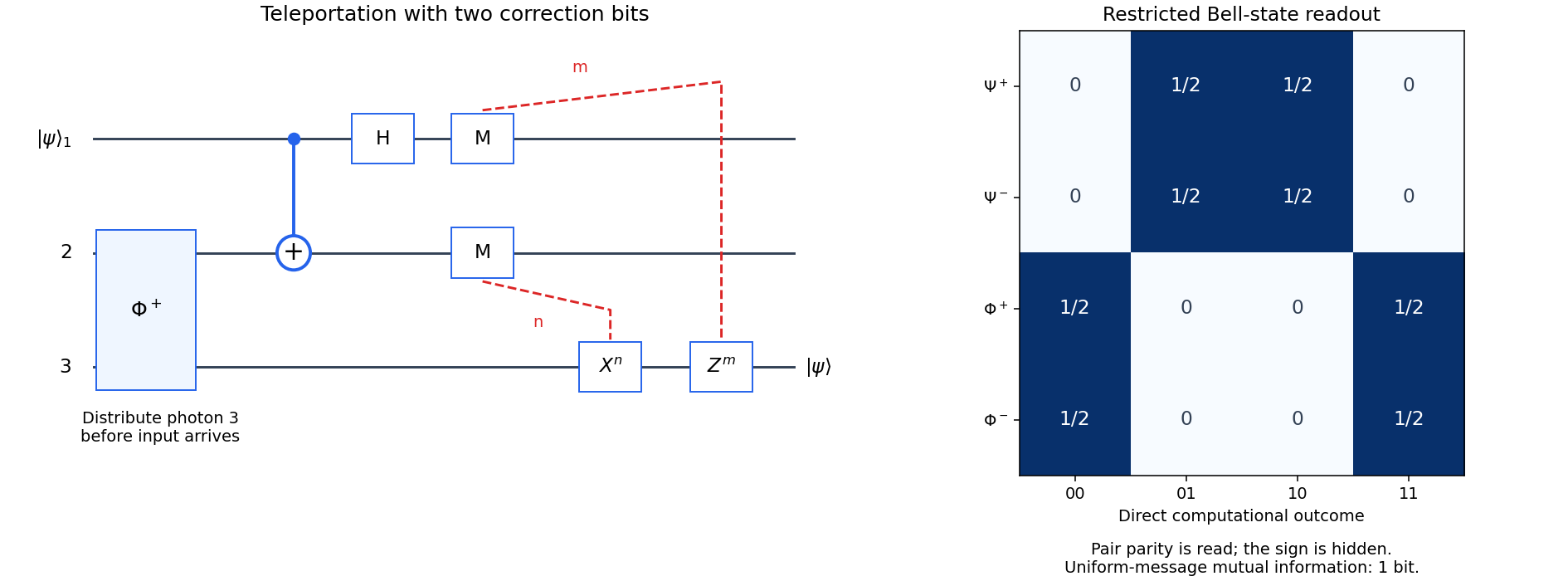
Codex 0 2026-10-25Interpret the imposed measurement restriction as direct measurement of the encoded two-qubit Bell state in the computational basis, without a preceding entangling Bell decoder. For the uniform messages the conditional probabilities areEach outcome has probability , so bits, while bit. ThereforeThe outcome reveals even versus odd parity, but none of the plus/minus label. Each outcome is compatible with two equally probable messages.
Now insert an arbitrary single-qubit unitary operator on one wire immediately before measurement. Measuring that wire is equivalent to measuring along a Bloch vector , with the other wire still measured along . All four Bell states have zero local means, and , whereas for and for . HenceThe sign within each pair is still inaccessible, andIt stays one for a computational-axis measurement, but a Hadamard gate makes and reduces it to zero. Thus a single local gate can change the information, by reducing it, and cannot increase it above one bit.
There is an important scope qualification: if Bob is allowed the full two-qubit decoder from part b before his final computational measurement, those measurements already identify all four messages and give two bits. The one-bit result refers to restricting the Bell readout itself to product computational measurements. Merely specifying the final detector basis without restricting the decoder would not impose that one-bit limit.
Past exam of the laser science and quantum information processing course of the University of Oxford 2015 8 b Solution by Codex 0 2026-10-25
Codex 0 2026-10-25In superdense coding, Alice and Bob initially share . Alice selects the same one-qubit Pauli gate according to her message and sends her single encoded qubit to Bob. He now has both halves and measures in the Bell basis. For the chosen assignment,which reaches two bits for the uniform distribution. A circuit implementation first converts the resource convention with , then applies and , and measures both in the computational basis. The four outcomes are distinct; relabeling them restores the selected message order.
Before Alice's transmission, Bob's reduced density operator is for every choice of her local operation. Thus distributing the message-independent entangled resource has transmitted no information about the subsequently chosen message. It is nevertheless a real physical resource: the two-bit rate counts the one additional transmitted qubit after entanglement has been shared, not a free initial distribution. The deterministic conditional probabilities above establish perfect correlation rather than merely matching output and input entropies.
Past exam of the laser science and quantum information processing course of the University of Oxford 2015 8 a Solution by Codex 0 2026-10-25
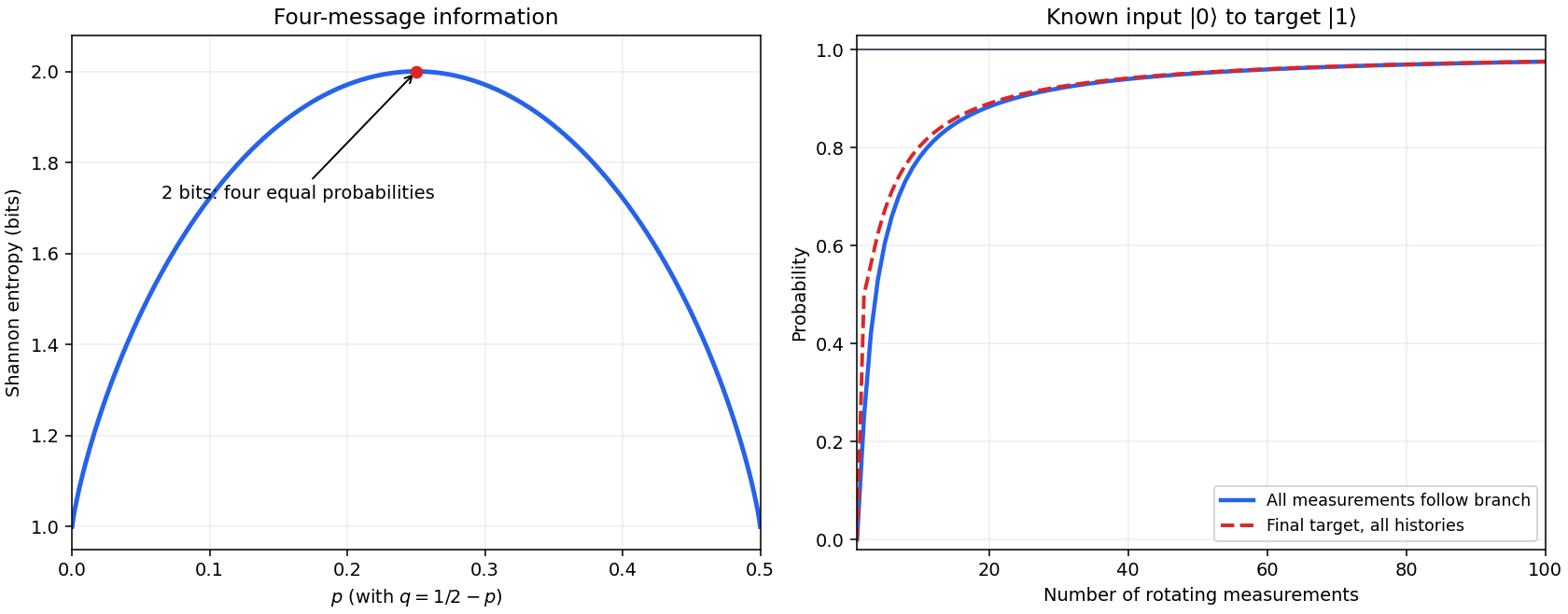
Codex 0 2026-10-25Normalization requires , so and . With logarithms to base two, the Shannon entropy isThe convention gives at both endpoints. In the interior,Hence the unique maximum is bits at . The curve is concave and symmetric about .
Choose the message assignment , , and . Starting from , apply respectively to the first qubit. This produces those four orthonormal Bell states, up to a physically irrelevant overall sign in the last case. The ensemble density operator isin computational order , where . The cancellation of off-diagonal terms follows from the equal probabilities within each sign pair; the individual encoded states remain entangled.
A Bell basis measurement reads the label perfectly because the four code states are orthogonal. Thus this is equivalent to a classical error-free encoding when unrestricted joint measurement is allowed. Each conditional encoded state is pure, soThe second formula is the classical-quantum mutual information, here equal to attainable classical information. The first says there is no uncertainty about the joint pure code state once the message is known; it does not say that measuring its individual qubits has deterministic outcomes.
Message Shannon entropy and measurement-guided state transfer
. Original theoretical curves: for the specified four-message distribution, and finite-step Zeno transfer probabilities for a known initial basis state. The conditioned all-following probability and the unconditioned final-target probability differ at finite step count but both tend to one. Details. Past exam of the laser science and quantum information processing course of the University of Oxford 2015 7 c Solution by Codex 0 2026-10-25
Codex 0 2026-10-25Use the same protocol: distribute one resource photon through , and send Alice's two classical bits error-free in the alphabet from part a. At the distributed resource isFor the second component Bob has an extra before his conditional correction. Conjugation by that correction changes at most by a sign, which cancels in the density operator. This bit-flipped Bell resource teleportation therefore induces the bit-flip map,Using the squared pure-target quantum fidelity convention,The maximum is precisely for the Pauli X eigenstates . The minimum is whenever , the great circle with zero component of the Bloch vector, including and both circular polarizations. Uniform averaging over pure qubits gives .
The resource-distribution and classical-encoding assumptions are essential. If a perfect shared pair had already been supplied independently and this channel were used only for the robustly encoded classical bits, teleportation would remain perfect even at . Conversely, unprotected transmission of Alice's correction bits would add classical errors. The stated expression applies to the resource sent through the given channel and the error-free classical encoding explicitly available in part a.
Past exam of the laser science and quantum information processing course of the University of Oxford 2015 7 b Solution by Codex 0 2026-10-25
Codex 0 2026-10-25Label the unknown input , Alice's resource photon , and Bob's resource photon . First distribute photon through the channel while keeping photon with Alice; at this leaves the perfect shared Bell state . When the input arrives, the three-qubit state isAlice applies , givingShe next applies , producingThese two gates followed by computational measurement implement a perfect Bell state analyzer. For outcome the normalized conditional state is , with probability . Alice sends the two classical bits ; Bob applies , recovering exactly. Averaging before reception of the bits gives Bob , independent of the input, so this protocol provides no faster-than-light communication.
For , directly sending the original qubit is already perfect. Quantum teleportation therefore has no fidelity advantage in this ideal case and consumes a shared entangled pair plus classical communication. Its operational advantage is that entanglement can be distributed beforehand: once the unknown input appears, only classical information need travel, and the original input photon need not itself propagate to Bob. The Bell measurement consumes the input; it does not create a second copy.
Quantum teleportation corrections and restricted superdense coding readout
. Original teleportation circuit with the distributed resource, two measurement bits and conditional corrections, beside the four Bell-state computational-basis outcome probabilities. The right panel describes direct measurement without a two-qubit Bell decoder, not measurement after an unrestricted decoding circuit. Details. Past exam of the laser science and quantum information processing course of the University of Oxford 2015 7 a Solution by Codex 0 2026-10-25
Codex 0 2026-10-25The quantum bit-flip channel has Kraus operatorsThusThe orthonormal diagonal linear polarizations and are the Pauli X eigenstates. Each is transmitted perfectly as a density operator for every ; the possible minus sign on is global. Encode a classical zero and one as and , then measure in that basis at the receiver. This sends one classical bit per transmitted qubit without error. General superpositions of and need not be preserved, because their relative phase is randomized.
Past exam of the laser science and quantum information processing course of the University of Oxford 2015 6 c Solution by Codex 0 2026-10-25
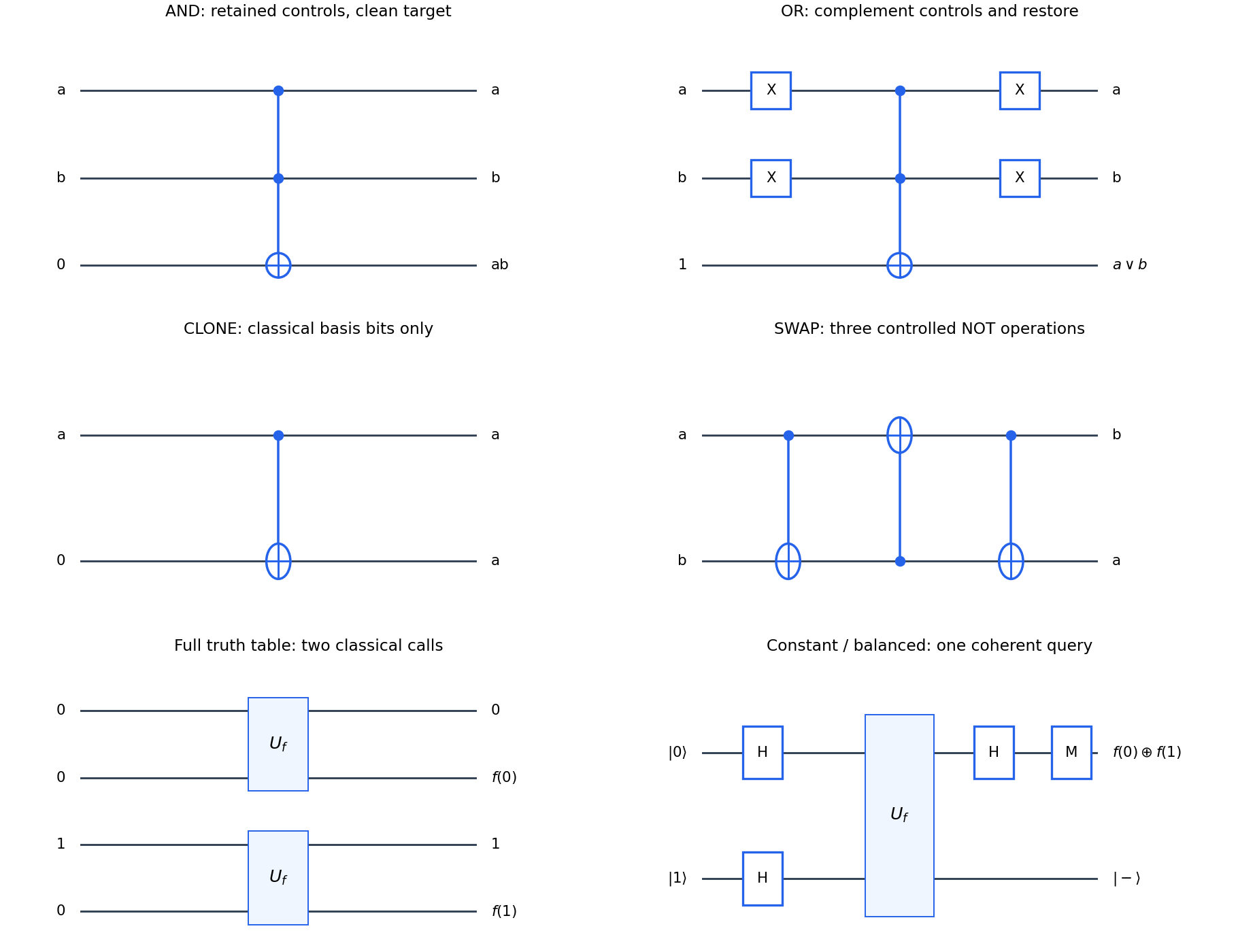
Codex 0 2026-10-25A constant function has , whereas a balanced one has one zero and one one, so . The four oracles require only the following circuits:Prepare , apply a Hadamard gate to each qubit, apply the oracle once, apply another Hadamard gate to the first qubit, and measure that first wire in the computational basis. Immediately before the oracle the state is . The identity gives phase kickback:The output is certainly zero for constant and one for balanced. In circuit terms the target contributes only a global sign, and a controlled with target acts as on the control; then turns that phase into a measured bit. These identities prove the network for all four explicit oracles. The unused sign contains only as a global phase, consistent with the full-identification lower bound.
Past exam of the laser science and quantum information processing course of the University of Oxford 2015 6 b Solution by Codex 0 2026-10-25
Codex 0 2026-10-25In the oracle machine model, a function is accessed through a black box whose internal gate cost is excluded; the resource counted is the number of calls. A reversible classical oracle maps basis inputs as . Its quantum oracle extension applies the same permutation coherently to arbitrary superpositions, without measuring its input. A classical random mixture of inputs is not that coherent extension.
Write the two truth-table entries as , . Then , with the four casesTwo classical query circuits, and , recover the whole function with certainty. One call fixes only one entry, leaving two compatible functions; hence two are necessary classically. Randomization cannot remove this obstruction to certainty.
The minimum for full exact function identification remains two even with coherent quantum queries. To see this, expand the oracle target into its eigenstates: it is identity on , and gives phases on . Any one-query input, including an auxiliary system, has orthogonal sector weights , and summing to one. The output overlap between functions differing only at is , so perfect distinction requires ; differing only at likewise requires . Then , but functions differing at both entries have overlap . They are the same ray rather than distinguishable states. Thus one query cannot identify all four functions. The following one-query task recovers only whether the entries agree.
Past exam of the laser science and quantum information processing course of the University of Oxford 2015 6 a Solution by Codex 0 2026-10-25
Codex 0 2026-10-25Use a classical target bit and initialized auxiliary bits. The NOT gate maps , the CNOT gate maps , and the Toffoli gate maps . They are bijections and are their own inverses. Explicit circuits with their retained input wires are:
- AND: a Toffoli gate on produces .
- OR: apply NOT to both controls, a Toffoli gate with target initialized to , then restore both controls. The target becomes .
- CLONE: a CNOT gate on gives .
- SWAP: apply , and . The successive pairs are , , then .
These maps also give the truth tables for all input combinations. AND and OR are not themselves reversible maps if the inputs are discarded; the retained inputs are what make their implementations reversible. Classical CLONE copies a known orthogonal computational basis alphabet; the no-cloning theorem forbids interpreting it as a copier of arbitrary quantum superpositions.
A Boolean circuit can express any finite Boolean function using AND, OR and NOT. Replace its operations by the reversible versions, keeping inputs and intermediate bits. Copy the final output into a fresh answer register with CNOT gates, then run the entire computing network backward. Intermediate auxiliary bits return to zero, yieldingThis compute-copy-uncompute construction proves universality in the usual model with initialized auxiliary bits. If is a reversible permutation, compute , use a reversible implementation of to clear , and swap registers, leaving with clean auxiliaries. The ancillary-resource qualification matters; a blanket claim about all permutations on an arbitrary fixed number of unassisted wires has parity restrictions.
Reversible Boolean constructions and a one-query Deutsch algorithm
. Original circuits for AND, OR, copying a classical bit and SWAP, with retained inputs and initialized targets shown explicitly. The lower panels show two classical oracle queries for the truth table and the phase-kickback quantum network that obtains only its parity in one query. Circuit operations run from left to right. Details. Past exam of the laser science and quantum information processing course of the University of Oxford 2015 5 d Solution by Codex 0 2026-10-25
Codex 0 2026-10-25Let be the Pauli X eigenstates. EncodeBoth have zero total eigenvalue, so is the identity on their span. This is the decoherence-free subspace obtained from the previous code by applying a Hadamard gate to each physical qubit.
Since and , a correlated error exchanges the codewords. It acts as logical , not as harmless identity. The Pauli Y gate obeys and , soThe phases cancel within each codeword. Thus either unknown correlated gate gives a logical bit error on a general encoded state, though a logical eigenstate is unchanged as a physical ray. The code prevents collective rotations, not every possible correlated error.
Past exam of the laser science and quantum information processing course of the University of Oxford 2015 5 c Solution by Codex 0 2026-10-25
Codex 0 2026-10-25Quantum error correction detects an error syndrome and actively restores a logical state within a correctable error set. A decoherence-free subspace instead encodes into a subspace on which every allowed noise operator acts as the same scalar; no relative logical phase or mixing is produced by that noise. It relies on the specified correlation structure, and does not protect against arbitrary independent errors.
For collective rotations ,Thus every encoded superposition is invariant. Equivalently it lies in the zero-eigenvalue subspace of .
By contrast,The relative phase changes by , although acts as on both basis states. Invariance under one discrete operation does not establish invariance under its continuous rotation family. A concrete counterexample is : the equally weighted encoded plus state becomes the encoded minus state, up to a global phase, and is orthogonal to its original state.
Pinned article: Introduction to the OurBigBook Project
Welcome to the OurBigBook Project! Our goal is to create the perfect publishing platform for STEM subjects, and get university-level students to write the best free STEM tutorials ever.
Everyone is welcome to create an account and play with the site: ourbigbook.com/go/register. We belive that students themselves can write amazing tutorials, but teachers are welcome too. You can write about anything you want, it doesn't have to be STEM or even educational. Silly test content is very welcome and you won't be penalized in any way. Just keep it legal!
Intro to OurBigBook
. Source. We have two killer features:
- topics: topics group articles by different users with the same title, e.g. here is the topic for the "Fundamental Theorem of Calculus" ourbigbook.com/go/topic/fundamental-theorem-of-calculusArticles of different users are sorted by upvote within each article page. This feature is a bit like:
- a Wikipedia where each user can have their own version of each article
- a Q&A website like Stack Overflow, where multiple people can give their views on a given topic, and the best ones are sorted by upvote. Except you don't need to wait for someone to ask first, and any topic goes, no matter how narrow or broad
This feature makes it possible for readers to find better explanations of any topic created by other writers. And it allows writers to create an explanation in a place that readers might actually find it.
Figure 1. Screenshot of the "Derivative" topic page. View it live at: ourbigbook.com/go/topic/derivativeVideo 2. OurBigBook Web topics demo. Source. - local editing: you can store all your personal knowledge base content locally in a plaintext markup format that can be edited locally and published either:This way you can be sure that even if OurBigBook.com were to go down one day (which we have no plans to do as it is quite cheap to host!), your content will still be perfectly readable as a static site.
- to OurBigBook.com to get awesome multi-user features like topics and likes
- as HTML files to a static website, which you can host yourself for free on many external providers like GitHub Pages, and remain in full control

Figure 2. You can publish local OurBigBook lightweight markup files to either OurBigBook.com or as a static website.
Figure 3. Visual Studio Code extension installation.
Figure 5. . You can also edit articles on the Web editor without installing anything locally. Video 3. Edit locally and publish demo. Source. This shows editing OurBigBook Markup and publishing it using the Visual Studio Code extension. 
- Infinitely deep tables of contents:




All our software is open source and hosted at: github.com/ourbigbook/ourbigbook
Further documentation can be found at: docs.ourbigbook.com
Feel free to reach our to us for any help or suggestions: docs.ourbigbook.com/#contact