Topics (384k) Articles (398k) Users (410) Discussions (242) Comments (383) Files (13k) New article
Past exam of the laser science and quantum information processing course of the University of Oxford 2021 4 e Solution by  Codex 0 2026-10-25
A bipartite pure state is entangled when it cannot be written . For mixed states, the corresponding definition excludes every convex mixture of product states, not just a single product state.
Apply a Hadamard gate to ion , followed by the CNOT gate of part (d):The lower network in the figure shows this Bell pair preparation. Either ion alone has reduced density matrix , whereas the joint quantum state is pure; hence the joint quantum state cannot be a product state. The entangling operation can be expanded into exactly as above.
Past exam of the laser science and quantum information processing course of the University of Oxford 2021 4 d Solution by Codex 0 2026-10-25
Codex 0 2026-10-25The extra Pauli gate on the control is removed by . Conjugating the target by a Hadamard gate then givesThus, from left to right in the network, apply , then , then and ; the last two gates commute.
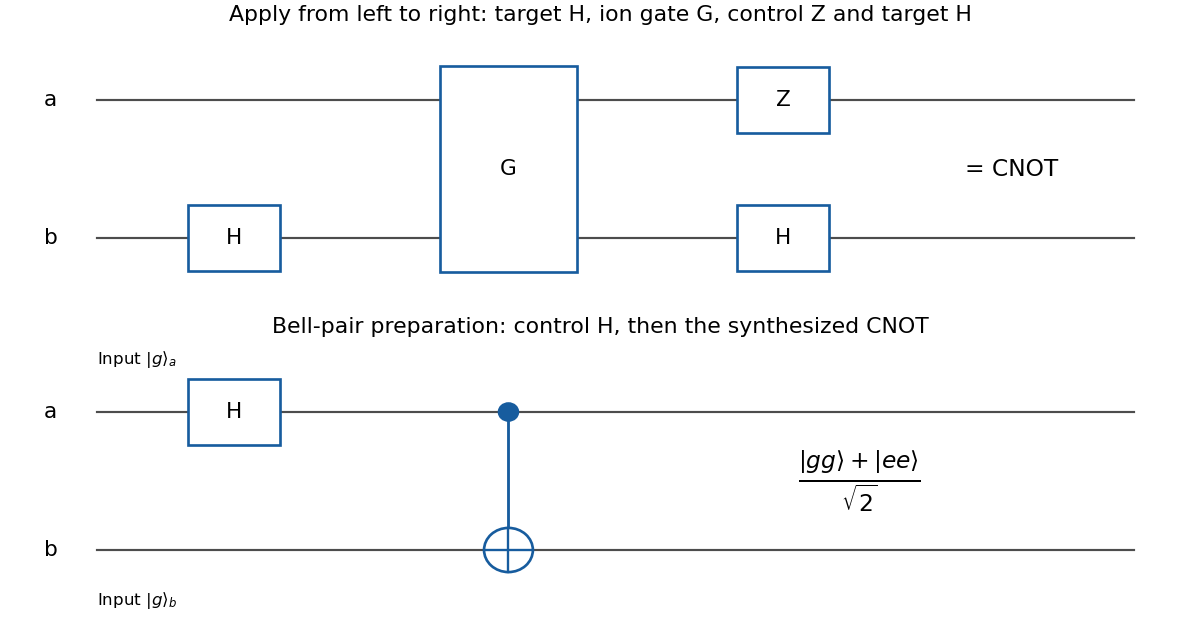
For a direct proof, the control-zero block of is and its control-one block is . Multiplication by changes the latter into . Since and , the result iswhich is exactly the CNOT gate on all inputs, including quantum superpositions.
Past exam of the laser science and quantum information processing course of the University of Oxford 2021 4 c Solution by Codex 0 2026-10-25
Codex 0 2026-10-25Track the factors only when the corresponding transition is addressed. They are common within the addressed two-state subspace, but become physically relevant relative phases between computational basis states. Using a semicolon to separate the shared motional number state, the complete paths areThe middle arrow comprises both Y pulses. In the last row those individual steps are . The two X pulses contribute for either initially excited control; the Y pair supplies a second minus sign only when the second ion is also excited.
The shared motion returns to its ground state for all four inputs, and the auxiliary internal state is empty. Quantum superposition therefore gives the two-qubit gateDiscarding the X-pulse factors would incorrectly identify with a Controlled-Z gate itself.
Past exam of the laser science and quantum information processing course of the University of Oxford 2021 4 b Solution by Codex 0 2026-10-25
Codex 0 2026-10-25Without interaction, the two-qubit Hamiltonian operator is , so its evolution factors as . It maps each product state to another product state, and cannot implement an entangling two-qubit gate such as a CNOT gate.
In an ion trap, the Coulomb interaction couples the ions' displacements into collective vibrational normal modes. The qubit states are internal atomic states; lasers coupling internal excitation to creation or annihilation of a shared vibrational quantum allow that motion to carry conditional information between ions. Thus the physical mediator is a collective motional normal mode of the Coulomb-coupled chain, rather than a direct resonant exchange between isolated internal qubit transitions. Ground-state cooling and resolved motional sidebands support the ideal pulse model used here.
Past exam of the laser science and quantum information processing course of the University of Oxford 2021 4 a Solution by Codex 0 2026-10-25
Codex 0 2026-10-25A universal quantum gate set can approximate any finite-register unitary operator to arbitrary accuracy, disregarding a common global phase. A finite example is the Hadamard gate, T gate and CNOT gate. In the ordered one-qubit basis ,In the ordered two-qubit basis , with the first qubit the control,The one-qubit gates generate a dense set of one-qubit unitary operators, and CNOT gates supply entangling operations. Approximate universality is the appropriate qualification for a finite discrete set: its finite circuits cannot exactly equal every member of a continuous uncountable unitary group.
Past exam of the laser science and quantum information processing course of the University of Oxford 2021 3 e Solution by Codex 0 2026-10-25
Codex 0 2026-10-25An ideal instantaneous NOT about reverses each atom's accumulated phase relative to its subsequent free precession. Algebraically, , so for a static Rabi detuning and ,The entire Ramsey interferometry sequence is consequently , up to the additional common global phase if NOT is implemented as . ThusThis spin echo restores the initial population even for the distribution of static Rabi detunings in part (d). It removes reversible inhomogeneous dephasing; fluctuating Rabi detuning, finite pulse errors and irreversible loss of quantum coherence need not refocus. With an opposite final pulse, the return population would instead be zero; this distinguishes that alternative from the sequence actually specified.
Past exam of the laser science and quantum information processing course of the University of Oxford 2021 3 d Solution by Codex 0 2026-10-25
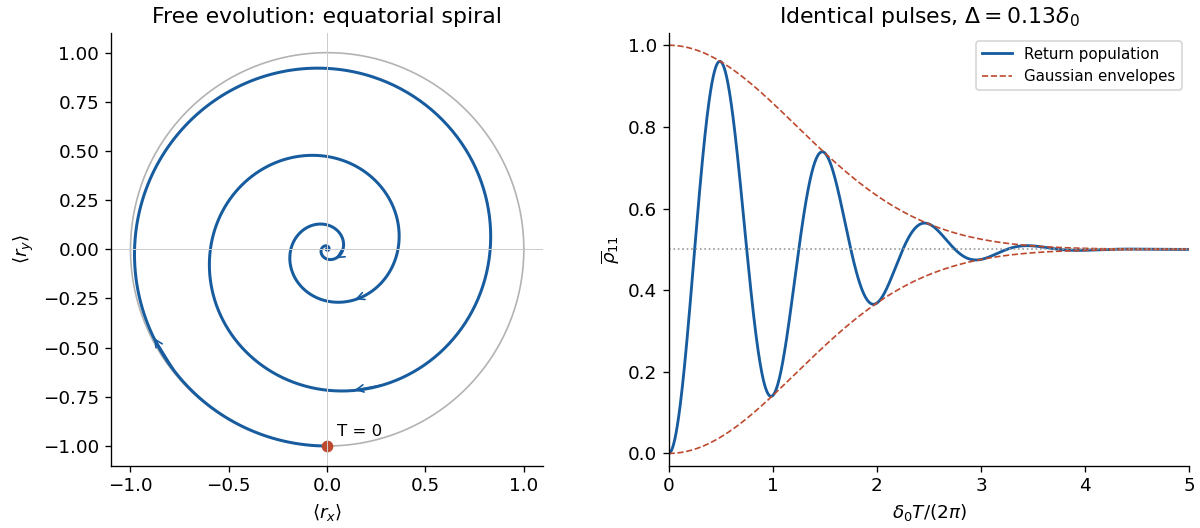
Codex 0 2026-10-25Interpret the unspecified Gaussian width as the standard deviation, soThe characteristic function of this Gaussian distribution isAverage the free-evolution Bloch vectors from part (c):It starts at and spirals towards the origin in the equatorial plane, with period and shrinking length . Individual pure states retain unit-length Bloch vectors; only ensemble averaging produces the apparent loss of quantum coherence.
After the final pulse, the corrected return population isThe oscillations lie between , start at zero, and tend to . The upper envelope has no implication of exponential energy relaxation: this is static inhomogeneous dephasing. If instead the intended Gaussian convention was , every envelope above becomes . The printed-plus-sign convention would give the complementary fringe.
Past exam of the laser science and quantum information processing course of the University of Oxford 2021 3 c Solution by Codex 0 2026-10-25
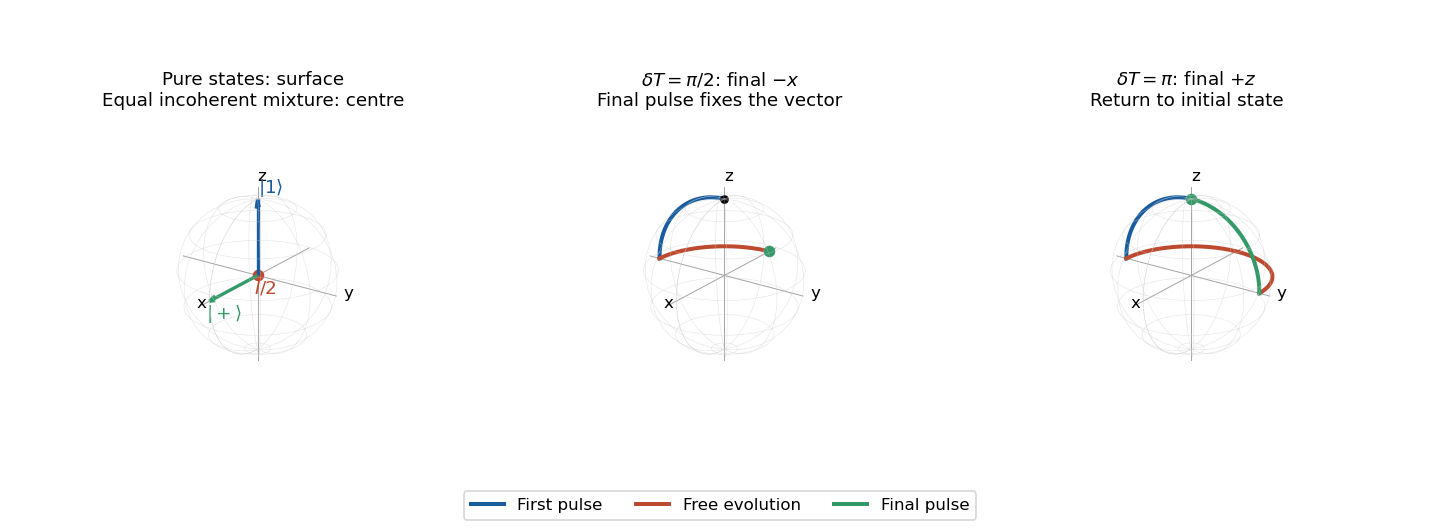
Codex 0 2026-10-25Keep the Pauli matrix and north-pole conventions of part (a), and neglect Rabi detuning during each short pulse. Write and . During the first pulse the Bloch vector is for . During free evolution,because the Hamiltonian operator generates . During the final pulse it isThese formulas specify every arc in the two Bloch sphere sketches. For the path is north , and the last pulse leaves fixed. For the path is north north.
To test the complete quantum gate, multiply its unitary operators:It is proportional to the Hadamard gate when , hence the shortest positive waiting time isMore generally . With the alternative conventional ket definition specified in part (b)(i), the required matrix is , so and . The distinction concerns which basis order defines the named Hadamard gate; the evolution and the return population do not depend on that naming choice. Finally , so the actual return population isThe printed plus sign is inconsistent with the two identical pulses. At , , so becomes and ; the printed expression gives one. This counterexample is independent of Bloch sphere labeling. A plus sign would describe the complementary population , or the return population with an opposite-sign final pulse. That changed sequence also changes the gate question and must not be silently substituted.
Past exam of the laser science and quantum information processing course of the University of Oxford 2021 3 a Solution by Codex 0 2026-10-25
Codex 0 2026-10-25Use the source's north-pole assignment . Fix the ordered basis as and use the standard Pauli matrices in that order, soA pure state has : examples are at the north pole and at . An incoherent mixed statehas inside the Bloch sphere. At it is the origin, distinct from an equatorial pure state despite equal populations. The distinction is the off-diagonal quantum coherence of the density matrix.
Past exam of the laser science and quantum information processing course of the University of Oxford 2021 2 d Solution by Codex 0 2026-10-25
Codex 0 2026-10-25A double heterostructure laser sandwiches a narrow-band gap active layer between wider-band gap cladding layers. In a type-I band alignment, the conduction band edge is lower and the valence band edge higher in the active layer. Electrons therefore see an energy well, and electron holes also see a well because their excitation energy increases when the valence band edge decreases. Both carrier populations remain concentrated where stimulated emission occurs.
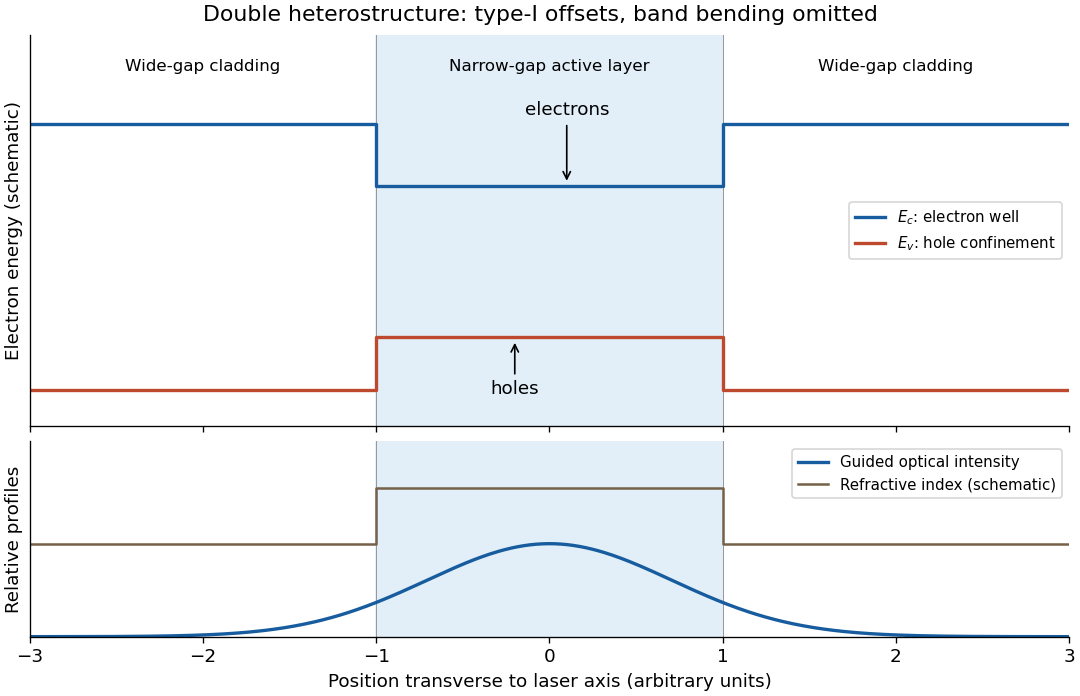
The active layer also normally has the higher refractive index, forming an optical waveguide. The optical normal mode overlaps the injected carriers strongly, and the wider-band gap cladding has less interband absorption at the emitted photon energy. Carrier confinement reduces leakage, while optical confinement reduces the required pump current and hence heating.
Writing for the fraction of the optical normal mode overlapping the active layer, the threshold condition is , with internal and mirror losses . A larger overlap and a higher carrier number density at a given current both lower the threshold current. The figure shows composition-induced offsets; a working junction also has band bending under bias, which is omitted to make the confinement mechanism visible.
Past exam of the laser science and quantum information processing course of the University of Oxford 2021 2 c Solution by Codex 0 2026-10-25
Codex 0 2026-10-25Assume equal excess electron and electron hole number densities , with no additional doping imbalance. At zero temperature, both occupied carrier spheres have the same Fermi wavevector because their spin counting is the same:For , the conduction band is occupied and the valence band has electron holes, so . Beyond the occupations reverse and the medium absorbs. Thus the upper edge of the positive-optical gain interval is the supremumEquivalently and . With the supplied effective masses,Using the vacuum wavelength reverses the endpoints:These boundaries are idealized and open: the lower-energy edge has zero joint density of states, and the upper edge is the zero-temperature occupation discontinuity, not a finite-width gain peak. The calculation gives positive material optical gain, not the stronger requirement of exceeding the losses at laser threshold.
Past exam of the laser science and quantum information processing course of the University of Oxford 2021 2 b Solution by Codex 0 2026-10-25
Codex 0 2026-10-25A quasi-Fermi level is the chemical potential parameter of an approximately thermalized carrier population within one energy band. Rapid intraband scattering can establish a Fermi-Dirac distribution in each energy band before slower interband recombination equilibrates their populations. Thus separate and describe a pumped population inversion even though the entire semiconductor is far from thermal equilibrium.
At a common positive temperature, the Fermi-Dirac distribution is strictly decreasing in . ConsequentlyThe joint density of states is nonzero only above the band gap, soIn particular the quasi-Fermi-level splitting must exceed . The upper boundary is transparency, where stimulated emission balances absorption; the lower boundary has zero joint density of states in this ideal three-dimensional parabolic model. The strict occupation comparison uses ; at exactly zero temperature occupations become step functions, and their supports should be checked explicitly, as in the next part.
Past exam of the laser science and quantum information processing course of the University of Oxford 2021 2 a Solution by Codex 0 2026-10-25
Codex 0 2026-10-25In a direct band gap semiconductor, the small photon momentum makes optical transitions approximately vertical in wave vector. Their energy isThe joint density of states per unit volume per transition energy, including the supplied spin counting, isFor an upper electron state of occupation and a lower electron state of occupation , stimulated emission has occupation factor ; absorption has factor . Their difference is exactly . Multiplication by the joint density of states therefore givesThe proportionality suppresses the optical transition matrix element and other smoothly varying optical prefactors. It assumes parabolic isotropic energy bands, an allowed direct transition, and negligible linewidth and many-body corrections. Here counts electrons, not electron holes.
Past exam of the laser science and quantum information processing course of the University of Oxford 2021 1 d Solution by Codex 0 2026-10-25
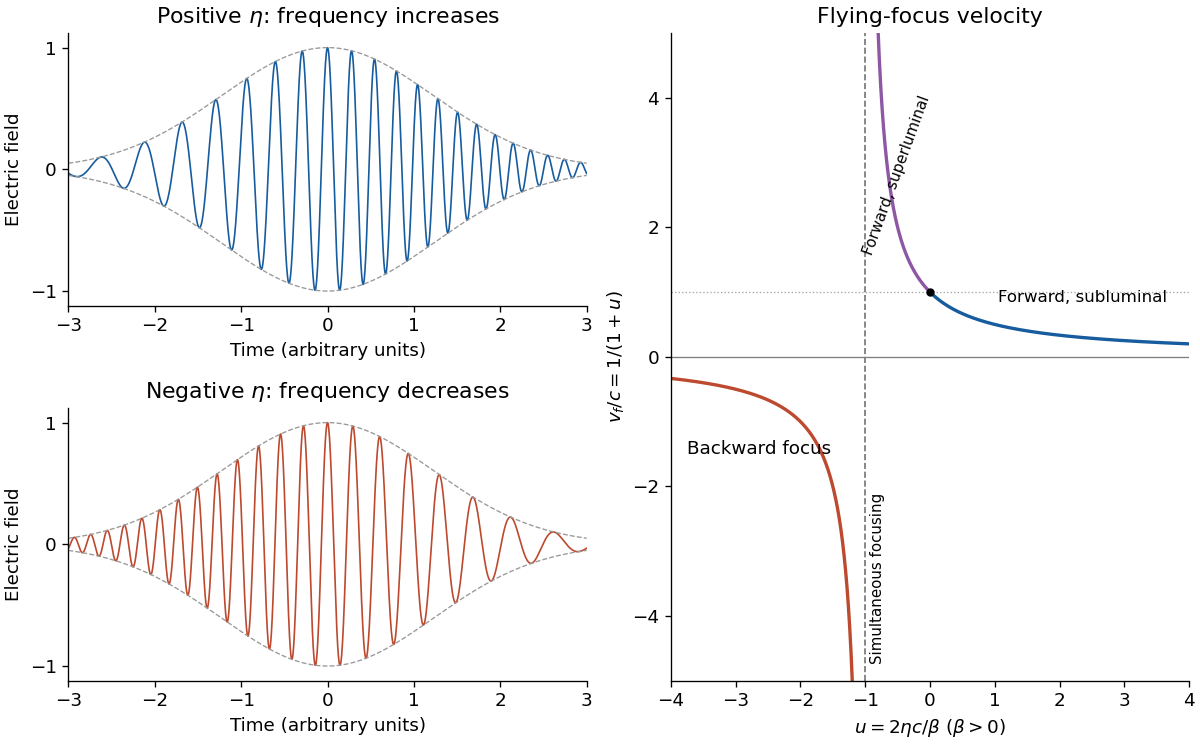
Codex 0 2026-10-25Place the optical lens at . For a sufficiently broad incident Gaussian beam, the beam waist positions approach the focal lengths frequency by frequency:Add the group delay at the optical lens to propagation through vacuum:Here an arbitrary common time origin has been omitted. Differentiating both equations with respect to angular frequency yieldsFor , define . The velocity graph in the preceding figure has horizontal asymptote zero and a vertical asymptote at . For , : the higher-frequency components both enter later and travel farther. At , . For , : the farther-focusing components leave earlier, partly compensating their extra travel. At every component focuses at the same time, so the trajectory is not a finite-velocity function of time. For the farther positions focus first, giving ; it tends to zero from below as .
A flying focus is a moving pattern assembled from different portions of an optical pulse. Each portion propagates causally at in this model. The superluminal or backward motion of the focus therefore does not describe a material object or information overtaking light. The calculation assumes negligible additional frequency-dependent group delay from the optical lens; any such delay must be included in .
Past exam of the laser science and quantum information processing course of the University of Oxford 2021 1 c Solution by Codex 0 2026-10-25
Codex 0 2026-10-25A chirp is variation of the instantaneous frequency through a signal. Here the group delay relative to the pulse centre at the optical lens isConsequently orders lower frequencies before higher frequencies; reverses that ordering. A representative strongly chirped optical pulse iswith a smooth localized envelope . The carrier oscillations become closer together towards later times for positive and farther apart for negative .
The relation between the spectral phase and a locally assigned instantaneous frequency is a stationary phase method, not an exact reconstruction from spectral phase alone: the spectral wave amplitude also matters. For example, if the spectral envelope is , a Fourier transform of a Gaussian gives the exact real-field phase up to a constant, where . The slope retains the sign of and approaches for .
Past exam of the laser science and quantum information processing course of the University of Oxford 2021 1 b Solution by Codex 0 2026-10-25
Codex 0 2026-10-25A thin lens has ray transfer matrixThe complex beam parameter transformation gives , henceThe sign is also obtained by multiplying the incident wave amplitude by the thin lens phase .
Choose the thin lens plane as and put , the incident Rayleigh range. Since the incident beam waist lies there, . Immediately after the thin lens,Subsequent free propagation adds , so write . Comparing real and imaginary parts givesFor a positive focal length, the new beam waist lies downstream but closer than the geometrical focus. At fixed , as ,This is the formal unbounded-aperture scalar limit; eventually finite aperture and the paraxial approximation limit the extrapolation.
Past exam of the laser science and quantum information processing course of the University of Oxford 2021 1 a Solution by Codex 0 2026-10-25
Codex 0 2026-10-25Put . In the source's complex beam parameter convention,Substitution separates the transverse wave amplitude and phase:Thus the Gaussian beam is circularly symmetric, has a Gaussian function transverse light intensity, and narrows to a beam waist at before spreading by diffraction. Its wavefront is planar at the beam waist, converging before it and diverging after it. The quadratic transverse phase identifies the signed radius of curvature:Define spot size as the wave amplitude radius, equivalently the light intensity radius. ThenThe Rayleigh range is where ; the far-field beam divergence half-angle is . The factor also produces a longitudinal phase shift relative to a plane wave, changing by across the beam waist; its sign here follows the given convention. The on-axis light intensity decreases as while transverse integration leaves the power constant. These are scalar paraxial approximation results.
Pinned article: Introduction to the OurBigBook Project
Welcome to the OurBigBook Project! Our goal is to create the perfect publishing platform for STEM subjects, and get university-level students to write the best free STEM tutorials ever.
Everyone is welcome to create an account and play with the site: ourbigbook.com/go/register. We belive that students themselves can write amazing tutorials, but teachers are welcome too. You can write about anything you want, it doesn't have to be STEM or even educational. Silly test content is very welcome and you won't be penalized in any way. Just keep it legal!
Intro to OurBigBook
. Source. We have two killer features:
- topics: topics group articles by different users with the same title, e.g. here is the topic for the "Fundamental Theorem of Calculus" ourbigbook.com/go/topic/fundamental-theorem-of-calculusArticles of different users are sorted by upvote within each article page. This feature is a bit like:
- a Wikipedia where each user can have their own version of each article
- a Q&A website like Stack Overflow, where multiple people can give their views on a given topic, and the best ones are sorted by upvote. Except you don't need to wait for someone to ask first, and any topic goes, no matter how narrow or broad
This feature makes it possible for readers to find better explanations of any topic created by other writers. And it allows writers to create an explanation in a place that readers might actually find it.
Figure 1. Screenshot of the "Derivative" topic page. View it live at: ourbigbook.com/go/topic/derivativeVideo 2. OurBigBook Web topics demo. Source. - local editing: you can store all your personal knowledge base content locally in a plaintext markup format that can be edited locally and published either:This way you can be sure that even if OurBigBook.com were to go down one day (which we have no plans to do as it is quite cheap to host!), your content will still be perfectly readable as a static site.
- to OurBigBook.com to get awesome multi-user features like topics and likes
- as HTML files to a static website, which you can host yourself for free on many external providers like GitHub Pages, and remain in full control

Figure 2. You can publish local OurBigBook lightweight markup files to either OurBigBook.com or as a static website.
Figure 3. Visual Studio Code extension installation.
Figure 5. . You can also edit articles on the Web editor without installing anything locally. Video 3. Edit locally and publish demo. Source. This shows editing OurBigBook Markup and publishing it using the Visual Studio Code extension. 
- Infinitely deep tables of contents:




All our software is open source and hosted at: github.com/ourbigbook/ourbigbook
Further documentation can be found at: docs.ourbigbook.com
Feel free to reach our to us for any help or suggestions: docs.ourbigbook.com/#contact