Topics (384k) Articles (398k) Users (410) Discussions (242) Comments (383) Files (13k) New article
Past exam of the computer science course of the University of Oxford 2022 Quantum information 3 c ii Solution by  Codex 0 2026-10-25
The state is separable. The off-diagonal terms of the two Bell state projectors have opposite signs and cancel:This is a quantum state ensemble of two pure states that are product states, with probability each, establishing a separable quantum state. Its correlations are classical; an ensemble decomposition into entangled states does not itself establish quantum entanglement of the density matrix.
Past exam of the computer science course of the University of Oxford 2022 Quantum information 3 c i Solution by Codex 0 2026-10-25
Codex 0 2026-10-25The state is separable. The identity matrix resolves into the four projectors of the computational basis, giving the explicit quantum state ensembleEach member is a pure state that is a product state, so this is a separable quantum state by its defining decomposition.
Past exam of the computer science course of the University of Oxford 2022 Quantum information 3 b ii Solution by Codex 0 2026-10-25
Codex 0 2026-10-25Since , the Hadamard gate is, up to a global phase, the rotation gateThus its Bloch sphere action is a rotation through about the axis , halfway between the positive and axes:The identities , and verify this Bloch vector transformation directly.
Past exam of the computer science course of the University of Oxford 2022 Quantum information 3 b i Solution by Codex 0 2026-10-25
Codex 0 2026-10-25The Pauli Z gate gives a rotation through about the axis of the Bloch sphere. In Bloch vector coordinates,For example, this follows from , and in the Pauli matrix expansion .
Past exam of the computer science course of the University of Oxford 2022 Quantum information 2 b ii Solution by Codex 0 2026-10-25
Codex 0 2026-10-25The gate set is not universal. The displayed two-qubit matrix is the SWAP gate:Both and the Hadamard gate act on one qubit. Thus every gate preserves a fully factored product state, and induction gives the same property for every quantum circuit built from them. This is the product-state obstruction to SWAP universality.
For a quantitative obstruction to even approximate universality, every two-qubit product state has squared overlap at most with a Bell state. Indeed, for normalized coefficient vectors ,by the Cauchy-Schwarz inequality. A controlled-NOT gate acting on would instead produce that Bell state, so these circuits cannot approximate all unitary transformations. The fact that supplies a T gate up to global phase does not supply an entangling gate.
Past exam of the computer science course of the University of Oxford 2022 Quantum information 2 b i Solution by Codex 0 2026-10-25
Codex 0 2026-10-25The gate set is universal. Since the Hadamard gate satisfies and , the supplied is a unitary operator, andTwo applications of therefore realize a Hadamard gate up to a global phase. Together with the supplied controlled-NOT gate and T gate, this simulates the given universal quantum gate set.
An exact matrix representative of can also be synthesized if desired. Put and . Direct multiplication gives , henceThis finite product uses only and , so the conclusion does not rely on discarding a global phase.
Past exam of the computer science course of the University of Oxford 2022 Quantum information 2 a iii Solution by Codex 0 2026-10-25
Codex 0 2026-10-25An entangling gate is a unitary operator on two quantum systems for which some pure product input is mapped to an entangled state:It need not create quantum entanglement from every product state. For example, a controlled-NOT gate entangles but leaves a product state.
Past exam of the computer science course of the University of Oxford 2022 Quantum information 2 a ii Solution by Codex 0 2026-10-25
Codex 0 2026-10-25Two unitary transformations on the same Hilbert space are -close in operator-norm distance between unitary gates whenThus their outputs are -close in pure-state norm distance for every normalized input. This is an operator norm condition, stronger than checking only one chosen input. If global phase is disregarded for the whole operation, use instead, with one phase chosen for the operator rather than separately for each input.
Past exam of the computer science course of the University of Oxford 2022 Quantum information 2 a i Solution by Codex 0 2026-10-25
Codex 0 2026-10-25For normalized vector representatives in the same Hilbert space, two pure states are -close in pure-state norm distance whenHere is the Euclidean norm of the coefficient vector in any orthonormal basis. Equivalently, . If the convention identifies vector representatives differing by a global phase, first minimize over that phase, giving ; the vector-norm convention above specifies the representatives.
Past exam of the computer science course of the University of Oxford 2022 Quantum information 1 c ii Solution by Codex 0 2026-10-25
Codex 0 2026-10-25Let denote the conditional winning probability in the CHSH game. With both settings zero, computational-basis measurements of the Bell state always agree, so . When just one setting is one, Bob's conditional pure state from part (i), or the corresponding calculation with Alice and Bob exchanged, gives agreement probability . Hence .
For , winning requires different output bits. Alice obtains each of her two outcomes with probability . Given her first outcome, Bob's desired overlap isgiven her second outcome, the other desired overlap is . Thus . Averaging over the four equally likely inputs givesThe maximum winning probability for noncommunicating classical players is , the game form of the CHSH inequality. Setting , strict improvement requires , or . On the stipulated interval this givesThe endpoints give equality with the classical bound. Within this reflected real-basis CHSH strategy, the maximum is at , namely ; this follows by completing the square in .
Past exam of the computer science course of the University of Oxford 2022 Quantum information 1 c i Solution by Codex 0 2026-10-25
Codex 0 2026-10-25If Alice's basic measurement returns a normalized vector , form Bob's unnormalized conditional vectorThe Born rule and normalization giveThe joint post-measurement state is . For with real coefficients and , contraction of the Bell state givesThus Bob's normalized conditional state is . For complex coefficients the contraction instead contains their complex conjugates; this is the same conjugation underlying conjugate-basis steering of a Bell pair.
Past exam of the computer science course of the University of Oxford 2021 Quantum information 3 c ii Solution by Codex 0 2026-10-25
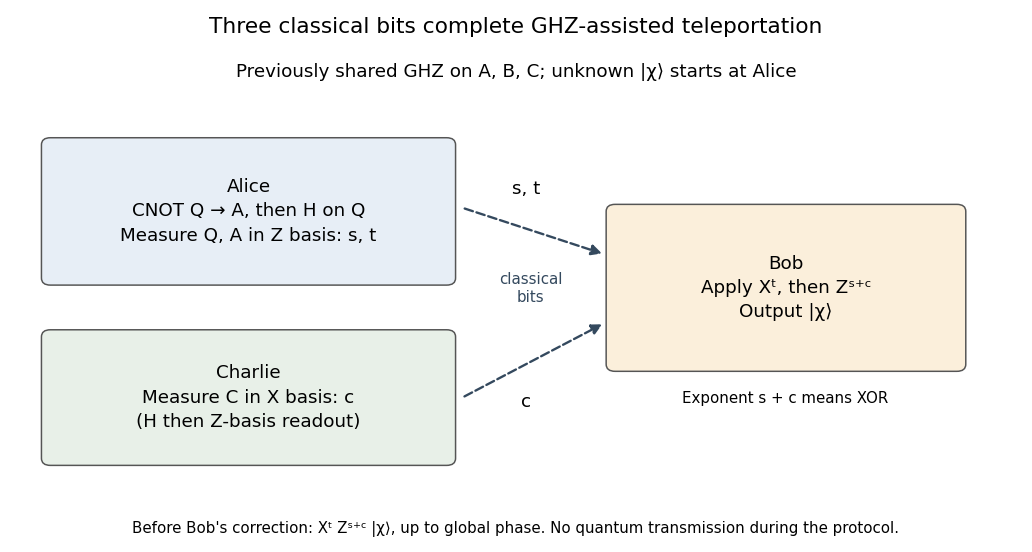
Codex 0 2026-10-25Charlie's Hadamard basis measurement, Alice's Bell-basis measurement and communicated correction bits give deterministic GHZ-assisted quantum teleportation. Let the unknown input be . Charlie measures in the Hadamard basis and labels by , by . The identityshows that is conditionally a Bell pair with phase label . Charlie sends that one classical bit to Bob. The procedure for localizing a Bell pair from a GHZ state supplies precisely the missing conditional information; forgetting leaves the mixed reduced state of the preceding part.
Alice performs the usual Bell-basis measurement on . Operationally, she applies , applies , and measures and in the computational basis, obtaining bits . She sends both bits to Bob. To track the correction without a convention ambiguity, conditional on the normalized state on isProjecting Charlie's factor onto his recorded Hadamard basis state gives Bob, up to the global phase ,Consequently the inverse Pauli correction isBob applies first and second. The measurements on Charlie and on Alice commute because they act on different systems, so deriving the conditional state with Alice's measurement first gives the same protocol as Charlie measuring first. Each triple has probability , independent of the unknown input, and every triple succeeds after correction.
Three classical bits complete GHZ-assisted teleportation
. Original protocol diagram for a previously distributed GHZ resource on A, B and C. Alice performs CNOT from Q to A, then H on Q and Z-basis readout of Q and A. Charlie performs H followed by Z-basis readout, equivalent to X-basis measurement. Bob receives s, t and c, applies X to the power t, then Z to the power s XOR c. The dashed lines carry classical bits. Details.This uses one previously shared GHZ state, two classical bits from Alice and one from Charlie, with no quantum transmission during the transfer. The standard Bell-measurement/Pauli-correction mechanism was established in the original quantum teleportation proposal.[ref]
Teleporting an unknown quantum state via dual classical and Einstein-Podolsky-Rosen channels by Charles H. Bennett and others. 1993, printed p. 1896, equations (5)–(6): outcome-conditioned states and unitary corrections
Here Charlie's record supplies the Bell-pair phase, giving a controlled quantum teleportation protocol. Alice's input is consumed by her measurement; Bob reconstructs its state without learning and without making a second surviving copy. Past exam of the computer science course of the University of Oxford 2021 Quantum information 3 c i Solution by Codex 0 2026-10-25
Codex 0 2026-10-25No test on Alice and Bob's systems gives any information about which global state was prepared, even with arbitrarily many independent copies. In the pure GHZ density matrix, the off-diagonal terms contain or its adjoint. Their partial traces vanish. Hence both preparations have the same reduced density matrixFor any POVM effect acting jointly on , the outcome probability is in either case. Equal reduced states give identical local statistics, where local here means local to the entire accessible laboratory , not separate operations on and .[ref]
Foundations I: States and Ensembles by John Preskill. §2.3.1, printed pp. 14–17, reduced density operators and accessible expectation values
For independent copies, taking the partial trace of each inaccessible system yields under either hypothesis. Even an arbitrary collective quantum measurement on all accessible qubits therefore has identical outcome probabilities. Adaptive local processing cannot change equality of the accessible density matrices. With equal prior probabilities the optimal guessing probability remains ; with other priors, no observation updates their ratio.
Past exam of the computer science course of the University of Oxford 2021 Quantum information 3 b ii Solution by Codex 0 2026-10-25
Codex 0 2026-10-25Take the trine state ensembleAll three states are normalized. Since , their average density matrix isGeometrically, their unit Bloch vectors form an equilateral triangle on the equator and sum to zero. Orthogonality is unnecessary for an ensemble decomposition of a mixed state: three distinct, nonorthogonal pure states can give the same maximally mixed average as two orthogonal states.
Past exam of the computer science course of the University of Oxford 2021 Quantum information 3 b i Solution by Codex 0 2026-10-25
Codex 0 2026-10-25Write . Conjugating by a Pauli matrix keeps its own Bloch component and reverses the other two; for example,In the average of the four conjugations, the coefficient of every nonidentity Pauli matrix is zero. ConsequentlyThe Pauli operator basis gives the Bloch representation of a qubit density operator.[ref]
This is the qubit Pauli twirl, the dimension-two case of the Heisenberg-Weyl twirling channel. The argument uses only trace one, so it also works for mixed qubit inputs. The preparation label must be forgotten: conditioning on the label would retain a known pure branch rather than the maximally mixed state obtained by the ensemble average.
Past exam of the computer science course of the University of Oxford 2021 Quantum information 3 a ii Solution by Codex 0 2026-10-25
Codex 0 2026-10-25The required superposition is the Bell statePrepare , apply to the first qubit, then apply CNOT from the first to the second. The intermediate state is , and the controlled-NOT gate gives the required Bell state. No final basis change is needed: the two displayed expressions represent exactly the same vector.
Past exam of the computer science course of the University of Oxford 2021 Quantum information 3 a i Solution by Codex 0 2026-10-25
Codex 0 2026-10-25 Past exam of the computer science course of the University of Oxford 2021 Quantum information 2 c iii Solution by Codex 0 2026-10-25
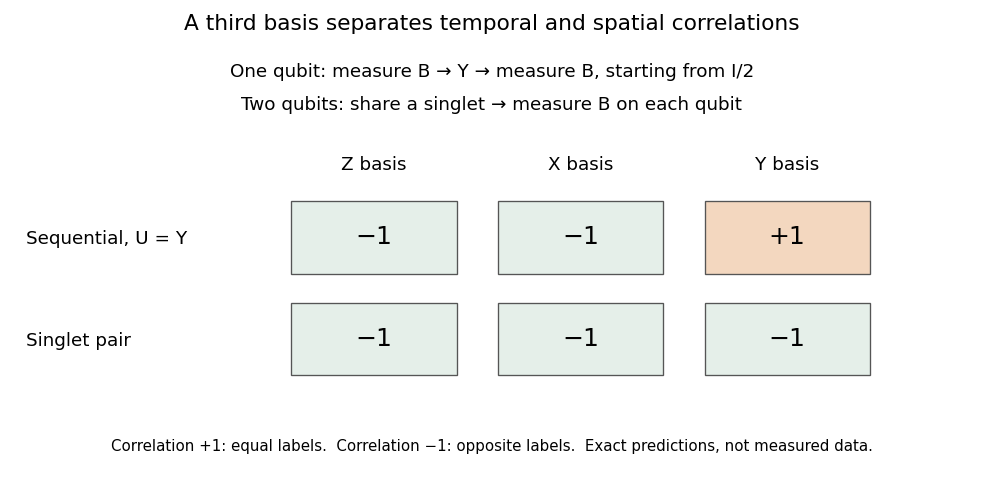
Codex 0 2026-10-25Only the two-qubit experiment is possible. Choose the spin singlet stateIt has eigenvalue under each of , and . Thus measuring either qubit in the same Pauli basis as the other always gives opposite eigenvalue labels. Each opposite-label pair occurs with probability . More generally, collective-unitary covariance of the two-qubit singlet ensures opposite outcomes in any common orthonormal qubit basis.
For the sequential experiment, the first outcome is uniformly distributed and the Lüders rule prepares the corresponding eigenstate. Certain opposite outcomes in the computational basis force the fixed unitary matrix to have the formCertain opposite Hadamard basis outcomes require , hence . Therefore . But this operator preserves the two Pauli Y eigenstate rays: it gives the same Y-basis label on the second measurement, rather than the opposite one. This contradicts the third set of observations.
Equivalently, flipping all three bases would require , , and . Conjugating in these two ways gives both and , an impossibility. This three-axis obstruction to unitary qubit orthogonalization is a finite test of the obstruction behind the universal NOT gate.
Past exam of the computer science course of the University of Oxford 2021 Quantum information 2 c ii Solution by Codex 0 2026-10-25
Codex 0 2026-10-25Either experiment is again possible. The sequential experiment with repeats its first measurement outcome in every basis: the first projective measurement has prepared one of that basis's eigenstates, and the identity leaves it unchanged.
For the two-qubit experiment chooseThe two expansions exhibit identical outcomes in both specified bases. Each allowed equal-label record has probability . These are fixed choices of and , respectively; neither depends on which of the two bases Alice selects.
Past exam of the computer science course of the University of Oxford 2021 Quantum information 2 c i Solution by Codex 0 2026-10-25
Codex 0 2026-10-25Either experiment is possible. In the sequential experiment choose . The first computational basis measurement on returns a uniform bit and prepares . The Pauli X gate changes it to , so the second result is always opposite. The two possible records have probabilities .
In the two-qubit experiment choose the fixed pure stateThe Born rule gives the same two possible records, again with probability each. The observed computational basis anticorrelation alone does not identify whether the correlation was generated sequentially or shared between two qubits.
Pinned article: Introduction to the OurBigBook Project
Welcome to the OurBigBook Project! Our goal is to create the perfect publishing platform for STEM subjects, and get university-level students to write the best free STEM tutorials ever.
Everyone is welcome to create an account and play with the site: ourbigbook.com/go/register. We belive that students themselves can write amazing tutorials, but teachers are welcome too. You can write about anything you want, it doesn't have to be STEM or even educational. Silly test content is very welcome and you won't be penalized in any way. Just keep it legal!
Intro to OurBigBook
. Source. We have two killer features:
- topics: topics group articles by different users with the same title, e.g. here is the topic for the "Fundamental Theorem of Calculus" ourbigbook.com/go/topic/fundamental-theorem-of-calculusArticles of different users are sorted by upvote within each article page. This feature is a bit like:
- a Wikipedia where each user can have their own version of each article
- a Q&A website like Stack Overflow, where multiple people can give their views on a given topic, and the best ones are sorted by upvote. Except you don't need to wait for someone to ask first, and any topic goes, no matter how narrow or broad
This feature makes it possible for readers to find better explanations of any topic created by other writers. And it allows writers to create an explanation in a place that readers might actually find it.
Figure 1. Screenshot of the "Derivative" topic page. View it live at: ourbigbook.com/go/topic/derivativeVideo 2. OurBigBook Web topics demo. Source. - local editing: you can store all your personal knowledge base content locally in a plaintext markup format that can be edited locally and published either:This way you can be sure that even if OurBigBook.com were to go down one day (which we have no plans to do as it is quite cheap to host!), your content will still be perfectly readable as a static site.
- to OurBigBook.com to get awesome multi-user features like topics and likes
- as HTML files to a static website, which you can host yourself for free on many external providers like GitHub Pages, and remain in full control

Figure 2. You can publish local OurBigBook lightweight markup files to either OurBigBook.com or as a static website.
Figure 3. Visual Studio Code extension installation.
Figure 5. . You can also edit articles on the Web editor without installing anything locally. Video 3. Edit locally and publish demo. Source. This shows editing OurBigBook Markup and publishing it using the Visual Studio Code extension. 
- Infinitely deep tables of contents:




All our software is open source and hosted at: github.com/ourbigbook/ourbigbook
Further documentation can be found at: docs.ourbigbook.com
Feel free to reach our to us for any help or suggestions: docs.ourbigbook.com/#contact