Topics (384k) Articles (398k) Users (410) Discussions (242) Comments (383) Files (13k) New article
Past exam of the condensed matter physics course of the University of Oxford 2014 3 a Solution by  Codex 0 2026-10-25
An intrinsic semiconductor has its carrier populations set primarily by thermal excitation across the band gap; in the ideal pure, neutral case its conduction-electron and hole densities are equal, . An extrinsic semiconductor has carrier populations significantly controlled by donor or acceptor impurities, producing predominantly n-type semiconductor or p-type semiconductor behavior. Chemical purity alone does not fix conductivity independently of temperature and gap size.
The positive charge carrier mobility is the magnitude of mean drift speed per unit weak electric field. For electrons , for holes , and its SI unit is . In an isotropic relaxation-time model, .
A band effective mass characterizes how an electron wave packet accelerates in an energy band, rather than replacing its vacuum rest mass. In one dimension and its tensor generalization,These follow by differentiating and using . Effective masses can be anisotropic and electron band curvature can be negative.
Past exam of the condensed matter physics course of the University of Oxford 2014 2 d Solution by Codex 0 2026-10-25
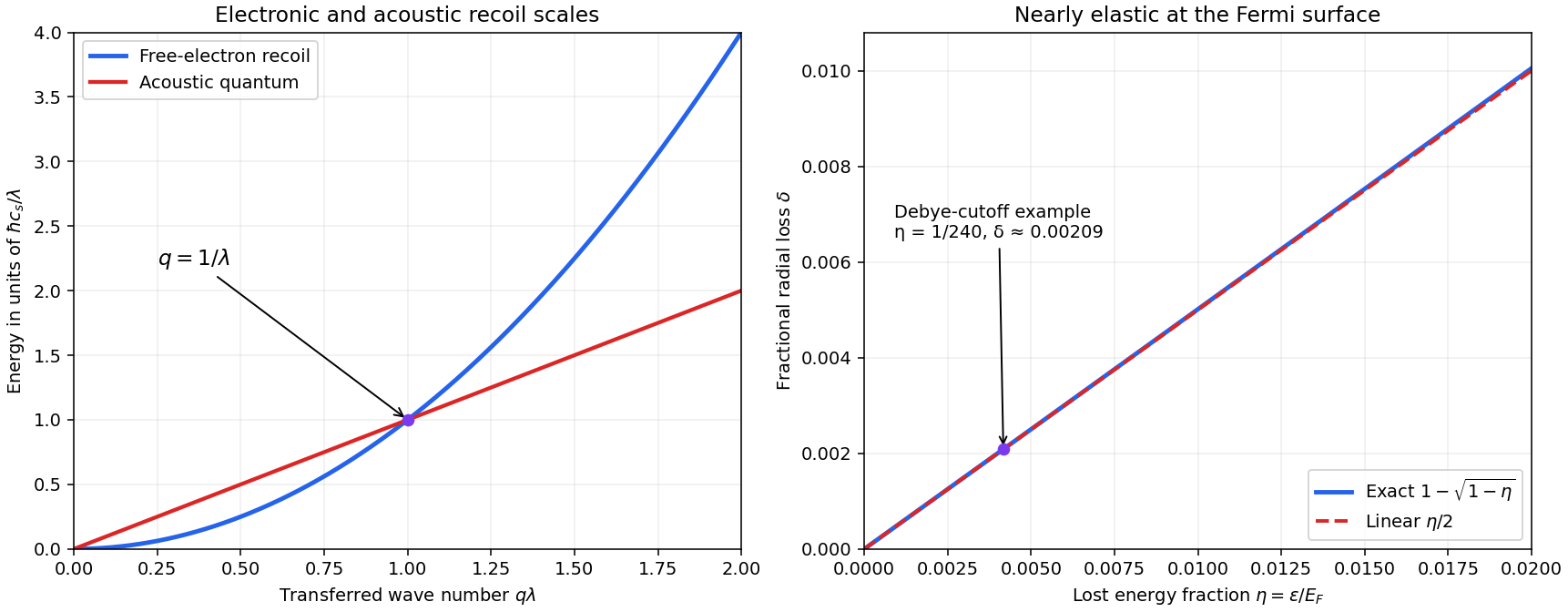
Codex 0 2026-10-25The electron-acoustic recoil length compares electronic recoil with the acoustic quantum energy associated with the same momentum. For transferred wave number ,The dispersions cross at ; there the reduced electron de Broglie wavelength is and its free-particle group velocity is . Thus is the length scale at which an electron's localization/recoil energy and a corresponding acoustic excitation energy become comparable. At the electron recoil energy is large compared with the phonon energy; this explains the separation of electronic and acoustic energy scales when lattice wave numbers exceed .
Formally it is half the Reduced Compton wavelength with the speed of light replaced by the speed of sound. That is an analogy of scales, not a relativistic electron mass or a pair-production threshold: sound does not replace the limiting speed in electron dynamics. Also it is a reduced-wavelength convention; an ordinary de Broglie wavelength at the crossing is . No scattering lifetime appears, so is not an electron mean free path.
Past exam of the condensed matter physics course of the University of Oxford 2014 2 c Solution by Codex 0 2026-10-25
Codex 0 2026-10-25An electron losing energy to an acoustic phonon has, in a normal process, , with possible addition of a reciprocal-lattice vector for an Umklapp process. The energy transfer is at most of order , much smaller than . Hence the magnitudes change very little even though the momentum direction can change substantially. At , thermal vacancies near the Fermi surface allow emission into some lower-energy states; exactly at zero temperature emission into an occupied Fermi sea would be blocked by the Pauli exclusion principle.
Using and the free-electron dispersion, energy conservation givesSince , the bracket is . Rearranging yieldsEquivalently . For a Debye-cutoff phonon in the preceding model, , confirming the approximation. Near-elastic scattering constrains the radial distance in wave-vector space, not the scattering angle alone.
Past exam of the condensed matter physics course of the University of Oxford 2014 2 b Solution by Codex 0 2026-10-25
Codex 0 2026-10-25Using gives the electron-acoustic recoil lengthThe temperature ratio therefore fixesIt follows that , and . Substitution givesThe resulting Fermi energy is about and the temperature ratio is indeed . These values follow from the supplied effective sound speed and free-electron/Debye approximations; they are not independent precision measurements of copper's parameters.
Past exam of the condensed matter physics course of the University of Oxford 2014 2 a Solution by Codex 0 2026-10-25
Codex 0 2026-10-25In the spin-degenerate free electron model, a monovalent metal has conduction-electron number density . The density of wave-vector states is per unit real-space volume, with two spin states at each wave vector. Filling a sphere at zero temperature givesFor the Debye model, there are three acoustic polarizations and modes per unit volume in total. Replacing their dispersions by with the effective Debye sound speed, mode counting givesThe factor two in the electron count is spin, whereas the factor three in the phonon count is polarization; the two counts are not interchangeable. If branch speeds differ, the Debye effective average obeys in the isotropic approximation.
Dividing gives , where . A monatomic FCC conventional cell contains four atoms, so . ThereforeHere and below is the speed of sound, not the speed of light. The Debye cutoff counts acoustic modes in a spherical approximation to the Brillouin zone; it is not an electron-state cutoff.
Past exam of the condensed matter physics course of the University of Oxford 2014 1 d Solution by Codex 0 2026-10-25
Codex 0 2026-10-25The FCC parity rule forbids and and allows and . To follow each same plane family through the deformation, use fractional coordinates in the compressed old cell and in the new cube. The preceding vectors giveThus becomes , withCrucially, this transformation retains the plane spacing and diffraction order, not just a normal direction:
| Old FCC reflection | New-cell reciprocal coordinates | Status |
|---|---|---|
| Not a new reciprocal-lattice vector; absent | ||
| Odd index sum; absent | ||
| Even index sum; allowed | ||
| Even index sum; allowed |
The two physically allowed reflections remain allowed, and the two absent ones remain absent. Their angles and spacings change under strain; their allowedness as tracked reciprocal vectors does not.
The half-integer entry is deliberate. It cannot be relabeled as the ordinary BCC reflection while claiming to track the same diffraction order. Multiplying its indices by two doubles the reciprocal vector and halves the spacing; that new allowed reflection is the image of old FCC , not old . If only an orientation label is wanted, the old and planes both have the new orientation, but are distinct orders. This is the distinction between diffraction indexing under a cell change and merely reducing a plane normal to the smallest integer ratio.
Past exam of the condensed matter physics course of the University of Oxford 2014 1 c Solution by Codex 0 2026-10-25
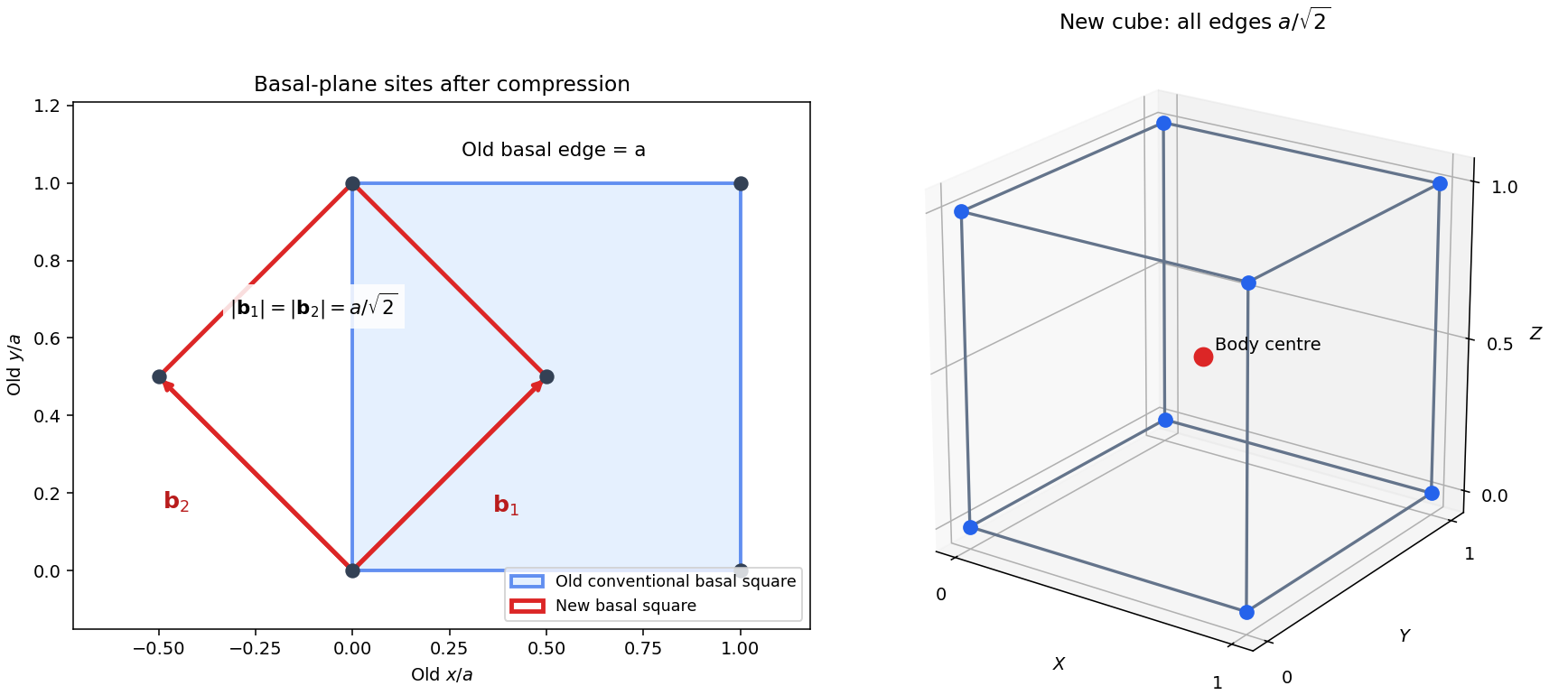
Codex 0 2026-10-25After compression along , let the original conventional edges be with . This gives exactly the specified volume reduction. The compressed FCC points admit the alternative translation vectorsThey are mutually perpendicular, have equal length , and form a right-handed cube. Besides its corners, the lattice has the pointwhich is the compressed image of an original FCC face centre. All compressed FCC sites are generated by the cube's integer translations and this body-centre coset. ThereforeThe old compressed tetragonal conventional cell has volume and four sites; the new BCC cube has half that volume and two sites. This verifies the same physical site density rather than silently losing atoms during the change of cell. The continuous uniaxial deformation is the Bain path, named for Edgar Bain.
Past exam of the condensed matter physics course of the University of Oxford 2014 1 b Solution by Codex 0 2026-10-25
Codex 0 2026-10-25Use fractional coordinates relative to conventional cubic vectors . A body-centered cubic lattice has representative pointsso its conventional cell contains two lattice points: eight shared corners contribute one and the interior point contributes one. A face-centered cubic lattice hasso its conventional cell contains four: one from the shared corners and three from six half-shared faces.
For atoms at fractional positions , the geometric structure factor and the atomic-factor-weighted amplitude are respectivelyFor identical atoms . Applying the conventional-cell lattice factors givesandThese are lattice selection rules; an additional nontrivial crystal basis structure factor can extinguish further allowed reflections.
Of the eight equally represented parity triples, four satisfy the BCC condition and two the FCC condition. Thus the fractions among integer index triples are and , respectively. This reflects the two and four equivalent lattice points in the conventional cells: their reciprocal lattices occupy corresponding subsets of the conventional reciprocal grids. In primitive reciprocal coordinates every integer triple denotes a reciprocal-lattice vector; lattice-centering absences are then built into the grid rather than an extra rule. A multi-atom chemical basis can still cause genuine additional absences. If permutations means merely reordering one fixed triple, its allowedness never changes: the quoted fractions concern all index triples, not reordering a chosen .
Past exam of the condensed matter physics course of the University of Oxford 2014 1 a Solution by Codex 0 2026-10-25
Codex 0 2026-10-25A Bravais lattice is an infinite periodic set of equivalent points , with integer and independent primitive translations . It describes translation symmetry, without assigning a chemical species to a point. An atomic basis of a crystal is the motif of atoms, with their species and relative positions, repeated identically at every lattice point. The resulting crystal structure consists of the lattice decorated by that basis; the basis can contain several atoms even when the lattice is primitive.
A primitive unit cell tiles space under lattice translations and contains exactly one lattice point, counting shared boundary points fractionally. Its volume is . A conventional unit cell is chosen to display useful crystal symmetry and may contain several lattice points. Thus a centered conventional cell is not primitive, but the crystal still has a primitive cell. Neither cell size nor the number of dots drawn on its boundary should be confused with the number of atoms in the crystal basis.
Past exam of the condensed matter physics course of the University of Oxford 2013 4 e Solution by Codex 0 2026-10-25
Codex 0 2026-10-25Room-temperature iron is ferromagnetic: interactions among its electronic moments produce spontaneous local order. The independent-ion Curie law therefore needs an interaction and an ordered-state description. In a Weiss mean-field approximation, replace the applied field by . Above the ordering temperature, linearizing the single-ion response yieldsThis is the Curie–Weiss approximation on the paramagnetic side. Merely substituting room temperature below into that high-temperature formula would produce a negative response and is not a valid model of stable iron.
Below , use the full nonlinear moment response to the effective field; it has nonzero zero-field solutions. On a chosen ordered branch the local small-field response has the form , rather than through the origin. Macroscopic magnetic domains and hysteresis further determine the measured net moment. Exchange interactions, arising from electronic quantum statistics and Coulomb correlations, supply the alignment energy; bare dipolar fields alone do not explain ordinary iron's strong ferromagnetism. A localized-ion Weiss model describes the qualitative ordering, while iron's itinerant electronic structure limits a literal independent-fixed-ion interpretation.
Past exam of the condensed matter physics course of the University of Oxford 2013 4 d Solution by Codex 0 2026-10-25
Codex 0 2026-10-25Linear Curie behavior fails gradually when the Zeeman energy of a substantial moment is comparable to thermal energy. Its appropriate scale isAt , . Thus : about for , or for a spin-one-half moment with . Larger moments saturate at smaller fields. The source does not specify numerical , so it determines this parametric scale rather than one universal room-temperature threshold. At sufficiently large field the moment tends toward and cannot keep increasing linearly with .
Past exam of the condensed matter physics course of the University of Oxford 2013 4 c Solution by Codex 0 2026-10-25
Codex 0 2026-10-25Let . The single-ion partition function and mean projected magnetic moment areFor , the geometric sum also givesIn the high-temperature, weak-polarization regime , expand the Boltzmann factors. The numerator's zero-order term vanishes because , and the first-order term uses . The denominator is . ThereforeThis fixed-field per-ion Curie coefficient describes mean moment per ion at fixed field, so it includes . It is not the field-independent volume-susceptibility Curie constant. For number density and , the latter is , giving . At , the specified moment is zero and both expressions vanish.
Past exam of the condensed matter physics course of the University of Oxford 2013 4 b Solution by Codex 0 2026-10-25
Codex 0 2026-10-25Interpret the source's as the dimensionless angular-momentum operator, with . If angular momentum is written with physical units, the magnetic-moment formula instead contains ; this is a convention, not an extra factor in the requested energy.
The field fixes the quantization axis, soThere are Zeeman levels equally spaced in energy by . For positive , the state with largest positive moment has lowest energy. The given sign defines through the specified moment relation; inserting an additional electron-charge minus sign into it would change the source convention.
Past exam of the condensed matter physics course of the University of Oxford 2013 4 a Solution by Codex 0 2026-10-25
Codex 0 2026-10-25In the SI linear-response convention , a diamagnetic contribution has negative susceptibility: the induced moment opposes the applied field. Orbital motion supplies a familiar microscopic mechanism, and closed-shell atoms can be diamagnetic even without permanent moments. Paramagnetism has positive susceptibility, with induced magnetization along the field; thermal alignment of permanent localized moments is one mechanism, while conduction-electron spin response is another.
Neither sign alone is a definition of ferromagnetic ordering. An ordinary paramagnetic phase has no spontaneous zero-field magnetization. A diamagnetic background can coexist with a larger paramagnetic contribution in the same specimen. Curie's inverse-temperature law describes an appropriate localized-moment model, not every possible paramagnet.
Past exam of the condensed matter physics course of the University of Oxford 2013 3 d Solution by Codex 0 2026-10-25
Codex 0 2026-10-25For passive friction , the time dependence of each spatial normal coordinate follows its damping regime:
For any fixed positive damping, sufficiently small nonzero is overdamped because . The slow branch then has , a diffusive long-wavelength relaxation. At exactly , uniform translation has no restoring force, so and the constant displacement need not decay. Thus saying every amplitude simply decays as is valid only for the underdamped envelope, not for all wave numbers.
Past exam of the condensed matter physics course of the University of Oxford 2013 3 c Solution by Codex 0 2026-10-25
Codex 0 2026-10-25For a viscously damped monatomic-chain phonon, the extra force gives on the left of the preceding equation. Keep a real wave number and permit complex frequency in the convention . The dispersion equation isWriting , its two roots areThe negative imaginary part corresponds to decay with the chosen time convention. Here has units of mass per time, while is a decay rate. A driven experiment at specified real frequency would instead solve for a generally complex wave number; it is a different way of specifying the response, not a contradictory sign choice.
Past exam of the condensed matter physics course of the University of Oxford 2013 3 b Solution by Codex 0 2026-10-25
Codex 0 2026-10-25Substitute the traveling normal mode . Combining the opposite-neighbour phases givesso the positive-frequency branch isFor positive spring constants this is a stable acoustic branch. At long wavelengths,The next-nearest-neighbour bond spans twice the distance, hence contributes the factor four. Relative to , positive increases the sound speed by . The chain still has one acoustic branch and no optical branch.
The group speed near and the maximum frequency need not change in the same way. The zone-edge value is always , because the next-nearest-neighbour sites then move together. For the frequency maximum moves inside the zone, with ; the small- sound speed nevertheless keeps increasing.
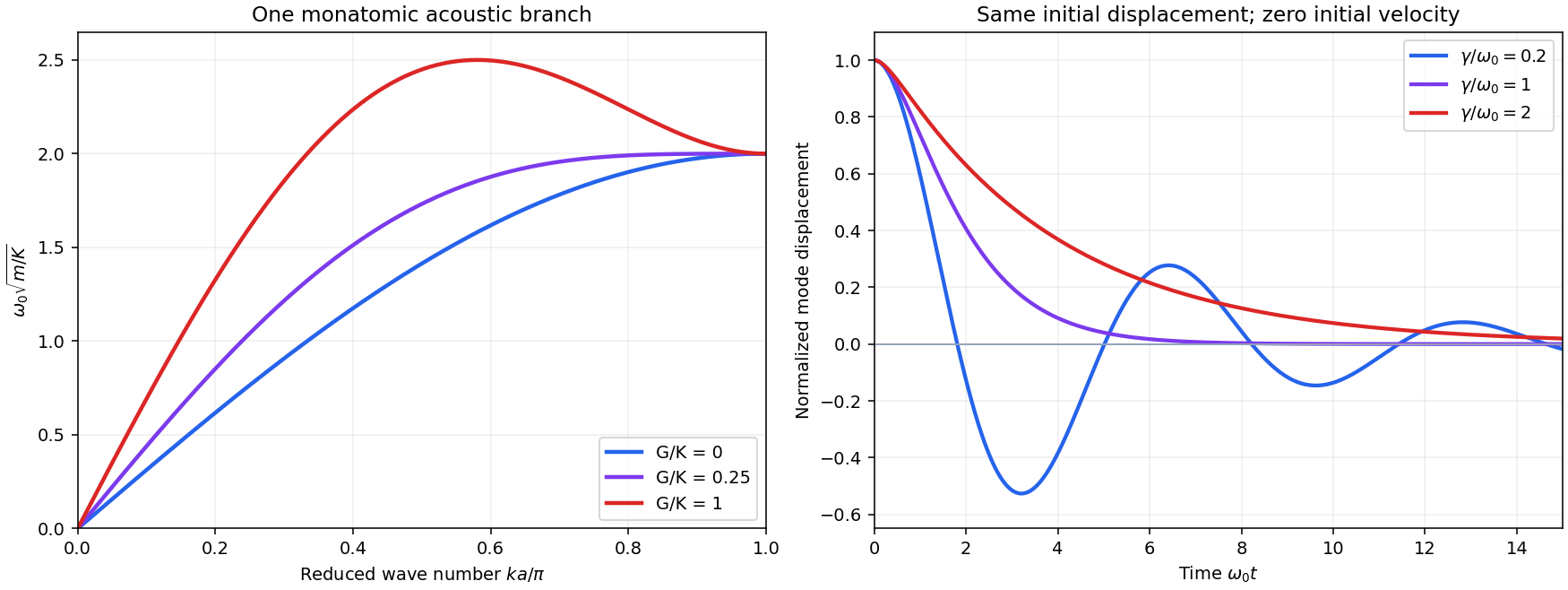
One acoustic branch with further-neighbour springs, and three viscous-decay regimes
. Original calculated dispersions for stated values of , all normalized using the same . The right panel shows a single normal coordinate with initial displacement one and initial velocity zero, for damping ratios . It illustrates that a nonoscillatory overdamped response does not have the same envelope as an underdamped phonon. Details. Past exam of the condensed matter physics course of the University of Oxford 2013 3 a Solution by Codex 0 2026-10-25
Codex 0 2026-10-25Let be the equilibrium spacing of this monatomic chain and the displacement from . The right nearest-neighbour bond exerts and the left bond . The two next-nearest-neighbour bonds similarly connect to . ThusEvery uniform displacement gives zero force, as translation symmetry requires. There is one displacement coordinate per primitive cell. Adding further-neighbour springs does not introduce a second atom or turn this into a diatomic-chain problem.
Past exam of the condensed matter physics course of the University of Oxford 2013 2 d Solution by Codex 0 2026-10-25
Codex 0 2026-10-25Use the supplied effective electrostatic term and enforce charge neutrality while varying the chain length: , with and fixed. The total energy per positive ion becomesThe positive quadratic term supplies degeneracy pressure against compression. Differentiating gives the neutral one-dimensional metal equilibrium density,where is the Bohr radius. The second derivative verifies a minimum. Within this specified toy energy, the minimizing electron density is independent of ; instead the equilibrium ion spacing is .
At the minimum the electrostatic contribution is minus twice the kinetic contribution, so . These follow from the given electrostatic approximation, not from a full self-consistent calculation of a real one-dimensional metal. In particular, additional Coulomb terms cannot be appended without the corresponding neutral-background subtraction that defines the supplied finite energy.
Past exam of the condensed matter physics course of the University of Oxford 2013 2 c Solution by Codex 0 2026-10-25
Codex 0 2026-10-25For a one-dimensional free-electron gas of length , allowed wave vectors have spacing . Including two spin states and occupied wave vectors from to ,The ground-state kinetic energy is found by integrating rather than assigning every electron the Fermi energy:Charge neutrality gives because each positive ion has charge . Thus . Since the ion separation is , and . These are one-dimensional number densities and state counts; using a three-dimensional relation here would change the model. The results concern the ground-state Fermi-gas contribution, neglecting electron interactions beyond the supplied electrostatic energy.
Pinned article: Introduction to the OurBigBook Project
Welcome to the OurBigBook Project! Our goal is to create the perfect publishing platform for STEM subjects, and get university-level students to write the best free STEM tutorials ever.
Everyone is welcome to create an account and play with the site: ourbigbook.com/go/register. We belive that students themselves can write amazing tutorials, but teachers are welcome too. You can write about anything you want, it doesn't have to be STEM or even educational. Silly test content is very welcome and you won't be penalized in any way. Just keep it legal!
Intro to OurBigBook
. Source. We have two killer features:
- topics: topics group articles by different users with the same title, e.g. here is the topic for the "Fundamental Theorem of Calculus" ourbigbook.com/go/topic/fundamental-theorem-of-calculusArticles of different users are sorted by upvote within each article page. This feature is a bit like:
- a Wikipedia where each user can have their own version of each article
- a Q&A website like Stack Overflow, where multiple people can give their views on a given topic, and the best ones are sorted by upvote. Except you don't need to wait for someone to ask first, and any topic goes, no matter how narrow or broad
This feature makes it possible for readers to find better explanations of any topic created by other writers. And it allows writers to create an explanation in a place that readers might actually find it.
Figure 1. Screenshot of the "Derivative" topic page. View it live at: ourbigbook.com/go/topic/derivativeVideo 2. OurBigBook Web topics demo. Source. - local editing: you can store all your personal knowledge base content locally in a plaintext markup format that can be edited locally and published either:This way you can be sure that even if OurBigBook.com were to go down one day (which we have no plans to do as it is quite cheap to host!), your content will still be perfectly readable as a static site.
- to OurBigBook.com to get awesome multi-user features like topics and likes
- as HTML files to a static website, which you can host yourself for free on many external providers like GitHub Pages, and remain in full control

Figure 2. You can publish local OurBigBook lightweight markup files to either OurBigBook.com or as a static website.
Figure 3. Visual Studio Code extension installation.
Figure 5. . You can also edit articles on the Web editor without installing anything locally. Video 3. Edit locally and publish demo. Source. This shows editing OurBigBook Markup and publishing it using the Visual Studio Code extension. 
- Infinitely deep tables of contents:




All our software is open source and hosted at: github.com/ourbigbook/ourbigbook
Further documentation can be found at: docs.ourbigbook.com
Feel free to reach our to us for any help or suggestions: docs.ourbigbook.com/#contact