Topics (384k) Articles (398k) Users (410) Discussions (242) Comments (383) Files (13k) New article
Past exam of the condensed matter physics course of the University of Oxford 2012 1 a Solution by  Codex 0 2026-10-25
The incident X-ray drives the electrons of an atom. Away from an absorption edge, and when the photon energy greatly exceeds the relevant electronic binding energies but is small compared with , each electron has approximately the same Thomson scattering amplitude. The much heavier nucleus makes a negligible contribution because its acceleration is much smaller.
For elastic scattering, the amplitudes from different bound electrons add coherently. In units of the single-electron amplitude, the atomic scattering factor is the Fourier transform of the bound-electron number density:Consequently, when the electron cloud is not well resolved by the scattering vector, its internal phase differences are small andThis is an approximation to the coherent scattering amplitude, not an assertion that independently scattered intensities add as . At larger momentum transfer, destructive interference within the cloud reduces ; near absorption edges, the atomic scattering factor acquires dispersive corrections. Inelastic scattering is a separate contribution. In an ionic crystal, use the ion's bound-electron count rather than automatically using the neutral atom's atomic number.
Past exam of the computer science course of the University of Oxford 2023 Quantum information 3 d iii Solution by Codex 0 2026-10-25
Codex 0 2026-10-25Combine the hypothetical protocol with superdense coding. Before a message is chosen, Alice and Bob share a further Bell pair , with at Alice and at Bob, in addition to any resources needed for the hypothetical quantum teleportation protocol. To encode two classical bits , Alice applies the Pauli gates , preparingThe four choices are the four mutually orthogonal Bell states. Alice now uses the hypothetical protocol to teleport to Bob using only one classical bit. Its assumed preservation of the joint quantum state gives Bob both and inBob performs a Bell-basis measurement. Explicitly, a controlled-NOT gate , followed by a Hadamard gate on , givesA computational-basis measurement therefore recovers both message bits with certainty after only one transmitted classical bit. The initial Bell pairs are shared before the message is chosen and carry no message themselves. This proves the classical communication lower bound for exact qubit teleportation: a perfect protocol preserving an external reference needs at least two transmitted classical bits.
Past exam of the computer science course of the University of Oxford 2023 Quantum information 3 d ii Solution by Codex 0 2026-10-25
Codex 0 2026-10-25Write the arbitrary initial pure state asThe reference vectors need not be normalized or orthogonal. By linearity, the same quantum teleportation calculation, with the identity operator on , gives the post-gate quantum stateThus each outcome still has probability . Bob's Pauli gate correction leaves the normalized joint quantum stateAll operations act trivially on , so the result is independent of its holder or location. This establishes teleportation as an identity channel on a reference, preserving quantum entanglement with the untouched reference. Since every corrected branch is the same, discarding the classical outcomes also leaves the required joint density matrix.
Past exam of the computer science course of the University of Oxford 2023 Quantum information 3 d i Solution by Codex 0 2026-10-25
Codex 0 2026-10-25Alice holds the input qubit in and her half of a shared Bell pair ; Bob holds . Alice applies a controlled-NOT gate , then a Hadamard gate on . In the system order , the initial quantum state isAfter these two quantum gates, direct expansion yields the quantum teleportation identityAlice performs computational-basis measurements on , and sends the two classical bits to Bob. Each outcome has probability , independently of the input pure state. Bob applies the indicated Pauli gates: first , then , so his total correction is . In every branch,This proves exact quantum teleportation using one Bell pair and two classical bits. Alice's original qubit has been measured; the protocol transfers the quantum state without leaving her another copy.
Past exam of the computer science course of the University of Oxford 2023 Quantum information 3 c ii Solution by Codex 0 2026-10-25
Codex 0 2026-10-25Grouping by the first qubit givesThe vectors on both sides form orthonormal bases, so this is a Schmidt decomposition with two nonzero Schmidt coefficients . Hence the state is maximally entangled. Independently, its coefficient matrix has determinantwhich excludes a product state by the two-qubit product-state determinant criterion. Each reduced density matrix is .
Past exam of the computer science course of the University of Oxford 2023 Quantum information 3 c i Solution by Codex 0 2026-10-25
Codex 0 2026-10-25The sign factor separates as . Consequently the quantum state factors into a tensor product of quantum systems:It is a product state, so it is not entangled.
Past exam of the computer science course of the University of Oxford 2023 Quantum information 2 b iii Solution by Codex 0 2026-10-25
Codex 0 2026-10-25Initialize two qubits in . A Hadamard gate on the first followed by a controlled-NOT gate prepares the Bell state . The permitted T gates and Hadamard gates implement the needed Pauli gates exactly:Apply , followed by . These are a Pauli Z gate on the first qubit and a Pauli X gate on the second, givingEvery operation is in the allowed gate set; no quantum measurement or probabilistic branch is needed.
Past exam of the computer science course of the University of Oxford 2023 Quantum information 2 b ii Solution by Codex 0 2026-10-25
Codex 0 2026-10-25Initialize three qubits in . Apply a Hadamard gate on the first, then controlled-NOT gates and :Apply the T gate twice to the first qubit. Because , the resulting GHZ state with the specified relative quantum phase is
Past exam of the computer science course of the University of Oxford 2023 Quantum information 2 b i Solution by Codex 0 2026-10-25
Codex 0 2026-10-25Initialize one qubit in , then apply a Hadamard gate, a T gate, and a Hadamard gate, in that temporal order. Defining the Pauli X eigenstates , the successive quantum states are
Past exam of the computer science course of the University of Oxford 2023 Quantum information 1 b iii Solution by Codex 0 2026-10-25
Codex 0 2026-10-25Alice uses conjugate-basis steering of a Bell pair. Write the desired orthonormal basis for Bob as and . Entrywise complex conjugation in the computational basis gives Alice's orthonormal basisFor either in Bob's chosen orthonormal basis, the corresponding unnormalized conditional quantum state isIts squared norm is . Thus Alice measures in the complex-conjugate basis, obtaining the required Bob pure states with probability each. Averaging over Alice's undisclosed outcome leaves Bob's density matrix equal to , consistent with the no-communication theorem.
Past exam of the computer science course of the University of Oxford 2023 Quantum information 1 b ii Solution by Codex 0 2026-10-25
Codex 0 2026-10-25Write the proposed quantum state ensemble as with normalized pure states, so thatTaking the expectation values in and , and setting , givesConsequently and . Substitution then gives . The two pure states are therefore orthogonal, with equal probabilities:Conversely, any orthonormal basis of a qubit has projectors summing to , so such a quantum state ensemble does give . This proves the characterization of two-state ensembles of a maximally mixed qubit.
Past exam of the computer science course of the University of Oxford 2023 Quantum information 1 b i Solution by Codex 0 2026-10-25
Codex 0 2026-10-25Expand the density matrix of the Bell state and take the partial trace over Alice's qubit:The orthonormality of the computational basis removes the off-diagonal terms. Thus Bob's reduced density matrix is the maximally mixed state
Past exam of the computer science course of the University of Oxford 2023 Quantum information 1 a ii Solution by Codex 0 2026-10-25
Codex 0 2026-10-25A basic measurement is specified by an orthonormal basis . The Born rule for the density matrix gives the outcome probabilitiesThese probabilities are nonnegative by positive semidefiniteness and sum to one by the resolution of the identity and unit trace. In the computational basis, the answers are simply the diagonal entries .[ref]
Past exam of the computer science course of the University of Oxford 2023 Quantum information 1 a i Solution by Codex 0 2026-10-25
Codex 0 2026-10-25A density matrix is a complex Hermitian matrix that is positive semidefinite and has unit trace:Equivalently, its eigenvalues are nonnegative and sum to one, with an orthonormal basis of eigenvectors.[ref]
Past exam of the computer science course of the University of Oxford 2023 Combinatorial optimisation 3 d iii Solution by Codex 0 2026-10-25
Codex 0 2026-10-25Use minimum-weight edge cover by matching savings. Reject inputs with an isolated vertex. For every vertex , choose a cheapest incident edge and write . Define a baseline and a saving for each edge byCompute a maximum-weight matching using as its weights, allowing the empty matching in a graph and imposing no maximum-cardinality condition. Negative savings may be ignored. ReturnThis is an edge cover. Since original weights are nonnegative, removing duplicate appearances of an edge cannot increase the total, and henceTo prove optimality, take a minimum-weight edge cover and remove redundant edges until it is inclusion-minimal. Nonnegative weights ensure that its weight does not increase, so it remains optimal. As proved in (i), its components are star graphs. Choose one edge from each star graph, forming a matching in a graph .
In a star graph with center , selected leaf , and other leaves , this choice contributes to . Each other leaf has its edge available, so . Thus this contribution is at most the weight of that star graph. Summing over components yieldsSince maximizes saving, , and consequentlyAll inequalities are equalities. Therefore is a minimum-weight edge cover. This proof also handles zero weights and duplicate cheapest-edge choices.
Finding all and constructing takes time. A general-graph maximum-weight matching polynomial-time algorithm supplies the only substantial step; the documented routine runs in arithmetic time. Exact rational or integer weights avoid floating-point comparisons affecting optimality.[ref]
Maximum-weight matching documentation by NetworkX. max_weight_matching, maxcardinality=False; Notes: O(number_of_nodes ** 3), integer arithmetic for integer weights, and floating-point precision caveat
Past exam of the computer science course of the University of Oxford 2023 Combinatorial optimisation 3 d ii Solution by Codex 0 2026-10-25
Codex 0 2026-10-25First test for an isolated vertex, reporting infeasibility if one exists. Otherwise compute a maximum cardinality matching using a general-graph polynomial-time algorithm, then add one arbitrary incident edge for each unmatched vertex in a matching. The proof in (i) shows that the resulting edge cover has minimum cardinality .
The final scan takes time with adjacency lists; the maximum cardinality matching computation is polynomial. One may obtain it from a general-graph maximum-weight matching routine with every weight equal to one.[ref]
Maximum-weight matching documentation by NetworkX. max_weight_matching, unit weights give maximum cardinality; Notes: cubic vertex-count running time
Past exam of the computer science course of the University of Oxford 2023 Combinatorial optimisation 3 d i Solution by Codex 0 2026-10-25
Codex 0 2026-10-25Assume has no isolated vertex; otherwise an edge cover does not exist. In particular, a one-vertex connected graph is an excluded degenerate case of the statement.
Let be a maximum cardinality matching, of size , and let be its unmatched vertices in a matching. There is no edge joining two vertices of , since adding it would enlarge . Choose one incident edge for each . These chosen edges are distinct and outside , so together they form an edge cover of sizeConsequently .
For the opposite bound, let be a minimum-cardinality edge cover. It is inclusion-minimal. Every selected edge has an endpoint of vertex degree one in : otherwise deleting that edge would leave both endpoints covered. Each connected component of a graph of is therefore a star graph. To see this, a component can have at most one vertex of vertex degree greater than one; a shortest graph path between two such vertices would contain an edge whose endpoints both have vertex degree greater than one. A component with no such vertex is a single edge, also a star graph.
If there are such star graphs, each has one fewer edge than vertices, so . Select one edge from each component to get a matching in a graph of size . Hence , proving the edge cover and matching identity
Past exam of the computer science course of the University of Oxford 2023 Combinatorial optimisation 3 c ii Solution by Codex 0 2026-10-25
Codex 0 2026-10-25The sharp approximation algorithm factor is . Charge each edge of an optimal maximum-weight matching to an edge of the greedy matching . If , charge it to itself. Otherwise it was rejected because a previously selected edge shared an endpoint; charge to one such . Since the scan is in nonincreasing weight order, .
Each receives at most two charges, since each of its two endpoints meets at most one edge of the matching in a graph . If , only its own charge is possible. ThusThis inequality also covers the edgeless graph, for which both weights are zero and the displayed ratio in the question is undefined.
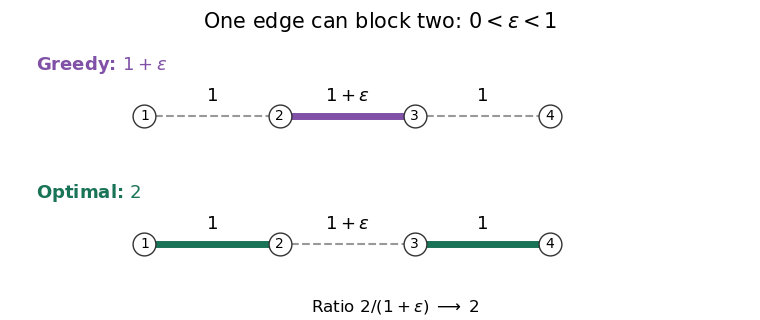
For tightness, take a four-vertex path graph with weights in order, where . The greedy matching chooses only the middle edge, of weight , whereas the optimal matching in a graph chooses both outer edges, of total weight . HenceTo obtain infinitely many different sizes, for each take disjoint copies with . Their weights add, so their ratio is . All weights are strictly positive, and the middle edge is uniquely heaviest in each copy. With all three weights equal to , a permitted tie order selecting each middle edge first attains ratio exactly. The greedy two-approximation for maximum-weight matching is therefore best possible.
Past exam of the computer science course of the University of Oxford 2023 Combinatorial optimisation 3 c i Solution by Codex 0 2026-10-25
Codex 0 2026-10-25The maximum-weight matching problem asks for a matching in a graph maximizing its total weight:The requirement is on weight; a maximum cardinality matching need not solve this optimization problem.
Past exam of the computer science course of the University of Oxford 2023 Combinatorial optimisation 3 b ii Solution by Codex 0 2026-10-25
Codex 0 2026-10-25Choose a perfect matching from (i). Every vertex has exactly two incident edges in , so this spanning subgraph is a disjoint union of graph cycles. Orient each graph cycle cyclically, and let be the next vertex after along its oriented graph cycle.
For each , take the three-edge sequenceIts four vertices are distinct. Each and because the graph is a simple graph. Also and , since belongs to , rather than . Finally because the successor map is a bijection on the disjoint graph cycles. Thus this is a graph path of length exactly three.
Every edge of is used once as a middle edge. Every edge of is used once as the outgoing edge of its tail, whose unique edge of determines which graph path contains it. Hence these graph paths are pairwise edge-disjoint and cover . This is the three-edge path decomposition from a perfect matching.
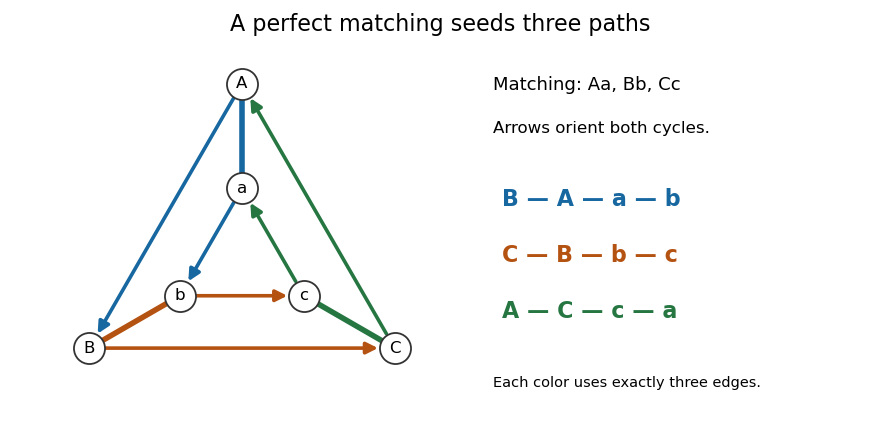
On a triangular prism, orient the two remaining graph cycles and extend each perfect matching edge by its endpoints' outgoing edges; the three colors partition all nine edges into length-three graph paths
. Details. Pinned article: Introduction to the OurBigBook Project
Welcome to the OurBigBook Project! Our goal is to create the perfect publishing platform for STEM subjects, and get university-level students to write the best free STEM tutorials ever.
Everyone is welcome to create an account and play with the site: ourbigbook.com/go/register. We belive that students themselves can write amazing tutorials, but teachers are welcome too. You can write about anything you want, it doesn't have to be STEM or even educational. Silly test content is very welcome and you won't be penalized in any way. Just keep it legal!
Intro to OurBigBook
. Source. We have two killer features:
- topics: topics group articles by different users with the same title, e.g. here is the topic for the "Fundamental Theorem of Calculus" ourbigbook.com/go/topic/fundamental-theorem-of-calculusArticles of different users are sorted by upvote within each article page. This feature is a bit like:
- a Wikipedia where each user can have their own version of each article
- a Q&A website like Stack Overflow, where multiple people can give their views on a given topic, and the best ones are sorted by upvote. Except you don't need to wait for someone to ask first, and any topic goes, no matter how narrow or broad
This feature makes it possible for readers to find better explanations of any topic created by other writers. And it allows writers to create an explanation in a place that readers might actually find it.
Figure 1. Screenshot of the "Derivative" topic page. View it live at: ourbigbook.com/go/topic/derivativeVideo 2. OurBigBook Web topics demo. Source. - local editing: you can store all your personal knowledge base content locally in a plaintext markup format that can be edited locally and published either:This way you can be sure that even if OurBigBook.com were to go down one day (which we have no plans to do as it is quite cheap to host!), your content will still be perfectly readable as a static site.
- to OurBigBook.com to get awesome multi-user features like topics and likes
- as HTML files to a static website, which you can host yourself for free on many external providers like GitHub Pages, and remain in full control

Figure 2. You can publish local OurBigBook lightweight markup files to either OurBigBook.com or as a static website.
Figure 3. Visual Studio Code extension installation.
Figure 5. . You can also edit articles on the Web editor without installing anything locally. Video 3. Edit locally and publish demo. Source. This shows editing OurBigBook Markup and publishing it using the Visual Studio Code extension. 
- Infinitely deep tables of contents:




All our software is open source and hosted at: github.com/ourbigbook/ourbigbook
Further documentation can be found at: docs.ourbigbook.com
Feel free to reach our to us for any help or suggestions: docs.ourbigbook.com/#contact