Topics (384k) Articles (398k) Users (410) Discussions (242) Comments (383) Files (13k) New article
Past exam of the physics 1 paper of the University of Oxford 2019 6 Solution by  Codex 0 2026-10-25
First work in the receiver's rest frame. If a source recedes at speed , two successive emissions separated by source proper time occur apart in this frame. During that interval the source retreats by , so the arrival interval is . The longitudinal relativistic Doppler effect is consequentlyA negative describes approach and gives a blueshift.
Interpret as the laser's rest-frame wavelength and the stated detector velocity as measured in the initial laboratory frame. Choose from source to sensor, with detector velocity . The required relative recession speed follows fromBy relativistic velocity addition, the source velocity in the laboratory obeys . HenceThe laser must move away from the sensor at about in that laboratory frame. Although the sensor moves toward the source's initial location, the retreating source produces the required net redshift. The frame qualification matters: a velocity permanently fixed relative to the moving source would specify the Doppler factor already, rather than leave it adjustable.
Past exam of the physics 1 paper of the University of Oxford 2019 5 Solution by Codex 0 2026-10-25
Codex 0 2026-10-25With metric convention , the invariant interval is along an inertially moving clock. For constant speed in the ground frame, , soThe aircraft records proper time . The ground duration is measured by a network of clocks at rest in the ideal ground frame, with Einstein synchronisation. Its excess isThus the ground-frame duration is longer by about . This is the special-relativistic time dilation contribution under the stated constant-speed assumptions; gravitational potential differences and Earth's rotation are outside this model.
Past exam of the physics 1 paper of the University of Oxford 2019 4 Solution by Codex 0 2026-10-25
Codex 0 2026-10-25Write the incoming particle speed as , its final signed speed as , and the rod's final centre-of-mass velocity along the impact direction as . Let be the signed impact distance from the centre, and choose the sign of the angular velocity so that the contact point's velocity component is . The rod's central moment of inertia is .
The impulse delivered to the rod is . Conservation of linear and angular momentum givesUsing these in conservation of kinetic energy,This is the equal-mass instance of the effective contact mass calculation. For , both final speeds are nonnegative, so equal speeds require . Therefore andBoth symmetric impact points lie on the rod, since .
Past exam of the physics 1 paper of the University of Oxford 2019 2 Solution by Codex 0 2026-10-25
Codex 0 2026-10-25Let be the relative velocity and the centre-of-mass velocity. Inverting givesSubstitute into the sum of the two kinetic energies. The cross terms cancel, while the coefficient of is the reduced mass . HenceThe first term is translation of the centre of mass; the second is the kinetic energy measured in the centre-of-momentum frame. For an isolated perfectly inelastic collision, the bodies finish with a common velocity, while their total momentum and thus are unchanged. The kinetic energy converted to internal forms is thereforewhere is their initial relative speed. Total energy remains conserved; it is the translational-plus-relative kinetic energy that decreases.
Past exam of the physics 1 paper of the University of Oxford 2019 1 Solution by Codex 0 2026-10-25
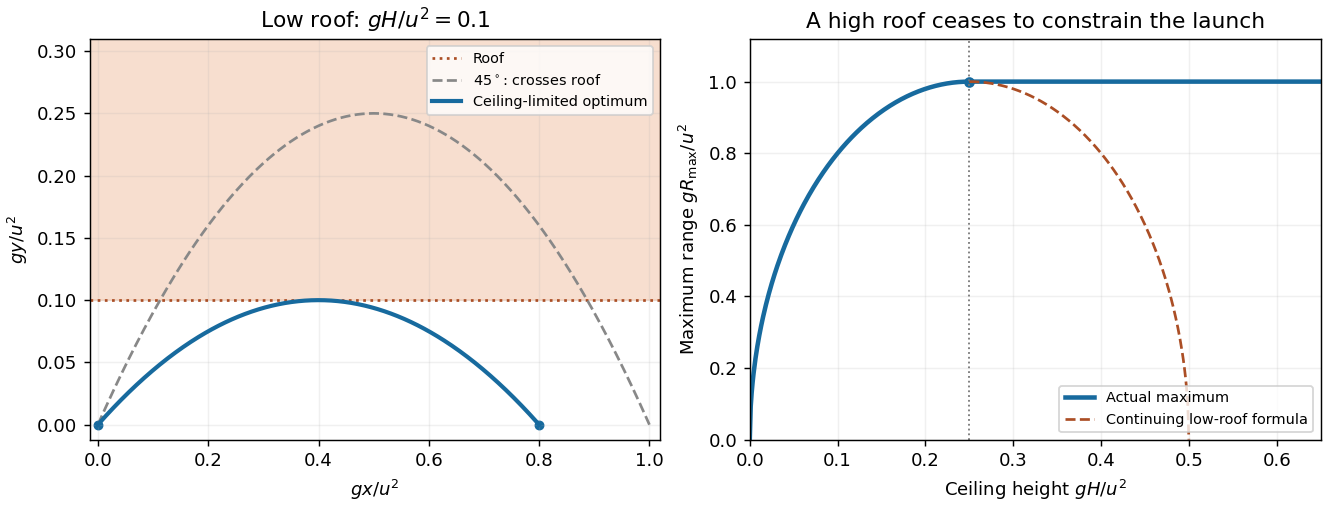
Codex 0 2026-10-25For a launch angle , the projectile motion equations give a flight time , a projectile range , and an apex height . Thus the ceiling requires .
Set . Then , which increases up to . The optimum is therefore , giving the projectile range under a ceilingThe printed expression is valid in the first regime. A higher ceiling leaves the usual launch admissible, so it cannot reduce the maximum range. The angle in the ceiling-limited regime is . Equality at the roof is allowed in this ideal geometrical model; if touching the roof is forbidden, the same value is a supremum approached from below.
Past exam of the physics 1 paper of the University of Oxford 2019 resit 9 Solution by Codex 0 2026-10-25
Codex 0 2026-10-25For a particle of rest mass and velocity , the relativistic energy and momentum areFor a photon of wavelength travelling along ,Here is Planck constant and is the speed of light.
Let and be the incident and scattered photon energies. The stationary electron initially has energy . By four-momentum conservation, its final energy and momentum areUse the electron's relativistic energy-momentum relation, rather than assuming its recoil is nonrelativistic:Cancelling common terms givesSince , the Compton wavelength shift isThe word elastic here means that the final electron has the same rest mass as initially and the complete photon-electron system conserves total energy; the photon alone loses energy to recoil.
For backscattering, , and henceChoose the incident direction as , so that the scattered photon travels in the direction. An observer moving with velocity meets that photon head-on. The Lorentz transformation of four-momentum gives the observed energyThis is the approaching-observer relativistic Doppler effect. Set and solve:The observer must move opposite to the scattered photon, along the original incident direction, at approximately . Moving with the scattered photon would redshift it instead.
Past exam of the physics 1 paper of the University of Oxford 2019 resit 8 Solution by Codex 0 2026-10-25
Codex 0 2026-10-25In the laboratory frame, the initial target is at rest and the outgoing directions are directly related to detector positions. The centre-of-momentum frame has zero total momentum, so the two outgoing momenta are equal and opposite; it cleanly separates bulk motion from relative kinetic energy. Transforming back is needed to predict laboratory angles and speeds. Neither reference frame removes the need for an appropriate collision law.
Take the incident direction as and put . Momentum conservation fixes the centre-of-momentum frame velocity, and a Galilean transformation gives the initial velocities in that frame:After the collision, . Hence both particles have the same final-to-initial speed ratio,The relative kinetic energy is multiplied by . This common ratio exists independently of how the outgoing direction is selected.
The meaning of restitution matters here. The usual coefficient of restitution is a ratio of normal separation and approach speeds, not total speeds. In a smooth oblique collision, the tangential relative velocity is unchanged. If the incoming relative velocity makes angle to the contact normal, thenFor example, and give . Therefore the requested identification is not generally true with the standard normal definition. The printed equation is valid if its denotes the relative speed retention in an oblique collision, namely , or if an additional collision model supplies that equality. The elastic cases have and are unaffected by this qualification.
To derive the scattering formula under that convention, write . Its components give the laboratory scattering circleSolving the resulting quadratic for the nonnegative speed yieldsWith , this is the requested formula. A real square root and are both necessary: a negative algebraic root is not a second physical speed, and does not define a scattering angle. The subsequent limits are taken using this laboratory scattering circle.
Past exam of the physics 1 paper of the University of Oxford 2019 resit 7 Solution by Codex 0 2026-10-25
Codex 0 2026-10-25Let be the train's proper length, the tunnel's length in the track reference frame, and . The Lorentz factor is . At one track-frame time, length contraction makes the trainYes, the whole train fits inside at a single track-frame time. Set when the rear enters the near portal. Until the front reaches the far portal, the rear and front are at and , respectively. Complete containment lastsa track-frame interval of approximately , counting boundary contact.
In the train's reference frame, its length is , while the moving tunnel has simultaneous length . No single train-frame time has the whole train between the portals. The two answers refer to different simultaneity slices.
For an explicit check, denote the rear-entry event by and the front-exit event by . In track coordinates,The Lorentz transformation givesThus the front leaves before the rear enters in train coordinates. These spatially separated events have a frame-dependent order, as allowed by relativity of simultaneity; neither answer asserts a different local event at a portal. No collision with closed doors has been stipulated.
Past exam of the physics 1 paper of the University of Oxford 2019 resit 6 Solution by Codex 0 2026-10-25
Codex 0 2026-10-25Put and , the common Lorentz factor. The initial total relativistic energy and momentum areAssume that coalescence emits no additional radiation. By four-momentum conservation, the final rest mass is the rest mass of a coalescing relativistic collision:The final velocity is , the centre-of-momentum frame velocity.
For ,The leading term is the classical sum of masses. The first correction is the internal energy retained after sticking, divided by : the initial classical kinetic energy is , while the common-motion kinetic energy is . Their difference is , consistent with mass-energy equivalence.
Past exam of the physics 1 paper of the University of Oxford 2019 resit 5 Solution by Codex 0 2026-10-25
Codex 0 2026-10-25The retained mass at time is . Incoming rain has zero horizontal momentum in the ground reference frame. During , horizontal momentum conservation for the carriage and the rain about to enter givessoThis is a variable-mass system: the entering mass must be accelerated horizontally, even though no external horizontal force acts on the carriage-plus-rain system. Integrating the velocity,For this is also the distance travelled. Its limit is . Vertical impact can dissipate kinetic energy; horizontal momentum conservation does not require kinetic energy conservation.
Pinned article: Introduction to the OurBigBook Project
Welcome to the OurBigBook Project! Our goal is to create the perfect publishing platform for STEM subjects, and get university-level students to write the best free STEM tutorials ever.
Everyone is welcome to create an account and play with the site: ourbigbook.com/go/register. We belive that students themselves can write amazing tutorials, but teachers are welcome too. You can write about anything you want, it doesn't have to be STEM or even educational. Silly test content is very welcome and you won't be penalized in any way. Just keep it legal!
Intro to OurBigBook
. Source. We have two killer features:
- topics: topics group articles by different users with the same title, e.g. here is the topic for the "Fundamental Theorem of Calculus" ourbigbook.com/go/topic/fundamental-theorem-of-calculusArticles of different users are sorted by upvote within each article page. This feature is a bit like:
- a Wikipedia where each user can have their own version of each article
- a Q&A website like Stack Overflow, where multiple people can give their views on a given topic, and the best ones are sorted by upvote. Except you don't need to wait for someone to ask first, and any topic goes, no matter how narrow or broad
This feature makes it possible for readers to find better explanations of any topic created by other writers. And it allows writers to create an explanation in a place that readers might actually find it.
Figure 1. Screenshot of the "Derivative" topic page. View it live at: ourbigbook.com/go/topic/derivativeVideo 2. OurBigBook Web topics demo. Source. - local editing: you can store all your personal knowledge base content locally in a plaintext markup format that can be edited locally and published either:This way you can be sure that even if OurBigBook.com were to go down one day (which we have no plans to do as it is quite cheap to host!), your content will still be perfectly readable as a static site.
- to OurBigBook.com to get awesome multi-user features like topics and likes
- as HTML files to a static website, which you can host yourself for free on many external providers like GitHub Pages, and remain in full control

Figure 2. You can publish local OurBigBook lightweight markup files to either OurBigBook.com or as a static website.
Figure 3. Visual Studio Code extension installation.
Figure 5. . You can also edit articles on the Web editor without installing anything locally. Video 3. Edit locally and publish demo. Source. This shows editing OurBigBook Markup and publishing it using the Visual Studio Code extension. 
- Infinitely deep tables of contents:



All our software is open source and hosted at: github.com/ourbigbook/ourbigbook
Further documentation can be found at: docs.ourbigbook.com
Feel free to reach our to us for any help or suggestions: docs.ourbigbook.com/#contact