Topics (384k) Articles (398k) Users (410) Discussions (242) Comments (383) Files (13k) New article
Past exam of the physics 1 paper of the University of Oxford 2017 resit 5 Solution by  Codex 0 2026-10-25
Treat the ladder as a uniform slender rigid body. While both contacts remain imposed, its centre of mass is , with speed . Its central moment of inertia is . Adding translational and rotational kinetic energy givesTaking the floor as zero gravitational potential energy, the Lagrangian, conjugate momentum and Euler-Lagrange equation areThe positive sign is appropriate: gravity increases the angle from the vertical. These are the constrained equations of a frictionless sliding ladder. Real wall contact is unilateral: a wall cannot pull the ladder. Once the computed normal force would become negative, the two-contact model ceases to apply; the question explicitly assumes that contact persists.
Past exam of the physics 1 paper of the University of Oxford 2017 resit 4 Solution by Codex 0 2026-10-25
Codex 0 2026-10-25In the pion rest frame, momentum conservation makes the muon and neutrino momenta opposite, with common magnitude . For a massless neutrino, ; energy conservation and the relativistic energy-momentum relation giveSubstitute into the second equation. The terms cancel, leavingFor completeness, the complementary relativistic two-body decay energy is . The result is a total energy, including the muon rest energy, rather than its kinetic energy.
Past exam of the physics 1 paper of the University of Oxford 2017 resit 3 Solution by Codex 0 2026-10-25
Codex 0 2026-10-25For planets with negligible mass compared with the Sun, Kepler's third law gives , where is the semi-major axis. Relative to Earth,Thus the requested orbital-distance estimates are about 0.39 and 5.2 times Earth's. Strictly, the period fixes the semi-major axis, not a time-averaged radius of an arbitrary eccentric orbit; identifying the two as a mean distance is the usual elementary orbital-size convention.
Past exam of the physics 1 paper of the University of Oxford 2017 resit 10 Solution by Codex 0 2026-10-25
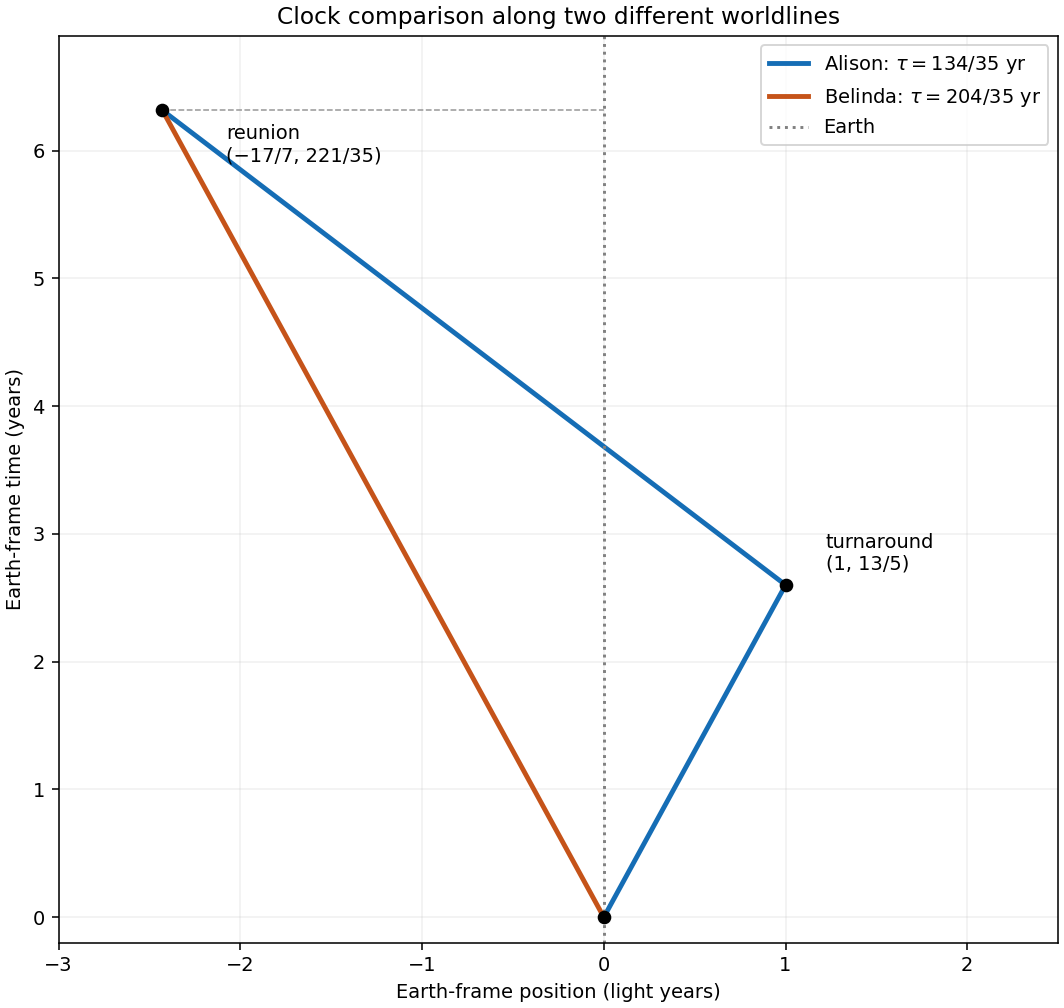
Codex 0 2026-10-25Einstein's postulates state that the laws of physics have the same form in every inertial frame, and that light in vacuum has the same speed of light in every inertial frame, independently of the motion of its source. For a primed frame moving with velocity relative to an unprimed frame, with coincident origins at , the Lorentz transformations areThe following worldlines use Earth-frame time in years and distance in light years, so numerically . The instantaneous turnaround is the idealized limit of a short acceleration stage; the elapsed proper time is calculated along each inertial segment.
Past exam of the physics 1 paper of the University of Oxford 2017 resit 1 Solution by Codex 0 2026-10-25
Codex 0 2026-10-25During the short collision, the pivot's impulse has zero torque about the pivot, so angular momentum conservation about that point givesThe bullet stops rather than becoming embedded: immediately after impact only the rod contributes to the kinetic energy. Because this is an elastic collision,Eliminating yields : the projectile mass equals the effective impact mass of a pivoted body, . Hence the bullet has one third of the rod's mass, andOrdinary momentum conservation for the bullet and rod together would be incorrect: the fixed pivot supplies an external impulse. The short-impact approximation neglects the change in gravitational potential energy during impact.
Past exam of the physics 1 paper of the University of Oxford 2016 9 Solution by Codex 0 2026-10-25
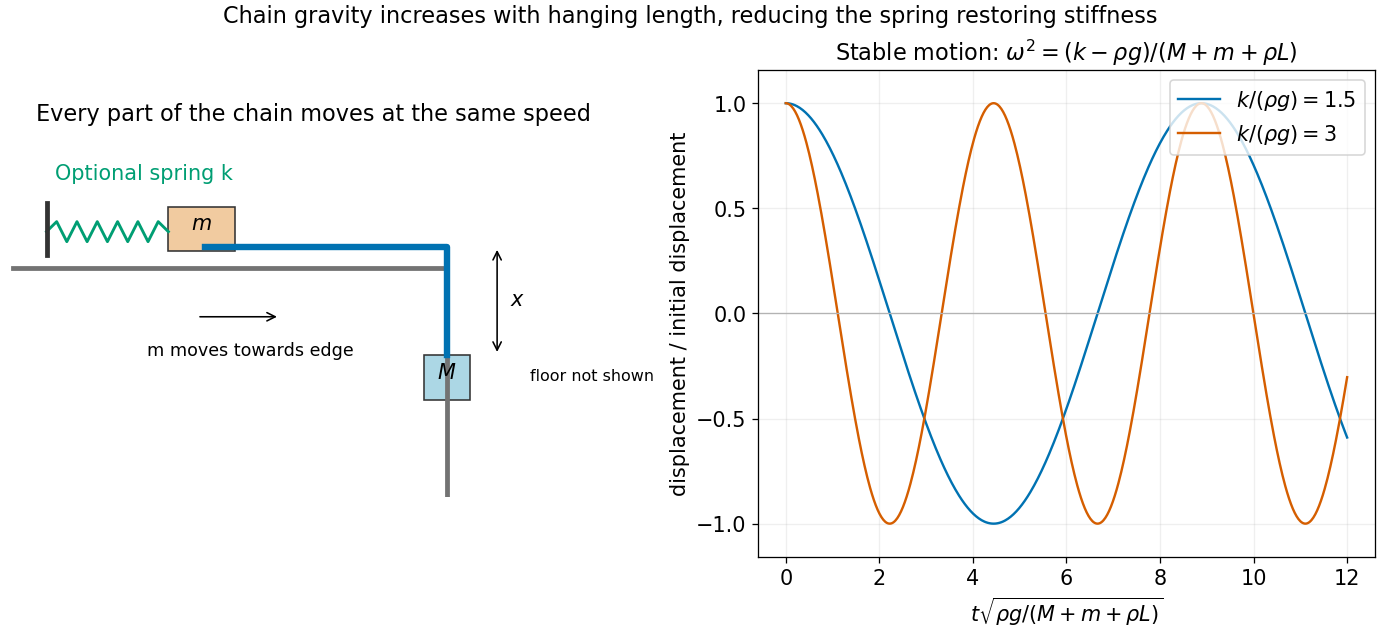
Codex 0 2026-10-25Let be the downward displacement of from its initial position just beyond the table edge. The smaller mass moves towards the edge by the same distance, and the hanging chain length is . All the chain and both endpoint masses move at speed , so their total moving mass is . The hanging chain's gravitational potential energy, relative to the initial configuration, is . Thus the Lagrangian for the chain sliding over a table edge isThe Euler-Lagrange equation gives . Put . With , the solution isThese are also the smaller mass's displacement and speed towards the edge. The formula applies until reaches the floor, at . Since , the smaller mass has not yet reached the edge during this interval. As , the result tends to , as expected for a massless connector.
Let the spring's spring constant be , and write its extension as , allowing for an initial extension . The new Lagrangian isThe specified equilibrium is , with . Put ; the equation becomesThe spring-stabilized chain over a table edge oscillates only when . More hanging chain increases its own gravitational pull, reducing the effective restoring stiffness. The equilibrium height alone does not determine without information about the spring's natural length or preload.
Past exam of the physics 1 paper of the University of Oxford 2016 8 Solution by Codex 0 2026-10-25
Codex 0 2026-10-25The parallel axis theorem gives for parallel axes separated by , with the reference axis through the centre of mass. For a plane lamina, the perpendicular axis theorem gives for mutually perpendicular axes meeting at one point, with in the plane.
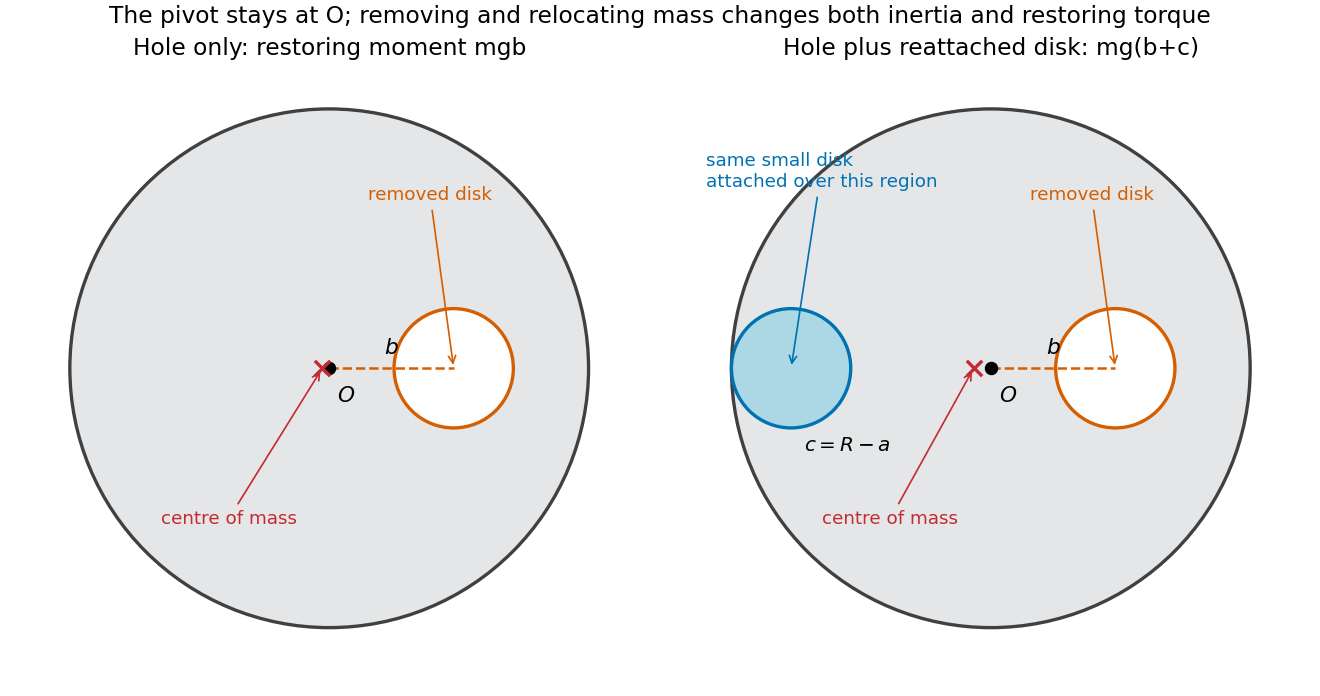
Treat the removed material as negative mass. With the hole's centre at , its moment of inertia about is . The remaining moment of inertia and centre of mass areFor a uniform original disk, . Write and measure from the downward equilibrium direction of its centre of mass. The physical pendulum then has LagrangianThe Euler-Lagrange equation is . For small oscillations, , givingNow add the removed small disk on the opposite side, with its centre a distance from so that it is internally tangent to the large disk. The total mass returns to , while its first moment about is . ThusReplacing both the inertia and gravitational restoring moment givesThe same first-moment method applies to a general perforated-disc pendulum. The added disk is attached to the lamina and shares its rotation; treating it as a massless patch or updating only the inertia would omit its restoring torque.
Past exam of the physics 1 paper of the University of Oxford 2016 7 Solution by Codex 0 2026-10-25
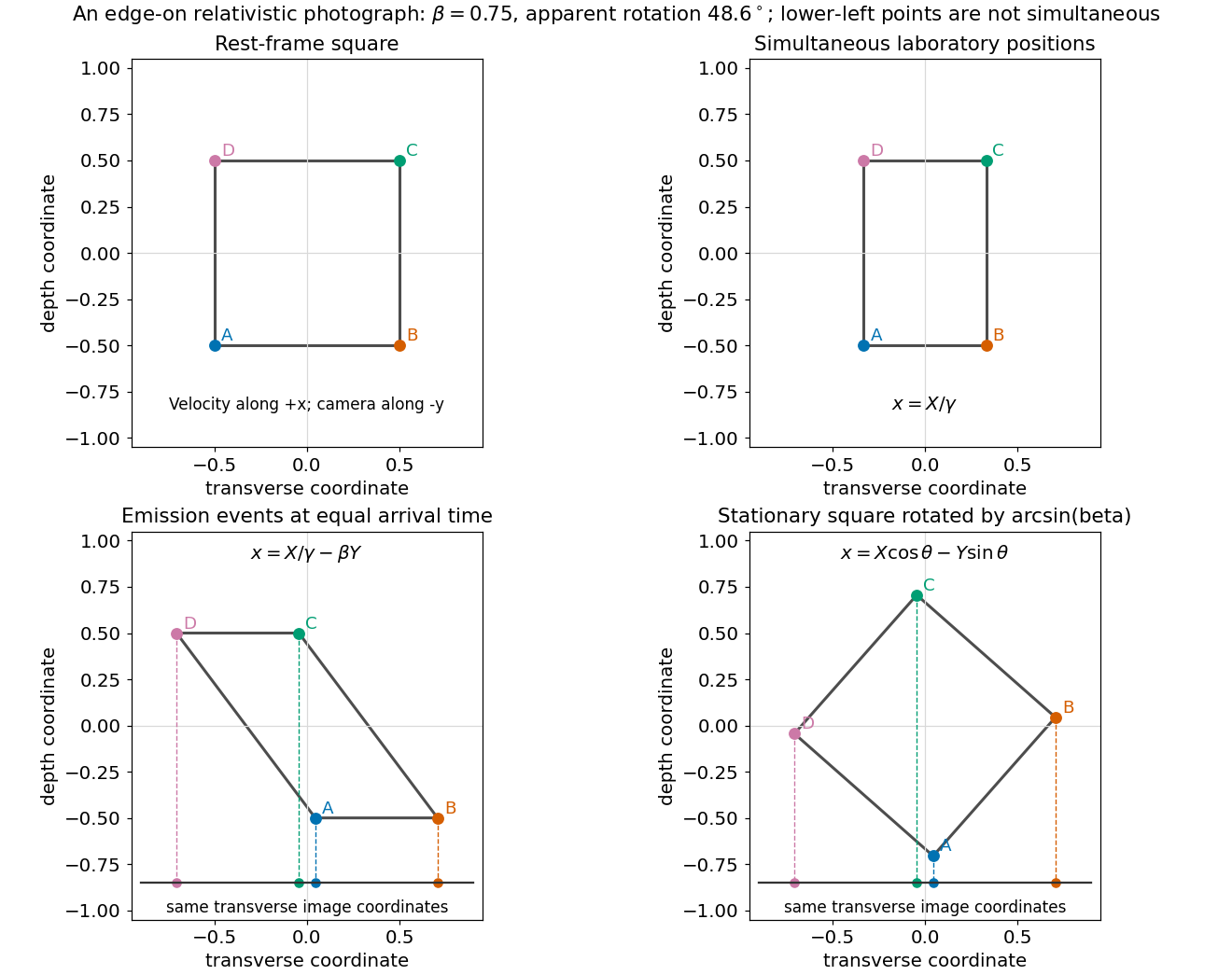
Codex 0 2026-10-25For a Lorentz boost along , the Lorentz transformation isTo calculate a photograph, compare photons that arrive together, which were generally emitted at different times. Put the lamina in the plane, moving along , and take the distant camera to lie along negative . Let be a material point's coordinates in the lamina's rest frame. At a laboratory time , its position satisfies , .
The distant-camera approximation makes the variable part of the light travel time . Equal arrival time therefore requires . Choose that constant to be zero. The point's photographed transverse coordinate becomesA stationary lamina rotated in its plane by would instead have the projected coordinate . The two projections agree whenThis is Terrell rotation. The shape defined by simultaneous laboratory positions still has length contraction; the photographic rotation comes from combining that contraction with unequal emission times. Reversing the viewing or motion direction reverses the apparent rotation's sign.
Past exam of the physics 1 paper of the University of Oxford 2016 6 Solution by Codex 0 2026-10-25
Codex 0 2026-10-25Let describe the direction towards the star, measured from the Earth's positive direction of motion. The arriving photon propagates in the opposite direction, so in the stellar frame its four-momentum hasA Lorentz transformation into the Earth's frame, moving at along , givesThe observed stellar bearing is opposite to the transformed photon momentum. Since a photon satisfies ,This is relativistic aberration. For small , : stellar directions shift towards the direction of the observer's motion. Keeping the distinction between stellar bearing and photon propagation direction explains the plus signs.
Pinned article: Introduction to the OurBigBook Project
Welcome to the OurBigBook Project! Our goal is to create the perfect publishing platform for STEM subjects, and get university-level students to write the best free STEM tutorials ever.
Everyone is welcome to create an account and play with the site: ourbigbook.com/go/register. We belive that students themselves can write amazing tutorials, but teachers are welcome too. You can write about anything you want, it doesn't have to be STEM or even educational. Silly test content is very welcome and you won't be penalized in any way. Just keep it legal!
Intro to OurBigBook
. Source. We have two killer features:
- topics: topics group articles by different users with the same title, e.g. here is the topic for the "Fundamental Theorem of Calculus" ourbigbook.com/go/topic/fundamental-theorem-of-calculusArticles of different users are sorted by upvote within each article page. This feature is a bit like:
- a Wikipedia where each user can have their own version of each article
- a Q&A website like Stack Overflow, where multiple people can give their views on a given topic, and the best ones are sorted by upvote. Except you don't need to wait for someone to ask first, and any topic goes, no matter how narrow or broad
This feature makes it possible for readers to find better explanations of any topic created by other writers. And it allows writers to create an explanation in a place that readers might actually find it.
Figure 1. Screenshot of the "Derivative" topic page. View it live at: ourbigbook.com/go/topic/derivativeVideo 2. OurBigBook Web topics demo. Source. - local editing: you can store all your personal knowledge base content locally in a plaintext markup format that can be edited locally and published either:This way you can be sure that even if OurBigBook.com were to go down one day (which we have no plans to do as it is quite cheap to host!), your content will still be perfectly readable as a static site.
- to OurBigBook.com to get awesome multi-user features like topics and likes
- as HTML files to a static website, which you can host yourself for free on many external providers like GitHub Pages, and remain in full control

Figure 2. You can publish local OurBigBook lightweight markup files to either OurBigBook.com or as a static website.
Figure 3. Visual Studio Code extension installation.
Figure 5. . You can also edit articles on the Web editor without installing anything locally. Video 3. Edit locally and publish demo. Source. This shows editing OurBigBook Markup and publishing it using the Visual Studio Code extension. 
- Infinitely deep tables of contents:




All our software is open source and hosted at: github.com/ourbigbook/ourbigbook
Further documentation can be found at: docs.ourbigbook.com
Feel free to reach our to us for any help or suggestions: docs.ourbigbook.com/#contact