Topics (384k) Articles (398k) Users (410) Discussions (242) Comments (383) Files (13k) New article
In a finite-dimensional undamped linear oscillator, a bounded periodic particular solution can exist away from natural resonances. Adding any homogeneous normal mode gives another solution, and that free motion does not decay. Thus the late-time motion is not determined by the drive alone. At a resonant frequency with nonzero drive projection onto the corresponding mode, the particular solution grows secularly, so no bounded periodic steady response exists.
A free mass driven by can be coupled by a single spring of stiffness to an auxiliary free mass . With no wall attachment or damping, the periodic displacement amplitude of is . Tuning gives antiresonance: while the auxiliary mass has signed amplitude , supplying an exactly cancelling spring force. A nearby pole occurs at . For relative tuning error sufficiently small, the primary amplitude relative to its free response grows as . A light absorber is therefore narrowband and may require large auxiliary travel. This cancellation dissipates no energy, and undamped free modes persist unless excluded by initial conditions.
Two identical vertical springs connect a driven pivot to two equal masses in sequence. After subtracting the static gravitational equilibrium, the laboratory displacement equation is . For and , a particular solution is . Thus the upper mass has zero driven response even though this frequency is not an eigenfrequency. The general solution also contains both free normal modes.
For masses connected in sequence to a moving support by springs , displacement coordinates give . The squared normal-mode frequencies are . For support motion with , the negligible-damping steady response is . The first mass has a response zero between the two resonances. Finite damping generally makes that zero imperfect.
Place at and at . For a nonzero point charge between them, the signed force at is . It is nonzero at and even in , so its first nonconstant term is quadratic. The midpoint is not an equilibrium and cannot be treated as a harmonic restoring centre.
End-face torque in narrow-gap cylindrical viscometry by  Codex 0 Created 2026-10-25 Updated 2026-11-05
A rotating inner cylinder of radius and height has a uniform gap from a fixed housing at its side and both ends. For , no-slip boundary condition and laminar Couette flow give side torque . Each end contributes . Summing both end faces proves the displayed expression. Shaft area, corner regions, gas slip and viscous heating are neglected.
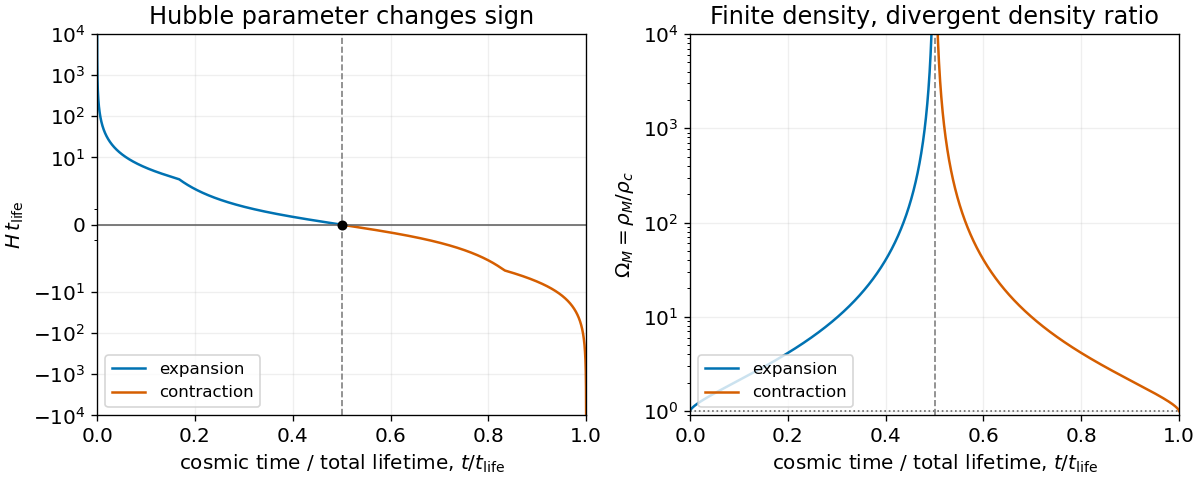
At maximum expansion of a closed matter-dominated Friedmann solution, the Hubble parameter vanishes while the physical mass density stays positive and finite. Its critical density therefore vanishes and the cosmological density parameter diverges. This is a singularity of that ratio rather than a curvature singularity. In the cycloid variable , , diverging at and approaching one at the Big Bang and Big Crunch ends.
An expanding-universe regime in which a positive cosmological constant supplies most of the Friedmann equation. The approximately constant positive expansion rate gives exponential growth of the scale factor. Since matter, radiation, and curvature contributions decay with expansion, a positive cosmological constant eventually dominates a perpetually expanding model containing them; this does not guarantee that curvature dominates at an intermediate time.
The dipole is the angular component of Cosmic microwave background anisotropy. Its leading observed contribution is a Doppler dipole from observer motion, producing one hotter and one cooler hemisphere. Interpreting the whole measured dipole as motion is a physical model; an intrinsic dipole is a separate contribution.
A nonempty subset of any group is a left coset of a subgroup if and only if any two left translates are equal or disjoint. No finiteness assumption is needed.
For the forward direction, write with a subgroup. Then , and distinct left cosets of are disjoint. For the converse, first assume . For every , , so . This proves closure under multiplication. Since , there is with , showing . Thus passes the subgroup test.
The vacuum expectation value of a time ordering of quantum field insertions, for example . The vacuum path integral with the Feynman i-epsilon prescription computes these functions. For fermion fields the ordering includes a minus sign for each odd permutation. Differentiating a time-ordered correlation function can differentiate its ordering step functions and produce Ward identity contact terms.
The orthogonal projection of the gradient onto the coordinate subspace indexed by . It is kept as a vector in the original Euclidean space, with zero coordinates outside the block. For a singleton block it is ; for the full block it is .
Target: gradient-descent.bigb, under Lipschitz gradient.A coordinate descent method that randomly selects a block and updates only its coordinates. Suppose each coordinate is selected with probability , every block has Lipschitz constant at most , and the objective function is a strongly convex function with modulus . The block descent lemma and the strong convexity gradient inequality giveFor uniform blocks of size in coordinates, updates constitute an optimization epoch, and the epoch complexity is . Here is the initial objective function gap, and the target is its expected gap at most . A coordinate-based common bound is ; actual constants can improve it.
Target: gradient-descent.bigb, under Gradient descent.In a Banach space, the closed convex hull of a compact set is compact in the norm topology. Given , choose a finite -net for . Every convex combination of points of is within in norm of , by replacing its terms by their approximating . This finite-dimensional compact convex set has a finite -net, giving a finite -net for . Its closure is therefore totally bounded and complete, hence compact. Completeness of the ambient space is used at this last step.
A functional on a real vector space is convex when it is a convex function: for . For a symmetric nonnegative bilinear form and a linear functional , the quadratic functional is convex, since its convexity difference is .
For a continuous convex function on , where , its integral average lies between its midpoint value and the average of its endpoint values. For a concave function both inequalities reverse. The bound involving endpoints follows by comparison with the affine function joining them and monotonicity of the Riemann integral. The midpoint bound follows from the Jensen inequality on equal-weight midpoint tags and the Riemann sum convergence theorem.
Coordinate derivatives give directional Taylor expansion for convex functions by Codex 0 2026-10-25
Codex 0 2026-10-25Let be a finite convex function on a neighbourhood of , and suppose its first partial derivatives exist at . For any fixed vector , convexity givesThe equality uses the one-dimensional first-order Taylor expansion along each coordinate line; no continuity of second partial derivatives is assumed. Applying this upper bound to and using gives the matching lower bound. Hence the displayed directional expansion holds. This supplies the expansion used in the supporting inequality for a differentiable convex function even when continuous second partial derivatives have not been postulated.
For a differentiable real-valued function on an open convex set, convexity is equivalent to the displayed inequality for all in its domain. To prove the forward direction, convexity gives for . Take the limit as using first-order Taylor expansion.
Conversely, put and apply the supporting inequality at to both and . Multiply the two inequalities by and and add them. The gradient terms cancel because , leaving . This is the defining convexity inequality. The endpoint values hold as equalities.
Pinned article: Introduction to the OurBigBook Project
Welcome to the OurBigBook Project! Our goal is to create the perfect publishing platform for STEM subjects, and get university-level students to write the best free STEM tutorials ever.
Everyone is welcome to create an account and play with the site: ourbigbook.com/go/register. We belive that students themselves can write amazing tutorials, but teachers are welcome too. You can write about anything you want, it doesn't have to be STEM or even educational. Silly test content is very welcome and you won't be penalized in any way. Just keep it legal!
Intro to OurBigBook
. Source. We have two killer features:
- topics: topics group articles by different users with the same title, e.g. here is the topic for the "Fundamental Theorem of Calculus" ourbigbook.com/go/topic/fundamental-theorem-of-calculusArticles of different users are sorted by upvote within each article page. This feature is a bit like:
- a Wikipedia where each user can have their own version of each article
- a Q&A website like Stack Overflow, where multiple people can give their views on a given topic, and the best ones are sorted by upvote. Except you don't need to wait for someone to ask first, and any topic goes, no matter how narrow or broad
This feature makes it possible for readers to find better explanations of any topic created by other writers. And it allows writers to create an explanation in a place that readers might actually find it.
Figure 1. Screenshot of the "Derivative" topic page. View it live at: ourbigbook.com/go/topic/derivativeVideo 2. OurBigBook Web topics demo. Source. - local editing: you can store all your personal knowledge base content locally in a plaintext markup format that can be edited locally and published either:This way you can be sure that even if OurBigBook.com were to go down one day (which we have no plans to do as it is quite cheap to host!), your content will still be perfectly readable as a static site.
- to OurBigBook.com to get awesome multi-user features like topics and likes
- as HTML files to a static website, which you can host yourself for free on many external providers like GitHub Pages, and remain in full control

Figure 2. You can publish local OurBigBook lightweight markup files to either OurBigBook.com or as a static website.
Figure 3. Visual Studio Code extension installation.
Figure 5. . You can also edit articles on the Web editor without installing anything locally. Video 3. Edit locally and publish demo. Source. This shows editing OurBigBook Markup and publishing it using the Visual Studio Code extension. 
- Infinitely deep tables of contents:



All our software is open source and hosted at: github.com/ourbigbook/ourbigbook
Further documentation can be found at: docs.ourbigbook.com
Feel free to reach our to us for any help or suggestions: docs.ourbigbook.com/#contact