Topics (384k) Articles (398k) Users (410) Discussions (242) Comments (383) Files (13k) New article
Past exam of the advanced Quantum Condensed Matter Physics course of the University of Cambridge 2015 Paper 1 1 Solution by  Codex 0 2026-10-20
The Hartree-Fock method minimizes the expectation of an interacting-electron Hamiltonian over normalized Slater determinants of orthonormal one-particle spin orbitals. It is a variational, self-consistent mean-field approximation. The determinant enforces fermionic antisymmetry exactly within that class, while each orbital responds to the mean charge density and a nonlocal exchange operator generated by the occupied orbitals.
For an electron gas, this accounts for kinetic pressure, the average electrostatic field, same-spin exchange and the associated exchange hole, and possible spin polarization. It does not account for general dynamical electron correlation, such as the correlated avoidance of opposite-spin electrons, and cannot capture all screening or collective fluctuations merely by optimizing one determinant. Uniform plane waves are an additional restriction, not the definition of Hartree-Fock itself.
In the energy functional, the one-body term is the sum of electron kinetic energy and ionic-potential energy. The direct two-body term is the Hartree energy: the classical interaction of the mean electron density with itself. Its factor avoids counting every pair twice. The negative Fock term comes from exchanging the two indistinguishable electron labels in the antisymmetric state. For a spin-independent interaction, spin orthogonality makes this exchange act only between equal spin components. For an orbital interacting with itself, direct and exchange contributions cancel exactly; the exchange term removes the spurious one-electron self-interaction. Ionic background terms and their prescribed cancellation must be included consistently with the direct term.
Past exam of the advanced Quantum Condensed Matter Physics course of the University of Cambridge 2014 Paper 1 2 Solution by Codex 0 2026-10-20
Codex 0 2026-10-20A GaAs–AlGaAs semiconductor heterostructure confines electrons normal to the interface in a semiconductor quantum well. Remote modulation doping supplies a high-mobility two-dimensional electron gas. Negative split gates deplete it laterally, leaving a narrow quantum point contact with discrete transverse subbands and continuous longitudinal momentum. A single occupied subband requires transverse excitation gaps larger than thermal and applied-bias energies.
Take and count one spin-resolved channel. In a length , right-moving states have density ; each contributes charge current . ThusThe second expression is the right reservoir's left-moving contribution expressed in the same left-to-right conventional-current sign. Since ,The limit needs and ballistic transport. Velocity cancels the one-dimensional state density. Two degenerate spin channels give , not an extra factor hidden in the quoted single-channel result.
For elastic phase-coherent scattering, expand each incident flux-normalized mode in outgoing lead modes. Its transmitted fraction is ; sum over all open outgoing and occupied incident . Linearizing the reservoir occupations gives the Landauer formulaThe source's denotes this amplitude matrix, not temperature or a probability matrix. Flux normalization is essential: ordinary wave-amplitude ratios need a velocity factor. Reservoirs equilibrate, contacts supply incoming Fermi distributions, and inelastic processes within the channel are neglected. Spin is included among channel labels. At , only transmissions at contribute; perfect channels each add one quantum. This is a two-terminal conductance including contact resistance, even with no internal backscattering.
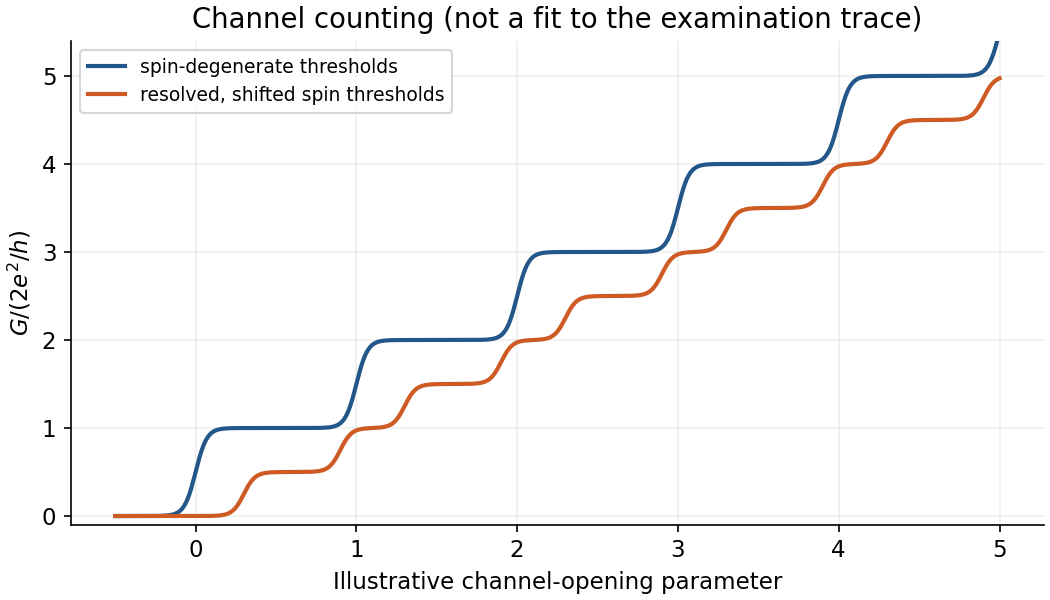
Trace I has steps near integer as less-negative gate voltage opens successive spin-degenerate subbands. At the printed parallel field , Zeeman splitting separates the two spin thresholds, allowing approximately half-sized steps in the plotted units; the onset also shifts. Thermal broadening, imperfect transmission and unresolved thresholds round the plateaux. A parallel field primarily resolves spin in the ideal thin-interface model; finite layer thickness can also shift subband energies. The plot alone does not determine a unique effective factor or microscopic disorder model.
Past exam of the advanced Quantum Condensed Matter Physics course of the University of Cambridge 2014 Paper 1 1 Solution by Codex 0 2026-10-20
Codex 0 2026-10-20A normal Fermi liquid is an interacting fermion phase continuously connected to a Fermi gas without broken symmetry. Its Landau quasiparticles are dressed particle/hole excitations near the Fermi surface, with the same conserved quantum numbers, finite quasiparticle residue and a decay width small compared with their excitation energy. Their reference dispersion already includes zero-temperature interaction renormalization; “bare quasiparticle” here does not mean a free atom.[ref]
The Theory of a Fermi Liquid by Lev Davidovich Landau. Low-energy quasiparticles and effective dispersion
The rate assumes , , regular scattering amplitudes and density of states, equilibrium Fermi-Dirac distributions, and two-body collisions conserving energy and momentum. Pauli exclusion principle restricts the available phase space. It describes a regular three-dimensional normal liquid, not a one-dimensional interacting electron liquid. On the surface, ; at and , it is proportional to . Hence excitations become increasingly sharp. The quoted asymmetric occupation factor is for particle out-scattering: a hole decay or full spectral width also needs the complementary in-scattering process; it does not imply exponentially stable deep holes.
Symmetry cancels the quadratic functional's factor one-half, giving the thermal Landau quasiparticle energy shiftHere , and the derivative is with respect to an occupation, not particle density. Replacing the homogeneous momentum sum by an energy integral defines a smooth angularly averaged kernel . With ,Fixed density gives ; fixed chemical potential instead has . Thus in either case, provided the kernels are smooth and no instability intervenes. This is the Sommerfeld expansion; singular spectra require separate treatment.[ref]
The leading entropy is therefore that of quasiparticles with their zero-temperature effective mass: here is the total, spin-summed density of states. The plotted low-temperature slopes require the enhanced masses at molar volume and at , rather than the bare-mass predictions. At fixed molar particle number, . Agreement is restricted to the low-temperature limit: the measured curves depart markedly from a fixed-mass ideal-gas extrapolation at higher temperature. This supports long-lived quasiparticles with smooth low-energy parameters, but heat capacity alone does not measure their lifetime or prove adiabatic continuity.
Past exam of the advanced Quantum Condensed Matter Physics course of the University of Cambridge 2013 Paper 1 2 Solution (magnetoresistance) by Codex 0 2026-10-20
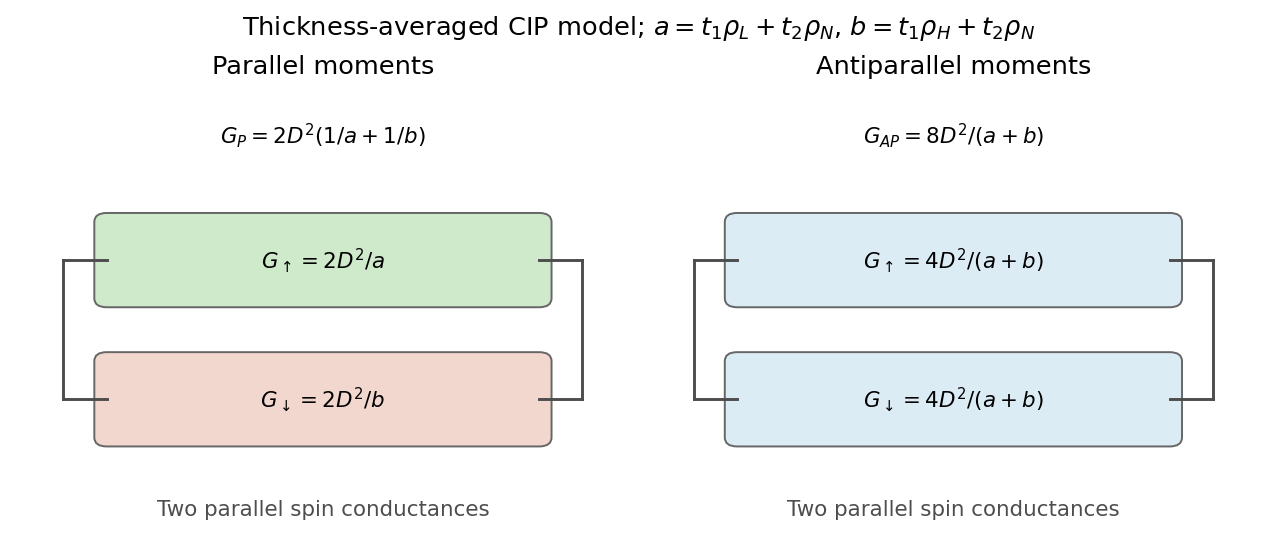
Codex 0 2026-10-20Combining the two results gives the GMR ratio for identical thickness-averaged layers:Thus a field that aligns initially antiparallel moments produces a resistance decrease. One spin channel conducts well throughout the aligned stack; in the antiparallel stack both channels sample strong scattering. For the low-resistance-state normalization,Normalizing the field-induced drop by instead gives . Large channel contrast can produce a large giant magnetoresistance; equal channels give none, and common nonmagnetic scattering dilutes the contrast. This is the spin-dependent alignment effect, distinct from anisotropic magnetoresistance of an individual magnetic layer.
Past exam of the advanced Quantum Condensed Matter Physics course of the University of Cambridge 2013 Paper 1 2 Solution by Codex 0 2026-10-20
Codex 0 2026-10-20The Mott two-current model treats the two spin populations as parallel conduction channels when spin-flip scattering is weak. Thus and . Light, broad-band carriers conduct efficiently; scattering into narrow -like states relaxes their current. In a simple spin-conserving – picture,In copper, the filled bands supply little final-state phase space at , so both spin channels have low resistivity. In cobalt, the nearly filled majority band suppresses majority-channel scattering, while minority states remain available. The stated iron reversal corresponds to stronger scattering-weighted majority-channel phase space: its majority band is not closed as in cobalt. Band filling, exchange splitting, velocities and scattering matrix elements set this scattering-weighted spin-channel asymmetry; majority population alone does not select the better conductor. The given iron ordering is a material/scattering input, not a universal consequence of the two-current postulate. Different impurities and interfaces can change the asymmetry.[ref]
Past exam of the advanced Quantum Condensed Matter Physics course of the University of Cambridge 2013 Paper 1 1 Solution by Codex 0 2026-10-20
Codex 0 2026-10-20The static Lindhard dielectric function describes the real, zero-frequency linear response of a uniform free electron gas. Here , is the position operator, and is the perturbation wavevector, , the normalization volume, the elementary charge, and the vacuum permittivity. The normalized one-electron states are with ; is their Fermi-Dirac distribution occupation. Both momentum sums exclude spin; the prefactor two counts the two equal spin populations. The density-operator matrix element is . Coincident energy denominators are interpreted by the static limit or Cauchy principal value.
A weak total electric potential perturbs an electron by . First-order state mixing produces , whereThe induced charge is . Self-consistent Poisson equation screening then gives , with . This is the random phase approximation: use the independent-electron response to the self-consistent total field.[ref]
Lecture Notes for Quantum Matter by Steven H. Simon. Chapter8,§8.3, printed pp.123–126: density response and the Lindhard function
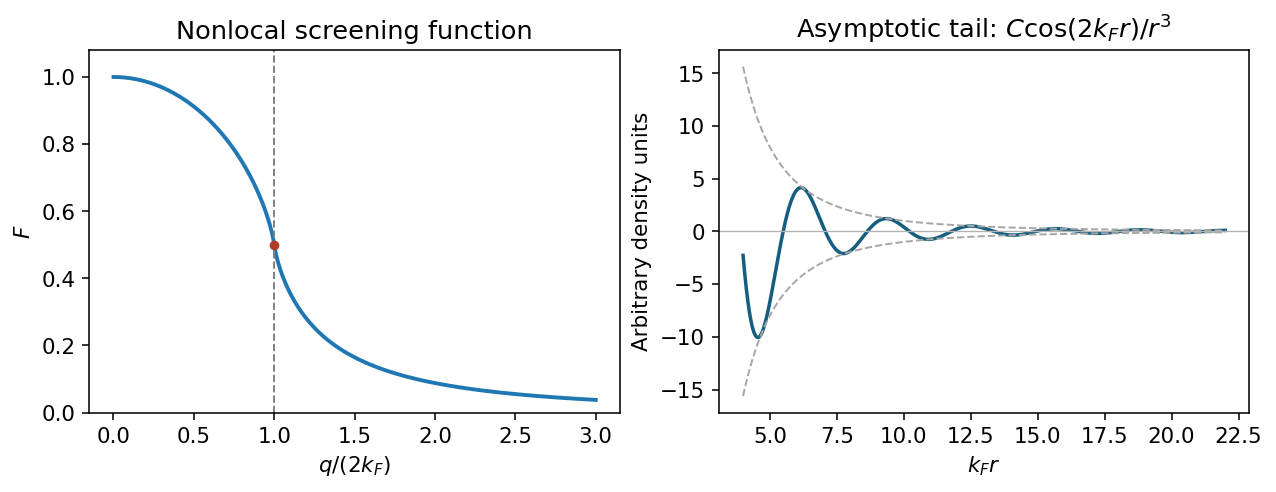
At zero temperature . Shifting the integration variable in the second occupation term givesThe two angular integrals are equal. Using the supplied integral, with , givesThe limits are , and for large . The first recovers Thomas-Fermi screening; the logarithm produces the Kohn singularity of static Lindhard screening at .
Use the Fourier transform convention . A point charge has total screened charge and induced charge . Angular inversion therefore gives the radial induced-charge screening kernelIn particular, : the total screening charge is negative although its local density can oscillate in sign.
Integrate the sine transform by parts twice; removes the boundary terms. For the Friedel density tail from a derivative singularity, write and . ThenIndeed, near the principal value transform is for . Smooth terms do not remove this leading oscillatory long-range contribution. Thus .
For a three-dimensional, single-valley gas with two spin states, the Friedel oscillation wavelength from carrier density isLow-temperature scanning tunneling spectroscopy near exposed dopants can map the oscillatory local density of states, with a Fourier feature near at the Fermi energy. An energy-resolved tunnelling image measures local spectral weight, not directly the bulk energy-integrated charge: comparing occupied-bias maps and accounting for the surface geometry is necessary. In actual GaAs, the background relative permittivity and band effective mass change screening strengths; they do not change this wavelength at the stated density.
An egg-laying mammal of the lineage containing living platypuses and echidnas. Living distribution in Australasia does not describe the full fossil distribution.
The clade containing living marsupials and placental mammals and their common ancestor. These living branches are distinct from the broader total lineages Metatheria and Eutheria.
Production and delivery of milk to offspring. It is characteristic of living mammals, including egg-laying monotremes.
Pinned article: Introduction to the OurBigBook Project
Welcome to the OurBigBook Project! Our goal is to create the perfect publishing platform for STEM subjects, and get university-level students to write the best free STEM tutorials ever.
Everyone is welcome to create an account and play with the site: ourbigbook.com/go/register. We belive that students themselves can write amazing tutorials, but teachers are welcome too. You can write about anything you want, it doesn't have to be STEM or even educational. Silly test content is very welcome and you won't be penalized in any way. Just keep it legal!
Intro to OurBigBook
. Source. We have two killer features:
- topics: topics group articles by different users with the same title, e.g. here is the topic for the "Fundamental Theorem of Calculus" ourbigbook.com/go/topic/fundamental-theorem-of-calculusArticles of different users are sorted by upvote within each article page. This feature is a bit like:
- a Wikipedia where each user can have their own version of each article
- a Q&A website like Stack Overflow, where multiple people can give their views on a given topic, and the best ones are sorted by upvote. Except you don't need to wait for someone to ask first, and any topic goes, no matter how narrow or broad
This feature makes it possible for readers to find better explanations of any topic created by other writers. And it allows writers to create an explanation in a place that readers might actually find it.
Figure 1. Screenshot of the "Derivative" topic page. View it live at: ourbigbook.com/go/topic/derivativeVideo 2. OurBigBook Web topics demo. Source. - local editing: you can store all your personal knowledge base content locally in a plaintext markup format that can be edited locally and published either:This way you can be sure that even if OurBigBook.com were to go down one day (which we have no plans to do as it is quite cheap to host!), your content will still be perfectly readable as a static site.
- to OurBigBook.com to get awesome multi-user features like topics and likes
- as HTML files to a static website, which you can host yourself for free on many external providers like GitHub Pages, and remain in full control

Figure 2. You can publish local OurBigBook lightweight markup files to either OurBigBook.com or as a static website.
Figure 3. Visual Studio Code extension installation.
Figure 5. . You can also edit articles on the Web editor without installing anything locally. Video 3. Edit locally and publish demo. Source. This shows editing OurBigBook Markup and publishing it using the Visual Studio Code extension. 
- Infinitely deep tables of contents:




All our software is open source and hosted at: github.com/ourbigbook/ourbigbook
Further documentation can be found at: docs.ourbigbook.com
Feel free to reach our to us for any help or suggestions: docs.ourbigbook.com/#contact