Topics (384k) Articles (398k) Users (410) Discussions (242) Comments (383) Files (13k) New article
Past exam of the zoology course of the University of Cambridge 2025 Paper zm6 2 Solution by  Codex 0 2026-10-20
The hypothesis has two distinct components: the tissue changes its material response, and that change causally affects collective cell migration. A moving tissue may generate different stresses without becoming mechanically different. Conversely, a changed viscosity or yield stress need not generate directed movement without a driving force. The experiment should distinguish force production, material response and geometry.
First obtain a time-resolved three-dimensional map of the embryo using minimally perturbing live-cell imaging. Label nuclei and membranes, register tissue motion, and measure cell speeds, directional persistence, neighbour exchanges, strain rates and the timing of morphogenesis. Track cells relative to their neighbours as well as to the microscope: bulk translation alone does not show internal rearrangement. Compare equivalent developmental stages and anatomical regions, and quantify cell proliferation, death and differentiation so that changes in tissue composition are not mistaken for migration.
Next apply a calibrated mechanical perturbation. An embedded deformable droplet with known interfacial properties can report anisotropic stresses; magnetic actuation can impose a controlled deformation and reveal recovery, viscoelasticity and a possible yield stress. A controlled force step followed by relaxation probes different timescales. Laser ablation of a loaded junction provides a complementary recoil measurement, but recoil velocity depends on both pre-existing tension and dissipation: it is not an absolute tension measurement without a mechanical model. Probe different directions because tissue response may be anisotropic.
An informative precedent combined magnetically actuated droplets and cell tracking in the extending zebrafish body axis. Posterior tissue was more fluid-like than the more mature anterior region. Perturbations of N-cadherin and contractility helped connect adhesion and rearrangements to mechanical integrity and elongation.[ref]
A fluid-to-solid jamming transition underlies vertebrate body axis elongation by Alessandro Mongera and others. Figures 1–3, droplet-based stress/yield measurements and cell rearrangements; Figure 4, relation to axis extension
This motivates a specific mechanism to test in the new embryo; it does not establish that all migrating tissues undergo the same transition.For causality, change the proposed material property locally and acutely, before migration changes. For example, use optogenetics to alter contractility in a defined region, or a reversible adhesion perturbation, with unilluminated and light-only controls. Measure the material response again rather than assuming the manipulation made the tissue stiffer. Then test whether the spatial pattern and timescale of migration change as predicted. Restore the perturbed component or reverse the manipulation to seek rescue. Mosaic interventions help distinguish changes in migrating cells from changes in their surroundings, although altered signal transduction remains a potential confounder.
Finally fit a mechanical model to measured stresses, geometry and material parameters, then predict a held-out perturbation rather than merely fitting the original flow. Replicate across embryos, randomize treatment, analyse trajectories blind to treatment, and use the embryo as the independent biological replicate. Evidence is strongest when a measured material change precedes movement, targeted intervention changes both in the predicted way, and rescue restores both without simply restoring tissue viability.
Past exam of the zoology course of the University of Cambridge 2025 Paper zm6 1 Solution by Codex 0 2026-10-20
Codex 0 2026-10-20An animal biological cell must generate a protrusion, couple that protrusion to its surroundings, move its body and cell nucleus, and release or rearrange contacts behind it. Cell polarity makes these events persistent in one direction. At cellular scales, inertia is usually negligible: active forces balance resistance continuously, rather than giving the cell momentum that carries it forward after propulsion stops. ATP consumption maintains the system away from thermodynamic equilibrium.
At the front, actin polymerization can push the cell membrane into a lamellipodium. Whether this produces advance depends on coupling to the environment: without a mechanical grip, the actin network can move backward instead. On a flat adhesive substrate, integrins bind the extracellular matrix and connect through focal adhesions to the cytoskeleton. Regulated engagement transmits traction, while rearward myosin contraction and adhesion turnover move the rest of the cell. Adhesions must resist slipping long enough to transmit force but release to avoid anchoring the rear indefinitely. Another protrusive mechanism is a membrane bleb: local separation of the cell membrane from the cell cortex, driven by intracellular pressure, expands the membrane before a new cortex assembles underneath it.
A two-dimensional culture surface offers a broad basal contact area and little geometrical obstruction above the cell. A three-dimensional environment adds pore size, fibre orientation, matrix stiffness, and resistance from surrounding cells. The same cells may switch between elongated, strongly adhesive migration and more rounded, weakly adhesive movement. Proteolysis can enlarge a path through the extracellular matrix, but a sufficiently permissive existing pore need not require digestion. The relatively stiff cell nucleus can become the main bottleneck; its passage depends on deformation, confinement and force transmission. Extensive squeezing can damage the nuclear envelope, so migration speed alone is not a sufficient measure of successful transit.
A decisive experiment removed all functional integrins from mouse leukocytes. Their interstitial migration in three-dimensional environments persisted, and myosin became particularly important for passage through narrow gaps. This distinguishes force generation from a particular adhesion mechanism: confinement and friction can provide useful coupling even without integrin anchoring.[ref]
Thus “three-dimensional migration requires stronger adhesion” is not a general rule. A useful comparison holds ligand density, matrix stiffness and pore geometry as independently controlled as possible, measures whole-cell and nuclear movement, and perturbs actin, myosin, integrins and matrix digestion separately. Differences then identify which mechanical requirement has changed, rather than treating dimensionality as a single unexplained variable.
Past exam of the zoology course of the University of Cambridge 2025 Paper zm5 6 Solution by Codex 0 2026-10-20
Codex 0 2026-10-20I would combine quantitative-genetic cross-fostering with controlled transfer of maternal brood-chamber material in the dung beetle Onthophagus taurus. The hypothesis is that maternal genetic differences influence offspring development partly through the amount of food provided and partly through the composition of material transferred from the mother's body. These pathways must be separated: a larger brood provision, a beneficial microorganism and an inherited offspring allele can all increase offspring mass, but imply different mechanisms.
The system has three relevant precedents. A paternal half-sib study of Onthophagus taurus detected genetic variation in maternal brood provisioning and substantial maternal contributions to offspring phenotype. [ref]
The genetics of maternal care: direct and indirect genetic effects on phenotype in the dung beetle Onthophagus taurus by John Hunt and others. PNAS 99, pp. 6828–6832; paternal half-sib design, brood mass and maternal contributions
A separate study reared this species with sterile dung and detected maternal contributions and shared bacterial sequences in the brood chamber and offspring, supporting transmission through the provisioned environment. [ref]Brood ball-mediated transmission of microbiome members in the dung beetle, Onthophagus taurus (Coleoptera: Scarabaeidae) by Anne M. Estes and others. PLoS ONE 8, e79061; sterile dung, brood-chamber material and parent–offspring bacterial sequence comparisons
Experimental developmental benefits of pedestal-associated microbiota were demonstrated in Onthophagus gazella, including context dependence under environmental stress; those functional results should not be assumed automatically to hold in Onthophagus taurus. [ref]Developmental and Ecological Benefits of the Maternally Transmitted Microbiota in a Dung Beetle by Daniel B. Schwab and others. The American Naturalist 188, pp. 679–692; Onthophagus gazella, pedestal removal and environmental stress
The conceptual link is an indirect genetic effect: the provider's genotype affects the recipient's phenotype through a rearing environment. The transferred mediator would be maternal faecal or secreted material, including associated viable microorganisms and soluble products. This fits the socially transferred material framework because the mother contributes material processed in or produced by her body; collecting external dung alone would not establish such a transfer. [ref]
Socially transferred materials: why and how to study them by Sanja Maria Hakala and others. Trends in Ecology & Evolution 38, pp. 446–458; framework and distinction from merely collecting external food
The actual molecular mediator is an experimental question. Finding bacterial DNA or a protein in a brood chamber does not establish that it is alive, active, beneficial, or responsible for an indirect genetic effect.First establish a common-garden breeding population with a recorded pedigree and genotype markers. Use a paternal half-sib design with several dams per sire and several adult daughter providers per dam, distributed among independently randomized rearing containers. Standardize donor age, mating history, developmental nutrition and adult diet, and block dung source, moisture and temperature. Because maternally inherited microbes can themselves produce family resemblance, rear replicate provider families with a standardized microbial inoculum in an additional common-rearing arm. Persistence of a family difference alone is insufficient evidence for host genetic causation.
For the initial cross-fostering experiment, allow each provider to construct several brood balls on weighed, standardized dung. Measure construction time, final dry-mass estimate from matched material, egg-chamber properties and maternal faecal pedestal quantity. Remove the original egg before hatching and replace it with an age-matched egg from a separately bred recipient family. Randomize recipient families across provider families, with reciprocal assignments and repeated providers; include handled own-egg and untouched controls. Record egg size and biological-mother identity so that egg provisioning and other pre-transfer maternal effects are not silently attributed to the foster provider.
One possible balanced allocation has 20 sire families, two dams per sire and two daughter providers per dam, giving 80 providers. Four independently prepared brood balls per provider yield 320 offspring-rearing units, allocated across multiple recipient families and collection blocks. This is an illustrative feasible structure, not a claim of adequate power. The effective replication for a sire-level genetic component is much smaller than 320; repeated balls estimate provider consistency and within-provider variation. A pilot-based simulation of the planned pedigree, variance components, mortality and missing samples should determine the final scale before outcomes are examined.
Measure larval growth trajectories, survival, development time and adult size; subsequently measure reproductive performance where feasible. Score provisioning behaviour blind to family and recipient treatment. Collect matched donor and provision samples for absolute microbial load, community composition and soluble chemical profiles. Include extraction blanks, reagent controls and bacterial-load standards, especially because low-biomass sequence samples are vulnerable to contamination. Shared 16S sequences provide limited discrimination among strains; culture or higher-resolution sequencing can test whether a donor-associated strain actually reaches and persists in a recipient.
For an offspring reared in a ball prepared by provider , an animal model in quantitative genetics could use:Here is the direct genetic effect of the offspring, the additive provider contribution, a repeatable non-genetic provider effect, a biological-mother effect, and prespecified batch and rearing terms. Genetic effects use the pedigree or genomic relationship matrix; provider identity alone cannot identify . If the pedigree contains informative relatives in both roles, direct–indirect genetic covariance can also be estimated. Otherwise that covariance is not identified by the first experiment and should not be assumed known. Crossed recipient and provider families distinguish a general provider effect from matching between a particular recipient genotype and provider background.
The second experiment tests the transferred pathway rather than merely adding a microbial measurement to that model. Construct uniform artificial brood balls with the same treated dung, food mass and chamber geometry, and transfer equal donor-equivalent pedestal material. Compare intact material, material separated into a cell-free soluble fraction, a preparation containing non-viable microbial cells, and a live-cell add-back or rescue preparation. Include material-free, medium and sham-processing controls, together with untreated natural balls as a benchmark. Test viability rather than inferring it from a sterilization label. All processed-dung groups must share the same processing, because sterilization can also change nutritional and chemical properties.
Within a subset, exchange washed live-cell fractions and soluble fractions independently between donor families. A crossed donor-cell-source by donor-soluble-source design asks whether offspring differences track microbial cells, soluble maternal products, or their interaction. Hold total food quantity and transfer volume constant. Include both a standardized live-cell dose, testing compositional differences, and a naturally varying dose arm, testing a possible maternal-genotype effect on delivered quantity. An equal-dose experiment alone could erase a real dose-mediated pathway. Test a candidate cultured community or identified molecule in a dose range anchored to measured natural transfers, rather than interpreting a large artificial supplement as evidence for normal function.
The predicted pattern is specific. If food mass explains the provider effect, equalizing mass should greatly reduce it. If viable maternal microbes mediate an additional effect, removing viability at equal food quantity should reduce the relevant donor-associated growth difference, and a compatible live add-back should restore it. An effect retained in a cell-free fraction instead motivates identifying soluble maternal or microbial products. A failed rescue can reflect processing damage or a missing microbial partner, rather than absence of any natural pathway. If all provider differences disappear after standardized rearing, a non-genetic maternal or microbial inheritance explanation becomes more plausible than the proposed host genetic effect.
Analyse the cross-fostering data first for total provider genetic contributions, then analyse the randomized material manipulations for mechanism. Simply adjusting for a measured mediator can block part of the effect or introduce bias; causal mediation needs assumptions and experimental support. Prespecify the primary outcomes, appropriate survival analysis, family and donor clustering, planned contrasts and treatment-by-recipient-background interactions. Offspring within a maternal pedigree and repeated chemical measurements are not independent genetic replicates. Measure provider costs, such as future fecundity and provisioning effort, because faster-growing offspring alone do not establish the evolutionary advantage of the provisioning behaviour.
The decisive result would connect provider genotype to a measured transfer difference and then experimentally connect that difference to recipient performance, independently of offspring genotype and food quantity. Negative outcomes remain informative: maternal influence without additive provider variance is a maternal effect without the demonstrated genetic component, while heritable provisioning effects without a material-mediated mechanism leave a genuine indirect genetic effect whose pathway is still unresolved.
Past exam of the zoology course of the University of Cambridge 2025 Paper zm5 5 Solution by Codex 0 2026-10-20
Codex 0 2026-10-20Non-human animals show evidence for several components of social-state tracking, but the evidence does not establish a uniform, human-like theory of mind. Theory of mind should be decomposed into sensitivity to goals, visual access, knowledge and belief, rather than treated as a single ability that an animal either possesses or lacks. The central evidential question is whether behaviour requires representing another's mental state, or can be explained by learned relationships among observable actions, contexts and outcomes.
Goal attribution has support from experiments distinguishing similar outcomes produced by different actions. Chimpanzees responded differently to a person who was unwilling to transfer food and one who was willing but unable: they persisted differently and left earlier in the unwilling condition. [ref]
‘Unwilling’ versus ‘unable’: chimpanzees’ understanding of human intentional action by Josep Call and others. Developmental Science 7, pp. 488–498; matched food-withholding outcomes and differing actions
Holding the absence of food transfer broadly constant prevents the explanation that any unrewarded trial produces the same reaction. The contrast supports sensitivity to the organization or apparent purpose of actions. However, differences in movement and affect remain observable cues, so the finding need not imply a fully explicit concept of intention. Generalization to new obstacles and action sequences is a stronger test than repeating familiar signals.Visual perspective taking concerns another individual having a different view. When dominant and subordinate chimpanzees competed for food, subordinates preferentially obtained food to which they had better visual access. Giving the subordinate a headstart forced its choice before the dominant's approach could reveal the answer, reducing a straightforward movement-following explanation. [ref]
Chimpanzees know what conspecifics do and do not see by Brian Hare and others. Animal Behaviour 59, pp. 771–785; occlusion, competitive food choice and subordinate headstart controls
Such controls support tracking of another's visual access. They do not show that the subject represents every aspect of how the scene looks to the other animal; access to an object is a narrower problem than its appearance from a different viewpoint.The distinction extends from seeing to knowing. An animal can potentially remember whether another witnessed hiding even after neither currently sees the food. Controlled competitive tasks found chimpanzees sensitive to knowledge versus ignorance, yet not successful in closely related false-belief conditions. [ref]
Chimpanzees know what others know, but not what they believe by Juliane Kaminski and others. Cognition 109, pp. 224–234; matched knowledge–ignorance and false-belief competition tests
Knowledge attribution therefore has stronger support in those tasks than an unrestricted ability to predict action from mistaken beliefs. Negative performance is not proof of incapacity: memory, inhibitory demands, motivation and task comprehension may limit the response. But a positive result for knowledge should not be relabelled a positive result for belief simply because both are social.Bird studies provide evidence beyond primates. Ravens that had experienced a peephole altered cache-protection behaviour when a potential observer could be heard but not seen. The use of recorded sounds removed an actual competitor's gaze and movements as immediate guides, and the manipulation of available visual access made the test more informative than comparison of merely occupied and empty rooms. [ref]
Ravens attribute visual access to unseen competitors by Thomas Bugnyar and others. Nature Communications 7, 10506; peephole experience, playback and caching in the absence of visible competitors
This supports generalization from access conditions to a possible observer. It remains possible to model performance through learned relations between openings, sounds and risk; novel transfer tests are needed to distinguish how abstractly the bird represents “being seen”.Experience with one's own actions can also change responses to others. Scrub jays with previous pilfering experience showed stronger re-caching responses after having been observed caching. [ref]
Effects of experience and social context on prospective caching strategies by scrub jays by Nathan J. Emery and others. Nature 414, pp. 443–446; prior pilfering experience and re-caching after observation
One interpretation is projection of the bird's own pilfering experience onto a potential competitor. Another is acquisition of a more general rule about cache vulnerability. The finding makes prior experience a causal candidate and suggests a relation between self and other, but it does not establish that the bird consciously imagines another individual's intentions. Observed and unobserved caching, prior experience and the opportunity to relocate food all need to be distinguished.False-belief understanding sets a particularly demanding criterion: the subject must predict an agent using information that the subject knows is wrong. In great apes, an anticipatory looking paradigm found looks towards the location where an agent falsely believed an object remained, even when the subject had seen the object's removal. [ref]
Great apes anticipate that other individuals will act according to false beliefs by Christopher Krupenye and others. Science 354, pp. 110–114; anticipatory looking in false-belief scenarios
This bypasses some demands of an active food-choice response. Yet gaze towards a previously attended location can also arise from action prediction, attentional cues or associations with where an actor last saw an object. Anticipation is therefore evidence about prediction, whose representational basis needs further controls.A subsequent experiment manipulated the ape's own experience of a barrier that looked the same from a distance but was either opaque or translucent. All subjects then watched the same test actions. Those with the opaque experience were more likely to anticipate the actor searching according to the outdated location. [ref]
Great apes use self-experience to anticipate an agent’s action in a false-belief test by Fumihiro Kano and others. PNAS 116, pp. 20904–20909; visually matched opaque and translucent barriers and identical test videos
Because the visible test behaviour was held constant, an explanation relying only on a difference in the actor's immediate behaviour was weakened. The result supports transfer from self-experience to another's informational situation. It still leaves questions about the breadth of the represented belief: a limited model of visual registration and action expectation may succeed without the flexible propositional reasoning characteristic of human language.Taken together, positive anticipatory-looking results and negative active-choice results need not be forced into a single yes/no answer. The tasks measure different outputs and impose different demands. Stronger evidence would show the same individuals generalizing across novel agents, objects and routes of access, distinguishing true belief, false belief and ignorance while physical events, attention and rewards are controlled. Eye-tracking analyses should specify regions and timing in advance, report the subjects who produce no usable anticipatory look, and avoid inferring population-wide competence solely from a selected subset of trials. Replication and uncertainty around effects matter especially with small captive samples.
The relation to self-representation is similarly componential. Using one's experience of a transparent barrier to predict another's access suggests some correspondence between self and other. It does not demonstrate an autobiographical self or reflection on one's own beliefs. Metacognition, such as selective information seeking when knowledge is missing, concerns monitoring one's own processing and is not equivalent to attributing knowledge to somebody else. Mirror self-recognition concerns one's body and is neither a necessary consequence nor a sufficient demonstration of belief attribution. These distinctions prevent a visually based test from becoming a universal scale of mentality.
The defensible conclusion is a mosaic: animals can track goals and access, some experiments support knowledge attribution and belief-sensitive predictions, and the most elaborate interpretation remains contested. The experiments constrain possible representations of self and others; their value lies in progressively excluding alternatives, rather than naming a mental state after any apparently intelligent social response.
Past exam of the zoology course of the University of Cambridge 2025 Paper zm5 4 Solution by Codex 0 2026-10-20
Codex 0 2026-10-20Lack of direct access to another animal's subjective experience limits some claims about consciousness, but does not prevent testable explanations of sensory processing, behavioural function or evolutionary history. The essential distinction is between occupying another individual's standpoint and explaining what information it acquires, how it uses that information, and the consequences for survival and reproduction. Thomas Nagel's argument concerns the subjective character of experience, rather than a claim that objective bat biology is inaccessible. [ref]
What Is It Like to Be a Bat? by Thomas Nagel. The Philosophical Review 83, pp. 435–450, especially pp. 439–442: subjective standpoint versus objective description
For behavioural biology, Tinbergen's four questions keep the explanatory targets separate. Mechanism asks what sensory and neural processes produce a response; development asks how it changes with maturation and experience; function asks how it affects performance or fitness; evolutionary history asks how it arose and differs among relatives. [ref]
On aims and methods of Ethology by Nikolaas Tinbergen. Zeitschrift für Tierpsychologie 20, pp. 410–433; causation, development, survival value and evolution
Not knowing a bat's exact experience does not make the latter questions equivalent to guessing its feelings. It does mean that a functional explanation, even a very successful one, is not by itself an explanation of the qualitative character of consciousness.Echolocation illustrates substantial knowledge without shared phenomenology. Acoustic recordings and experiments on sensory access linked ultrasonic vocalization and hearing to obstacle avoidance in flying bats. [ref]
The sensory basis of obstacle avoidance by flying bats by Donald R. Griffin and others. Journal of Experimental Zoology 86, pp. 481–506; acoustic and sensory tests of obstacle avoidance
Modern tests can vary echo delay, level or interference while measuring detection or flight responses. A prediction about ranging is available from propagation physics: for sound speed , a round-trip echo delay from a stationary target at distance gives approximately:An illustrative delay at corresponds to . The factor two comes from outward and return travel. Real ranging also depends on target motion, atmospheric conditions, filtering and the timing of emission. None of these testable relationships requires a scientist to experience an echo as the bat does.The experimental controls matter because a successful animal can exploit an unintended cue. Changing a visual target might also change its acoustic reflection; changing an echo's delay might accidentally change its intensity. Appropriate comparisons manipulate the putative information while holding other cues constant, include sham manipulation, and measure baseline performance. A psychometric function across stimulus levels is more informative than a single success rate. Signal detection theory distinguishes sensitivity from response criterion, helping separate a sensory change from greater willingness to respond. Failure in an unfamiliar apparatus may reflect motivation or the required motor response rather than absence of the sensory capacity.
This approach also prevents treating human perception as the definition of available information. A stimulus invisible to us or outside our hearing range can be salient to the animal. The correct physical description must use the animal's receptors, spatial and temporal resolution, and ecological setting. Human photographs, displays and loudspeakers can omit relevant information or introduce artefacts. Conversely, an animal's failure to categorize objects in our preferred way need not show poor understanding: the experimental categories may not correspond to the distinctions its biology makes useful. Sensory ecology is therefore a substantive constraint on design, even though the animal's qualitative viewpoint remains partly inaccessible.
Causal intervention can connect sensory machinery to behaviour without settling phenomenology. The adult squirrel-monkey opsin-addition experiment demonstrated improved chromatic discrimination following a specified alteration of receptor input. [ref]
Gene therapy for red-green colour blindness in adult primates by Katherine Mancuso and others. Nature 461, pp. 784–787; adult squirrel monkeys, added L opsin and colour discrimination
That supports a functional inference about information use. It cannot report the appearance of the new colours to a monkey. Distinguishing these claims makes the experiment more, rather than less, informative: its conclusion is tied to an observable prediction instead of an assumed human-like experience.Similarly, we can study affect-like influences on decisions without claiming to have measured a feeling directly. In bumblebees, unexpected sucrose reward altered responses to ambiguous cues, with evidence for a dopamine-dependent component and tests of behaviour in more than one context. [ref]
Unexpected rewards induce dopamine-dependent positive emotion-like state changes in bumblebees by Clint J. Perry and others. Science 353, pp. 1529–1531; ambiguous-cue tests, sucrose reward and dopamine manipulation
Such judgement bias is evidence of an internal state influencing decisions; it is not a direct readout of happiness. Changes in activity, hunger, reward valuation or stimulus discrimination can produce superficially similar results and require control. Nor is an unexplained behavioural difference stronger evidence for subjective experience merely because an experimenter finds it familiar.Evolutionary explanations require an additional bridge. Showing that a bat uses echoes establishes a mechanism; showing improved capture or obstacle avoidance under relevant conditions tests a current function. Demonstrating historical adaptation additionally requires comparisons, inherited variation and an account of the selection pressures or ancestry involved. One can test the prediction that signal structure differs with clutter or prey characteristics while allowing for shared ancestry and body size. A useful hypothesis should predict differences under specified circumstances, rather than explain every outcome retrospectively by invoking what the animal “wanted”.
There are nevertheless real limits. Different internal models can generate the same choice, and an animal cannot necessarily provide the linguistic reports that make some human experiments possible. Success with one discrimination does not reveal the complete content of a representation, and a neural correlate does not uniquely specify an experience. Questions about felt intensity, emotional quality or a reflective awareness of self demand converging behavioural and physiological evidence and may remain underdetermined. This is an epistemic limitation, not evidence that the corresponding experiences are absent.
A productive position avoids both unconstrained anthropomorphism and an equally unsupported denial of mental processing. Specify which sensory information or internal state the model requires, derive predictions, test alternatives and state the level of inference. We can explain much of the evolution and function of animal behaviour through objective relationships among information, decisions and fitness, while remaining uncertain about precisely what those processes feel like to the animal. The residual uncertainty should limit the wording of our conclusions and improve experimental design, rather than stop the research.
Past exam of the zoology course of the University of Cambridge 2025 Paper zm5 3 Solution by Codex 0 2026-10-20
Codex 0 2026-10-20Sensory genetics shows that evolution can change receptor molecules, their expression and neural organization, and that the relation between genes and perception is neither one-to-one nor confined to protein-coding mutations. Genetic architecture concerns the number, effects, interactions and arrangement of contributing variants in a specified population and environment. Identifying a receptor is one achievement; explaining variation in sensory performance, its development and its evolutionary consequences requires several additional steps.
A foundational result is that a large sensory repertoire can arise by gene duplication followed by divergence. Cloning of human visual-pigment genes revealed related but distinct short-, medium- and long-wavelength-sensitive pigments, with particularly close sequence similarity between the latter two. [ref]
Molecular genetics of human color vision: the genes encoding blue, green, and red pigments by Jeremy Nathans and others. Science 232, pp. 193–202; cloned visual-pigment genes and sequence comparisons
This links colour vision to a history of related opsins, rather than requiring a wholly new biochemical mechanism for every sensitivity. However, additional gene copies need not produce additional functional sensory channels: copies can be lost, expressed together, or differ too little in sensitivity to support useful discrimination.The distinction follows from the physics of receptor stimulation. In a simplified model, input to receptor class is proportional to:where is the light spectrum reaching the eye and its effective spectral sensitivity. Different spectra can produce the same , so a single receptor cannot independently determine wavelength and intensity. Comparing multiple receptor classes allows more information, but the animal also needs suitable neural circuits, a decision process and an appropriate task. Thus an opsin sequence is not a complete description of a perceived colour, and a colour vision test must vary brightness to prevent intensity from supplying the answer.
Regulatory differences can be as important as changes in the receptor sequence. Crosses between cichlid species expressing different opsin combinations identified relatively few regions contributing to expression differences, including both cis-regulatory elements and trans-regulation. [ref]
Genetic basis of differential opsin gene expression in cichlid fishes by Karen L. Carleton and others. Journal of Evolutionary Biology 23, pp. 840–853; crosses and cis- and trans-acting regulatory regions
The same inherited receptor repertoire can therefore support different visual sensitivities through deployment of different members. A trans-acting regulator can coordinate several genes, whereas a local regulatory change can alter a more restricted expression pattern. These are mechanistic possibilities, not a rule that cis changes are always specific or trans changes always costly. Developmental stage and light exposure also matter, so comparisons need common rearing, matched ages and measurements beyond a single transcript sample.Experimental addition of a receptor can test whether downstream processing can use the new input. Adding a human long-wavelength opsin to adult dichromatic Saimiri sciureus produced new colour-discrimination performance. [ref]
Gene therapy for red-green colour blindness in adult primates by Katherine Mancuso and others. Nature 461, pp. 784–787; adult squirrel monkeys, added L opsin and colour discrimination
The result challenges the assumption that a new sensory channel always requires a matching circuit assembled only in early development. It does not imply that every sensory deficit can be corrected this way or that the monkeys' subjective experience became identical to a human's. Stable pre-intervention performance, tests across chromatic directions and controls against brightness cues make the inference stronger than expression of the introduced gene alone.Olfaction reveals a related architecture at a larger receptor repertoire. Molecular cloning identified a very large family of candidate olfactory receptor genes with expression in olfactory tissue. [ref]
A novel multigene family may encode odorant receptors: a molecular basis for odor recognition by Linda B. Buck and others. Cell 65, pp. 175–187; cloning a large receptor gene family from olfactory tissue
This supplies diversity of molecular recognition, but it does not imply one gene for every odour or one receptor for every behavioural response. Odour mixtures and concentrations can engage overlapping inputs, and the same sensory input can acquire different significance through context and learning. Establishing receptor function requires physiological responses to defined stimuli, appropriate expression controls and comparison with cells lacking the receptor.genes also help organize the neural map receiving those inputs. Labelling mouse neurons expressing a particular receptor showed convergence at characteristic locations in the olfactory bulb. Receptor-swap experiments changed targeting, indicating a contribution of receptor identity to axon guidance. [ref]
Visualizing an Olfactory Sensory Map by Peter Mombaerts and others. Cell 87, pp. 675–686; labelled receptor-expressing neurons and receptor-swap experiments
The receptor was not the sole determinant: the resulting projection was not simply an arbitrary map wholly specified by the substituted molecule. This connects molecular recognition with neural development and illustrates pleiotropy, while leaving room for other guidance mechanisms and activity-dependent refinement. A gene can influence the wiring through which its own sensory signal will be interpreted.Sensory loss likewise need not mean simple destruction of a receptor gene. In cave populations of Astyanax mexicanus, increased embryonic Hedgehog signalling was associated with lens apoptosis and arrested eye development; experimental overexpression in surface fish reproduced important elements of the phenotype. [ref]
Hedgehog signalling controls eye degeneration in blind cavefish by Yoshiyuki Yamamoto and others. Nature 431, pp. 844–847; midline expression, lens apoptosis and experimental overexpression
Manipulating a developmental pathway therefore provides causal evidence beyond observing an association between cave residence and blindness. It does not identify every naturally selected causal variant, prove that eye reduction was directly favoured rather than indirectly associated with other traits, or establish the same mechanism in all cave populations. Developmental competence and the adult phenotype can differ substantially.These findings also connect sensory genetics with speciation. In Lake Victoria cichlids, differences in the light environment, visual pigments, mating signals and preference were associated with reproductive differentiation. [ref]
Speciation through sensory drive in cichlid fish by Ole Seehausen and others. Nature 455, pp. 620–626; light gradients, visual pigments, colours and preferences
The connection is that selection on obtaining information can change the relative effectiveness of signals; it is not a claim that every opsin variant is an isolating barrier. One must separately establish expression, sensitivity, preference and reproductive consequences.Several general methodological lessons follow. A quantitative trait locus is an interval associated with variation, not automatically the causal gene. A large detected effect does not exclude many small effects, and laboratory crosses may sample only a subset of natural variants. Fine mapping, allele replacement, reciprocal genetic backgrounds, a genetic rescue experiment and neural or behavioural measurements can connect successive causal steps. Pleiotropy, genetic linkage and environmental covariance require different explanations even when all produce correlated sensory traits. Conversely, absence of segregating variation in one laboratory stock says little about all evolutionary routes available to a lineage.
Sensory systems can evolve through changes in molecular recognition, gene regulation, developmental organization and use of existing circuitry. Their genetic architecture both enables and constrains these routes, while functional experiments are needed to connect a genomic difference to an animal's sensory performance.
Past exam of the zoology course of the University of Cambridge 2025 Paper zm5 2 Solution by Codex 0 2026-10-20
Codex 0 2026-10-20dispersal determines potential encounters and genetic exchange; mate preference helps determine which encounters become reproduction. speciation depends on the resulting gene flow and the evolution of barriers to it. None of the three can be understood simply from the distance animals move or from a laboratory preference score. Dispersal is movement, while gene flow requires genetic contribution to later generations. Mate preference is responsiveness to possible partners; realized mating also depends on encounter rate, competition, availability and acceptance by both sexes.
Reduced movement can allow populations to diverge through natural selection and genetic drift. During allopatric speciation, different environments, signal systems or histories can generate reproductive differences without continual exchange of alleles. At secondary contact, these differences may maintain isolation, permit extensive merging, or produce partial barriers. Current coexistence does not establish sympatric speciation: the populations may have diverged elsewhere. Conversely, appreciable movement need not prevent divergence if migrants seldom reproduce or their descendants perform poorly.
A small illustrative calculation shows why migrant numbers and effective contribution differ. Suppose migrants constitute a fraction of potential breeders, residents have reproductive weight one, and migrants have weight after mate acceptance, with equal survival and other fecundity. Their fraction of the successful breeding pool is then:For and , this is . These are invented values, not a migration estimate. The normalization matters, and the expression describes weighted breeders, not automatically ancestry in every offspring or a complete model of sex-specific mating. It nevertheless demonstrates why substantial dispersal can coexist with much smaller genetic exchange.
Movement is often nonrandom with respect to habitat. If animals select the resource on which they also meet mates, habitat preference produces assortative mating without an explicit preference for a partner's identity. In Rhagoletis pomonella, apple- and hawthorn-associated populations mate in relation to their hosts. Mark-and-recapture studies found that host fidelity substantially restricted exchange, while host preference and differences in emergence timing contributed to the barrier. [ref]
Host fidelity is an effective premating barrier between sympatric races of the apple maggot fly by Jeffrey L. Feder and others. PNAS 91, pp. 7990–7994; three mark-and-recapture studies and host-associated gene flow
The estimated exchange was not zero: the example concerns partial, measurable premating isolation, rather than complete reproductive closure. It also warns against equating geographic overlap of host plants with random encounters among insects.Ecological specialization and mating can remain coupled when the same characteristic affects both, a magic trait, or when separate relevant loci are genetically linked. Pea-aphid mapping linked host-related adaptation and reproductive isolation, making Acyrthosiphon pisum an example in which host association has a genetic basis rather than being inferred solely from field distribution. [ref]
Genetic linkage of ecological specialization and reproductive isolation in pea aphids by David J. Hawthorne and others. Nature 412, pp. 904–907; mapping host adaptation and habitat preference
A mapped association does not establish one causal mutation with several effects. Pleiotropy, tight genetic linkage and correlated environmental responses can produce similar phenotypic patterns and require different tests.Direct preference for a signal creates another route. In Heliconius, wing patterns are involved in ecological interactions and mate recognition. Genetic crosses between Heliconius melpomene and Heliconius cydno mapped major effects on male courtship preference, including a region tightly linked to the colour-pattern locus Optix. [ref]
Genetic dissection of assortative mating behavior by Richard M. Merrill and others. PLoS Biology 17, e2005902; preference QTLs, linkage to optix, and limitations of courtship assays
Such coupling helps preserve associations between cues and preferences against genetic recombination. Yet the mapping interval is not an identified “speciation gene”, and a male's courtship duration can also depend on a female's response. Manipulated or artificial models, standardized females and reciprocal behavioural assays help separate visual preference from other interacting traits. Both sexes can exert choice; a female-choice-only account would miss this example.The sensory environment can itself connect habitat and mate preference. Lake Victoria cichlids show associations among depth-related light conditions, visual-pigment variation, male colours and female preferences consistent with sensory drive. [ref]
Speciation through sensory drive in cichlid fish by Ole Seehausen and others. Nature 455, pp. 620–626; light gradients, visual pigments, colours and preferences
Preference need not begin as a direct mechanism to avoid hybrids: sensory adaptation for detecting resources can change the attractiveness of a mating signal. Changing the light environment can then weaken a previously effective colour barrier. Sensory sensitivity, signal appearance and preference are related measurements, however, and none should be substituted for an actual assay of mating or genetic exchange.Dispersal can also create rather than dissolve reproductive novelty. Founders bring new combinations of signals and developmental backgrounds into contact, and hybridization can generate a distinct combination rather than merely homogenize populations. Alternatively, repeated immigration can swamp locally favoured alleles or continually break associations between signal and preference. The outcome depends on ecological selection, the genetic architecture of the barriers, recombination, density and mating costs, not on a universal migration threshold.
After contact, reinforcement can strengthen premating isolation if hybridization imposes a fitness cost and heritable mate discrimination reduces that cost. It requires selection against the consequences of interpopulation mating, not just a finding that sympatric individuals prefer their own type. Differences between contact and non-contact populations could instead reflect habitat, population history or differential survival. Common rearing, reciprocal crosses, controlled cue presentation and direct estimates of hybrid performance make the alternatives distinguishable. Migration can supply variation needed for such evolution while also eroding the resulting barrier.
The most informative research therefore measures the entire sequence: departure, movement, settlement, encounter, mating and descendant contribution. Tracking and mark–recapture reveal movement; choice and no-choice tests reveal different aspects of preference and acceptance; parentage and genomic ancestry reveal realized reproduction. A preference assay needs controls for condition, familiarity, developmental experience and stimulus intensity. Barriers operating at successive stages must be assessed conditionally, rather than adding percentage reductions that refer to different denominators. speciation becomes possible when ecological and mating processes maintain sufficiently persistent reproductive separation; dispersal and mate preference jointly determine that separation and can either strengthen or weaken it.
Past exam of the zoology course of the University of Cambridge 2025 Paper zm5 1 Solution by Codex 0 2026-10-20
Codex 0 2026-10-20There is no general basis for assigning behaviour a smaller causal role in macroevolution. Its immediate effects are usually easier to measure within populations, but those effects can alter lineage formation and persistence. The comparison needs a definition of “contribution”: the proportion of evolutionary changes initiated by behaviour, their magnitude, their necessity, or the strength of available evidence would give different answers. Microevolution concerns change within biological populations; macroevolution concerns patterns at and above the level of species, including speciation, adaptive radiation and extinction. They are connected processes with different objects of measurement.
At the population scale, animal behaviour changes who encounters which resources, survives, mates and reproduces. Habitat preference changes exposure to ecological natural selection; mate choice changes reproductive success; dispersal changes the spatial distribution of alleles. Behaviour can therefore affect the evolution of other traits even if the behaviour itself does not evolve. Conversely, an environmentally induced change in behaviour is not automatically evolutionary change. Learning and phenotypic plasticity can occur within one lifetime, whereas an evolutionary claim requires persistence through inherited differences or an explicitly specified process of cultural inheritance.
A simple population genetics calculation makes the distinction concrete. Let be an individual's number of copies of a focal allele, its contribution to reproduction, and . With unbiased Mendelian segregation and no other transmission change, the expected allele frequency after selection satisfies:Behaviour can change and thereby change the covariance, whether selection acts directly on a behavioural difference or on another trait whose consequences depend on behaviour. The equation does not imply that every correlation between a behaviour and reproductive success is genetic: common environment, age and condition can generate such correlations. A common garden experiment, a pedigree and measurements across environments help identify the inherited component.
Behaviour may expose a previously uncommon phenotype to selection. Foraging in a new habitat can make a different resource profitable, after which selection can refine feeding structures or behavioural response thresholds. Laboratory competitions between spadefoot tadpoles from populations differing in expression of a carnivore ecomorph found differences in resource capture and morphology consistent with adaptive refinement of a formerly plastic response. Expression without the inducing cue also supported genetic assimilation. [ref]
Plasticity-led evolution: evaluating the key prediction of frequency-dependent adaptation by Nicholas A. Levis and David W. Pfennig. laboratory competition and expression of the carnivore ecomorph in spadefoot tadpoles
This is a combination of behaviour and development, not proof that behaviour universally comes first. Genetic accommodation requires evolution of the response, rather than assuming that an acquired habit is copied directly into DNA.The opposite effect is also possible. Through phenotypic buffering, movement or flexible foraging may keep individuals in suitable conditions and reduce selection on physiological or morphological differences. Thus flexibility can promote occupation of a new environment, delay genetic divergence, or prevent local extinction. The sign depends on whether behaviour changes exposure to selection or allows animals to avoid it. A short-term adaptive response is consequently not evidence for a universal acceleration of evolutionary change.
At the boundary between populations and species, the behavioural effects are particularly direct. Assortative mating, host choice and learned signals can reduce gene flow. In the Big Bird lineage of Darwin's finches, field observations and genomic ancestry documented an immigrant Geospiza conirostris breeding with a resident Geospiza fortis and the formation of an endogamous descendant lineage. Song and distinctive morphology contributed to mating within that lineage. [ref]
Rapid hybrid speciation in Darwin's finches by Sangeet Lamichhaney and others. Science 359, pp. 224–228; immigrant ancestry, endogamy and the Big Bird lineage
The evidence links immigration, hybridization and mate recognition to rapid reproductive separation; it does not show that song alone caused isolation or establish the lineage's indefinite future persistence. Nevertheless, behaviour participates in an event conventionally classified as macroevolution.Over longer periods, these mechanisms can influence the rates of lineage origination and disappearance. Behaviour that permits colonization can expose populations to ecological opportunity and eventual adaptive radiation. Specialization in host use or mating signals can strengthen reproductive barriers. Conversely, costly reproductive competition or inflexible resource use can increase vulnerability. In fossil ostracods, greater sexual dimorphism was associated with greater estimated extinction risk, using carapace differences as a proxy for male reproductive investment. [ref]
High male sexual investment as a driver of extinction in fossil ostracods by Maria João Fernandes Martins and others. Nature 556, pp. 366–369; dimorphism as a proxy and fossil extinction estimates
This is unusually direct evidence about actual lineage loss, but an anatomical proxy does not preserve courtship or experimentally isolate sexual selection from every correlated attribute. It supports a possible connection rather than a general law that strong sexual selection causes extinction.Evaluating a claim about relative importance also requires correcting unequal evidence. Contemporary behavioural experiments can manipulate cues and follow reproduction, whereas most ancient behaviour must be inferred from traces, anatomy or living relatives. Living-only comparative studies omit extinct lineages and can confuse a trait associated with diversification with a trait that evolved after diversification. Comparisons should allow for shared ancestry, environmental opportunity and incomplete sampling, and distinguish an increased speciation rate from a reduced extinction rate. Counting observed behavioural changes over years against anatomical changes over millions of years is not a meaningful common denominator.
Behaviour has demonstrable population-level effects and plausible, sometimes well-documented effects on speciation and extinction. The stronger conclusion is that its evolutionary influence is context-dependent and transmitted across scales, while the evidence becomes harder to identify over deep time. A qualified statement about evidential accessibility is defensible; a general ranking of causal importance is not.
Past exam of the zoology course of the University of Cambridge 2025 Paper zm1 6 Solution by Codex 0 2026-10-20
Codex 0 2026-10-20The turtle problem is the difficulty of placing turtles on the reptile phylogenetic tree, historically intensified by conflict between their unusual skulls and other anatomical or molecular evidence. Their closed or extensively roofed temporal region once appeared to identify a primitively anapsid lineage outside Diapsida. Evidence instead places living turtles within the diapsid radiation, commonly as the sister lineage to archosaurs. The inference requires distinguishing retention of an ancestral state from secondary modification.
The traditional scheme counts openings behind the orbit (anatomy) on each side of the skull. An anapsid condition lacks the characteristic temporal openings; a synapsid condition has one, classically lower; a diapsid condition has upper and lower openings separated by bony structures. These descriptions originally provided convenient anatomical categories. The eye socket is not a temporal opening, and a notch open to a skull margin, or temporal emargination, must not automatically be equated with a completely bounded temporal fenestra. bone identities and contacts matter as much as the count.
On a literal state-based scheme, a roofed turtle skull resembles the inferred primitive amniote condition. That resemblance helped motivate positions outside the main diapsid groups and comparisons with extinct anapsid-grade reptiles. Other anatomical analyses allied turtles with different reptile branches. Their shell and strongly modified skull make character comparison difficult: several apparently correlated characters may belong to one functional transformation, and absence of an opening can conceal a more complex history. A shared absence is especially weak evidence when the opening can be closed independently.
Molecular evidence provides an independent character system. Nicholas G. Crawford and colleagues sampled more than a thousand ultraconserved elements with associated variable sequence, using representatives of major living reptile lineages, including the tuatara. Their analyses supported turtles as the sister group of archosaurs, rather than the sister group of all other living reptiles or a lineage within lepidosaurs.[ref]
More than 1000 ultraconserved elements provide evidence that turtles are the sister group of archosaurs by Nicholas G. Crawford and others. Nuclear-locus sampling, inclusion of tuatara and inferred turtle–archosaur relationship
In this hypothesis, crocodilians and birds are closer to one another than either is to turtles. The schematic in solution 4 shows that distinction: “sister to archosaurs” does not mean “a living archosaur”.A large number of aligned bases is not a substitute for checking the analysis. Appropriate outgroups, broad taxon sampling, correct orthology and models that address rate or composition differences are needed. Analyses across loci and model choices test sensitivity; gene histories may also differ from the species tree. Molecular data from living species cannot directly locate every extinct turtle-like animal. They provide a living backbone against which the anatomical placement of fossils can be tested.
Stem-turtle discoveries provide a particularly discriminating anatomical test. Pappochelys, a Middle Triassic animal described by Rainer R. Schoch and Hans-Dieter Sues, combines broadened ribs and robust ventral elements relevant to shell origins with temporal anatomy retaining a small upper opening and a ventrally open lower region. This supports a diapsid ancestry even though the animal lacks a complete modern shell.[ref]
A Middle Triassic stem-turtle and the evolution of the turtle body plan by Rainer R. Schoch and Hans-Dieter Sues. Skull openings, ribs, gastralia and phylogenetic interpretation of Pappochelys
Its significance is the associated character combination, not merely a hole selected because it agrees with a molecular tree. It shows that the shell and temporal roof need not have evolved as one indivisible package.A study using computed tomography of Eunotosaurus supplied another proposed part of the transition, interpreting hidden or ontogenetically altered temporal anatomy as evidence of diapsid ancestry.[ref]
Evolutionary origin of the turtle skull by G. S. Bever and others. Computed-tomographic anatomy, ontogenetic interpretation and placement of Eunotosaurus
The proposed placement of such early forms and the biological homology of particular openings remain matters for character analysis. One should not claim that every specimen retains an unambiguous pair of textbook diapsid holes, or that a single fossil resolves all deeper reptile relationships. Comparing growth stages, multiple specimens and independent postcranial characters is necessary to separate developmental closure from damage, preservation and mistaken bone identification.The general limitation is homoplasy. Openings can expand, merge with a margin, lose separating bars or become secondarily roofed; apparently similar counts can consequently have different histories. A derived closed roof cannot be classified reliably as primitively anapsid without a tree and additional characters. Conversely, changing the temporal condition does not remove a descendant from Diapsida. The same principle applies to synapsids: mammals remain members of that lineage despite extensive transformation of their skull architecture. An anatomical grade is not automatically a clade.
Even perfect recognition of a diapsid origin would not, by itself, decide whether turtles are nearest to lepidosaurs or archosaurs, since both are diapsid lineages. Resolving that question requires informative derived characters within the radiation, rather than recounting the ancestral pair of openings. Temporal architecture remains valuable when scored through explicit bone relationships and combined with other evidence; it fails when used as a stand-alone ancestry detector.
turtles demonstrate that temporal fenestration is an evolving character complex, not an immutable classification key. An ancestry-based classification can recognize turtles as modified diapsids while explaining their skull roof as a derived transformation. The strongest resolution brings molecular comparisons, fossil anatomy and developmental change into agreement without assuming that any one evidence source is infallible.
Past exam of the zoology course of the University of Cambridge 2025 Paper zm1 5 Solution by Codex 0 2026-10-20
Codex 0 2026-10-20The avian digit identity frameshift hypothesis proposes that positional condensations conventionally numbered II, III and IV develop morphological identities I, II and III. It separates the place where an anatomical digit develops from the inherited developmental identity expressed there. It is a hypothesis about evolutionary developmental biology, not a frameshift mutation in a DNA reading frame.
The problem arose from comparing two kinds of evidence. The hands of the theropod relatives of birds were traditionally reconstructed as retaining the first three anatomical digits. Their bone relationships and, in appropriate fossils, the phalangeal pattern of two, three and four phalanges supported identities I, II and III. Embryological studies of the bird wing instead assigned the principal surviving condensations to positions II, III and IV within a pentadactyl reference pattern, partly from their relation to the primary skeletal axis. If positional number necessarily fixed morphological identity, the interpretations appeared inconsistent.
biological homology is a historical claim, however, and a developmental coordinate need not be eternally coupled to the same character identity. Günter P. Wagner and Jacques A. Gauthier proposed an evolutionary change in that coupling: an anatomical digit formed at position II could execute an identity-I developmental program, and the two posterior anatomical digits could undergo the corresponding changes.[ref]
1,2,3 = 2,3,4: A solution to the problem of the homology of the digits in the avian hand by Günter P. Wagner and Jacques A. Gauthier. The developmental frameshift proposal reconciling positional and morphological assignments
With denoting a positional condensation and its resulting identity, the classical proposal is:This notation describes a change in specification. It does not mean that a fully formed thumb physically migrated into another anatomical digit's position during development.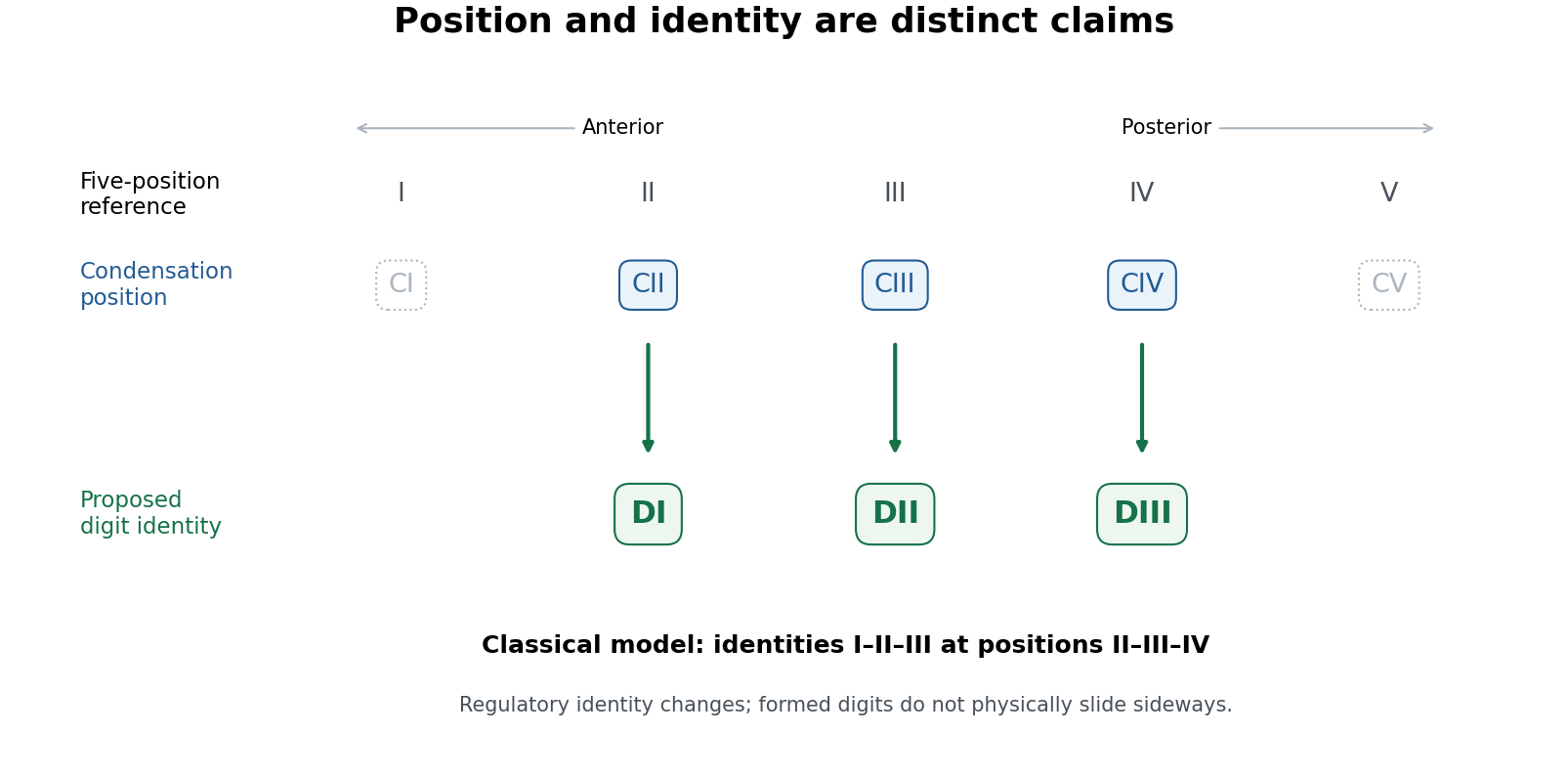
Positional condensations and morphological identities in the classical avian digit frameshift hypothesis
. Original conceptual diagram. The upper row is a five-position reference; the lower rows distinguish the retained positional assignments from the identities proposed for them. Dotted symbols indicate positions outside the three principal retained digits, without asserting that no transient cells or condensations ever occur there. This diagram states the classical model, not a universal molecular identity code. Details.The proposal yields tests. Anatomical identity should be assessed from several features of metacarpals, joints and phalanges, not by calling the anteriormost remaining anatomical digit “I” by definition. Condensation position should be established independently from staged embryos and fate mapping, rather than inferred solely from the adult hand. Molecular comparisons can then ask whether positional anatomical digit II in the wing shares a distinctive regulatory state with anatomical digit I in a reference limb. evolution of gene regulation, including the duration and distribution of Sonic hedgehog signalling and downstream interactions, offers a means of uncoupling position and later differentiation. Expression of one Hox gene is informative but is not a universally valid barcode of a complete digit identity.
Koji Tamura and colleagues used cell labelling and transplantation to compare wing and hindlimb development. The cells contributing to the posterior wing anatomical digit did not have the same relationship to the posterior signalling region, the zone of polarizing activity, as the corresponding hindlimb anatomical digit IV; their early separation was compatible with a digit-III developmental domain. This supplied experimental evidence against equating the posterior wing anatomical digit straightforwardly with hindlimb anatomical digit IV.[ref]
Embryological evidence identifies wing digits in birds as digits 1, 2, and 3 by Koji Tamura and others. Cell-labelling and transplantation comparisons of wing and hindlimb digit progenitors
Such experiments need embryos matched by developmental stage, verified label positions, assessment of label persistence and spread, and controls for effects of grafting on survival and growth. A cell's ultimate contribution establishes its fate under the tested conditions; it does not alone establish the evolutionary identity of every structure it forms. Comparing forelimb with hindlimb also requires recognizing that the two are already developmentally different organs. The stronger inference combines lineage tracing with anatomy and regulatory evidence.
Transcriptomic data sharpened, rather than simply ended, the debate. Zhe Wang and colleagues found a conserved anterior-digit signature consistent with identity I in the anteriormost wing anatomical digit, while the posterior wing anatomical digits showed derived expression identities rather than a simple conserved series.[ref]
Transcriptomic analysis of avian digits reveals conserved and derived digit identities in birds by Zhe Wang and others. Comparative digit transcriptomes and the distinctive anterior-wing-digit signature
A later multi-species comparison by Thomas A. Stewart and colleagues challenged the assumption that all corresponding anatomical digits possess a conserved tetrapod-wide molecular identity. Their results supported a more limited shift rather than treating every posterior anatomical digit as an unchanged identity displaced by one position.[ref]Evidence against tetrapod-wide digit identities and for a limited frame shift in bird wings by Thomas A. Stewart and others. Cross-species expression comparisons and limits of a universal digit-identity model
Tissue composition, sampling stage, orthology assignment and the choice of reference species are therefore essential controls in molecular tests.The evolutionary significance is substantial but bounded. birds are nested within theropod dinosaurs on evidence extending beyond anatomical digit number, including many skeletal transformations and feathered relatives. The preserved integument of Yutyrannus, for example, documents filamentous feathers in a nonavian tyrannosauroid, broadening the fossil distribution of feathers beyond birds.[ref]
A gigantic feathered dinosaur from the Lower Cretaceous of China by Xing Xu and others. Associated skeletons and filamentous feather preservation in Yutyrannus
A coherent developmental mechanism removes one apparent contradiction between embryology and that historical interpretation. It also illustrates why disagreement between positional and morphological evidence should trigger a mechanistic test rather than automatic rejection of either dataset. However, showing that a regulatory shift is developmentally possible is not proof that precisely the full classical shift occurred in the ancestral bird lineage.The durable result is that anatomical digit position and digit identity can evolve partly independently. Evidence for an identity-I anterior wing anatomical digit is stronger than a claim that all three anatomical digits retain invariant molecular identities I, II and III. The digit identity frameshift hypothesis remains a useful, testable bridge between fossil anatomy and development, with the exact extent and sequence of identity transformation requiring explicit comparison rather than assumed equivalence.
Past exam of the zoology course of the University of Cambridge 2025 Paper zm1 4 Solution by Codex 0 2026-10-20
Codex 0 2026-10-20A monophyletic group includes an ancestor and all its descendants; a paraphyletic group includes an ancestor but excludes some descendants; a polyphyletic group combines separate lineages while excluding their relevant common ancestry. The distinction concerns how membership relates to a phylogenetic tree, rather than how many visible similarities the members possess.
Consider a simplified tree of living amniotes: mammals form one branch, while the other contains lepidosaurs, turtles and archosaurs; living archosaurs comprise crocodilians and birds. Within the latter branch, birds are surviving dinosaurs. The tree below omits extinct branches and most living diversity, and its branch lengths represent neither age nor quantity of evolutionary change. It illustrates three choices of group on the same ancestry.
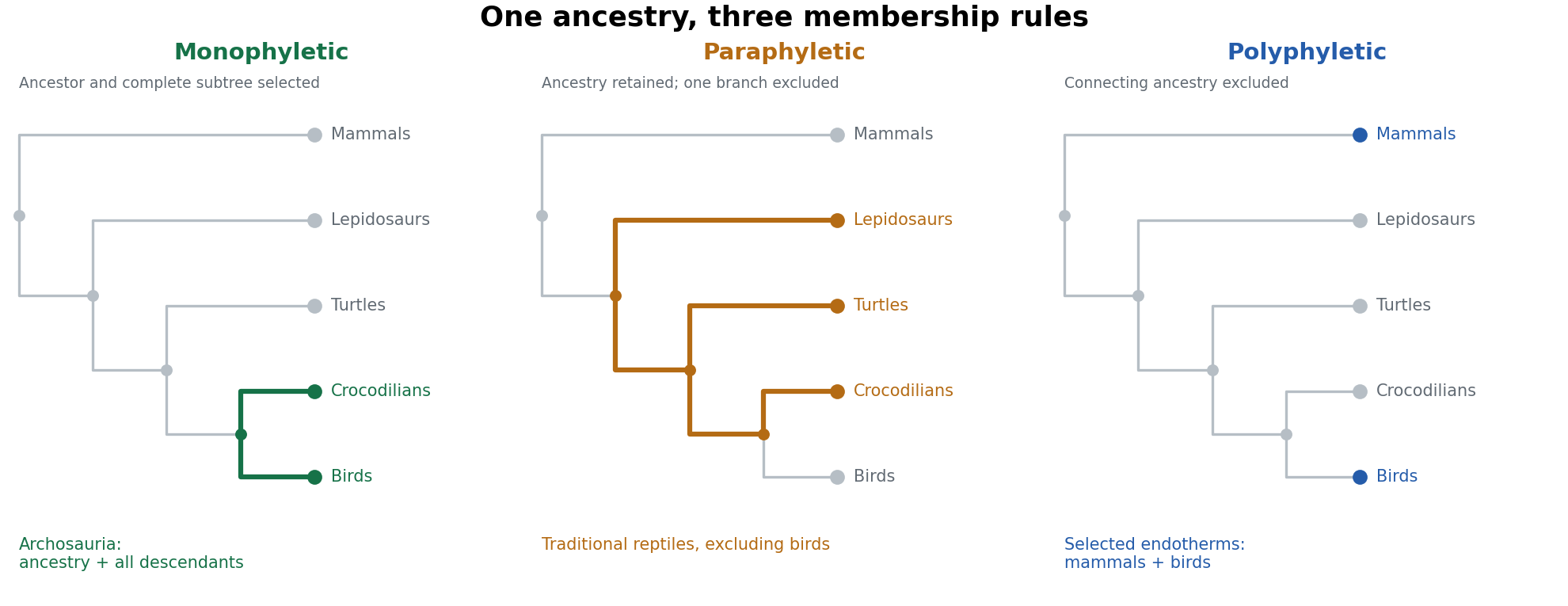
A monophyletic group is a clade. Archosauria includes the last common ancestor of birds and crocodilians and every descendant, including extinct dinosaurs and other extinct branches. In the simplified figure, selecting their shared node and both descendant tips gives the corresponding complete subtree. Sarcopterygii, with tetrapods included, is another example. A clade need not be recognized by a feature that remains visibly unchanged in every descendant: subsequent modification and loss are permitted. It also need not have a particular taxonomic rank.
A familiar paraphyletic group is the traditional assemblage “reptiles” when it includes turtles, lizards, snakes and crocodilians but explicitly excludes birds. The latter descend from within the ancestry otherwise assigned to that assemblage. The selected ancestry is therefore cut short at one of its own branches. Similarly, conventional “fish” that include finned sarcopterygians but exclude tetrapods form an evolutionary grade rather than a complete clade. These examples require the stated usage: Reptilia or Sauropsida can instead be defined as a clade that includes birds. The everyday word does not irrevocably determine the phylogenetic status of every technical definition bearing that name.
For polyphyly, consider assembling mammals and birds solely as the familiar independently evolved examples of sustained high metabolic heat production, while omitting their intervening ancestors and other descendants. This physiological grouping can be useful for comparing endothermy, but it does not identify one exclusive historical lineage. Their last common ancestor also has descendants such as lepidosaurs and crocodilians. On the usual inference of independent elaboration of the relevant physiology, the selected resemblance involves convergent evolution. Calling the assemblage “warm-blooded vertebrates” must not turn a selected physiological trait into evidence that birds are closer to mammals than to crocodilians. Moreover, endothermy and constant body temperature are not identical properties, and living taxon sampling does not locate every thermophysiological transition in extinct lineages.
There is a subtle distinction between the last two cases. A diagram of selected terminal tips alone can show that a group is not a clade, but does not always uniquely distinguish paraphyly from polyphyly. One must state which ancestors are included and the historical interpretation of the defining character. In the orange example, the ancestral reptile lineage is retained and one descendant branch excluded. In the blue example, similar functional outcomes are assembled from separate branches without including the connecting ancestry. The highlighted internal paths in the figure make that difference explicit.
clades are particularly suitable for discussing vertebrate evolution because their nested membership directly expresses common descent. They permit consistent statements such as “birds are dinosaurs” and “humans are sarcopterygians”, while allowing substantial changes in form and function. Shared derived characters, or synapomorphies, provide evidence for branches; shared ancestral states do not uniquely diagnose the smaller groups inheriting them, and independently acquired similarities require separate explanation. This framework makes character transformations testable against a branching history instead of arranging animals in a ladder of increasing complexity.
In practice the phylogenetic tree remains a hypothesis. More characters, better fossils or different evolutionary models can change inferred relationships. Naming a clade with an explicit ancestry-based definition helps keep the statement intelligible when that happens, but does not make the inference immune to error. Anatomical and molecular characters need biological homology assessment, appropriate taxon sampling and uncertainty estimates. For example, genome-scale data and stem-turtle anatomy independently address whether turtles lie near archosaurs, rather than treating one skull condition as sufficient to define the tree.[ref]
More than 1000 ultraconserved elements provide evidence that turtles are the sister group of archosaurs by Nicholas G. Crawford and others. Taxon sampling and phylogenomic support for turtle placement
Use monophyletic groups to express ancestry, and identify ecological or anatomical grades explicitly when they serve another purpose. paraphyletic groups can summarize retained ancestral organization, and polyphyletic groups can support functional comparisons, but neither should silently substitute for a complete lineage.
Past exam of the zoology course of the University of Cambridge 2025 Paper zm1 3 Solution by Codex 0 2026-10-20
Codex 0 2026-10-20Sarcopterygii is the clade comprising the most recent common ancestor of living coelacanths, lungfish and tetrapods, together with all its descendants. In this crown-based usage, humans are sarcopterygians: acquisition of limbs and loss of a fish-like outline do not remove descendants from a clade. Extinct taxa assigned along the stem require an explicitly broader total-group usage. A diagnosis lists characters useful for recognizing a group; a synapomorphy is a shared derived character whose position has been inferred on a phylogenetic tree. Those are related but not interchangeable statements.
Two particularly instructive traditional diagnostic features are the fleshy, internally supported paired appendages and true enamel associated with the dentition. The first survives conspicuously in our arms and legs. The second survives in our tooth crowns, although modern evidence requires qualification of its traditional status as an exclusively sarcopterygian innovation.
The paired-appendage transformation. A lobed fin contains musculature and a substantial endoskeleton extending into the appendage. In the relevant ancestral pattern, a single proximal skeletal element connects to the girdle: the humerus in the pectoral appendage, and the femur in the pelvic appendage. Subsequent elements elaborate the jointed internal axis. The important comparison is historical organization and articulations, not merely that both a fin and an arm contain bone. fins in other lineages also possess internal supporting elements, so the presence of any fin skeleton is too broad a diagnosis.
Within the lineage leading to tetrapods, the pectoral series can be recognized as humerus, radius bone and ulna, followed by increasingly elaborate distal elements. Tiktaalik retains fin rays but has a distal jointed skeleton capable of limb-like positioning against a substrate. Its combination of characters shows that parts of a wrist-like support system preceded a fully digit-bearing hand. Comparing several articulated specimens and the geometry of joint surfaces constrains the reconstruction better than matching isolated bones by outline.[ref]
The pectoral fin of Tiktaalik roseae and the origin of the tetrapod limb by Neil H. Shubin and others. Pectoral anatomy, joint configurations and proposed substrate-supported postures
Further changes included anatomical digits, loss of external fin rays in the limb, changes to the girdles and altered force transmission through the trunk. They did not all arise simultaneously. Early digit-bearing tetrapods were not uniformly five-fingered terrestrial walkers; aquatic settings and polydactyly make it misleading to present the modern human hand as the immediate purpose or original endpoint of the transition. Acanthostega, with eight anatomical digits in its forelimb, supplies a concrete counterexample to an ancestrally universal five-digit condition.[ref]
Polydactyly in the earliest known tetrapod limbs by Michael I. Coates and Jennifer A. Clack. Digit counts and implications for the ancestral tetrapod limb
Our own upper limb retains the proximal single-bone and paired-bone organization, but the shoulder, elbow, wrist and fingers are extensively specialized. Rotation of the radius bone relative to the ulna contributes to turning the forearm; an opposable thumb and independently controlled fingers support grasping. In the lower limb, the femur, tibia and fibula show the corresponding serial organization, while the pelvis, hip, knee and foot transmit loads in habitual bipedalism. These are derived modifications within tetrapods, rather than defining traits of all Sarcopterygii. Comparing our arm with a fish pectoral fin concerns biological homology between organisms; comparing arm and leg also involves serial homology within the body.
The dental transformation and its qualification. human tooth crowns have an outer layer of enamel over dentine. enamel is highly mineralized and is produced by epithelial ameloblasts, whereas dentine is a different tissue formed by odontoblasts. Identifying a fossil surface as enamel therefore requires tissue architecture and developmental or molecular comparison, not simply a shiny hard covering. In our teeth the coating has specialized organization into enamel rods and contributes to wear resistance during biting and chewing. tooth classes and crown shapes diversify the ancestral feeding apparatus; they are not themselves basal sarcopterygian synapomorphies. After eruption, loss of the enamel-producing cellular layer severely limits biological replacement of worn crown enamel.
The traditional contrast between sarcopterygian true tooth enamel and other hard coverings needs an explicit historical correction. Qingming Qu and colleagues combined fossil histology with evidence for enamel-matrix genes in the skin of gar. In Psarolepis, external odontodes carried enamel while the teeth lacked an enamel coating. Their evidence supported an origin in dermal coverings followed by expansion into the mouth, and an ancestry deeper than Sarcopterygii alone.[ref]
New genomic and fossil data illuminate the origin of enamel by Qingming Qu and others. Fossil tissue distribution and gar enamel-matrix gene expression
Thus enamel and its oral deployment must be coded separately; tooth enamel remains a useful traditional diagnostic comparison, but the tissue itself is not a uniquely sarcopterygian synapomorphy. Shared tissue can undergo heterotopy, loss and later modification.The two histories illustrate different forms of transformation visible in our bodies: an internally supported paired fin became a jointed, digit-bearing, specialized limb, and an inherited mineralized epithelial covering acquired a complex role in our dentition. A rigorous diagnosis states the anatomical level being compared and distinguishes inherited organization from later functional specialization. Neither the modern function nor the external human appearance determines membership of Sarcopterygii.
Past exam of the zoology course of the University of Cambridge 2025 Paper zm1 2 Solution by Codex 0 2026-10-20
Codex 0 2026-10-20The transition places vertebrate origins within a prolonged assembly of animal body plans, ecological interactions and preservational opportunities. It does not identify one boundary at which a complete modern vertebrate suddenly appeared. Three questions must be separated: when the relevant lineages diverged, when diagnostic features evolved, and when those features became recoverable as fossils.
The Ediacaran precedes the Cambrian, whose beginning is approximately 539 million years ago. Ediacaran communities already contained macroscopic organisms and evidence of animal movement and feeding. Kimberella, for example, has been interpreted from its body organization as a mollusc-like bilaterian; its relevance is that substantial animal differentiation predates the boundary, rather than that it is a vertebrate ancestor.[ref]
The Late Precambrian fossil Kimberella is a mollusc-like bilaterian organism by Mikhail A. Fedonkin and Benjamin M. Waggoner. Body reconstruction and bilaterian interpretation
trace fossils record activities that may otherwise leave no body remains. Increasingly elaborate movement and sediment disturbance reveal ecological capacities, but an isolated burrow does not identify a notochord, a head or a particular branch of the animal phylogenetic tree.Across the transition, animal skeletons, predation, burrowing and water-column communities became more prominent. Their appearance changes both biology and observation. Resistant skeletons improve preservation, while bioturbation can destroy the sedimentary surfaces that had preserved some earlier soft-bodied communities. Different preservational windows reveal different subsets of life. An apparent replacement in the fossil record can therefore combine real ecological turnover with taphonomic bias. One should compare anatomy and environments across several deposits rather than treating all Ediacaran absences as biological absences.
The Cambrian exceptional deposits provide positive evidence. Haikouichthys and Myllokunmingia from Chengjiang reveal small fish-like animals with combinations of axial, muscular and branchial structures interpreted as early vertebrate organization.[ref]
Lower Cambrian vertebrates from south China by D.-G. Shu and others. Descriptions and reconstruction of the two Chengjiang taxa
Metaspriggina from the Burgess Shale adds evidence from a distinct assemblage, including prominent eyes, segmented musculature, organized into myomeres, and serial branchial supports.[ref]A primitive fish from the Cambrian of North America by Simon Conway Morris and Jean-Bernard Caron. Anatomical description and reconstruction of Metaspriggina
These are more informative than an undifferentiated claim that “fish existed”: they allow particular characters to be mapped onto alternative phylogenetic trees.A plausible sequence involves a swimming chordate organization with a notochord and segmental musculature, followed by elaboration of anterior sensory and feeding systems along the vertebrate lineage. Nevertheless, fossil compressions can obscure boundaries or superimpose unrelated structures. Confidence should come from repeated specimens, bilateral agreement, positional relationships and combinations of characters, rather than resemblance of one dark patch to an organ. A structure absent from a compressed specimen may be unpreserved. Nor does a plausible early vertebrate have to be a member of the living vertebrate crown group, still less a direct ancestor of a living species. A stem group can contain extinct side branches showing different combinations of ancestral and derived states.
Living organisms constrain the reconstruction without forming a ladder. Molecular analyses place tunicates, rather than cephalochordates, as the closest living relatives of vertebrates.[ref]
Tunicates and not cephalochordates are the closest living relatives of vertebrates by Frédéric Delsuc and others. Phylogenomic comparison of chordate relationships
A modern lancelet is consequently a comparative relative with its own history, not an unchanged stage through which vertebrates passed. The same warning applies to living hagfish and lampreys. Their anatomy can reveal inherited features and secondary specializations; simplicity alone cannot polarize a character.The New Head hypothesis connects cranial sensory and feeding innovations with neural crest and ectodermal placodes. This is a developmental explanation for assembling a more elaborate head. Experiments on living chordates can test where cells originate, which structures they form and which regulatory interactions are needed. The fossil presence of eyes or branchial supports cannot directly demonstrate the embryonic migration of neural crest. Conversely, a conserved regulatory gene alone does not establish that a complete modern head existed in an Ediacaran ancestor. Developmental, molecular and anatomical evidence address complementary parts of the argument.[ref]
Neural crest and the origin of vertebrates: a new head by Carl Gans and R. Glenn Northcutt. Proposed developmental basis and functional significance of head innovation
Ecological context helps explain why these capacities might diversify. More active swimming, prey detection and food processing can create opportunities and selective pressures for improved sensory and locomotor coordination. molecular oxygen availability constrains the metabolic activities that can be sustained. Erik A. Sperling and colleagues compared modern low-oxygen animal communities and related the scarcity of carnivory at low oxygen levels to hypotheses about Cambrian ecological expansion.[ref]
Oxygen, ecology, and the Cambrian radiation of animals by Erik A. Sperling and others. Modern oxygen-gradient observations and the proposed ecological connection
This motivates a mechanism; environmental correlation alone neither dates the vertebrate ancestor nor establishes oxygenation as a sufficient single cause.The useful conclusion is a constrained historical sequence, with explicit gaps. Ediacaran evidence establishes antecedent animal complexity; Cambrian exceptional preservation documents recognizable early vertebrate combinations; comparative phylogenetics and evolutionary developmental biology test their placement and assembly. molecular clocks can estimate earlier divergences, but their dependence on rates and fossil calibration prevents them from turning every absence into a precise origin date.
Past exam of the zoology course of the University of Cambridge 2025 Paper zm1 1 Solution by Codex 0 2026-10-20
Codex 0 2026-10-20taphonomic bias is systematic distortion of biological information between a living community and the fossil record. Death, carcass decay, scavenging, transport, burial, chemical alteration, exposure and collection all filter what is observed. A deposit therefore samples organisms, body parts and environments unequally. This is more than incompleteness: preferential preservation of a particular tissue or habitat can produce a misleading pattern of abundance, anatomy or evolutionary timing.
An autochthonous fossil assemblage contains remains preserved where the organisms lived; an allochthonous fossil assemblage contains material transported from elsewhere. These describe provenance, rather than two levels of fidelity. In an allochthonous fossil assemblage, currents can separate elements by size, shape and density, concentrate resistant teeth or scales, remove delicate bodies and mix organisms from different habitats. Erosion and redeposition can also introduce older fossils into younger sediment. Such reworking differs from simple transport of recently dead animals. time averaging mixes deaths from different times even without long-distance transport. A concentration of robust remains consequently need not represent either a locally abundant living population or a single ecological event.
An autochthonous fossil assemblage avoids some transport distortion, but still selects organisms and characters. A bottom-dwelling community rapidly buried in place can be unusually well represented while swimmers above it, unmineralized tissues and organisms living outside that depositional setting are missing. Conversely, an intact carcass can travel before burial, whereas locally decayed remains can become disarticulated without transport. Articulation, abrasion, preferred orientation, sedimentary context and age agreement must therefore be evaluated together. Local preservation does not imply an unbiased biological census.
The contrast between cyclostomes and early members of the gnathostome lineage is particularly revealing. Living cyclostomes, hagfish and lampreys, have no extensive mineralized external skeleton comparable to the armour of many early jawless relatives of gnathostomes. Their bodies are dominated by tissues whose preservation usually requires exceptional conditions. The abundance of isolated mineralized scales, plates or teeth can thus make a hard-bodied lineage conspicuous where a soft-bodied contemporary is virtually invisible. Importantly, the armoured jawless assemblage traditionally called ostracoderms is not simply the ancestral cyclostome record: many of its members belong on the gnathostome stem. Absence of jaws does not by itself establish cyclostome affinity.
There is also a character-level filter. Robert S. Sansom and colleagues followed experimental carcass decay of living chordates, and then examined hagfish and lampreys in detail. Anatomical characters did not disappear at random: loss of diagnostic features could make a derived animal appear more primitive. This produces stemward slippage if investigators mistake an unpreserved feature for a feature absent in life. The result is relevant both to isolated soft-bodied fossils and to the apparently long primitive intervals preceding well-preserved groups.[ref]
Non-random decay of chordate characters causes bias in fossil interpretation by Robert S. Sansom and others. Experimental character-loss sequences and simulated consequences for fossil interpretation
[ref]Decay of vertebrate characters in hagfish and lamprey (Cyclostomata) and the implications for the vertebrate fossil record by Robert S. Sansom and others. Comparative decay of cyclostome tissues and diagnostic characters
A useful experimental design records fresh anatomy first, samples replicated carcasses through time under stated temperature and chemical conditions, and scores the same characters in each specimen. Comparisons between animals and between preservational conditions test whether the loss order is reproducible. Such experiments identify plausible biases; they do not recreate every burial chemistry or prove that every uncertain fossil has undergone the same sequence. In a phylogenetic character matrix, genuinely unobservable anatomy should normally be coded as unknown rather than automatically absent. Comparison across differently preserved specimens can sometimes recover information that one specimen lacks.
Exceptional discoveries show what the ordinary record omits. The Late Devonian lamprey Priscomyzon from South Africa preserves a recognizable oral apparatus and branchial region without a massive mineralized skeleton. It shows that early lamprey anatomy can be recovered when the appropriate soft-tissue window is available; the gap before such a discovery is not evidence that the lineage had just originated.[ref]
A lamprey from the Devonian period of South Africa by Robert W. Gess and others. Description and Late Devonian occurrence of Priscomyzon
The Cretaceous hagfish Tethymyxine preserves evidence including slime-producing structures, allowing characters unavailable in most older deposits to be brought into an analysis using phylogenetics. It supplies a minimum occurrence and anatomical information, not the date when hagfish originated.[ref]Hagfish from the Cretaceous Tethys Sea and a reconciliation of the morphological–molecular conflict in early vertebrate phylogeny by Tetsuto Miyashita and others. Fossil anatomy, slime-gland evidence and combined phylogenetic analysis
Conversely, Early Silurian Qianodus is known through mineralized tooth whorls: such durable small remains can establish an early occurrence of a toothed gnathostome even where complete bodies are missing.[ref]The defensible comparison concerns preservation probabilities as well as biological histories. First fossil occurrences are minimum ages, and unequal counts need not measure unequal diversity. Independent anatomical characters, comparable depositional settings, searches for small hard parts and exceptional soft-tissue deposits together give a better test of early vertebrate history than a literal reading of the most conspicuous remains.
Past exam of the zoology course of the University of Cambridge 2025 Paper zl6 5 Solution by Codex 0 2026-10-20
Codex 0 2026-10-20The developing mammalian heart grows by a changing combination of progenitor cell recruitment and division of differentiated cardiomyocytes. Differentiation is therefore not synonymous with permanent cell-cycle exit. Premature differentiation can exhaust a progenitor cell pool, while delayed differentiation can leave many cells unable to build a functional heart. The correct balance is spatial and temporal: different cardiac populations must be supplied, expand and mature in the right order.
Early cardiac mesoderm is specified through combinations of extracellular signals and transcription factors including GATA4, NKX2-5 and TBX5. The first heart field differentiates relatively early and contributes prominently to the initial heart tube and future left ventricle. The second heart field retains proliferative progenitor cells outside the tube for longer and adds cells at its poles, with major contributions to the right ventricle and outflow tract as well as other regions. These are useful developmental populations rather than perfectly isolated compartments with one exclusive marker. The key growth mechanism is delayed recruitment: maintaining a progenitor cell reservoir allows the heart tube to lengthen after its first contractile cells have differentiated.[ref]
FGF signalling helps support progenitor cell expansion, while BMP signalling contributes to specification and the transition toward differentiation. Their effects depend on developmental stage and location, so a global instruction to activate either pathway is inadequate. In mouse, an NKX2-5-dependent negative-feedback circuit limits Bmp2/Smad1 activity in heart-field progenitor cells. Nkx2-5 mutants initially overexpressed specification and progenitor cell programmes but subsequently failed to sustain normal second-heart-field proliferation and outflow-tract development. Reducing Smad1 activity rescued important aspects of these defects. The genetic rescue is stronger mechanistic evidence than an expression correlation: excessive specification-associated signalling can compromise the growth needed to construct the outflow tract.[ref]
Once incorporated into the heart, embryonic cardiomyocytes assemble sarcomeres and contribute to contraction while retaining substantial proliferative capacity. cell proliferation in this differentiated population thickens chamber walls and helps produce the tissue needed for septation. Chamber myocardium and non-chamber regions follow different regulatory programmes, allowing rapid chamber expansion alongside specialized conduction and junctional territories. The goal is not simply maximum cardiomyocyte number: the arrangement, coupling and regional identity of those cells are necessary for a coordinated pump.
Signals between cardiac layers couple growth to architecture. endocardium-derived neuregulin 1 acts through myocardial ErbB receptors, including ErbB2 and ErbB4, in ventricular trabeculation. Mouse loss-of-function experiments disrupting this ligand-receptor system produce severe defects in trabecular development. The phenotype demonstrates an essential tissue interaction, but absent trabeculae must not automatically be described as a pure proliferation defect: differentiation, adhesion, cell rearrangement and survival can also contribute. Separate measurements of these processes are needed.[ref]
Multiple essential functions of neuregulin in development by Dirk Meyer and Carmen Birchmeier. Targeted neuregulin mutation and embryonic cardiac phenotype
The epicardium and developing coronary system add further supporting signals and structural requirements as the ventricular wall grows. Proliferation must remain matched to oxygen delivery and tissue organization.Hippo signalling provides a direct brake on myocardial expansion. When active, the pathway restricts nuclear growth-promoting activity of YAP and its cooperation with TEAD factors. Conditional disruption of Hippo components in developing mouse hearts increased cardiomyocyte proliferation and enlarged the heart. Reducing beta-catenin dosage suppressed overgrowth in the tested mutants, supporting functional interaction with Wnt signalling. This demonstrates that differentiated myocardium contains an actively regulated growth programme; its number of divisions is not merely the residue of an earlier progenitor cell state.[ref]
Hippo pathway inhibits Wnt signaling to restrain cardiomyocyte proliferation and heart size by Todd Heallen and others. Cardiac conditional mutants, proliferation measurements and beta-catenin genetic interaction
Conversely, unrestricted proliferation is not necessarily desirable, because chamber geometry, septation and function must mature together.Around birth, cardiomyocytes undergo substantial changes in metabolism, sarcomere organization, electrical coupling and loading. Many mouse cardiomyocytes become binucleate or acquire polyploidy, while growth shifts increasingly toward cardiomyocyte hypertrophy. This transition is gradual and species-dependent, not a universal instantaneous switch at birth. A nucleus incorporating a nucleotide analogue may have undergone DNA replication without completing a new cell: endoreduplication and failed cytokinesis can mimic proliferation in a simple staining assay. Counts of total cardiomyocytes, nuclear number, DNA content and directly observed division are therefore needed alongside EdU and mitotic markers.
The early postnatal regeneration window illustrates the importance of developmental timing. Partial apex resection in one-day-old mice was followed by substantial myocardial restoration, and fate mapping implicated pre-existing cardiomyocytes; the reported capacity was greatly reduced by seven days of age. This is evidence that early differentiated cardiomyocytes retain regenerative potential under the tested injury conditions, rather than evidence for an indefinitely active adult cardiac stem-cell reservoir.[ref]
Transient regenerative potential of the neonatal mouse heart by Enzo R. Porrello and others. Age comparison, injury experiments and cardiomyocyte fate mapping
Injury severity and the method of measuring tissue restoration matter when comparing regenerative outcomes.To distinguish mechanisms experimentally, combine inducible lineage tracing with stage- and lineage-specific perturbation. Deleting a regulator before heart-field specification tests a different question from deleting it after cardiomyocyte differentiation. Follow progenitor cell number, recruitment, differentiated-cell number, completed division, apoptosis and chamber structure, then test pump function. Use littermate controls, verify recombination timing and specificity, and seek pathway-specific genetic rescue. A small heart with few marker-positive cells could reflect failed specification, reduced proliferation, delayed deployment or excess death. The developmental solution is an ordered handover: expand competent progenitor cells, recruit them into differentiated tissue, permit controlled division of working myocardium, and progressively constrain division as mature structure and function are established.
Past exam of the zoology course of the University of Cambridge 2025 Paper zl6 4 Solution by Codex 0 2026-10-20
Codex 0 2026-10-20positional information allows cells to choose an appropriate developmental response for their location; positional memory allows a location-dependent identity to persist after the original signal has changed. Neither is identical to cell differentiation. Two connective-tissue cells can have similar current functions but different information about where they belong in a limb. Development must establish these relationships, while regeneration must reconstruct missing relationships from an incomplete stump.
In the classical positional information framework, a tissue first establishes coordinates and cells interpret them according to their competence and developmental history. A morphogen gradient is one possible coordinate system. Different thresholds can elicit different gene expression states, but concentration alone is not the entire signal: exposure duration, feedback, changing tissue geometry and the response network also matter. Thus the same positional signal can produce different differentiated structures in different competent tissues.[ref]
Positional information and the spatial pattern of cellular differentiation by Lewis Wolpert. The separation of positional specification from cellular interpretation
The vertebrate limb bud is patterned along three interacting axes: proximal-distal, anterior-posterior and dorsal-ventral. The apical ectodermal ridge supplies FGF signalling that supports distal outgrowth and survival. Its early removal causes distal truncation, but this does not uniquely demonstrate that cells measure time in a progress zone: cell loss, altered growth and loss of signals can also change the structures that remain.[ref]
Positional Information in Chick Limb Morphogenesis by Dennis Summerbell and others. Classical progress-zone formulation and limb-bud experiments
Distal FGF signals and proximal influences interact with Hox genes and other regulators to organize stylopod, zeugopod and autopod territories. One must distinguish a positional identity defect from a failure to supply enough cells to execute that identity.Anterior-posterior patterning provides a more direct signal-relocation test. Grafting posterior zone of polarizing activity tissue to the anterior of a chick limb bud produces duplicated digit patterns. Sonic hedgehog is expressed in the posterior region, and anterior implantation of cells expressing it reproduces polarizing activity. This connects a localized molecular signal to a change in spatial identity, rather than merely correlating expression with posterior development. Digit pattern still depends on signal duration, growth and downstream regulation; a static concentration-to-digit lookup table is inadequate.[ref]
Sonic hedgehog mediates the polarizing activity of the ZPA by Robert D. Riddle and others. Expression analysis and anterior implantation of SHH-expressing cells
Along the dorsal-ventral axis, dorsal Wnt7a promotes Lmx1b in mesenchyme, while ventral Engrailed-1 helps restrict dorsal signalling. Interactions among these systems allow outgrowth and coordinate specification to remain aligned.Regeneration adds the problem of interpreting an amputation plane. An axolotl limb usually replaces structures distal to the cut: a wrist-level stump does not routinely add a new upper arm before rebuilding the hand. This implies that regenerative outgrowth retains or reconstructs level-specific information. A blastema contains proliferative progenitor cells beneath a specialized wound epithelium, but it is not a uniformly pluripotent mass. Transgenic graft and lineage experiments showed substantial memory of tissue origin and differences among progenitor cell populations. The distinction between tissue identity and spatial identity is essential: producing cartilage does not alone show that its proximal-distal address is correct.[ref]
Cells keep a memory of their tissue origin during axolotl limb regeneration by Martin Kragl and others. Labelled tissue grafts and lineage-restricted contributions to the blastema
Retinoid experiments show that positional identity can be reprogrammed. Treatment of distal axolotl amputations with vitamin A or related retinoids can generate proximal structures before distal ones, sometimes producing a much more complete limb from a distal stump. This is difficult to explain as simple acceleration of growth, because the identities and sequence of regenerated structures change. It supports proximalization of the responding tissue. Nevertheless, pharmacological reprogramming does not by itself prove that an endogenous retinoid gradient is the sole normal coordinate system; dose-dependent toxicity and effects on growth must be assessed separately.[ref]
Vitamin A and pattern formation in the regenerating limb by Malcolm Maden. Proximal-distal duplications after retinoid treatment of axolotl amputations
Spatial confrontation supplies another test. In an accessory-limb assay, a wound with appropriate nerve support can be combined with tissue of a different circumferential identity. Productive anterior-posterior interactions can support a patterned extra outgrowth, whereas wound healing and proliferation alone need not generate a complete limb. In axolotl experiments, anterior FGF8 and posterior Sonic hedgehog activities were identified as interacting signals, and manipulating them could replace aspects of the normally required tissue confrontation. This connects positional disparity to a signalling circuit that promotes regeneration, without implying that FGF8 and SHH encode every spatial identity by themselves.[ref]
FGF8 and SHH substitute for anterior–posterior tissue interactions to induce limb regeneration by Eugen Nacu and others. Signal localization and substitution in regenerative assays
A rigorous molecular test would transplant permanently labelled connective-tissue cells between defined limb positions, score their contribution and spatial identity, and perturb a candidate positional regulator specifically in those cells. Compare position-matched grafts, rotated or mismatched grafts, sham operations and equal nerve support; measure survival and proliferation so that graft failure is not mistaken for lost positional identity. Assess skeletal pattern and lineage output as well as positional markers, with rescue of the candidate perturbation. Such experiments separate a stable address, responsiveness to local signals and a generic requirement for outgrowth. Development and regeneration reuse signalling pathways, but regeneration additionally depends on retained information, wound-specific competence and communication between cells carrying different positional histories.
Pinned article: Introduction to the OurBigBook Project
Welcome to the OurBigBook Project! Our goal is to create the perfect publishing platform for STEM subjects, and get university-level students to write the best free STEM tutorials ever.
Everyone is welcome to create an account and play with the site: ourbigbook.com/go/register. We belive that students themselves can write amazing tutorials, but teachers are welcome too. You can write about anything you want, it doesn't have to be STEM or even educational. Silly test content is very welcome and you won't be penalized in any way. Just keep it legal!
Intro to OurBigBook
. Source. We have two killer features:
- topics: topics group articles by different users with the same title, e.g. here is the topic for the "Fundamental Theorem of Calculus" ourbigbook.com/go/topic/fundamental-theorem-of-calculusArticles of different users are sorted by upvote within each article page. This feature is a bit like:
- a Wikipedia where each user can have their own version of each article
- a Q&A website like Stack Overflow, where multiple people can give their views on a given topic, and the best ones are sorted by upvote. Except you don't need to wait for someone to ask first, and any topic goes, no matter how narrow or broad
This feature makes it possible for readers to find better explanations of any topic created by other writers. And it allows writers to create an explanation in a place that readers might actually find it.
Figure 1. Screenshot of the "Derivative" topic page. View it live at: ourbigbook.com/go/topic/derivativeVideo 2. OurBigBook Web topics demo. Source. - local editing: you can store all your personal knowledge base content locally in a plaintext markup format that can be edited locally and published either:This way you can be sure that even if OurBigBook.com were to go down one day (which we have no plans to do as it is quite cheap to host!), your content will still be perfectly readable as a static site.
- to OurBigBook.com to get awesome multi-user features like topics and likes
- as HTML files to a static website, which you can host yourself for free on many external providers like GitHub Pages, and remain in full control

Figure 2. You can publish local OurBigBook lightweight markup files to either OurBigBook.com or as a static website.
Figure 3. Visual Studio Code extension installation.
Figure 5. . You can also edit articles on the Web editor without installing anything locally. Video 3. Edit locally and publish demo. Source. This shows editing OurBigBook Markup and publishing it using the Visual Studio Code extension. 
- Infinitely deep tables of contents:




All our software is open source and hosted at: github.com/ourbigbook/ourbigbook
Further documentation can be found at: docs.ourbigbook.com
Feel free to reach our to us for any help or suggestions: docs.ourbigbook.com/#contact