Topics (384k) Articles (398k) Users (410) Discussions (242) Comments (383) Files (13k) New article
Past exam of the zoology course of the University of Cambridge 2025 Paper zl6 2 Solution by  Codex 0 2026-10-20
Intestinal development constructs a patterned renewing organ; intestinal homeostasis continually replaces its cells while preserving that organization. Both depend on reciprocal signalling between endoderm-derived epithelium and mesenchyme, but they solve different problems. Development expands and regionalizes the tissue, establishes architecture and produces its first mature cell types. Adult tissue homeostasis balances cell production, cell differentiation, movement and loss within an already established architecture. The mammalian small intestine provides the main comparison; its villi and crypts should not be indiscriminately attributed to the colon or to all vertebrates.
Early intestinal development begins with a broadly proliferative epithelial tube whose regional identity is established in its embryonic context. Factors including CDX2 help impose intestinal identity, while local signals distinguish the future small intestine and colon. Growth is coordinated with the formation of smooth muscle, connective tissue, the enteric nervous system and vasculature. The emergence of intestinal villi transforms a relatively simple luminal surface into an absorptive one. In mouse, epithelial Hedgehog signalling promotes underlying mesenchymal clusters, and BMP signalling helps space those clusters. In explants, increased BMP activity suppresses clusters whereas BMP inhibition produces merged clusters and abnormal villus patterns. This supports a role in pattern generation, not simply in the terminal differentiation of enterocytes.[ref]
Villification in the mouse: Bmp signals control intestinal villus patterning by Katherine D. Walton and others. Explant BMP perturbations and the comparison with chick villification
The mechanics and signalling must be distinguished across species. In chick, sequential smooth muscle differentiation constrains growth, generating ridges, zigzags and villi through buckling. In mouse, patterned mesenchymal clusters arise before equivalent surface deformation, so the chick sequence is not a general account of mammalian villus initiation. The common principle is reciprocal communication between layers; the ordering of mechanical and chemical patterning differs. In development, therefore, an abnormal villus pattern could arise from defective mesenchymal organization, epithelial growth or mechanical coupling, even if the final epithelial cell differentiation markers are present.
As villi emerge, proliferative cells become concentrated in intervillus regions, and intestinal crypts develop chiefly around the perinatal and postnatal transition in mouse. The fetal proliferative epithelium is consequently not simply a miniature adult crypt. Paneth cells and other components of the mature niche also appear on their own developmental schedules. Demonstrating an adult stem-cell marker in an embryonic cell would not alone establish that the embryonic lineage hierarchy or niche requirements are identical to the adult ones.
In adult small-intestinal tissue homeostasis, cycling Lgr5 positive intestinal stem cells at crypt bases generate renewed stem cells and transit-amplifying cells. Descendants differentiate into absorptive enterocytes and secretory populations including goblet cells, enteroendocrine cells, tuft cells and Paneth cells. Most differentiated descendants move toward the villus tip and are shed, whereas Paneth cells occupy the crypt base. lineage tracing from the Lgr5 locus generated persistent contributions to all epithelial lineages, providing functional evidence for self-renewal and multipotency rather than relying on marker expression alone.[ref]
Identification of stem cells in small intestine and colon by marker gene Lgr5 by Nick Barker and others. Inducible lineage tracing and persistence of labelled epithelial lineages
The adult niche spatially restricts developmental pathways. High local Wnt signalling and R-spondin support crypt stemness and growth, while BMP signalling restrains crypt-like programmes outside their appropriate domain. Notch signalling favours absorptive over secretory lineage allocation partly by opposing ATOH1-dependent secretory specification. Thus a single pathway can control both population maintenance and cell composition: stimulating proliferation is not sufficient if the resulting cell differentiation balance is wrong. Stromal signals are essential in vivo, and Paneth cells provide additional local support in small intestine; the colon maintains stem cells without a small-intestinal Paneth-cell arrangement. Niche dependence cannot therefore be equated with dependence on one invariant supporting cell type.
The adult organ is dynamically stable rather than cellularly static. A stem-cell clone can expand while neighbouring stem-cell clones disappear through neutral drift, with the total compartment maintained.[ref]
Intestinal crypt homeostasis results from neutral competition between symmetrically dividing Lgr5 stem cells by Hugo J. Snippert and others. Multicolour clonal tracing and neutral-drift analysis
At the organ level, sustained excess production generates expansion or neoplasia; excess loss causes barrier failure. Development deliberately changes total cell number, surface area and proportions over time, whereas adult maintenance constrains their long-term averages. Nevertheless, adult tissue homeostasis remains responsive to feeding, microbes, immune signals and injury, and is not a completely fixed endpoint.Experimental models expose both continuity and differences. A single sorted Lgr5 positive cell can produce a self-renewing intestinal organoid containing organized differentiated progeny in a suitable matrix and supplied growth factors. This establishes epithelial self-organization under defined conditions, not niche independence in the absence of extracellular signals: the medium replaces important niche functions.[ref]
Single Lgr5 stem cells build crypt-villus structures in vitro without a mesenchymal niche by Toshiro Sato and others. Single-cell cultures, lineage organization and defined culture requirements
Embryonic explants retain the mesenchyme needed to study villus patterning, while adult intestinal organoids are especially useful for stem-cell maintenance and lineage allocation. Neither alone reproduces an intact organ's circulation, innervation, immune environment and longitudinal regionalization.Finally, injury reveals an important bridge between development and maintenance. cell fate plasticity can restore missing stem cells, so the normal adult lineage flow is not an irreversible restriction of all descendants. Committed progenitor cells can recover stem-cell function under particular injury conditions, but this does not establish that all mature villus cells routinely do so. A decisive comparison uses stage-specific lineage tracing, matched marker analysis and timed pathway perturbation, measuring architecture and functional output as well as cell proliferation. Development and adult renewal reuse molecular machinery while differing in tissue geometry, developmental competence and the direction of net population change.
Past exam of the zoology course of the University of Cambridge 2025 Paper zl6 1 Solution by Codex 0 2026-10-20
Codex 0 2026-10-20The central task is to measure the cellular events that precede a branch, then perturb those events while preserving cell viability and organ identity. Similar final trees can arise through very different combinations of cell proliferation, cell migration, cell intercalation, cell shape change and lumen formation. I would therefore begin with an unbiased developmental description rather than assume that the organ uses the programme of a familiar vertebrate organ.
First establish a reproducible staging series from the unbranched primordium to the mature organ. Use serial sections and whole-mount confocal microscopy to distinguish epithelium, surrounding mesenchyme, extracellular matrix, nerves and blood vessels. Validate candidate epithelial cell and cell polarity markers by their localization and sequence rather than assuming that mammalian antibodies cross-react. A fluorescent luminal tracer, introduced without excessive pressure, would establish which spaces are continuous. Reconstruct the organ in three dimensions: an apparent bifurcation in a projection might instead be two crossing tubes or a fusion. Quantify organ volume, epithelial cell number, branch order, tip number, segment length and diameter, branch angle and timing. Distinguish lateral budding, tip bifurcation and branch fusion. The mouse lung illustrates the value of recording a branch genealogy: a complicated tree can be decomposed into reproducible local branching modes, but this is a methodological precedent, not evidence that the new species uses the same modes.[ref]
The branching programme of mouse lung development by Ross J. Metzger and others. Developmental reconstruction and identification of local branching modes
Next establish intact-animal live-cell imaging, preferably with light-sheet fluorescence microscopy if optical access allows it, and a complementary explant culture containing both epithelium and mesenchyme. Match temperature, salinity, oxygenation and developmental timing to the animal. Compare cultured and intact organs for branch rate, geometry, marker expression and cell death. Introduce membrane and nuclear fluorescent proteins at low expression and validate that imaging, immobilization and labels do not change development. Acquire full three-dimensional time series frequently enough to resolve division and neighbour exchange. Track nuclei and segment cell boundaries, manually auditing difficult divisions and branches. Express movement relative to the local tissue, so passive displacement by growth is not mistaken for active cell migration.
Measure separately the sources of tissue expansion. Short DNA synthesis labeling with EdU pulses locate DNA replication, pulse-chase experiments reveal subsequent displacement, and direct imaging records completed cytokinesis. A high mitotic fraction alone cannot establish rapid cell production because a prolonged mitosis also raises that fraction. Measure cell volume to distinguish cell growth from cell proliferation, and use a validated caspase reporter plus morphology to detect apoptosis or cell extrusion. For an explicitly bounded region, the bookkeeping identity is , where counts completed divisions in the region, deaths and live-cell entries and exits across its boundary. This checks whether tracked behaviours explain the measured cell-number change; lumen inflation or stretching can enlarge the organ without increasing .
Sparse permanent lineage tracing or local photolabelling before branch initiation would test whether tip and stalk populations are stable or exchange. Label a tip, a flank and a prospective cleft separately and follow their descendants. Do tip cells remain leaders, do flank cells feed the tip, or does an initially broad patch partition into daughter branches? Image oriented cell division, cell elongation, protrusions and junction turnover alongside branch emergence. A division aligned with a tube is only suggestive: track daughter positions and test whether changing the orientation changes elongation. Quantify neighbour exchanges to identify cell intercalation. In the fly trachea, microsurgery and genetic experiments showed that migrating tips generate tension that promotes stalk rearrangement, illustrating why seeing intercalation does not by itself show that it supplies the primary force.[ref]
Tip-cell migration controls stalk-cell intercalation during Drosophila tracheal tube elongation by Emmanuel Caussinus and others. Genetic and microsurgical tests of tip-generated tension
Then make acute, staged causal tests. Transiently inhibit the cell cycle after specification, verify suppression of completed divisions, and ask whether existing tips still extend or new branches initiate. Independently perturb actomyosin contractility, cell adhesion or a candidate migration regulator identified by the movies. Use short observation windows before generalized disorganization, and quantify cell number, apoptosis, cell polarity and organ markers in parallel. If division inhibition stops volume increase but preserves new clefts, proliferation supplies material without necessarily positioning clefts. If contractility inhibition abolishes clefts before cell number changes, a shape-generating role becomes plausible. Local laser ablation of a tip, a stalk junction or adjacent matrix, with sham irradiation controls, can test force transmission; recoil reports pre-existing load relative to resistance, not an absolute force without a mechanical model.
Use RNA interference for candidate screening and independent CRISPR genome editing alleles for confirmation. Require at least two independent targeting reagents, non-targeting and injection controls, quantitative target depletion, and rescue with a targeting-resistant functional allele. Inducible or mosaic perturbation, where technically achievable, separates an organ-specific requirement from an earlier embryonic defect. Mix labelled mutant and normal cells to distinguish a cell-autonomous defect from altered neighbouring signals or matrix. Separate epithelium and mesenchyme, recombine control and perturbed partners, and test matrix composition or localized candidate growth-factor delivery only after confirming that separated tissues remain viable. Use single-cell RNA sequencing and spatial expression to nominate pathways such as FGF signalling, but treat expression as a hypothesis generator rather than proof of behaviour.
Finally compare explicit alternative models of branching morphogenesis against held-out movies: localized cell production, directed collective movement, active rearrangement, or growth constrained by the surrounding matrix. Each should predict both branch geometry and the observed cell trajectories, and its response to a spatially restricted perturbation. Randomize treatment, blind segmentation and use animals from independent clutches as biological replicates; many cells within one animal do not replace independent animals. The strongest outcome is a causal chain from molecular perturbation to altered cell behaviour to altered branch geometry, supported by rescue and by measurements showing that general developmental delay cannot explain it.
Past exam of the zoology course of the University of Cambridge 2025 Paper zl3 6 Solution by Codex 0 2026-10-20
Codex 0 2026-10-20Conflicts are reduced by changing who benefits from cooperation, constraining opportunities for selfish success, or imposing costs on exploiters. The same logic operates between organisms and inside them, but the units that reproduce and transmit differ. Resolution need not mean eliminating all conflict or giving every participant its preferred outcome: it can be a stable compromise, suppression by a powerful party, or a continuing arms race.
An evolutionary conflict exists when different inherited strategies or replicating lineages favour different outcomes. Between organisms, individuals may disagree over resources, mating or contributions to a shared activity. Within an organism, cell lineages can gain from proliferating at their neighbours' expense, and genes can gain a transmission advantage that harms the rest of the genome. A common environment or membership of one body does not guarantee identical interests.
Between organisms, alignment can make restraint individually worthwhile. Genetic relatedness can reward benefits to relatives through inclusive fitness; repeated interaction can link current help to later returns; and partner choice can make productive cooperation a condition of continued association. Reliable exchange can also make a partner's survival directly valuable. None of these mechanisms requires conscious agreement. They work only where their gains outweigh the available selfish alternative, including the costs of assessment and enforcement.
Conditional allocation supplies another route. In soybean experiments, preventing rhizobial nitrogen fixation reduced bacterial reproductive success, while physiological measurements implicated reduced oxygen supply to non-fixing nodules. This supports host control that makes poor service costly to the symbiont. The treatment forced noncooperation in an otherwise cooperative strain: it tests the consequences of service failure, rather than demonstrating the evolutionary origin of a particular cheating mutation.[ref]
Host sanctions and the legume-rhizobium mutualism by E. Toby Kiers and others. 2003, nitrogen-free atmosphere treatment and nodule responses
Social insects show how relatedness and enforcement interact without making a colony conflict free. Workers can produce haploid sons, creating disagreement over male production. With a sufficiently multiply mated queen, a worker may be more related to queen-produced males than to the average other worker's sons. Experiments in honeybees found strong discrimination against worker-laid male eggs, supporting worker policing. The result establishes differential treatment of eggs; relatedness and colony productivity are possible selective benefits and must be evaluated rather than assumed equivalent.[ref]
Worker policing in the honeybee by Francis L. W. Ratnieks and P. Kirk Visscher. 1989, genetic incentives and experimental egg discrimination
Within multicellular organisms, common descent changes the baseline. Development from a single-cell bottleneck normally makes most cells close genetic relatives and links their lineage's long-term transmission to successful reproduction of the organism. Germline-soma differentiation further restricts the routes by which a proliferating somatic lineage can reach future generations. These features help explain extensive cellular cooperation, but they are incomplete protection: somatic mutation can create a clone that grows faster within the body even while lowering host survival or reproduction.
Cell-cycle regulation, DNA-damage responses, apoptosis, tissue architecture and immune responses can restrict such expansion. Some mechanisms remove damaged cells; others reduce opportunities for spread or prevent extra divisions from translating into transmission. Their developmental and maintenance functions mean that they should not all be described as adaptations exclusively for cancer suppression. Cancer demonstrates that the constraints can fail, especially when selection on the organism is weak at ages after most reproduction.
Apoptosis and cell competition are also not automatically measures of collective welfare. In experimental Drosophila tissues, higher Myc expression made clones eliminate lower-Myc neighbours and expand at their expense. This showed that a process involving elimination of neighbouring cells can be exploited by a locally successful lineage. It cautions against labelling whichever cells win a contest “best for the organism.”[ref]
dMyc Transforms Cells into Super-Competitors by Eduardo Moreno and Konrad Basler. 2004, mosaic tissues, neighbour elimination and clonal expansion
Genetic conflict can persist even when cells descend from one zygote, because loci may have different transmission rules. A sex-linked meiotic driver can increase its own representation by impairing gametes carrying the alternative chromosome. Autosomal alleles can instead favour restoration of a more balanced transmission system. In Drosophila simulans, genetic and molecular work identified the autosomal suppressor not much yang, which suppresses an X-linked sex-ratio distorter; cytological work connected distortion to failure of Y-bearing sperm maturation. This is a concrete case of a genomic countermeasure, rather than an assumption that Mendelian inheritance is intrinsically immune to selfish elements.[ref]
A sex-ratio Meiotic Drive System in Drosophila simulans. I: An Autosomal Suppressor by Yun Tao and others. 2007, suppressor characterization and sperm-development evidence
The comparison reveals two common principles. First, common transmission can align interests, as in relatives, vertically transmitted symbionts and clonally developing cells. Second, discrimination can make selfish strategies less profitable, as in partner sanctions, worker egg removal and suppression of a driver. Compartmentalization can help target the responsible partner or lineage, but its effect depends on scale: a compartment founded by one symbiont may reduce within-compartment mixing while still allowing competition among host compartments.
There are also important differences. Separate organisms can often leave, switch partners or use outside resources, so the costs of exit shape bargaining and partner choice. An ordinary somatic cell has few such reproductive alternatives and is usually integrated into a developmentally specified body. Genes inside that cell cannot choose partners in the behavioural sense, but recombination, linkage and differential transmission change the selection acting on suppressors. At either scale, suppression can select for evasion, producing continuing counteradaptation rather than permanent harmony.
A successful explanation therefore specifies the competing units, their routes of transmission, the benefit of the proposed control mechanism, and the level at which success is measured. More offspring, more surviving symbionts, a larger clone and greater representation of one chromosome are different outcomes. Conflicts are resolved to the extent that mechanisms make the lower-level selfish alternative less successful relative to its competitors; neither organismal organization nor social cooperation is evidence that the underlying conflict has vanished.
Past exam of the zoology course of the University of Cambridge 2025 Paper zl3 5 Solution by Codex 0 2026-10-20
Codex 0 2026-10-20Dependence evolves when a partner becomes a sufficiently reliable part of the environment that specialization on its services outcompetes maintaining an autonomous alternative. Reciprocal evolutionary change requires additional evidence. Ecological interdependence, obligate symbiosis and coevolution describe different properties: present-day benefit, inability to persist without assistance, and reciprocal heritable responses to selection, respectively.
An association can begin with incidental benefits. One species releases metabolic products, modifies habitat or consumes a toxin; another uses the altered environment. Initially neither partner need have evolved a service for the other. Repeated association can favour increased access to that benefit, spatial attachment or mechanisms that exchange complementary resources. Metabolic cross-feeding may arise from waste uptake before either producer becomes dependent on a particular recipient. This route requires no foresight and does not imply that the interaction started as costly altruism.
Once a service is sufficiently reliable, retaining an expensive redundant function may yield little advantage. Adaptive gene loss can then make the recipient dependent. Neutral deterioration under relaxed selection is another possible route, particularly when small populations and transmission bottlenecks weaken purifying selection. These explanations have different predictions about costs and selection and should not be conflated: a missing gene is not evidence, by itself, that losing it was adaptive. Moreover, dependence is conditional on the environment. A lineage unable to grow alone in one natural setting may grow without its usual partner when the missing resource or protection is experimentally supplied.
Experiments with Prochlorococcus illustrate this distinction. The cyanobacterium is vulnerable to extracellular hydrogen peroxide, and co-culture with peroxide-removing Alteromonas protected cells and enabled growth at low densities. Removing the surrounding microbial community also altered peroxide accumulation in seawater assays. These results establish an ecological dependence on a diffusible protective service in the tested conditions. They do not demonstrate that one specific helper species must be present, that helpers require Prochlorococcus in return, or that gene loss and reciprocal adaptation were observed evolving during the experiment.[ref]
Dependence of the Cyanobacterium Prochlorococcus on Hydrogen Peroxide Scavenging Microbes for Growth at the Ocean's Surface by J. Jeffrey Morris and others. 2011, peroxide measurements, co-culture and growth experiments
Reciprocal specialization can make dependence bilateral. If each partner increasingly relies on a different product or function supplied by the other, selection can favour complementary investment and reduced redundancy. Inherited association strengthens that feedback: successful host reproduction also transmits symbionts, so investment in host function can improve symbiont transmission. Vertical transmission and physical compartmentalization can therefore align some fitness consequences. They do not make interests identical, because symbionts can still compete within hosts and hosts can favour reduced costs of support.
Aphids and Buchnera aphidicola provide a strong example of a highly integrated association. The sequenced Buchnera aphidicola genome has extensive losses but retains pathways associated with essential amino-acid provision, consistent with nutritional complementation of the aphid's diet. The bacterium depends on the host-associated setting, while the host uses its biosynthetic contributions. This pattern supports derived specialization and loss of autonomy; the genome alone does not establish every metabolite exchanged or directly reconstruct the order of historical evolutionary changes.[ref]
Genome sequence of the endocellular bacterial symbiont of aphids Buchnera sp. APS by Shuji Shigenobu and others. 2000, reduced genome and retained biosynthetic functions
Dependence can also arise through repeated behavioural or ecological specialization rather than physical integration. A pollinator can specialize on a floral resource, or a predator on a particular prey. The affected partner may then evolve recognition, defence or counter-exploitation. Such interactions may remain facultative, asymmetric or antagonistic. Conversely, obligate association can arise through one lineage's losses while the other changes little. Thus the intensity of current dependence does not measure the amount of reciprocal evolution.
Coevolution requires each lineage to alter selection on the other, with a heritable response in both. A functional match between two traits is insufficient: both could have adapted to the same abiotic environment, one could have tracked the other, or different partners could produce the same match. An association might also result from ecological sorting of already compatible types. Immediate behavioural adjustment or altered gene expression is phenotypic plasticity unless an inherited change in the response itself is demonstrated.
Experimental host-parasite evolution gives a clearer test. In replicated populations of bacteria and bacteriophages, temporal comparisons of bacterial resistance and phage infectivity demonstrated reciprocal escalation, with divergence among replicate populations. Here changes in the antagonist's traits change the selective environment confronting the other lineage. This is evidence for an antagonistic arms race rather than merely a close ecological association. It also shows why coevolution is not restricted to beneficial partnerships.[ref]
Antagonistic coevolution between a bacterium and a bacteriophage by Angus Buckling and Paul B. Rainey. 2002, experimental resistance-infectivity dynamics and between-population differentiation
For a mutualism, reciprocal-transplant experiments can cross evolved hosts with ancestral and evolved symbionts, measuring both parties' performance in a common environment. Parallel evolution without the partner and controls for adaptation to the culture medium help isolate partner-mediated selection. In natural systems, time-shift assays, reciprocal genotype combinations and evidence that relevant traits affect partner fitness strengthen an inference; simple correlations and matching phylogenies remain vulnerable to shared environmental or transmission histories. Diffuse coevolution involving several interchangeable partners is possible and need not produce a one-to-one species pair.
The result may be complementary specialization and increasingly integrated reproduction, but stability is not guaranteed. Cheaters, changing environments, loss of partners and altered transmission can destabilize even an obligate association. The transition from incidental benefit to dependence is therefore explained by the relative costs of autonomy and association; the transition to coevolution is established only when reciprocal selection and heritable responses are demonstrated.
Past exam of the zoology course of the University of Cambridge 2025 Paper zl3 4 Solution by Codex 0 2026-10-20
Codex 0 2026-10-20Relatedness is not required when responding to others yields a sufficient direct benefit, and coordination need not begin as costly altruism. Coordinated behaviour means that individuals adjust the timing, position or type of their actions relative to others. Cooperation concerns benefits provided through an interaction, while evolutionary altruism specifically imposes a direct fitness cost on the actor. Confusing these categories makes unrelated coordination appear harder to explain than it is.
Consider animals travelling together. Matching a neighbour's direction can reduce an individual's predation risk or help it reach food. Both the responder and the neighbour may benefit immediately; no deferred repayment or kin recognition is necessary. Likewise, complementary hunters can each increase their own chance of capture by responding to another's actions. The relevant condition is that the expected direct return to the response exceeds its costs, relative to available alternatives. That condition depends on ecology, not merely on whether companions share genes.
A clear interspecific example is joint hunting by groupers and giant moray eels, which cannot be close genetic relatives. Field observations documented nonrandom associations, grouper recruitment signals and benefits to both partners. Their different hunting modes expose prey that could evade either hunter alone. Each captured prey item is swallowed by its captor, limiting disputes over division of a carcass. The study supports a direct-benefit mechanism; it does not require alternating favours or prove that every recruitment signal evolved specifically in that association.[ref]
Interspecific communicative and coordinated hunting between groupers and giant moray eels in the Red Sea by Redouan Bshary and others. 2006, associations, recruitment and complementary hunting modes
Simple response rules can make individually advantageous actions fit together. Attraction, alignment, avoidance and following informed individuals can generate collective movement without central control. A quorum response makes commitment more likely after enough others act, potentially preventing one mistaken individual from drawing the whole group into danger. Such proximate rules still need an evolutionary explanation: heritable differences in responsiveness must affect expected survival or reproduction in the environments where the rule is expressed.
Experiments with three-spined sticklebacks used moving replica fish to manipulate apparent social information. Larger groups under perceived risk were less readily led by a single replica than solitary fish, and nonlinear response models explained these decisions better than simple proportional copying. Simulations linked these rules to improved decisions under specified assumptions. The experiment establishes a plausible coordination mechanism; actual lifetime fitness gains and the historical selection of its parameters remain separate questions.[ref]
Quorum decision-making facilitates information transfer in fish shoals by Ashley J. W. Ward and others. 2008, replica-fish experiments and decision models
The strategic problem also depends on the payoff matrix. In a coordination game, joining a hunt can be a best response when others join, while acting alone is better when nobody else participates. Shared cues, recruitment signals and learned conventions can move a group toward the mutually beneficial equilibrium. Here the difficulty is reaching or maintaining compatible choices. In a prisoner's dilemma, by contrast, withholding a contribution pays better against either partner action in a one-shot encounter. An account of coordinated hunting must establish which incentives actually apply rather than assume every group activity is a public-goods dilemma.
When cooperation does carry an immediate cost, direct reciprocity can make future consequences matter. In a deliberately simple repeated donation game, giving costs and benefits a partner by . If encounters continue with probability , perpetual mutual cooperation yields . Defecting once against a cooperator yields if it then triggers permanent noncooperation. Cooperation is preferable against that deviation whenThis is a conditional comparison under recognition, reliable observation and the specified retaliation rule. It is not a universal threshold for animal cooperation, nor does it show that a rare cooperative strategy can always invade an uncooperative population. Primary repeated-game modelling and computer tournaments established how such contingent interactions can sustain cooperation under suitable conditions.[ref]
The evolution of cooperation by Robert Axelrod and William D. Hamilton. 1981, theoretical model and strategy tournament
Other mechanisms need not involve repayment by the same individual. Partner choice can reward useful collaborators through access to future interactions; leaving an unproductive association can impose an opportunity cost on a defector. Reputation can alter future access to different partners. Partner fidelity feedback occurs when helping a partner increases the actor's future benefits because that partner survives or becomes more productive. These mechanisms require appropriate encounter structure, information and opportunities to choose; naming them is not evidence that a particular species uses them.
Evolutionary policing or partner sanctions can change the returns to exploitation. As a mechanistic example involving unrelated partners, soybean experiments prevented a normally fixing rhizobial strain from fixing nitrogen by changing its atmospheric supply. Reduced bacterial reproductive success and oxygen-supply measurements supported a host-sanction interpretation. This shows how conditional resource allocation can favour service provision without kinship, although it is not by itself an example of synchronized animal movement or proof of the historical origin of the interaction.[ref]
Host sanctions and the legume-rhizobium mutualism by E. Toby Kiers and others. 2003, experimental prevention of nitrogen fixation and symbiont performance
Coordination can consequently evolve through several routes: immediate mutual benefit, stable contingent exchange, partner assortment, or changed incentives imposed by others. Learning can implement or transmit successful rules, while genetic evolution shapes learning capacities and costs. These explanations are compatible with multilevel descriptions of selection, but a claim that groups benefit is insufficient unless the process maintaining the relevant individual strategies is specified. Effective groups of unrelated individuals emerge when responding and contributing are viable strategies in their actual ecological and social setting.
Past exam of the zoology course of the University of Cambridge 2025 Paper zl3 3 Solution by Codex 0 2026-10-20
Codex 0 2026-10-20Consistent individual differences can bias who leads, works, reproduces or takes risks, but a social role is usually produced jointly by an individual's traits and its social environment. A stable pattern of participation is not necessarily a fixed genetic caste, and observed specialization is not automatically evidence of superior skill.
First distinguish the measurements. Animal personality denotes repeatable among-individual differences in behaviour; a behavioural syndrome is a correlation across behavioural contexts. A social role describes an individual's contribution or position in a particular group, such as initiating travel or carrying brood. A member can repeatedly occupy a role because of morphology, age, nutritional state, information, experience or treatment by others. Some of these causes change predictably during life, so consistency over a short observation window need not imply lifelong specialization.
One proximate route is variation in behavioural response thresholds. A worker with a lower threshold for responding to brood demand begins care sooner; a hungry fish leaves shelter sooner; an informed animal initiates movement toward food. Once a member acts, it can reduce the stimulus facing others. That negative feedback helps partition labour even when initial differences are small. Conversely, practice or social reinforcement can lower the actor's future threshold or increase others' reliance on it, amplifying small initial differences into persistent roles. These are testable mechanisms, not reasons to assume that a group allocates tasks deliberately.
Animal leadership illustrates the importance of relational effects. In experimental pairs of three-spined sticklebacks, researchers first measured willingness to leave cover, then paired fish and modelled their movements. Relatively bold fish more often initiated joint trips, but both partners adjusted to the other's movements. Leadership therefore arose from differences in responsiveness as well as spontaneous initiation. It was neither simply the most active fish's solitary phenotype nor evidence that followers had surrendered all influence.[ref]
Social feedback and the emergence of leaders and followers by Jennifer L. Harcourt and others. 2009, individual assays, paired trials and movement-state model
A second route is division of labour based on developmental or physiological differences. Body size can alter the mechanical returns to defence or transport; age can alter experience, residual lifespan and the cost of risky work. Members can thereby specialize on tasks for which their relative performance is better, even if another individual performs more tasks better in absolute terms. However, morphology may also constrain a role rather than represent an adaptation specifically for the present task, and an age pattern alone does not identify its endocrine or social cause.
Honeybee experiments provide evidence for that distinction. Rearing workers in groups of different sizes and transplanting older bees into otherwise forager-deficient colonies altered endocrine and behavioural development. Young workers could begin foraging unusually early under changed colony conditions. These manipulations show that worker-worker interactions affect age polyethism; age is not an independent clock that irreversibly assigns each bee its task.[ref]
Honeybee colony integration: worker-worker interactions mediate hormonally regulated plasticity in division of labor by Z. Y. Huang and Gene E. Robinson. 1992, group-rearing and older-worker transplant experiments
Roles can be maintained through feedback without being individually optimal in every context. Repeated experience can improve information about a particular location, while repeated exclusion from reproduction can make helping the best available option. A dominance hierarchy can distribute access to food or breeding, but rank may reflect competitive constraints rather than efficient allocation. A subordinate's increased work may therefore result from limited alternatives or coercion, not from a freely chosen cooperative specialization. These possibilities predict different changes after removing dominant members or opening breeding opportunities.
At the group level, complementary tendencies can reduce duplicated effort, switching costs and interference. A mixture of initiators and responsive followers can exploit information that a uniformly cautious group would not use; different thresholds can spread effort across tasks. Yet too many risk-taking initiators may fragment a group, while excessive following may create dependence on poorly informed leaders. The effects therefore depend on composition, task demand and environmental variation. A positive association between behavioural diversity and performance is not enough to establish that selection maintains that diversity: group size, resource supply and group age may influence both.
Nor does specializing necessarily make a worker an expert. In Temnothorax albipennis, measurements across several tasks found that individual specialization did not predict higher task efficiency, and much work was not performed by the most efficient workers. This rejects a simple specialization-equals-skill explanation in that study. It leaves other possible benefits, including task coverage and reduced switching or coordination costs, to be tested independently.[ref]
Specialization Does Not Predict Individual Efficiency in an Ant by Anna Dornhaus. 2008, individual task performance and allocation of labour
Persistent differences can themselves be socially maintained. An individual repeatedly treated as a leader obtains more opportunities to lead; a member repeatedly excluded from one task acquires less experience in it. Social niche specialization can thus stabilize a distribution of roles through feedback between behaviour and partner responses. At the same time, phenotypic plasticity permits replacement after a worker or leader disappears. A group can display stable role proportions while its individual members change roles, so stability of organization should not be confused with rigidity of membership.
A causal study should follow identified individuals across repeated contexts, estimate behavioural repeatability after accounting for age and state, and measure partners' responses. Cross-fostering, standardized hunger manipulations, group-composition changes and member removals can distinguish pre-existing propensities from social induction. Performance should be measured separately from time allocated to a task, and group productivity separately from each member's reproductive success. These distinctions also expose cases in which a role benefits others while imposing costs on its occupant.
Consistent differences therefore supply biases from which social organization can emerge, but the resulting roles are conditional, relational and often reversible. The strongest explanation links an individual trait to a response rule, shows how interactions turn that rule into a role, and tests the consequences for both the individual and the group.
Past exam of the zoology course of the University of Cambridge 2025 Paper zl3 2 Solution by Codex 0 2026-10-20
Codex 0 2026-10-20Both conflicts arise because family members value the same resource differently, but they concern different decisions. Sibling rivalry concerns allocation among offspring, whereas parent-offspring conflict concerns a parent's allocation relative to what an offspring would favour. Their consequences interact: offspring compete with one another inside a parental provisioning system that their own demands can also alter.
The basic mechanism is unequal genetic relatedness to the beneficiaries of an action. An offspring values its own additional survival or reproduction more strongly than an equal gain to a sibling. A parent, under a simple symmetric pedigree, is equally related to each of its offspring and can favour an allocation that maximizes their combined contribution. Neither statement implies that an offspring should demand everything: diverting resources from relatives can reduce its inclusive fitness. These differing interests underlie the original theory of parent-offspring conflict.[ref]
Parent-Offspring Conflict by Robert L. Trivers. 1974, theory of investment, sibling costs and the duration of care
Consider an explicit illustrative model. Let investment produce a direct offspring benefit and an opportunity cost measured in lost equivalent fitness contributions of other offspring. Assume a single parent, equal value of current and future offspring, no inbreeding, and relatedness between the focal offspring and those losing resources. After dropping a common parental relatedness factor, the parent's objective is , whereas the offspring's is . Interior optima therefore satisfyWith diminishing marginal benefits and , the offspring typically favours more investment. In particular, the range contains increments favoured by the offspring but opposed by the parent. For full siblings under the stated pedigree, ; for maternal half-siblings, . These values are not universal constants for all family structures, and parent survival, reproductive value and density dependence can alter the effective costs.
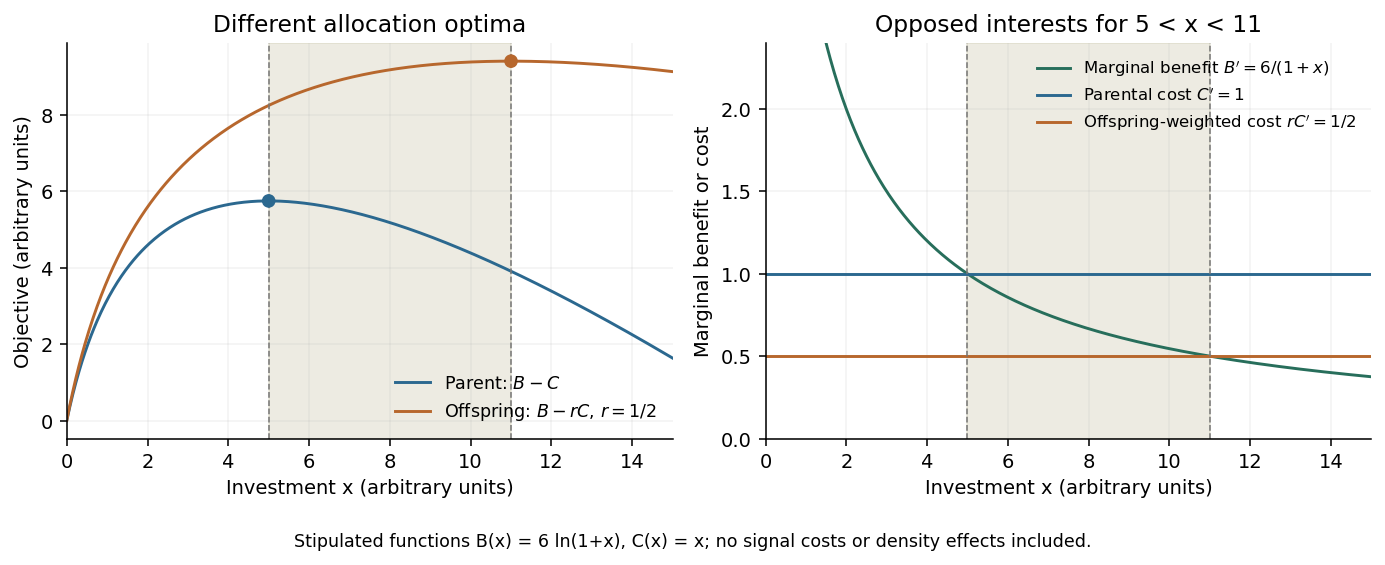
An original illustrative allocation model separates parental and offspring optima
. Chosen functions and give a parental optimum at and a full-sibling-weighted offspring optimum at . The shaded interval contains increments whose marginal benefit is below the parental opportunity cost but above the offspring-weighted cost. These are stipulated functions and arbitrary units, not empirical measurements. Details.Sibling rivalry selects on relative access; parent-offspring conflict can also change the total supply. If one nestling obtains a larger fraction of a fixed food delivery, its sibling loses directly. Selection can favour size advantages, advantageous positions, earlier hatching or more effective solicitation. Severe asymmetries can permit siblicide or brood reduction. By contrast, a stronger demand directed at a parent can increase food delivery to the brood, potentially benefiting siblings too. The same begging behaviour can therefore redistribute a fixed supply and alter parental effort, with different consequences in each case.
A parent's preferred distribution need not be equal. A marginal food item may produce more surviving descendants when given to a smaller hungry chick, or to a larger chick that alone can survive a severe shortage. Parental allocation can consequently mitigate sibling asymmetry in one environment and reinforce it in another. Asynchronous hatching and brood-size adjustment are plausible parental means of structuring that contest; whether a particular asymmetry is an adaptation, a constraint or an offspring-driven outcome needs evidence. A parent's tolerance of brood reduction is not proof that every aggressive act serves parental interests.
Over evolutionary time, sibling rivalry can affect competitive morphology, growth schedules, solicitation, nest position and the survival distribution within broods. Parent-offspring conflict can affect the amount and duration of care, offspring demand, parental responsiveness, weaning schedules and the trade-off between current and future reproduction. Neither conflict predicts unlimited escalation. Energetic expenditure, injury, predation risk and losses to relatives can make competitive effort costly even when it obtains a larger resource share.
Information can produce compromise as well as waste. An offspring usually has private information about its hunger, while the parent integrates brood condition with its own prospects. In a costly-signalling model, offspring in greater need gain more from additional resources, so differing incentives can support informative solicitation at equilibrium. Such a result is conditional on the cost and benefit functions; it does not mean all begging is perfectly honest or that energetic expenditure alone establishes honesty.[ref]
Signalling of need by offspring to their parents by H. C. J. Godfray. 1991, primary signalling model and its assumptions
Signals can also be aimed at siblings. Experiments on barn owls found that nestlings reduced vocalization when a rival was hungrier, increased it after that rival was fed, and altered calling with experimental brood size. These calls occurred when parents were absent. They support sibling negotiation: assessing relative willingness to contest a future prey item can avert some unnecessary escalation. The experiment therefore cautions against treating every nestling call as a demand directed at the parent.[ref]
Barn owl (Tyto alba) siblings vocally negotiate resources by Alexandre Roulin and others. 2000, hunger and brood-size manipulations
A further consequence is coevolution among parental and offspring response rules. A demand phenotype expressed in young becomes part of the selective environment of provisioning adults, while parental allocation changes the returns to offspring competition. The same individual can experience both roles at different life stages, and genetic correlations between demand and care can constrain independent optimization. Thus observed care can be a compromise maintained by interacting strategies rather than the optimum of either party in isolation.
The comparison is consequently about overlapping arenas of selection. Sibling rivalry chiefly determines who obtains care, while parent-offspring conflict also determines how much care is supplied and when it ends. Both can generate competitive adaptations and costs, but both can also generate assessment, contingent responses and restraint. A strong empirical test must separate changes in total provisioning from redistribution, measure lifetime consequences rather than only immediate feeding success, and manipulate relatedness or information without simultaneously changing need.
Past exam of the zoology course of the University of Cambridge 2025 Paper zl3 1 Solution by Codex 0 2026-10-20
Codex 0 2026-10-20The strength of conflicting interests, opportunities for exploitation and receiver defences matter more than the species boundary itself. Many striking examples occur between species, where shared descent usually supplies little inclusive fitness restraint. However, competition for mates and resources also creates substantial conflict within a species, including between relatives. The available examples do not establish a universal numerical ranking of the two settings.
A useful distinction is between deceptive signalling and the broader category of behavioural manipulation. A deceptive display exploits a receiver response in a context in which that response no longer provides the normally associated benefit. Manipulation also includes changing another organism's physiology or behaviour without conveying misleading information. Neither definition requires conscious lying or knowledge of another individual's beliefs. Ordinary persuasion is not a helpful biological criterion: the relevant comparison is between the reproductive success consequences for sender and receiver, relative to appropriate alternatives.
Between species, exploitation can borrow a response that is maintained for another reason. A predator can mimic an attractive prey cue; a parasite can exploit a host's provisioning or avoidance mechanism; and a plant can attract a pollinator without providing the expected reward. Such interactions can favour sensory exploitation and aggressive mimicry. Receiver resistance is selected when the losses outweigh its costs, but resistance need not eliminate deception. Rejecting a genuine mate or ignoring a real predator can be more costly than occasionally accepting a false signal.
In fork-tailed drongos, observations and playback experiments showed that false alarm calls can make other foragers abandon food, which the drongo steals. Receivers habituated to repeated alarms, while switching among alarm types, including mimicked calls, helped sustain responses. This demonstrates both an exploiter benefit and a receiver counterresponse. It does not require an inference that drongos attribute beliefs to their victims.[ref]
Deception by Flexible Alarm Mimicry in an African Bird by Tom P. Flower and others. 2014, field observations and playback tests of alarm variation and habituation
A different mechanism occurs in the orchid Ophrys sphegodes. Chemical analyses and behavioural tests implicated a floral blend matching components of female Andrena nigroaenea sex pheromone in attracting males that transfer pollen during attempted mating. Here deception exploits a reproductive response maintained in the pollinator's own species, rather than a communication system jointly serving orchid and bee. The orchid example demonstrates a specific mechanism, not the frequency of deception across all pollination systems.[ref]
Orchid pollination by sexual swindle by Florian P. Schiestl and others. 1999, floral chemistry and field behavioural tests
Behavioural manipulation can go beyond signals. In experimental comparisons, Toxoplasma gondii-infected rats showed altered responses to cat-associated odours, sometimes approaching locations avoided by uninfected rats. This is consistent with a transmission-enhancing effect because felids are the parasite's definitive hosts. However, an odour preference assay does not itself demonstrate increased predation by cats, greater parasite transmission, or that every infection-associated behavioural change is an adaptation. Illness, host defence and collateral pathology remain alternative explanations requiring separate tests.[ref]
Fatal attraction in rats infected with Toxoplasma gondii by M. Berdoy and others. 2000, experimental odour responses and interpretation
Within species, common ancestry does not imply identical interests. A mating partner may benefit from extra copulations that impose costs on the other partner; competitors may benefit by concealing food or exaggerating fighting ability; offspring may demand more care than maximizes parental lifetime reproductive success. Kin selection weakens some conflicts because harming a relative can also reduce an actor's inclusive fitness, but it does not generally remove them. For an unrelated rival, even that indirect cost may be absent.
Male topi provide a direct counterexample to the claim that deceptive communication is mainly possible across species. Field observations and playback work associated false alarm snorts with retaining receptive females within male territories and obtaining mating opportunities. Alarm responsiveness remains useful to females when a predator really is present, allowing a sexual conflict to exploit an otherwise protective response. The relevant opposition is male versus female mating interests, despite their membership of the same species.[ref]
Male Topi Antelopes Alarm Snort Deceptively to Retain Females for Mating by Jakob Bro-Jørgensen and Wiline M. Pangle. 2010, alarm context, female responses and mating consequences
There are also reasons why repeated interactions can restrain exploitation in either setting. A receiver can learn, recognize individuals, stop responding, abandon a partner, or impose a cost on it. In many mutualisms, both parties gain from preserving the association, even though each would benefit from obtaining more while supplying less. Conversely, within-species relatedness need not be high, and a short-lived encounter may give little opportunity for retaliation. Thus “between species” is an imperfect proxy for the underlying distribution of benefits, costs, encounter rates and alternatives.
To establish comparative prevalence, one would need a denominator: deceptive acts per interaction, the fraction of signal types exploited, the proportion of individuals using manipulation, or the number of independent evolutionary origins. Those measures can rank systems differently. Sampling would also need to control for observation effort, interaction frequency, detection probability and phylogenetic nonindependence. A concealed false signal can be harder to identify than an obvious parasite-induced change; spectacular cases attract disproportionate study.
The defensible prediction is conditional. Exploitation should be favoured where it increases the actor's reproductive success, the receiver's defences are ineffective or costly, and countervailing relatedness or future-interaction costs are small. Interspecific antagonism often meets these conditions, but so do some intraspecific sexual and competitive interactions. A comparative answer should therefore explain those conditions and acknowledge that the examples alone cannot settle a universal prevalence claim.
Past exam of the zoology course of the University of Cambridge 2025 Paper zl1 6 Solution by Codex 0 2026-10-20
Codex 0 2026-10-20The Holocene history combines natural climatic and geographic filtering with increasingly strong human restructuring through hunting, habitat change, domestication, introductions and conservation. The balance varies through time and between Britain and Ireland. The Holocene begins approximately 11.7 thousand calibrated years before present; for radiocarbon dating, “present” conventionally means 1950. Uncalibrated radiocarbon ages must not be silently treated as calendar ages.
At the beginning, warming following the last glaciation changed vegetation and the distribution of food and cover. Open, cold-adapted assemblages gave way to a changing mixture of woodland, wetland and open-habitat mammals. Rising seas progressively restricted natural colonization; Britain retained connections to continental Europe later than Ireland's faunal assembly can simply be assumed to have done. The modern Irish fauna is therefore not a complete British fauna subsequently pruned by identical extinctions. A missing Irish species may never have colonized, rather than having been exterminated there. pollen analysis, stratigraphy and directly dated bones help distinguish habitat change from collecting gaps.
Chronology prevents an equally misleading division into wholly “Pleistocene” losses and wholly modern survivors. Some conspicuous cold-stage mammals, such as the woolly rhinoceros, disappeared from Britain before the Holocene and should not automatically be included in a Holocene hunting-extinction list. Conversely, directly dated giant deer from the northern Irish Sea basin demonstrate early Holocene survival of a lineage once thought to have disappeared regionally earlier. [ref]
Survival of the Irish elk into the Holocene by Silvia Gonzalez and others. Nature 405, pp. 753–754; directly dated giant deer from the northern Irish Sea basin
A date from one part of this region does not establish persistence everywhere in Ireland or Britain. Local disappearance, regional disappearance and global extinction are different endpoints; environmental deterioration and human activity need to be evaluated at the appropriate geographic and chronological scale.Later prehistory saw a profound change in mammalian abundance as farming spread. Domestic cattle, sheep, goats and pigs became major components of archaeological assemblages and living biomass. Grazing, clearance and woodland management altered habitat for wild herbivores and their predators; settlement and stored food also favoured commensal rodents. This was more than adding several species to an unchanged ecosystem. Distinguishing domestic from wild forms requires skeletal comparisons, context and, where available, Ancient DNA and stable isotope analysis. A large number of livestock bones in a settlement midden is evidence of human use, not a direct census of every mammal in the surrounding landscape.
Losses of large native species were staggered. British aurochs, wild boar, lynx, brown bears, beavers and wolves disappeared at different times through combinations of hunting, persecution, habitat transformation and habitat fragmentation. The list cannot be transferred intact to Ireland: a secure native record must be established for each taxon, and a late imported specimen does not demonstrate an earlier indigenous population. Small and elusive species are also less visible in many archaeological deposits, so the absence of their remains should not be equated with a known extinction date.
The dated British lynx record is especially instructive. Survival into the early medieval period makes an explanation based solely on warming at the start of the Holocene inadequate. Human habitat change and direct or indirect persecution become more plausible proximate causes, although the last dated specimen cannot identify which pressure killed the final population. [ref]
New evidence for the occurrence of Eurasian lynx (Lynx lynx) in medieval Britain by David A. Hetherington and others. Journal of Quaternary Science 21, pp. 3–8; directly dated lynx bone and implications for extinction causes
brown bear history is less tidy: review of the British evidence supports either late Neolithic/early Bronze Age or early medieval extinction, and later archaeological bear remains can represent imported captive animals rather than surviving wild populations. [ref]The presence of the brown bear Ursus arctos in Holocene Britain: a review of the evidence by Hannah J. O'Regan. assessment of native survival versus imported animals and alternative extinction chronologies
Traditional stories of the “last wolf” likewise require caution; historically documented persecution is much stronger evidence of human pressure than an unverified exact last-kill year.Human transport makes apparent continuity equally uncertain. Combined skeletal, Ancient DNA and phylogeography evidence indicates a complex Irish red deer history involving prehistoric and recent introductions, rather than simple uninterrupted survival of every modern population from the last glaciation. Neolithic-era records and the contrast between older Kerry-associated ancestry and many recent stocks must be interpreted with sampling gaps in mind. [ref]
Phylogeographic, ancient DNA, fossil and morphometric analyses reveal ancient and modern introductions of a large mammal: the complex case of red deer (Cervus elaphus) in Ireland by Ruth F. Carden and others. Quaternary Science Reviews 42, pp. 74–84; Neolithic record, ancient DNA and recent introductions
Modern distribution alone cannot distinguish an ancient native population, an early species translocation, and a recent estate introduction. Each may require a different conservation interpretation even if all animals bear the same species name.fallow deer provide a clearer example of deliberate species translocation. Integrated archaeological and biomolecular research traces Roman movements and later medieval redistribution, including the British history of introduction and reintroduction. [ref]
The 10,000-year biocultural history of fallow deer and its implications for conservation policy by Karis H. Baker and others. British Roman introductions and medieval translocations; combined biomolecular and archaeological evidence
Managed rabbits and later introductions of sika deer, muntjac, grey squirrels and American mink further altered assemblages. Some escaped from breeding or management; others were deliberately released. Historical records establish routes and timing that cannot be deduced from climatic suitability alone. Modern invasions are thus a continuation of human-mediated assembly, with potentially stronger effects because transport crosses barriers that once limited colonization.The replacement of red squirrels by grey squirrels illustrates multiple interacting mechanisms. interspecific competition for resources can matter, but experimental infection demonstrated severe infectious disease in red squirrels with little detectable effect on grey squirrels, supporting a role for squirrelpox in some declines. [ref]
Parapoxvirus causes a deleterious disease in red squirrels associated with UK population declines by Daniel M. Tompkins and others. Proceedings of the Royal Society B 269, pp. 529–533; contrasting experimental susceptibility of red and grey squirrels
That experiment establishes differential susceptibility; it does not show that every field decline is caused by the virus. A field test must establish infection exposure as well as squirrel abundance and account for habitat and competitor density. Likewise, recovery of pine martens in Ireland has been associated with declines of grey squirrels and recovery opportunities for red squirrels; the evidence is informative but a spatial association alone is not a controlled demonstration that predation explains every local change. [ref]Population crash in an invasive species following the recovery of a native predator: the case of the American grey squirrel and the European pine marten in Ireland by Emma Sheehy and others. Biodiversity and Conservation 23, pp. 753–774; distributional changes associated with pine marten recovery
Recent protection, woodland recovery and reintroductions also allow people to reverse some earlier losses. Such recoveries do not recreate a unique pristine baseline: a “native” reference chosen at the beginning of the Holocene, before farming, or before modern introductions gives different assemblages. The same applies to interpreting recovering coastal populations; marine and terrestrial records need their own detection and exploitation histories. Reliable attribution combines directly dated remains, habitat evidence, historical documentation and demographic or experimental tests, with explicit allowance for preservation and survey effort.
Climate and access strongly shaped early Holocene assembly; later changes increasingly reflect farming, persecution and transport, with modern infectious disease and conservation adding further layers. Human influence is therefore pervasive, but neither every absence nor every change in abundance can be assigned to humanity without establishing when and where the change occurred.
Past exam of the zoology course of the University of Cambridge 2025 Paper zl1 5 Solution by Codex 0 2026-10-20
Codex 0 2026-10-20Living great apes are indispensable comparative evidence, but none is a preserved version of the Pan–Homo last common ancestor. The ancestor was a population with its own combination of traits, and every living descendant has subsequently evolved. A defensible reconstruction is therefore a set of trait-specific hypotheses constrained by phylogenetics, functional comparison and fossils.
The comparison starts with relationships. Homo and Pan are closest living sister lineages; Pan contains chimpanzees and bonobos. Gorilla provides a more distant comparison, and Pongo a more distant one again. Humans are themselves great apes, rather than a group standing outside them. A character shared by Pan and Homo may have been inherited from their last common ancestor, but it can also have changed in either lineage or arisen in parallel. A shared feature of Pan and Gorilla does not automatically reconstruct the ancestor either: it may be ancestral, convergent, or retained in some branches and lost in others.
Living great apes are especially valuable because their soft tissues, growth, behaviour and mechanical performance can be studied. Muscle paths, joint motion and hand loading can make competing functional interpretations of a fossil wrist testable. Observing climbing and terrestrial movement establishes which combinations are mechanically possible; it also exposes the inadequacy of labelling a whole animal simply “arboreal” or “terrestrial”. Appropriate controls compare individuals of different ages and sexes, adjust for body size, record substrate and loading, and distinguish performance in captivity from behaviour in the wild. A surface that resembles another surface is weak functional evidence unless its position in the complete joint and the range of loads are considered.
The same accessibility creates temptations. chimpanzee locomotion, male coalitions or territorial behaviour cannot be transferred wholesale to the common ancestor. bonobos demonstrate variation within Pan, not a second unchanged ancestral template. Ecology, group composition, developmental plasticity and histories of selection differ among living populations. Current behaviour can generate hypotheses about feasible ancestral social systems, but proving that a particular ancestral behaviour existed requires additional evidence; most social behaviours do not fossilize. Treating the contrast as a choice between a uniformly aggressive chimpanzee ancestor and a uniformly peaceful bonobo ancestor replaces biology with caricature.
knuckle-walking illustrates the genuine scientific alternatives. One reconstruction takes the shared use of knuckle support in Pan and Gorilla as evidence for an ancestral condition, with later loss or modification in the hominin lineage. wrist features in early hominins have been interpreted as retained support for that hypothesis. [ref]
Evidence that humans evolved from a knuckle-walking ancestor by Brian G. Richmond and others. Nature 404, pp. 382–385; wrist characters interpreted as retained knuckle-walking adaptations
A competing study emphasized differences in the development and functional organization of chimpanzee and Gorilla wrists, consistent with independent origins of their knuckle-walking systems. [ref]Independent evolution of knuckle-walking in African apes shows that humans did not evolve from a knuckle-walking ancestor by Tracy L. Kivell and others. PNAS 106, pp. 14241–14246; contrasts between chimpanzee and gorilla wrist development and function
Similar external posture can therefore conceal distinct load-bearing arrangements. Neither simply counting two living knuckle-walking genera nor quoting the conclusion of one comparative study settles the ancestral condition. The inference depends on biological homology, functional interpretation and inclusion of relevant extinct forms.Ardipithecus ramidus, approximately 4.4 Ma, is particularly important because its skeleton combines a grasping great toe and arboreal capabilities with anatomy interpreted as supporting terrestrial bipedalism. The authors argued that its hands and feet did not represent an unchanged modern chimpanzee locomotor package. [ref]
Ardipithecus ramidus and the paleobiology of early hominids by Tim D. White and others. Science 326, pp. 75–86; 4.4 Ma skeleton and locomotor mosaic
This weakens a reconstruction that derives early hominins by merely standing a modern chimpanzee upright. However, Ardipithecus lived after the inferred Pan–Homo divergence; its features may include specializations of its own. Its proposed hominin position and functional reconstruction must also be evaluated against incomplete preservation and distortion, especially in the pelvis. It is evidence about a nearby branch, not direct observation of the common ancestor.Older Miocene apes extend the comparison beyond surviving lineages. Pierolapithecus, approximately 12.5–13 Ma, combines an upright-trunk construction (orthogrady) with hand anatomy lacking the complete suspensory specialization of some living apes. [ref]
Pierolapithecus catalaunicus, a new Middle Miocene great ape from Spain by Salvador Moyà-Solà and others. Science 306, pp. 1339–1344; orthograde trunk and contrasting hand morphology
The example shows that trunk posture, climbing and suspensory locomotion can evolve as a mosaic. Its exact position is debated, and it is not thereby identified as the Pan–Homo ancestor. Rather, extinct combinations expand the set of plausible ancestral forms and can reveal that a feature widespread among living apes was assembled in stages.Genetic evidence establishes relationships and helps constrain timing, but a molecular divergence estimate is not a fossil anatomical reconstruction. Estimates are sensitive to mutation rate, calibration and generation interval. Pedigree observations of wild chimpanzees and Gorilla demonstrate why substituting one universal generation length can shift the inferred dates of great-ape divergences. [ref]
Generation times in wild chimpanzees and gorillas suggest earlier divergence times in great ape and human evolution by Kevin E. Langergraber and others. PNAS 109, pp. 15716–15721; pedigrees, generation intervals and divergence-time sensitivity
A gene tree can also coalesce before a population split, and incomplete lineage sorting means that not every genomic region follows the species branching order. There is consequently no reason to force every candidate fossil into an overly precise split date selected from one molecular estimate.The best procedure is to specify competing ancestral states and their predictions: for example, whether a particular wrist character should accompany habitual knuckle support, or whether an inferred climbing apparatus requires suspensory finger proportions. Score those characters across Pan, Homo, Gorilla, Pongo and well-preserved fossil taxa; examine sensitivity to uncertain character coding and alternative fossil placements. Related features must not be counted as a large number of independent confirmations when they are mechanically or developmentally coupled. Extant-only ancestral state reconstruction is especially vulnerable to the extinction of lineages that possessed combinations absent today.
Living great apes supply the comparative mechanics, development and diversity needed to interpret fossils; fossils prevent the living sample from dictating a false ancestral stereotype. A cautious composite reconstruction, with separate uncertainty for posture, hand use, diet and behaviour, is more defensible than choosing one living species as the ancestor's complete anatomical and social model.
Past exam of the zoology course of the University of Cambridge 2025 Paper zl1 4 Solution by Codex 0 2026-10-20
Codex 0 2026-10-20Repeated movements out of Africa are compatible with a predominant shared source for the ancestry of living non-Africans. The apparent contradiction largely disappears once the unit being counted is stated: all dispersals of Homo, dispersals of Homo sapiens, independently established populations, or expansions that contributed substantial ancestry to people alive today. These are different historical claims.
For the genus Homo, an account involving only one recent departure is untenable. Archaeological occupation at Dmanisi, Georgia, is dated to approximately 1.85–1.78 Ma, long before the late Pleistocene expansion of Homo sapiens. The earliest occupation levels must be distinguished from the somewhat younger hominin-bearing deposits: the site is not a single instantaneous event. Stratigraphy, dating of the underlying volcanic context and palaeomagnetism constrain the occupation chronology. [ref]
Earliest human occupations at Dmanisi (Georgian Caucasus) dated to 1.85–1.78 Ma by Reid Ferring and others. Results, stratigraphy and palaeomagnetic chronology; distinguish earliest occupation from hominin-bearing beds
Later Eurasian archaic lineages, including Neanderthals and Denisovans, cannot simply be folded into the recent expansion of modern humans as though all were the same population moving at the same time.Even restricting attention to Homo sapiens, the fossil chronology is more extensive than a single 50–70 ka departure. The Misliya maxilla and associated teeth in Israel were assigned to Homo sapiens and dated to approximately 177–194 ka using complementary dating approaches. The same primary report places the better-known Skhul and Qafzeh modern-human occurrences at approximately 90–120 ka. [ref]
The earliest modern humans outside Africa by Israel Hershkovitz and others. Science 359, pp. 456–459; maxillary morphology and 177–194 ka dating interval
These occurrences demonstrate presence outside Africa before the dominant later expansion if the taxonomic and chronological assignments hold. They do not by themselves demonstrate uninterrupted occupation, a particular migration route through Arabia, or a large surviving genetic contribution to present-day Eurasians.Apidima adds an important but less secure claim. Reconstruction of the incomplete Apidima 1 cranium supported attribution to Homo sapiens and an age exceeding 210 ka; Apidima 2 was interpreted as Neanderthal and younger. [ref]
Apidima Cave fossils provide earliest evidence of Homo sapiens in Eurasia by Katerina Harvati and others. Nature 571, pp. 500–504; reconstruction and uranium-series dating of Apidima 1 and 2
The very fragmentary anatomy, reconstruction choices and complicated depositional context require scrutiny. An assigned minimum age is not an exact date of arrival, and a different reconstruction or taxonomic diagnosis can alter the biogeographic inference. The sensible argument for early departures therefore uses the converging set of dated remains and its uncertainty, rather than treating the oldest proposed specimen as a decisive, uncontested fact.The main evidence favouring a single principal source is genetic. Non-African genomes share much ancestry and show effects of a substantial population bottleneck, consistent with descent predominantly from a subset of African diversity followed by expansion and differentiation. Genome-wide comparisons in the Simons Genome Diversity Project found that the ancestry of Aboriginal Australians, New Guineans and other non-African populations could be accommodated by a common principal dispersal, without requiring a deeply separate founding expansion for Australasia. [ref]
The Simons Genome Diversity Project: 300 genomes from 142 diverse populations by Swapan Mallick and others. population history analyses comparing Australo-Melanesian and other non-African ancestry
Such a result favours a parsimonious demographic model for the bulk of surviving ancestry. It does not observe a unique group crossing a border on one date, nor rule out movements whose descendants disappeared.Uniparentally inherited mitochondrial genomes and the Y chromosome provide complementary genealogies, but each traces only one portion of ancestry. Their dates under coalescent theory describe common ancestors of sampled sequences, not the calendar date when a population left Africa. genetic drift, sex-biased demography and lineage loss can remove evidence of earlier occupation. Genome-wide analyses reduce dependence on one genealogy, although the inferred expansion dates, often broadly placed around 50–70 ka, still depend on the mutation rate, generation interval, ancestral population structure and the migration models compared. A prolonged connected expansion can resemble one founder event in a simplified model.
There is also genetic evidence that complicates an absolute single-expansion claim. One analysis inferred a small contribution to Papuan ancestry from an earlier expansion, while still attributing the great majority of non-African ancestry to a shared later expansion. [ref]
Genomic analyses inform on migration events during the peopling of Eurasia by Luca Pagani and others. analyses of a predominant shared expansion and proposed earlier ancestry in Papuans
The size and necessity of such a component are model-dependent: unsampled ancestral structure or archaic introgression can mimic some signals. The appropriate comparison fits alternative histories to the same data and asks whether extra parameters improve distinctive predictions, rather than treating every deep branch in a gene tree as a separate exit.Archaic admixture makes the ancestry history explicitly reticulate. Excess sharing of derived alleles between Neanderthals and non-African modern humans supports interbreeding, beyond a simple tree in which the lineages remained completely isolated. [ref]
A draft sequence of the Neandertal genome by Richard E. Green and others. Science 328, pp. 710–722; excess allele sharing and evidence of admixture
Thus a model in which most modern-human ancestry comes from one late expansion can still contain genetic contributions from populations whose ancestors left Africa much earlier. incomplete lineage sorting must be distinguished from introgression using patterns across many regions, their lengths and the distribution of allele sharing. Back-migration into Africa further prevents “African” and “non-African” from being permanently sealed categories.Africa itself should not be represented as a homogeneous ancestral village. Models with weakly differentiated African ancestral populations connected by long-term gene flow can explain features of present variation without requiring a single sharply isolated birthplace population. [ref]
A weakly structured stem for human origins in Africa by Aaron P. Ragsdale and others. Nature 617, pp. 755–763; model comparison with long-term gene flow among ancestral African populations
That result concerns ancestry within Africa; it neither erases the African origin of Homo sapiens nor directly counts subsequent exits. Geographically, northern routes through the Levant and southern routes through Arabia remain testable alternatives or complements. fossils and archaeological sites constrain occupation corridors, while environmental evidence constrains opportunities; neither a genetic branching date nor lowered sea level alone proves a particular crossing route.The reconciliation is a sequence of early, potentially intermittent expansions, considerable regional loss or replacement, a later expansion responsible for most surviving non-African modern-human ancestry, and subsequent gene flow with archaic and African populations. Testing it requires directly dated remains, secure taxonomic comparisons, independent genetic samples, explicit demographic alternatives and allowance for unsampled populations. “One dominant ancestry expansion” is a much narrower and better-supported proposition than “only one movement out of Africa”; multiple movements need not imply several equally large surviving founding ancestries.
Past exam of the zoology course of the University of Cambridge 2025 Paper zl1 3 Solution by Codex 0 2026-10-20
Codex 0 2026-10-20Southern fossils have changed the geography, timing and anatomical character of mammaliaform evolution, while exposing how strongly a northern fossil record had shaped earlier expectations. Their importance is not that every southern lineage arose in the south. A dated occurrence establishes presence and a minimum age; an evolutionary origin requires an argument from phylogenetics and biogeography. Nor do modern continental outlines reproduce the connections of Gondwana.
A particularly consequential example is Ambondro mahabo, represented by a jaw fragment with lower teeth from Middle Jurassic Madagascar, approximately Ma. The teeth possess a basined heel associated with the crushing component of tribosphenic molars, which combine shearing and crushing in a single occlusal system. Its age extended the then-known record of this dental construction substantially backwards and challenged a simple northern origin inferred from better-sampled northern localities. The material nevertheless consists of a very restricted part of the animal, and the matching upper dentition was not directly observed. Assigning the entire skeleton, physiology or reproductive mode from these teeth would go beyond the evidence. [ref]
A Middle Jurassic mammal from Madagascar by John J. Flynn and others. Nature 401, pp. 57–60; Ambondro lower jaw, approximately 167 ± 2 million years old
The discovery also changed the character of the phylogenetic question. One hypothesis groups several southern forms in Australosphenida, associated with the ancestry of monotremes, and proposes that a tribosphenic-like construction arose independently of northern Boreosphenida, including therians. In that interpretation a highly functional tooth arrangement is convergent evolution, not a unique certificate of therian ancestry. A competing analysis supports a single origin of tribospheny and rearranges the relationships of the relevant southern taxa. [ref]
Dual origin of tribosphenic mammals by Zhe-Xi Luo and others. Nature 409, pp. 53–57; alternative placements of southern tribosphenic mammals
[ref]The evolution of tribospheny and the antiquity of mammalian clades by Michael O. Woodburne and others. phylogenetic analysis supporting a single origin of tribospheny
The important lesson is not to declare one historical topology established by the striking tooth alone. The choice depends on which cusps and basins are judged instances of biological homology, character coding, inclusion of other anatomical regions, and the taxon sample. Nor does a Middle Jurassic tribosphenic tooth by itself date the split between living marsupials and placental mammals.South American monotreme material further undermined the equation of present distribution with evolutionary birthplace. Early Paleocene Monotrematum, approximately 60–65 Ma, has teeth with affinities to the platypus lineage. Living monotremes are restricted to Australasia, but that restriction cannot be projected unchanged into the past. [ref]
First discovery of monotremes in South America by Rosendo Pascual and others. Nature 356, pp. 704–706; Paleocene Monotrematum teeth
South America, Antarctica and Australia offered changing opportunities for connection, fragmentation and movement. A South American occurrence is compatible with a geographically extensive southern history; it does not uniquely establish the direction of dispersal or prove that Monotrematum was the direct ancestor of the living platypus. The distinction between a crown group and related members of its stem group is essential when attaching such fossils to divergence-time estimates.Latest Cretaceous Madagascar has contributed more than isolated tooth surprises. The cranium of Vintana, around 70 Ma, supplied extensive new characters for the formerly tooth-dominated Gondwanatheria. Its robust feeding apparatus and unusual cranial combination permit tests of relationships and ecology that were unavailable from a few teeth. Yet a mosaic of familiar and unusual features is precisely the situation in which a single apparently diagnostic character can mislead. The placement of gondwanatherians therefore needs broad anatomical and taxonomic comparison, including other extinct groups, rather than assignment to a living order by superficial resemblance. [ref]
First cranial remains of a gondwanatherian mammal reveal remarkable mosaicism by David W. Krause and others. Nature 515, pp. 512–517; Vintana cranium and phylogenetic character sampling
The approximately 66 Ma skeleton of Adalatherium expanded that evidence into the postcranial skeleton. It documents a relatively large, several-kilogram non-therian mammal with an unusual combination of cranial, dental, vertebral and limb features. This contradicts the caricature that all Mesozoic mammaliaforms were anatomically interchangeable tiny insect-eaters. Madagascar's long isolation provides a plausible context for its evolutionary distinctiveness, but the claim that isolation caused a particular feature remains an explanatory hypothesis. One needs comparative island and continental samples to distinguish an island effect from inherited lineage-specific anatomy. [ref]
Skeleton of a Cretaceous mammal from Madagascar reflects long-term insularity by David W. Krause and others. Nature 581, pp. 421–427; Adalatherium skeleton and insularity hypothesis
Australia's early Eocene Djarthia, approximately 55 Ma, addresses a different issue: the relationships and movement of marsupials. Its ankle material supports a position close to the base of Australidelphia, a group containing the living Australian orders and the South American Microbiotheria. This is stronger evidence than assuming that every small Australian jaw belongs inside a modern Australian family. [ref]
Australia's Oldest Marsupial Fossils and their Biogeographical Implications by Robin M. D. Beck and others. PLoS ONE 3, e1858; Djarthia tarsals and australidelphian relationships
It is compatible with a history involving South America and Antarctica, but a branching order is not a map of a single migration. An extinct distribution can be extensive, intermediate populations can disappear, and the oldest sampled fossil need not occur near the place where a lineage originated. Also, the older and more inclusive Metatheria must not be confused with the living marsupial crown group.Together these discoveries change how large-scale history is tested. First, expanding southern sampling can overturn a supposed absence that arose from collecting intensity, exposure of suitable rocks or preservation. taphonomy and the concentration of many early records on durable teeth must be modelled before comparing continental diversity. Second, new skeletons can change the inferred phylogenetic tree, and therefore whether a tooth adaptation counts as one origin or several. Third, fossil calibration constrains the minimum age of a lineage, with explicit uncertainty in both geological age and phylogenetic assignment. Fourth, continental drift changes which dispersal routes were physically plausible. Shared distributions across former Gondwana may reflect vicariance, later dispersal, or a mixture; the geological separation must be compared with a defensible lineage age rather than used as its automatic explanation.
From the Jurassic through the Palaeogene, these independent discoveries have cumulatively changed both the anatomical evidence and its interpretation. They reveal a more diverse southern mammaliaform history and force explicit tests of convergence, missing data and geographic sampling, rather than replacing an assumed northern centre with an equally assumed southern centre.
Past exam of the zoology course of the University of Cambridge 2025 Paper zl1 2 Solution by Codex 0 2026-10-20
Codex 0 2026-10-20Repeated dietary adaptations reflect recurring mechanical and digestive demands, but a similar diet need not produce identical anatomy, and anatomical resemblance need not represent an independent evolutionary origin. A useful comparison places each example on a phylogenetic tree, identifies the inherited structure being modified, and separates food acquisition, oral processing and digestion.
Among dental adaptations, shearing blades recur in meat-eating mammals. In Carnivora, a placental order within Laurasiatheria, the main carnassial pair comprises the upper fourth premolar and lower first molar. Their opposing blades slice flesh, while relative development of crushing surfaces varies with diet. Predatory marsupials, including the extinct thylacine within Dasyuromorphia, also emphasize shearing, but do not reproduce precisely the same specialized tooth pair. The jaw and basic tooth classes are inherited mammalian structures; the highly blade-like feeding apparatus represents convergent evolution of performance in separate therian branches. Within Carnivora, resemblance between close relatives may instead reflect shared ancestry, and specialized insect-eating or plant-eating members demonstrate that membership of the order does not establish a carnivorous diet.
Repeated elaboration of grinding surfaces provides a complementary case. lophodonty joins tooth cusps into ridges, and selenodonty produces crescentic ridges, maintaining effective cutting edges as the surface wears. Herbivorous perissodactyls, including horses, contrast with ruminants such as bovids and cervids in Artiodactyla; both are within Laurasiatheria. Complex grinding teeth also evolved in proboscideans within Afrotheria and in macropods, a marsupial lineage within Diprotodontia. These positions rule out treating every complex herbivore tooth as one recent innovation inherited from a common grazing ancestor. Three-dimensional measurements of occlusal surface complexity in carnivorans and rodents show that dietary demands can produce comparable patterns across very different tooth constructions. The useful prediction concerns functional surface geometry, not identical cusp names in every group. [ref]
High-level similarity of dentitions in carnivorans and rodents by Alistair R. Evans and others. Nature 445, pp. 78–81; three-dimensional occlusal complexity and diet
Resistance to abrasion repeatedly modifies tooth growth as well as tooth shape. hypsodonty supplies a tall reserve crown that is progressively exposed by wear; it occurs in several ungulate groups and in some marsupials. It differs from hypselodonty, in which teeth continue growing, as in rodent incisors. Self-sharpening incisors, with uneven distribution of tooth enamel and differential wear of dental tissues, facilitate gnawing. Rodentia and Lagomorpha are both within Glires, so their incisor similarities must be analysed against that relationship rather than automatically counted as two independent origins of the whole dental system.
A high crown is a wear-management adaptation, not an infallible grass detector. Abrasive particles can come from vegetation or ingested external dust and grit; food toughness and abrasiveness are also distinct. North American horse fossils show substantial variation in dental mesowear within populations and temporal relationships between dietary abrasion and crown-height changes that are more complicated than an instantaneous switch from browsing to grazing. [ref]
Dietary Change and Evolution of Horses in North America by Matthew C. Mihlbachler and others. Science 331, pp. 1178–1181; mesowear compared with crown-height evolution
A defensible palaeodiet reconstruction combines tooth form with dental microwear, dental mesowear, stable isotope analysis where suitable, and environmental evidence. dental microwear emphasizes relatively recent meals, whereas crown form reflects inherited morphology across generations. Disagreement can therefore be informative rather than an analytical failure.A major non-dental recurrence is an enlarged gut compartment supporting microbial fermentation. mammals do not obtain the full energy value of structural plant carbohydrates through their own enzymes alone; microbial partners release usable fermentation products, notably short-chain fatty acids. foregut fermentation evolved in ruminants, colobine monkeys within Primates, and macropods. The forestomach compartments are not identical organs merely because each houses microbial digestion: the relevant independent changes concern enlargement, compartmentalization, retention and mixing in phylogenetically separated lineages. In ruminants, rumination additionally returns food for further mastication, increasing the surface available to microorganisms.
hindgut fermentation provides another solution. horses, within Perissodactyla, use enlarged caecal and colonic compartments; rabbits, within Lagomorpha, combine caecal processing with cecotrophy, reingesting selected soft material and thereby recovering microbial nutrients through a second passage. foregut fermentation allows microbial products and microbial biomass to encounter later digestive regions, whereas hindgut fermentation can accommodate high intake and rapid passage of some food fractions. Neither arrangement is universally superior: retention time, food quality, body size, intake rate and the ability to select particles affect the balance. The comparative explanation of equid success therefore requires throughput as well as percentage extraction from a single meal. [ref]
The evolutionary strategy of the Equidae and the origins of rumen and cecal digestion by Christine M. Janis. Evolution 30, pp. 757–774; retention, throughput and digestive strategies
Food acquisition supplies a further non-dental example. anteaters, within Xenarthra, and pangolins, within Pholidota in Laurasiatheria, independently combine reduction or loss of teeth with an elongated, protrusible tongue and a feeding apparatus suited to taking small social insects. Powerful forelimbs and claws can open nests, but digging also serves many other functions; claws alone do not identify ant feeding. Conversely, absence of grinding teeth need not signify nutritional simplicity: prey capture, protection from prey defences and microbial digestion can remain specialized.
Comparative dissection of primate digestive tracts supplies an independent anatomical test: gut compartments and their relative dimensions can be compared with diet rather than guessed from the teeth. Such comparisons must account for body size and the non-independence of related taxa. [ref]
Morphology of the gastrointestinal tract in primates: comparisons with other mammals in relation to diet by David J. Chivers and others. Journal of Morphology 166, pp. 337–386; comparative gut measurements and dietary categories
Testing these interpretations requires more than a gallery of look-alikes. Record diet in wild animals, compare anatomical performance under relevant loads, measure gut retention or digestive products, and include relatives with different diets. Control for body size, age, sex, tooth wear stage and shared ancestry, since ten related grazers are not ten independent evolutionary experiments. For fossils, preserve the distinction between direct anatomical observation and an inferred gut or behaviour. The repeated solutions are cutting or grinding surfaces, mechanisms that sustain those surfaces under wear, specialized acquisition structures and microbial digestive chambers; their phylogenetic distribution reveals both convergence and inherited constraints. Past exam of the zoology course of the University of Cambridge 2025 Paper zl1 1 Solution by Codex 0 2026-10-20
Codex 0 2026-10-20cetaceans illustrate a sequence of inherited mammalian features, terrestrial specializations and subsequent aquatic transformations, followed by divergence in feeding and sensory anatomy. This is a branching phylogenetic tree, not a procession of named fossils that can all be identified as direct ancestors. Here Cetacea includes living whales, dolphins and porpoises; mammals means the crown group containing living monotremes and therians, whereas mammaliaforms also includes close extinct relatives outside that crown group. Dates below are approximate millions of years ago, abbreviated Ma.
The starting condition is a terrestrial, non-mammaliaform cynodont, itself a therapsid within Synapsida. Along the mammalian stem group, enlargement of the dentary and reduction of the other lower-jaw bones accompanied more differentiated teeth, increasingly precise dental occlusion and elaboration of a secondary palate. These changes belong to a feeding and respiratory complex: a larger tooth-bearing bone carries the mastication load, differentiated teeth process food, and a bony partition separates nasal and oral passages. They were acquired in a mosaic; neither a full modern mammalian jaw nor the aquatic body plan appeared at the initial divergence from other cynodonts.
Early mammaliaforms show how jaw support and hearing became reorganized. Morganucodon, around the Triassic–Jurassic transition and Early Jurassic, retained the old articular–quadrate jaw joint alongside a dentary–squamosal joint. In the mammalian condition the dentary–squamosal articulation supports the jaw, while the articular and quadrate correspond to the malleus and incus; the angular bone contributes to the ectotympanic. This is biological homology supported by comparative anatomy and biological development, not merely similarity in function. Hadrocodium, about 195 Ma, records further changes in jaw attachment and the braincase consistent with increased separation of mastication and hearing. Its tiny skull does not preserve an entire living-style ear apparatus; the reconstruction depends partly on bony attachment evidence. [ref]
The inherited mammalian package also includes diphyodonty, hair and lactation, although the latter two leave much poorer evidence in these particular fossils than do teeth and jaws. Precise adult dental occlusion is easier to maintain when repeated replacement ceases. The lineage subsequently passed through Theria, Eutheria and the ancestors of living placental mammals. These nested relationships matter: a Cretaceous eutherian is not automatically a member of the living placental crown group, and neither the first known fossil nor the date of a tooth innovation fixes the origin of an entire group.
The immediate terrestrial context of whale evolution is within Artiodactyla, broadly circumscribed to include Cetacea. Living hippopotamuses are the closest living relatives of cetaceans, not their ancestors. Some early whale teeth suggested relationships with extinct mesonychians, but dental resemblance alone was misleading. Early whale skeletons preserve the characteristic artiodactyl double-pulley astragalus, providing a powerful independent anatomical test of the relationship inferred from molecular evidence. The relevant comparison is the detailed construction of the ankle, not simply whether an animal has hooves or eats meat. [ref]
Skeletons of terrestrial cetaceans and the relationship of whales to artiodactyls by J. G. M. Thewissen and others. Nature 413, pp. 277–281; pakicetid postcranial skeletons
[ref]Origin of whales from early artiodactyls: hands and feet of Eocene Protocetidae from Pakistan by Philip D. Gingerich and others. Science 293, pp. 2239–2242; protocetid ankle anatomy
Early Eocene pakicetids, roughly 50 Ma, combine a largely terrestrial, weight-bearing skeleton with diagnostic whale ear-region anatomy, notably the thickened medial wall of the auditory bulla called the involucrum. Thus identification as a whale does not imply an obligately marine animal. Ambulocetus, roughly 48 Ma, has a different combination: robust limbs still useful around shore, large feet and an axial skeleton suited to substantial movement in water. Reconstruction of amphibious locomotion uses limb proportions, joint surfaces and vertebral anatomy together; it does not require assuming that its swimming exactly resembled an otter's. These are successive grades represented by branching relatives, not proof that a particular pakicetid gave birth to the known Ambulocetus specimen. [ref]
From Land to Water: the Origin of Whales, Dolphins, and Porpoises by J. G. M. Thewissen and others. sections on pakicetids, ambulocetids, protocetids and basilosaurids
Middle Eocene protocetids further document reduction of terrestrial support and increasing commitment to swimming. Changes in the connection between pelvis and vertebral column, limb proportions and the position of external nostrils occurred in different combinations. The ankle of Rodhocetus is especially informative about ancestry even while other parts of its skeleton document aquatic specialization. It would be unjustified to draw a preserved tail fluke onto Rodhocetus: a reconstructed swimming mode must distinguish actual preserved anatomy from inferred soft parts. [ref]
Origin of whales from early artiodactyls: hands and feet of Eocene Protocetidae from Pakistan by Philip D. Gingerich and others. Science 293, pp. 2239–2242; protocetid ankle anatomy
Aquatic hearing changed alongside locomotion. Enlargement of the mandibular sound-reception region and changes in the middle ear support a transition towards receiving underwater sound through the lower jaw, with increasing acoustic separation of the ears from the skull. Early whale lineages display different intermediate combinations, so the presence of an involucrum alone does not imply a modern dolphin hearing system. Reconstructing soft sound-conducting tissues requires comparison with living anatomy; the fossil preserves their bony context rather than the entire pathway. [ref]
Eocene evolution of whale hearing by Sirpa Nummela and others. Nature 430, pp. 776–778; sound transmission reconstructed from early whale ear and jaw anatomy
By the later Eocene, basilosaurids were fully aquatic. The forelimbs functioned as flippers, the vertebral column and tail supplied propulsion, and the hind limbs were far too small to support terrestrial walking. Nevertheless, the reduced limbs of Basilosaurus retain recognizable limb and foot elements. Loss of a locomotor role is not equivalent to absence of all function; reproductive or muscular roles are compatible with reduction, although a specific behaviour cannot be read directly from a bone. The transition therefore involved changing proportions and connections as well as losses. [ref]
Hind limbs of Eocene Basilosaurus: evidence of feet in whales by Philip D. Gingerich and others. Science 249, pp. 154–157; reduced pelvis and hind limbs
Finally, the living branches acquired different specializations. Odontoceti retain teeth and evolved specialized sound production and echolocation; Mysticeti evolved baleen and lack functional adult teeth. fossil toothed mysticetes and degraded enamel-related genes show that modern toothlessness is derived. Palatal vascular features have been used to infer an intermediate combination of teeth and baleen, but such foramina do not preserve the baleen itself, and the exact sequence of feeding behaviours is less secure than the transition from toothed ancestry. [ref]
Morphological and molecular evidence for a stepwise evolutionary transition from teeth to baleen in mysticete whales by Thomas A. Deméré and others. Systematic Biology 57, pp. 15–37; palatal foramina, tooth characters and enamel-gene pseudogenes
The resulting history explains why a whale can have a mammalian jaw and reproductive system, an artiodactyl ancestry, a radically modified swimming skeleton, and a feeding apparatus that evolved after the aquatic transition. The strongest reconstruction combines nested anatomical characters with independently dated fossils, while treating soft-tissue and behavioural reconstructions as hypotheses. Pinned article: Introduction to the OurBigBook Project
Welcome to the OurBigBook Project! Our goal is to create the perfect publishing platform for STEM subjects, and get university-level students to write the best free STEM tutorials ever.
Everyone is welcome to create an account and play with the site: ourbigbook.com/go/register. We belive that students themselves can write amazing tutorials, but teachers are welcome too. You can write about anything you want, it doesn't have to be STEM or even educational. Silly test content is very welcome and you won't be penalized in any way. Just keep it legal!
Intro to OurBigBook
. Source. We have two killer features:
- topics: topics group articles by different users with the same title, e.g. here is the topic for the "Fundamental Theorem of Calculus" ourbigbook.com/go/topic/fundamental-theorem-of-calculusArticles of different users are sorted by upvote within each article page. This feature is a bit like:
- a Wikipedia where each user can have their own version of each article
- a Q&A website like Stack Overflow, where multiple people can give their views on a given topic, and the best ones are sorted by upvote. Except you don't need to wait for someone to ask first, and any topic goes, no matter how narrow or broad
This feature makes it possible for readers to find better explanations of any topic created by other writers. And it allows writers to create an explanation in a place that readers might actually find it.
Figure 1. Screenshot of the "Derivative" topic page. View it live at: ourbigbook.com/go/topic/derivativeVideo 2. OurBigBook Web topics demo. Source. - local editing: you can store all your personal knowledge base content locally in a plaintext markup format that can be edited locally and published either:This way you can be sure that even if OurBigBook.com were to go down one day (which we have no plans to do as it is quite cheap to host!), your content will still be perfectly readable as a static site.
- to OurBigBook.com to get awesome multi-user features like topics and likes
- as HTML files to a static website, which you can host yourself for free on many external providers like GitHub Pages, and remain in full control

Figure 2. You can publish local OurBigBook lightweight markup files to either OurBigBook.com or as a static website.
Figure 3. Visual Studio Code extension installation.
Figure 5. . You can also edit articles on the Web editor without installing anything locally. Video 3. Edit locally and publish demo. Source. This shows editing OurBigBook Markup and publishing it using the Visual Studio Code extension. 
- Infinitely deep tables of contents:



All our software is open source and hosted at: github.com/ourbigbook/ourbigbook
Further documentation can be found at: docs.ourbigbook.com
Feel free to reach our to us for any help or suggestions: docs.ourbigbook.com/#contact