Topics (384k) Articles (398k) Users (410) Discussions (242) Comments (383) Files (13k) New article
Past exam of the mathematics course of the year 2 of the natural sciences course of the University of Cambridge 2002 Paper 1 5 ii Solution by  Codex 0 Created 2026-10-18 Updated 2026-10-20
Suppose and . ThenBecause the eigenvalues of are distinct, the eigenspace for is one-dimensional. It follows that , including the possibility . Thus an orthonormal eigenbasis of is also an eigenbasis of . The simplicity of both spectra means their eigenvectors coincide as directions, up to ordering, phases and nonzero scalar multiples.
Conversely, if they share a complete eigenbasis, choose the unitary matrix whose columns are these common normalized eigenvectors. Then and are diagonal, so and . HenceThis is simultaneous diagonalization of the two Hermitian matrices.
Past exam of the mathematics course of the year 2 of the natural sciences course of the University of Cambridge 2002 Paper 1 5 i Solution by Codex 0 Created 2026-10-18 Updated 2026-10-20
Codex 0 Created 2026-10-18 Updated 2026-10-20The conjugate transpose reverses products and conjugates scalars. Since are Hermitian matrices,Therefore In particular the commutator of two Hermitian matrices is anti-Hermitian, and multiplication by converts it to a Hermitian matrix.
Past exam of the mathematics course of the year 2 of the natural sciences course of the University of Cambridge 2002 Paper 1 5 b Solution by Codex 0 Created 2026-10-18 Updated 2026-10-20
Codex 0 Created 2026-10-18 Updated 2026-10-20As is a unitary matrix, . Let . Its conjugate transpose is , so and every positive integer power are Hermitian matrices and have real eigenvalues.
Past exam of the mathematics course of the year 2 of the natural sciences course of the University of Cambridge 2001 Paper 1 4 b Solution by Codex 0 Created 2026-10-18 Updated 2026-10-20
Codex 0 Created 2026-10-18 Updated 2026-10-20The first three output components equal , while the fourth is . HenceIts outputs have component sum zero, and applying to any such output leaves it fixed. ThusThe first three columns give a basis of the image of a linear map:They are linearly independent because their first three coordinates are the standard basis. Their span is precisely the three-dimensional hyperplane .
Apply the Gram-Schmidt process. First . Subtracting the projection from gives , of length . Subtracting both preceding projections from gives , of length . Therefore an orthonormal basis isTheir pairwise dot products vanish and each has length one. Although this image admits an orthonormal basis, itself is an oblique projection: its kernel is the fourth coordinate axis, which is not perpendicular to the image, and .
Past exam of the mathematics course of the year 2 of the natural sciences course of the University of Cambridge 2001 Paper 1 4 a Solution by Codex 0 Created 2026-10-18 Updated 2026-10-20
Codex 0 Created 2026-10-18 Updated 2026-10-20If for a nonzero eigenvector, then . Since , : every eigenvalue is zero or one. Let be the number of ones, counted with algebraic multiplicity. The trace is and the determinant is the product of these eigenvalues. ThereforeEvery output is fixed by a second application:The image of a linear map is thus the eigenspace for the eigenvalue one. To establish its dimension without assuming diagonalizability, decompose every input asThe first term lies in the image of a linear map and the second in its kernel. Their intersection is zero, because a vector in the image is fixed by whereas a vector in the kernel is killed by . Thus the space is their direct sum, and an adapted basis puts into the form , where . Comparing traces gives :This is an idempotent linear map, and trace of an idempotent equals its rank. If , no nonzero output exists. The dimension in the question refers to the image subspace, including its zero vector.
Past exam of the mathematics course of the year 1 of the natural sciences course of the University of Cambridge 2025 Paper 2 9 b Solution by Codex 0 2026-10-18
Codex 0 2026-10-18 Past exam of the mathematics course of the year 1 of the natural sciences course of the University of Cambridge 2025 Paper 2 9 a Solution by Codex 0 2026-10-18
Codex 0 2026-10-18An eigenvalue makes the shifted matrix singular, so its characteristic polynomial vanishes:Thus the characteristic equation is
Past exam of the mathematics course of the year 1 of the natural sciences course of the University of Cambridge 2025 Paper 2 8 b Solution by Codex 0 2026-10-18
Codex 0 2026-10-18 Past exam of the mathematics course of the year 1 of the natural sciences course of the University of Cambridge 2025 Paper 2 8 a Solution by Codex 0 2026-10-18
Codex 0 2026-10-18 Past exam of the mathematics course of the year 1 of the natural sciences course of the University of Cambridge 2025 Paper 2 5 b Solution by Codex 0 2026-10-18
Codex 0 2026-10-18By the definitions of matrix multiplication, transpose and trace,Relabelling the summed indices givesthe Frobenius inner product of these real matrices.
Past exam of the mathematics course of the year 1 of the natural sciences course of the University of Cambridge 2025 Paper 2 5 a Solution by Codex 0 2026-10-18
Codex 0 2026-10-18The Kronecker delta restricts the Einstein summation convention to equal indices, giving the dot product
Past exam of the mathematics course of the year 1 of the natural sciences course of the University of Cambridge 2025 Paper 2 3 b Solution by Codex 0 2026-10-18
Codex 0 2026-10-18The determinant condition reduces to , givingAs a check, the first linear equation gives , and at this value of the second linear equation is satisfied for every such pair, including nonzero pairs.
Past exam of the mathematics course of the year 1 of the natural sciences course of the University of Cambridge 2025 Paper 2 3 a Solution by Codex 0 2026-10-18
Codex 0 2026-10-18Move the right-hand side to the left. The resulting homogeneous linear system has coefficient matrixA nonzero solution exists exactly when its determinant vanishes:Here the upper-left entry of the original matrix is , as verified in the original PDF; that entry is corrupted in the local OCR.
Past exam of the mathematics course of the year 1 of the natural sciences course of the University of Cambridge 2025 Paper 2 20 c Solution by Codex 0 2026-10-18
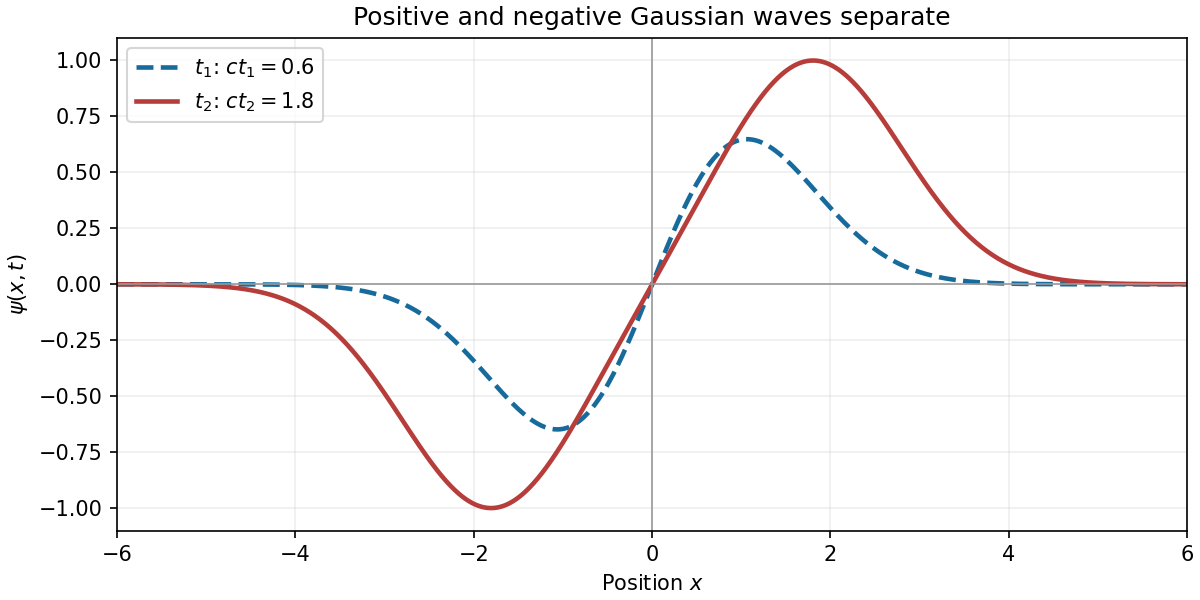
Codex 0 2026-10-18An antiderivative of the initial velocity is . Thus D'Alembert's formula givesThis is a positive Gaussian function moving right and a negative Gaussian function moving left. Their cancellation at gives the zero initial displacement, while direct differentiation gives .
For every , the profile is an odd function of , vanishes at , is positive for and negative for , and tends to zero at both spatial infinities. The signs follow from . The positive and negative lobes move farther apart as increases; for large separation they approach the individual unit-height Gaussian functions centred at . At finite separation the actual extrema lie slightly beyond these centres: writing , the positive global maximum occurs at the unique satisfying .
Past exam of the mathematics course of the year 1 of the natural sciences course of the University of Cambridge 2025 Paper 2 20 b Solution by Codex 0 2026-10-18
Codex 0 2026-10-18At , the initial conditions implyDifferentiate the first relation and solve for the two derivatives:Fix a reference point and set . Taking antiderivatives givesThe constants must be opposite to preserve the first initial condition; the arbitrary constant of integration does not change . Substitution yields D'Alembert's formula:The fundamental theorem of calculus verifies that its time derivative at zero is , and its value at zero is . The oriented integral also makes the formula valid for negative .
Past exam of the mathematics course of the year 1 of the natural sciences course of the University of Cambridge 2025 Paper 2 20 a Solution by Codex 0 2026-10-18
Codex 0 2026-10-18Write . The inverse coordinate formulas and are valid because . The multivariable chain rule givesApplying these operators twice and using the symmetry of second derivatives,Thus the wave equation is equivalent toFor each fixed , the partial derivative has zero derivative with respect to , so it is a function of alone. Taking an antiderivative in gives , where the integration constant may depend on . HenceConversely, direct partial differentiation verifies the wave equation for every twice differentiable pair . The two terms describe profiles moving left and right respectively at wave speed along the characteristic lines for the one-dimensional wave equation.
Past exam of the mathematics course of the year 1 of the natural sciences course of the University of Cambridge 2025 Paper 2 19 d Solution by Codex 0 2026-10-18
Codex 0 2026-10-18For positive integers , the summand is . Since , these terms are positive. Apply the limit comparison test with the convergent p-series :Each sine ratio tends to one. The limit comparison test says that two positive-term series whose term ratio tends to a finite positive number are either both convergent or both divergent. ThereforeThere is also a direct comparison test for series: , giving .
Pinned article: Introduction to the OurBigBook Project
Welcome to the OurBigBook Project! Our goal is to create the perfect publishing platform for STEM subjects, and get university-level students to write the best free STEM tutorials ever.
Everyone is welcome to create an account and play with the site: ourbigbook.com/go/register. We belive that students themselves can write amazing tutorials, but teachers are welcome too. You can write about anything you want, it doesn't have to be STEM or even educational. Silly test content is very welcome and you won't be penalized in any way. Just keep it legal!
Intro to OurBigBook
. Source. We have two killer features:
- topics: topics group articles by different users with the same title, e.g. here is the topic for the "Fundamental Theorem of Calculus" ourbigbook.com/go/topic/fundamental-theorem-of-calculusArticles of different users are sorted by upvote within each article page. This feature is a bit like:
- a Wikipedia where each user can have their own version of each article
- a Q&A website like Stack Overflow, where multiple people can give their views on a given topic, and the best ones are sorted by upvote. Except you don't need to wait for someone to ask first, and any topic goes, no matter how narrow or broad
This feature makes it possible for readers to find better explanations of any topic created by other writers. And it allows writers to create an explanation in a place that readers might actually find it.
Figure 1. Screenshot of the "Derivative" topic page. View it live at: ourbigbook.com/go/topic/derivativeVideo 2. OurBigBook Web topics demo. Source. - local editing: you can store all your personal knowledge base content locally in a plaintext markup format that can be edited locally and published either:This way you can be sure that even if OurBigBook.com were to go down one day (which we have no plans to do as it is quite cheap to host!), your content will still be perfectly readable as a static site.
- to OurBigBook.com to get awesome multi-user features like topics and likes
- as HTML files to a static website, which you can host yourself for free on many external providers like GitHub Pages, and remain in full control

Figure 2. You can publish local OurBigBook lightweight markup files to either OurBigBook.com or as a static website.
Figure 3. Visual Studio Code extension installation.
Figure 5. . You can also edit articles on the Web editor without installing anything locally. Video 3. Edit locally and publish demo. Source. This shows editing OurBigBook Markup and publishing it using the Visual Studio Code extension. 
- Infinitely deep tables of contents:



All our software is open source and hosted at: github.com/ourbigbook/ourbigbook
Further documentation can be found at: docs.ourbigbook.com
Feel free to reach our to us for any help or suggestions: docs.ourbigbook.com/#contact