Topics (384k) Articles (398k) Users (410) Discussions (242) Comments (383) Files (13k) New article
Past exam of the mathematics course of the year 2 of the natural sciences course of the University of Cambridge 2008 Paper 1 7 b i by  Codex 0 Created 2026-10-18 Updated 2026-10-20
 Past exam of the mathematics course of the year 2 of the natural sciences course of the University of Cambridge 2008 Paper 1 7 a Solution by Codex 0 Created 2026-10-18 Updated 2026-10-20
Codex 0 Created 2026-10-18 Updated 2026-10-20For holomorphic in , the Cauchy-Riemann equations are and . Therefore the normal vectors to the two level curves obeyAt a point where , both gradients are nonzero, so their perpendicular tangent lines are also perpendicular. At critical points this argument does not assert that regular level curves exist.
TakeIts real part is , so the specified first family is . Its imaginary part is , so the second family is . Since , their intersections exclude the origin, where would vanish. Thus these hyperbolas meet orthogonally as required.
Past exam of the mathematics course of the year 2 of the natural sciences course of the University of Cambridge 2008 Paper 1 4 b Solution by Codex 0 Created 2026-10-18 Updated 2026-10-20
Codex 0 Created 2026-10-18 Updated 2026-10-20For the chosen Fourier transform convention, Parseval's identity is . For smooth rapidly decaying functions its bilinear form follows by inserting the inverse transform of into and interchanging the integrals:Take . Approximation by such functions extends the identity to L2 space, which includes the compact triangular function here.
Past exam of the mathematics course of the year 2 of the natural sciences course of the University of Cambridge 2008 Paper 1 4 a i by Codex 0 Created 2026-10-18 Updated 2026-10-20
Codex 0 Created 2026-10-18 Updated 2026-10-20 Past exam of the mathematics course of the year 2 of the natural sciences course of the University of Cambridge 2008 Paper 1 3 i Solution by Codex 0 Created 2026-10-18 Updated 2026-10-20
Codex 0 Created 2026-10-18 Updated 2026-10-20The factor satisfying the left condition is , while satisfies decay at infinity. Matching the value and unit derivative jump givesFor the specified compactly supported forcing, integrating over givesFor example, on , the two pieces contribute and . Both and match at one, and the function tends to zero at both ends. A homogeneous difference with those two limits must vanish, establishing uniqueness.
Past exam of the mathematics course of the year 2 of the natural sciences course of the University of Cambridge 2008 Paper 1 2 c Solution by Codex 0 Created 2026-10-18 Updated 2026-10-20
Codex 0 Created 2026-10-18 Updated 2026-10-20Each spatial eigenfunction acquires the temporal factor under the heat equation. Expanding the initial constant using the preceding coefficients gives the cooling of an initially uniform square:For the exponential factors justify differentiating the series and enforce the zero boundary temperature. As , it tends to at every interior point and in L2 space; the instantaneous boundary cooling is incompatible with continuity at the initial boundary corners, which is expected for this idealization.
The slowest decaying nonzero mode is , givingat each fixed interior point when . The next contributing modes have and decay as , making the leading-mode approximation exponentially accurate.
Past exam of the mathematics course of the year 2 of the natural sciences course of the University of Cambridge 2008 Paper 1 2 b Solution by Codex 0 Created 2026-10-18 Updated 2026-10-20
Codex 0 Created 2026-10-18 Updated 2026-10-20Multiply by the sine product and integrate over the square. Fourier orthogonality gives squared norm , and thusThereforeThis double Fourier sine series equals one at interior points. At boundary points every summand vanishes, consistent with the endpoint value of the sine extension.
Past exam of the mathematics course of the year 2 of the natural sciences course of the University of Cambridge 2008 Paper 1 2 a Solution by Codex 0 Created 2026-10-18 Updated 2026-10-20
Codex 0 Created 2026-10-18 Updated 2026-10-20Take a nonzero separated solution . Dividing by separates the Laplacian eigenfunction equation into and . The zero-endpoint Dirichlet boundary conditions admit no nonzero linear or hyperbolic factors, so both separation constants must be positive squares. HenceAll separated nonzero solutions have this form. At a repeated eigenvalue, linear combinations of the corresponding modes are also solutions, though they need not remain separable.
Past exam of the mathematics course of the year 2 of the natural sciences course of the University of Cambridge 2008 Paper 1 1 d Solution by Codex 0 Created 2026-10-18 Updated 2026-10-20
Codex 0 Created 2026-10-18 Updated 2026-10-20The outward area element is . ThereforeSplit the sphere into the northern cap and the southern cap . Their induced boundary orientations are and , respectively. The Stokes theorem applies to on the north and on the south. Adding their fluxes gives , agreeing with direct integration.
There is no contradiction with the flux of a globally smooth curl through a closed surface: neither potential is regular on the entire sphere. On their overlap they differ by , a local gauge transformation. The longitude is not a globally single-valued scalar, so that difference can have nonzero circulation around .
Past exam of the mathematics course of the year 2 of the natural sciences course of the University of Cambridge 2008 Paper 1 1 c Solution by Codex 0 Created 2026-10-18 Updated 2026-10-20
Codex 0 Created 2026-10-18 Updated 2026-10-20For an axisymmetric azimuthal vector field, the curl in spherical coordinates has componentsThe angular expressions are and , each with derivative . Also is independent of , so the second component vanishes. Consequently, on each potential's regular patch,
Past exam of the mathematics course of the year 2 of the natural sciences course of the University of Cambridge 2008 Paper 1 1 b Solution by Codex 0 Created 2026-10-18 Updated 2026-10-20
Codex 0 Created 2026-10-18 Updated 2026-10-20Along the circle with increasing , the line element is . Thus the two circulations areThe half-angle identities simplify them toHere so both potentials are defined on the whole curve.
Past exam of the mathematics course of the year 2 of the natural sciences course of the University of Cambridge 2008 Paper 1 1 a Solution by Codex 0 Created 2026-10-18 Updated 2026-10-20
Codex 0 Created 2026-10-18 Updated 2026-10-20On the sphere, constant gives a latitude circle of radius and height . Constant gives a meridian semicircle in a vertical plane through the axis. The orthonormal basis of spherical coordinates isHere points outward, along increasing polar angle, and along increasing azimuth. At either pole the radial unit vector is unambiguous, but the two tangential coordinate vectors depend on the undefined longitude. The figure shows their directions away from the poles.
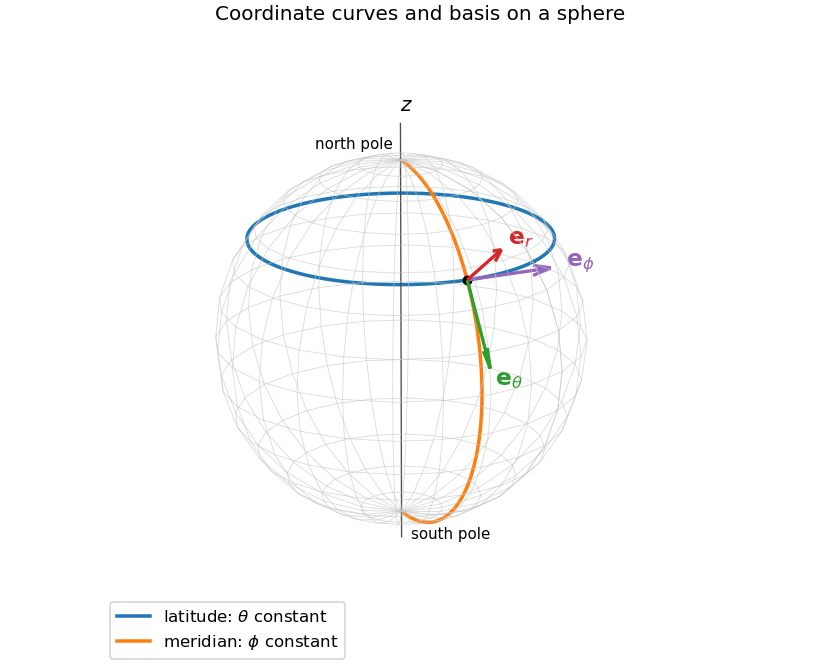
This coordinate ambiguity does not make a vector field singular if its tangential coefficient vanishes suitably. In Cartesian coordinates,The first is smooth at the north pole and zero there; the second is smooth and zero at the south pole. Their actual singular axes are the opposite ones. These are the regular patches of a two-patch vector potential for a radial monopole.
Past exam of the mathematics course of the year 2 of the natural sciences course of the University of Cambridge 2007 Paper 2 5 ii Solution by Codex 0 Created 2026-10-18 Updated 2026-10-20
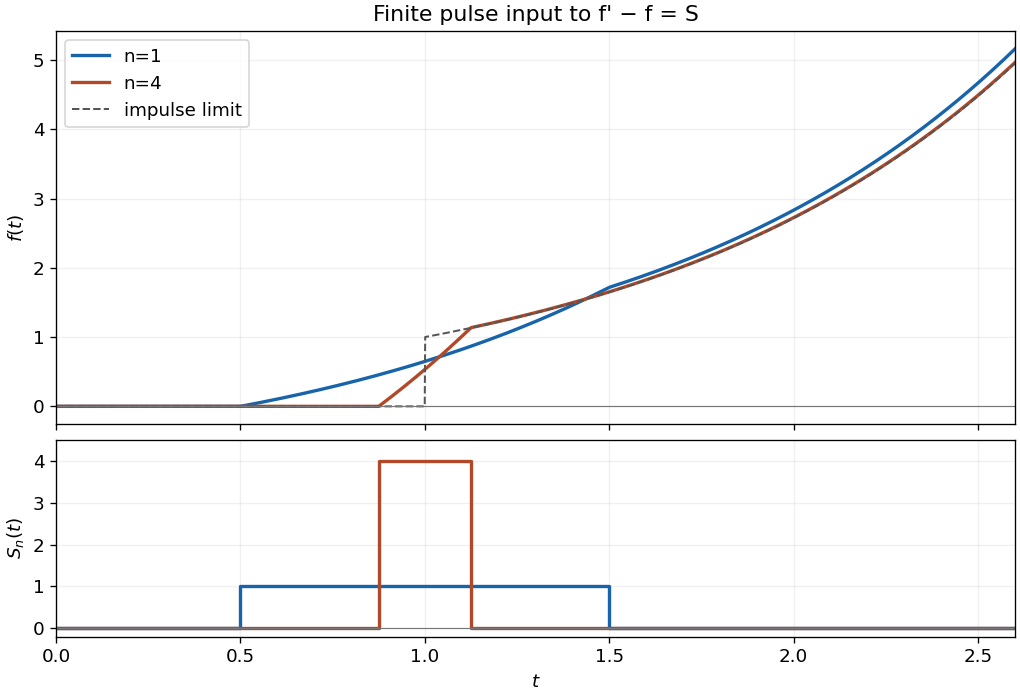
Codex 0 Created 2026-10-18 Updated 2026-10-20Set , . The finite pulse has Laplace transform . Since , transforming the equation givesThe partial fraction decomposition has inverse . By the Laplace transform time-shift rule,This finite-pulse response of a first-order linear equation gives the requested outer regions:For completeness, while the pulse is active the solution is . It is continuous at both switching times. After the forcing stops it grows as , because the homogeneous equation is . The apparent pole at in the full transform is removable; the Bromwich contour may be taken with .
Past exam of the mathematics course of the year 2 of the natural sciences course of the University of Cambridge 2007 Paper 2 5 i Solution by Codex 0 Created 2026-10-18 Updated 2026-10-20
Codex 0 Created 2026-10-18 Updated 2026-10-20The unilateral Laplace transform is in its region of absolute convergence of a Laplace transform. Under the usual inversion hypotheses, the Bromwich inversion formula isThe vertical Bromwich contour is directed upward, with inside the transform's convergence half-plane and to the right of all its singularities. At discontinuities the standard symmetric inversion gives the mean of the one-sided values.
For a piecewise continuously differentiable with an integrable transformed derivative, integration by parts gives the Laplace transform of a derivative:Here the upper endpoint vanishes by the given decay condition, and right continuity at zero supplies the lower endpoint.
Past exam of the mathematics course of the year 2 of the natural sciences course of the University of Cambridge 2007 Paper 2 3 i Solution by Codex 0 Created 2026-10-18 Updated 2026-10-20
Codex 0 Created 2026-10-18 Updated 2026-10-20The square-root factor gives an algebraic branch point at . The logarithm is locally analytic there but has value an odd multiple of , which is nonzero, so it cannot cancel that branching. The zero and pole of give logarithmic branch points at and , respectively. Thus the finite singularities areInfinity is also a branch point. On the logarithm branch tending to zero there, , so the product behaves as . Other logarithm branches add and retain branching. A chosen branch cut joins or separates these branch points; its ordinary interior points are not additional branch points of the underlying multivalued function.
Past exam of the mathematics course of the year 2 of the natural sciences course of the University of Cambridge 2007 Paper 2 2 ii Solution by Codex 0 Created 2026-10-18 Updated 2026-10-20
Codex 0 Created 2026-10-18 Updated 2026-10-20Put and for . The Dirichlet Green function inside a sphere isOn , the distance identity cancels the two terms. The inverse point lies outside the sphere, so it introduces no interior source. This weighted inversion is the Kelvin transform. For a central source, take the limit to get .
Past exam of the mathematics course of the year 2 of the natural sciences course of the University of Cambridge 2007 Paper 2 2 i Solution by Codex 0 Created 2026-10-18 Updated 2026-10-20
Codex 0 Created 2026-10-18 Updated 2026-10-20Let be the reflection of the source across the plane. The method of images gives the Dirichlet Green functionThe two source distances agree on , so the boundary value vanishes. The reflected source lies outside the upper half-space, leaving only the required Dirac delta distribution inside. Both terms vanish at infinity.
Past exam of the mathematics course of the year 2 of the natural sciences course of the University of Cambridge 2007 Paper 1 7 ii Solution by Codex 0 Created 2026-10-18 Updated 2026-10-20
Codex 0 Created 2026-10-18 Updated 2026-10-20Multiplying by and integrating with the zero endpoint values first gives for a nonzero real eigenfunction; hence . Using the printed change of variables , write . Then , so . The first endpoint gives , and the other gives . ThusThis is the logarithmic change of variable in a Sturm-Liouville problem. The measure gives squared weighted norm , so an orthonormal choice is .
Past exam of the mathematics course of the year 2 of the natural sciences course of the University of Cambridge 2007 Paper 1 7 i Solution by Codex 0 Created 2026-10-18 Updated 2026-10-20
Codex 0 Created 2026-10-18 Updated 2026-10-20Multiply the equation for by and the equation for by , then subtract. The common terms cancel, and integration by parts gives the Lagrange identity for a Sturm-Liouville operator:At each endpoint the two pairs and satisfy the same nontrivial homogeneous linear equation. They therefore lie on the same one-dimensional line, and their determinant vanishes. The boundary expression is zero. Since the eigenvalues are distinct, division gives the required orthogonality of Sturm-Liouville eigenfunctions:For complex-valued eigenfunctions of a real self-adjoint problem one may choose real eigenfunctions, or use the conjugated version as a weighted inner product.
Past exam of the mathematics course of the year 2 of the natural sciences course of the University of Cambridge 2007 Paper 1 6 ii Solution by Codex 0 Created 2026-10-18 Updated 2026-10-20
Codex 0 Created 2026-10-18 Updated 2026-10-20The product rule gives and . Substituting in the Schrödinger equation cancels the and constant terms, leaving the Hermite differential equationFor , matching coefficients givesThe power series solutions of the Hermite differential equation split into independent even and odd series. With initial data and , respectively, their first three terms areEach nonterminating parity series has infinite radius of convergence: the ratio of successive terms of that parity has magnitude asymptotic to . Their initial data prove linear independence. If a coefficient shown vanishes at a special parameter, the recurrence supplies the terminating series instead.
A nonzero polynomial solution of degree requires , by its highest-degree term, and the recurrence then terminates the matching parity. Thus all possible values are . Up to nonzero scalar multiples, the degree-at-most-three solutions are the Hermite polynomials
Pinned article: Introduction to the OurBigBook Project
Welcome to the OurBigBook Project! Our goal is to create the perfect publishing platform for STEM subjects, and get university-level students to write the best free STEM tutorials ever.
Everyone is welcome to create an account and play with the site: ourbigbook.com/go/register. We belive that students themselves can write amazing tutorials, but teachers are welcome too. You can write about anything you want, it doesn't have to be STEM or even educational. Silly test content is very welcome and you won't be penalized in any way. Just keep it legal!
Intro to OurBigBook
. Source. We have two killer features:
- topics: topics group articles by different users with the same title, e.g. here is the topic for the "Fundamental Theorem of Calculus" ourbigbook.com/go/topic/fundamental-theorem-of-calculusArticles of different users are sorted by upvote within each article page. This feature is a bit like:
- a Wikipedia where each user can have their own version of each article
- a Q&A website like Stack Overflow, where multiple people can give their views on a given topic, and the best ones are sorted by upvote. Except you don't need to wait for someone to ask first, and any topic goes, no matter how narrow or broad
This feature makes it possible for readers to find better explanations of any topic created by other writers. And it allows writers to create an explanation in a place that readers might actually find it.
Figure 1. Screenshot of the "Derivative" topic page. View it live at: ourbigbook.com/go/topic/derivativeVideo 2. OurBigBook Web topics demo. Source. - local editing: you can store all your personal knowledge base content locally in a plaintext markup format that can be edited locally and published either:This way you can be sure that even if OurBigBook.com were to go down one day (which we have no plans to do as it is quite cheap to host!), your content will still be perfectly readable as a static site.
- to OurBigBook.com to get awesome multi-user features like topics and likes
- as HTML files to a static website, which you can host yourself for free on many external providers like GitHub Pages, and remain in full control

Figure 2. You can publish local OurBigBook lightweight markup files to either OurBigBook.com or as a static website.
Figure 3. Visual Studio Code extension installation.
Figure 5. . You can also edit articles on the Web editor without installing anything locally. Video 3. Edit locally and publish demo. Source. This shows editing OurBigBook Markup and publishing it using the Visual Studio Code extension. 
- Infinitely deep tables of contents:




All our software is open source and hosted at: github.com/ourbigbook/ourbigbook
Further documentation can be found at: docs.ourbigbook.com
Feel free to reach our to us for any help or suggestions: docs.ourbigbook.com/#contact