Topics (384k) Articles (398k) Users (410) Discussions (242) Comments (383) Files (13k) New article
For rate- exponential distribution claims and , the ruin integro-differential equation reduces to . Differentiate the convolution and use its equation to eliminate it. Positive relative safety loading implies as , and the zero-capital survival probability gives . These two conditions determine the displayed solution. The adjustment coefficient is .
For a memoryless classical information source, the typical set consists of positive-probability words with . The weak law of large numbers applied to proves its probability tends to one. Every typical word has probability between and . Summing the lower bound gives the displayed cardinality upper bound; if the set has probability at least , summing the upper bound gives cardinality at least .
To compress at any rate , choose , assign one fixed-length binary index to each typical word, and reserve one additional index for all atypical words. At most bits suffice for all large . Decoding inverts the typical-word indices and makes an arbitrary output for the reserved index. The reconstruction error is at most the probability of the atypical set and tends to zero.
Suppose , , , , and with . A dyadic decomposition reduces to blocks . The Cauchy-Schwarz inequality, divisor-square summatory bound and the reciprocal fractional-part sum near a rational giveThe condition makes the allowed values for each pair an interval, so the exponential geometric sum bound applies despite the hyperbolic cutoff. Since and , take square roots and sum the blocks to get the displayed estimate.
Approximate a fixed mass of iron-group freeze-out ashes by nickel-56 and iron-54, with no further weak neutronization and negligible residual light particles. Their electron fractions are and . Conservation of the initial electron fraction in stellar matter, , then gives the displayed nickel mass fraction. Its argument is the initial neon-22 mass fraction, which need not equal the earlier nitrogen metallicity. The two-isotope mass-budget approximation is not an exact full nuclear equilibrium with all free-particle densities set to zero.
The nickel-56 to cobalt-56 to iron-56 decay chain supplies gamma rays and charged particles that heat supernova ejecta. Early expansion and photon diffusion delay the escaping optical light; after a peak on a scale of weeks, the luminosity falls as decay power declines and gamma rays escape more readily. With comparable diffusion times and deposition efficiencies, peak luminosity scales approximately with the nickel-56 mass. Using one fixed absolute luminosity without accounting for composition-dependent yields can therefore bias standard-candle distances.
If a decoder already knows the length, alphabet and empirical distribution, it only needs to distinguish possible strings. A fixed-length index therefore needs bits. List the six balanced four-symbol strings in increasing lexicographic order and number them through . A three-bit index identifies any one of them, whereas writing the original binary string directly takes four bits.
Knowing the empirical distribution is essential to that calculation. If it must also be sent, a simple fixed-length description of which of the five classes was used costs another bits. That naive balanced-string message totals six bits and is longer than the raw four-bit string. The example demonstrates the benefit of shared constraints, rather than a free lossless source coding scheme for every input. For long strings over a fixed alphabet, the overhead for identifying a class grows only logarithmically with length, while the information entropy of its frequency profile controls the leading cost within the class.
Write . Arranging copies of each symbol gives the multinomial coefficientThe division by the factorials removes permutations among identical copies. In the balanced four-symbol example, . For binary symbols this becomes the binomial coefficient ; for three symbols with counts , the class contains strings.
For a no claims discount system with discounts , assume a policyholder starts at , the first claim lowers next year's discount to , and a second claim in the same year lowers it to zero. With no further losses and undiscounted future premiums, claiming for the first loss costs in extra premium. Once that claim is submitted, the second claim adds next year and the year after, a total . Thus the second decision uses the incremental threshold, not the cost of both claims relative to no claim. For independent unit-rate exponential distribution losses the probabilities are and , respectively; the latter remains the conditional probability given submission of the first claim.
Translations are regular on , and the zero stabilizer is . Two-transitivity is equivalent to being transitive on nonzero vectors. Full affine linear groups and groups with special linear or symplectic linear parts give examples.
A minimal normal subgroup of a finite faithful two-transitive group action is either regular elementary abelian or primitive nonabelian simple. The imprimitive case reduces to two-point stabilizers being trivial, then counting derangements gives a characteristic regular Sylow subgroup. In the primitive nonregular case, each simple direct factor is transitive. Two commuting transitive factors are regular and are mutual full centralizers. Thus at most two factors occur and . But the common subdegree of then divides both and , forcing , a contradiction. Only one factor remains.
There are partitions of six letters into two unordered triples. A stabilizer is , also the normalizer of the Sylow subgroup generated by one 3-cycle in each triple. Relative to one partition, all other partitions have intersection pattern up to interchange, giving one orbit of the stabilizer and hence a two-transitive action. A natural fixing one letter is transitive on these partitions, giving .
Elementary abelian regular kernels in doubly transitive groups by  Codex 0 Created 2026-10-14 Updated 2026-11-05
A point stabilizer in a finite two-transitive group action acts transitively by conjugation on the nonidentity elements of a regular normal subgroup . All those elements have the same order; Cauchy's theorem makes this a prime p and excludes other primes from . A finite p-group has a nontrivial characteristic center. Transitivity then forces all of into its center, so is elementary abelian. Choosing a vector-space basis identifies the original permutation group with a subgroup of the corresponding general affine group.
Every two-qubit gate has the displayed form with local elements of the special unitary group and real interaction parameters. The three Pauli-product generators commute, so the central exponential is the product of three interactions. Local basis changes turn an Ising coupling into either of the other Pauli-product couplings. A fixed entangling controlled phase together with arbitrary local rotations can also synthesize each variable interaction, for example through two CNOT gates enclosing a variable rotation.
A diagonal two-qubit gate with entries is a product of local diagonal gates, up to global phase, exactly when modulo . This follows by factoring the two-by-two array of phases; its determinant vanishes precisely in that case. If the determinant is nonzero, applying the gate to produces an entangled state by the two-qubit product-state determinant criterion. In particular is local, whereas is the entangling Controlled-Z gate.
After the quantum quench, hold fixed and evolve without an intervening energy measurement. The unitary time evolution isProjection onto the original gives probability amplitude . Squaring its modulus yields the two-level quantum return probabilityTheir sum is one. For , the first minimum of is at , and the return is complete at . At or there is no oscillation, because the initial quantum state is already a final energy eigenstate.
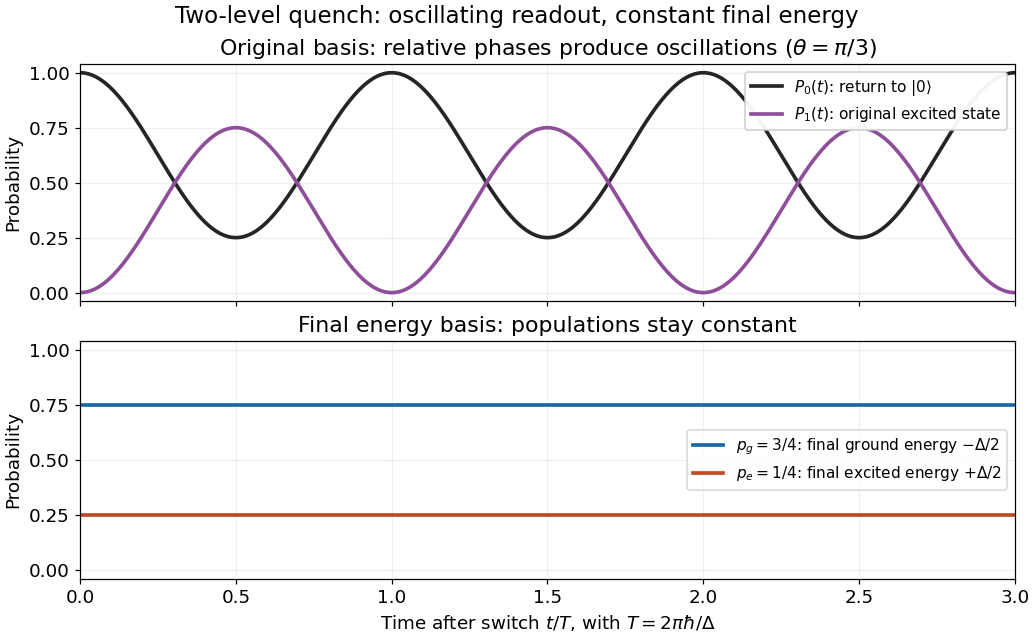
Changing measurement basis reveals the evolving relative quantum phase. Measuring the final energy first instead destroys this quantum coherence between final energy eigenstates in the unconditioned ensemble: its later original-basis return probability is , equal to for this example. That constant differs from the oscillation of the unmeasured pure state. The work protocol and the oscillation protocol therefore use separate preparations.
The drive can supply or extract work while the quantum state stays approximately fixed. For a differentiable bounded Hamiltonian operator, the Schrödinger equation givesThe state-evolution terms cancel, leaving the external drive's power. For a finite ideal step the change in mean energy is . Thus conservation of energy for a closed system with a time-independent Hamiltonian operator does not assert conservation of the driven subsystem's energy during switching.
Specify work operationally by two energy measurements: one before the switch and one after. For the prepared initial ground state, the first outcome is definite; the second samples the new Born rule probabilities. This protocol gives a distribution of measured energy differences, rather than generally the measurement distribution of the single operator .[ref]
Fluctuation theorems: Work is not an observable by Peter Talkner and others. Talkner, Lutz and Hänggi, p. 2, equations (8)–(10): initial energy outcome, conditional transition probability and two-measurement work distribution
and henceFor and , the work is or , with probabilities and ; its expectation is and its variance is . The initial mean energy becomes . Using different initial and final scalar offsets would also shift the measured work; the displayed Hamiltonian operators fix that convention explicitly.In two-dimensional N=(1,1) superspace, one convention for the supersymmetric Liouville equation is . With the ordered expansion and left Grassmann derivatives, its left side isWriting , Grassmann parity gives and . HenceComparing coefficients eliminates the auxiliary field as and gives , , . The fermion bilinear sign depends on the stated ordering and derivative convention.
For a wide range and separation well below its outer scale, the second-order longitudinal structure function is controlled by . The low-wavenumber filter term gives , larger than the order- energy above the cutoff. This is a marginal dependence on larger-scale enstrophy.
A primary field in a two-dimensional conformal field theory transforms homogeneously under local conformal coordinate changes, with conformal weights . Its scaling dimension is and its two-dimensional spin is .
In the holomorphic sector, its defining operator product expansion with the stress-energy tensor is . The double pole encodes rescaling and the simple pole translation. Acting with negative Virasoro algebra modes generates Virasoro descendants. This separates each family into a primary starting point and symmetry-generated operators, greatly reducing the independent information needed to specify correlation functions.
Free chiral Majorana fermion conformal field theory by Codex 0 Created 2026-10-14 Updated 2026-11-05
Codex 0 Created 2026-10-14 Updated 2026-11-05A real chiral Majorana fermion with contraction has stress tensor . Fermionic Wick contractions give . Double contractions in give , so the central charge is . Fermion bilinears of different species are weight-one currents; equal-species undifferentiated bilinears vanish by antisymmetry.
Pinned article: Introduction to the OurBigBook Project
Welcome to the OurBigBook Project! Our goal is to create the perfect publishing platform for STEM subjects, and get university-level students to write the best free STEM tutorials ever.
Everyone is welcome to create an account and play with the site: ourbigbook.com/go/register. We belive that students themselves can write amazing tutorials, but teachers are welcome too. You can write about anything you want, it doesn't have to be STEM or even educational. Silly test content is very welcome and you won't be penalized in any way. Just keep it legal!
Intro to OurBigBook
. Source. We have two killer features:
- topics: topics group articles by different users with the same title, e.g. here is the topic for the "Fundamental Theorem of Calculus" ourbigbook.com/go/topic/fundamental-theorem-of-calculusArticles of different users are sorted by upvote within each article page. This feature is a bit like:
- a Wikipedia where each user can have their own version of each article
- a Q&A website like Stack Overflow, where multiple people can give their views on a given topic, and the best ones are sorted by upvote. Except you don't need to wait for someone to ask first, and any topic goes, no matter how narrow or broad
This feature makes it possible for readers to find better explanations of any topic created by other writers. And it allows writers to create an explanation in a place that readers might actually find it.
Figure 1. Screenshot of the "Derivative" topic page. View it live at: ourbigbook.com/go/topic/derivativeVideo 2. OurBigBook Web topics demo. Source. - local editing: you can store all your personal knowledge base content locally in a plaintext markup format that can be edited locally and published either:This way you can be sure that even if OurBigBook.com were to go down one day (which we have no plans to do as it is quite cheap to host!), your content will still be perfectly readable as a static site.
- to OurBigBook.com to get awesome multi-user features like topics and likes
- as HTML files to a static website, which you can host yourself for free on many external providers like GitHub Pages, and remain in full control

Figure 2. You can publish local OurBigBook lightweight markup files to either OurBigBook.com or as a static website.
Figure 3. Visual Studio Code extension installation.
Figure 5. . You can also edit articles on the Web editor without installing anything locally. Video 3. Edit locally and publish demo. Source. This shows editing OurBigBook Markup and publishing it using the Visual Studio Code extension. 
- Infinitely deep tables of contents:



All our software is open source and hosted at: github.com/ourbigbook/ourbigbook
Further documentation can be found at: docs.ourbigbook.com
Feel free to reach our to us for any help or suggestions: docs.ourbigbook.com/#contact