Topics (384k) Articles (398k) Users (410) Discussions (242) Comments (383) Files (13k) New article

Every vector bundle on the projective line over a field splits as a direct sum of line bundles. Choose the largest integer with . A corresponding map is saturated, since saturation otherwise increases its degree. Inductively split its quotient as . Twisting the exact sequence by and using gives . Hence all extension groups vanish, and the sequence splits. The multiset of degrees is determined by the dimensions of all twisted global-section spaces.
A line subbundle is an injective map from a line bundle into a vector bundle whose quotient is locally free. Equivalently the injection splits locally. On a smooth algebraic curve, saturation of a rank-one coherent subsheaf produces a saturated line subbundle on a smooth curve.
Choose a fiber metric on a real rank- vector bundle . Its Thom space is the pointed quotient spaceobtained by collapsing the entire sphere bundle to one basepoint. For a compact Hausdorff space , it is also the one-point compactification of the total space of . A single fiber becomes .
For the trivial vector bundle , the quotient is , where adjoins a disjoint basepoint and denotes the smash product. In rank zero the convention is ; this keeps the basepoint even though the sphere bundle is empty.
For an oriented rank- vector bundle over a CW complex, its Thom class restricts to the positive generator on every fiber sphere. Multiplication by that class gives the Thom isomorphismThus the Thom space packages the degree shift of cohomology into one pointed space.[ref]
A symplectic vector bundle has a smooth fiberwise symplectic form, making each fiber a symplectic vector space. Its structure group reduces to the symplectic group. A symplectic normal bundle is an important example.
The fiberwise direct sum of two vector bundles over the same base. It is formed from the fiber product of their total spaces, with the direct-sum linear structure in each fiber. Transition matrices are block diagonal.
// Target: geometry-and-topology.bigb
A vector bundle is globally generated when its global sections span every fibre. The evaluation map in the display expresses this condition. On a projective curve its space of global sections is finite-dimensional, so a finite collection of sections suffices.
A G-structure on a real rank- vector bundle is a principal reduction of its frame bundle. Equivalently it has local frames whose transition matrices take values in , with the reduction consisting of their right -orbits. An orthogonal structure on a real vector bundle is equivalent to a fiber metric; a special orthogonal reduction is equivalent to that metric together with an orientation of a vector bundle.
For a smooth manifold , the tensor bundle is a vector bundle whose smooth sections of a vector bundle are tensor fields of type . Its transition functions of a vector bundle are tensor products of the tangent bundle transition matrices and their inverse transposes. Symmetric tensors and differential forms arise from the symmetric and alternating subbundles.
// Target: fiber-bundle.bigb
On an -dimensional smooth manifold, the density bundle is the real line bundle whose coordinate transformation uses the absolute value of the Jacobian determinant. A density can therefore be integrated without an orientation of a smooth manifold. A Riemannian metric gives the positive density , including on a nonorientable manifold.
// Target: fiber-bundle.bigb
The Von Mangoldt function is nonnegative and satisfies . Therefore the middle short-divisor coefficient in the Vaughan identity has the displayed pointwise bound. Grouping its long-divisor term as , with , gives . This grouping permits bounded-coefficient Type II sums after division by .
For reduced with and , the displayed bound follows by splitting Vaughan identity with parameters . Type I sums use short geometric-sum bounds; type II sums use the Cauchy-Schwarz inequality and rational spacing to control bilinear cancellation. A badly approximable number has a Dirichlet approximant with , yielding and hence .
// Target: analytic-number-theory.bigb
For a nonnegative count with positive mean, the Fano factor compares its variance to its mean. A Poisson distribution has factor one. Correlated production bursts or weak restoring feedback can give factors larger than one even at large molecular copy number.
// Target: mathematical-biology.bigb
Use the Fourier transform convention . If and for are integrable functions, moment differentiation of the Fourier transform yields a Fourier transform andThe dominated convergence theorem justifies these derivatives. Under these assumptions, vanishing moments are equivalent to vanishing derivatives through order at zero. For this gives a Peano zero ; for it gives . It does not by itself justify a th derivative or an estimate.
If also , subtract the degree- Taylor polynomial of inside the integral. Its Taylor remainder gives the stronger boundFor an integrable function with compact support, every weighted integral exists and its Fourier transform extends to an entire function. The language “zero of order at least ” is then literal analytic function terminology. If the next integral is nonzero, the order is exactly . The smooth-mask vanishing-moment criterion relates these cancellations to a refinement mask under its additional hypotheses.[ref]
Wavelet Bases. Wavelet Bases, §7.2.1, printed p. 206, Theorem 7.4 and proof of (i) ⇔ (ii): decay assumptions and differentiation of the Fourier transform
Let be an integrable function with at least one vanishing moment. For a unit jump discontinuity , where is the Heaviside step function, substitution into the coefficient givesThe signed integral of the whole analyzing function is zero, but the jump discontinuity cuts through its support of a function and usually leaves an unbalanced partial integral. At fixed relative position with nonzero partial integral, the coefficient decays as , slower than the Taylor remainder bound on a smooth region. “Edges survive” means this relative contrast: the normalized coefficients still tend to zero as .
For an original exact comparison, use the smooth polynomial at . The Haar wavelet and the second-difference analyzing function giveThe linear term cancels for ; it remains for . For the fixed unit jump discontinuity , choose so that at every scale. Then
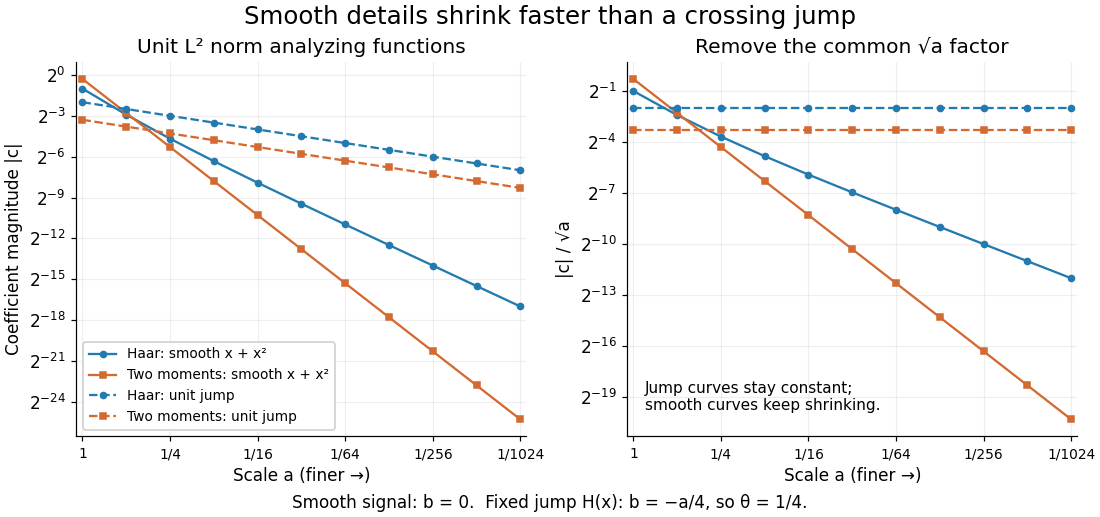
Position matters. If an analyzing function's support of a function lies entirely on one constant side of the jump discontinuity, its coefficient is zero. Even a crossing can cancel: has zero partial integral at . A jump discontinuity on a dyadic interval boundary can likewise escape finer Haar wavelets whose supports do not cross it. These examples describe particular functions and normalizations, not a universal ranking of wavelets for signal processing.
The Haar wavelet provides an explicit one-vanishing moment comparison:It cancels a constant polynomial, but not a nonconstant affine function. To obtain two vanishing moments by an equally transparent construction, take three adjacent unit intervals with heights proportional to :The L2 norm normalization follows from . Direct integration givesThus has exactly two vanishing moments. In fact its coefficient is a finite difference of adjacent local integrals:The weights are those of the second-order central difference. The first moment balances the centres of the three intervals; it is not enough merely to balance their signed areas.
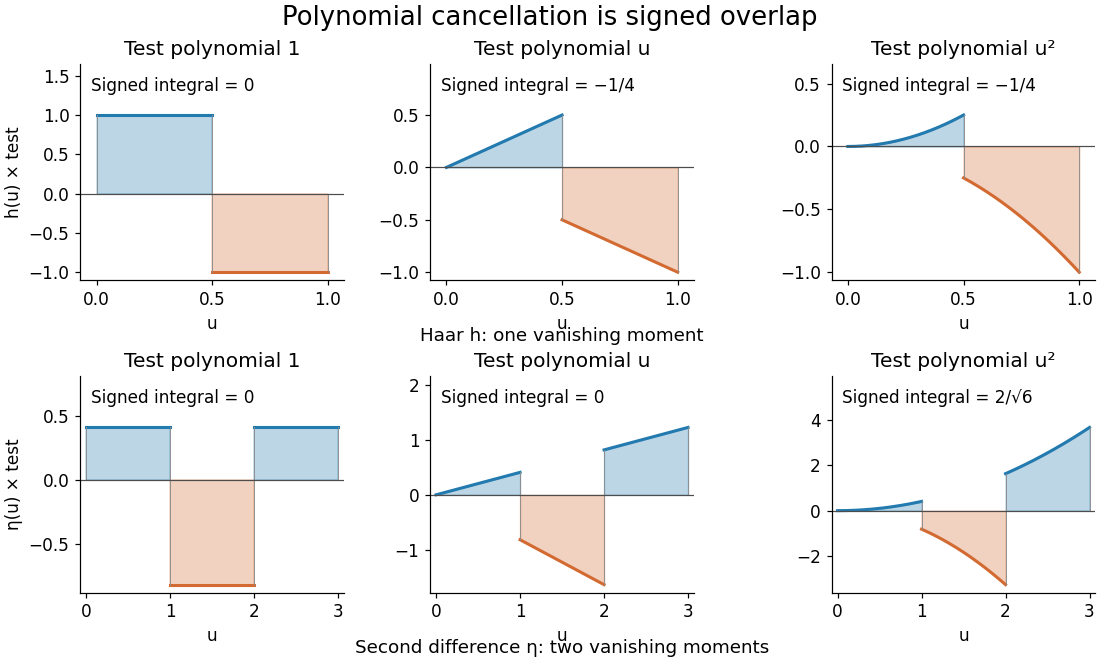
Signed overlaps of the Haar and second-difference analyzing functions with constant, linear, and quadratic test polynomials
. Details. This is a normalized analyzing function, with no orthonormal basis assertion. Indeed, its unit translate has nonzero L2 inner product:Hence these translates already fail orthogonality. The Daubechies wavelet construction imposes additional refinement and orthogonality requirements; two vanishing moments and unit L2 norm by themselves do not supply those requirements.
For and , define the shifted, scaled analyzing function and its coefficient byAssume the product is integrable; for example this holds for a locally integrable function and a bounded analyzing function with compact support. The bar is complex conjugation. This normalization preserves the L2 norm of the analyzing function. If is a polynomial of degree of a polynomial less than , then is a sum of monomials with . Linearity of integration and the vanishing moments give at every position and scale. Nonzero polynomials on the whole real line are not square-integrable, so this cancellation is an integral pairing; it is not a claim that these polynomials are vectors of .
Here is a quantitative reason that smooth regions yield small details. Let have compact support and vanishing moments, and suppose is times continuously differentiable on an interval containing and . Subtract its degree- Taylor polynomial at . If on that interval, the Taylor remainder bound givesThe factor comes from the Taylor remainder; comes from the coefficient normalization. Thus the analyzing function measures the departure from the local polynomial trend, rather than the height of itself. The wavelet coefficient decay for Hölder functions uses the same argument with a Hölder-Taylor remainder bound. These estimates concern regularity of on the analyzing function's entire support of a function; extra vanishing moments alone do not make smooth or establish an orthonormal wavelet construction.[ref]
A valuation ring for a nontrivial real-valued rank-one valuation is a principal ideal domain exactly when its value group is discrete. A least positive value makes the value group cyclic and lets every nonzero ideal be generated by an element of smallest valuation. Conversely, if the maximal ideal is principal, its generator has the least positive value. Nontriviality matters: a field with the trivial valuation is a principal ideal domain, but not a discrete valuation ring in the usual nontrivial convention.
For a stable free Klein-Gordon field with a complete timelike Killing flow and a positive self-adjoint one-particle energy generator, its positive spectral subspace selects positive-frequency solutions of positive Klein-Gordon inner product. Their annihilation operators define the ground-state Fock vacuum. Degenerate modes can be mixed by a unitary matrix without changing this splitting or vacuum. Merely being stationary near infinity is insufficient if the Killing field becomes spacelike in an ergoregion of a stationary spacetime; zero modes, instability or additional boundary conditions also require separate treatment. The choice of a ground state does not prevent other states, such as thermal states, from using the same particle operators.
// Target: statistical-physics.bigb
Pinned article: Introduction to the OurBigBook Project
Welcome to the OurBigBook Project! Our goal is to create the perfect publishing platform for STEM subjects, and get university-level students to write the best free STEM tutorials ever.
Everyone is welcome to create an account and play with the site: ourbigbook.com/go/register. We belive that students themselves can write amazing tutorials, but teachers are welcome too. You can write about anything you want, it doesn't have to be STEM or even educational. Silly test content is very welcome and you won't be penalized in any way. Just keep it legal!
Intro to OurBigBook
. Source. We have two killer features:
- topics: topics group articles by different users with the same title, e.g. here is the topic for the "Fundamental Theorem of Calculus" ourbigbook.com/go/topic/fundamental-theorem-of-calculusArticles of different users are sorted by upvote within each article page. This feature is a bit like:
- a Wikipedia where each user can have their own version of each article
- a Q&A website like Stack Overflow, where multiple people can give their views on a given topic, and the best ones are sorted by upvote. Except you don't need to wait for someone to ask first, and any topic goes, no matter how narrow or broad
This feature makes it possible for readers to find better explanations of any topic created by other writers. And it allows writers to create an explanation in a place that readers might actually find it.
Figure 1. Screenshot of the "Derivative" topic page. View it live at: ourbigbook.com/go/topic/derivativeVideo 2. OurBigBook Web topics demo. Source. - local editing: you can store all your personal knowledge base content locally in a plaintext markup format that can be edited locally and published either:This way you can be sure that even if OurBigBook.com were to go down one day (which we have no plans to do as it is quite cheap to host!), your content will still be perfectly readable as a static site.
- to OurBigBook.com to get awesome multi-user features like topics and likes
- as HTML files to a static website, which you can host yourself for free on many external providers like GitHub Pages, and remain in full control

Figure 2. You can publish local OurBigBook lightweight markup files to either OurBigBook.com or as a static website.
Figure 3. Visual Studio Code extension installation.
Figure 5. . You can also edit articles on the Web editor without installing anything locally. Video 3. Edit locally and publish demo. Source. This shows editing OurBigBook Markup and publishing it using the Visual Studio Code extension. 
- Infinitely deep tables of contents:




All our software is open source and hosted at: github.com/ourbigbook/ourbigbook
Further documentation can be found at: docs.ourbigbook.com
Feel free to reach our to us for any help or suggestions: docs.ourbigbook.com/#contact