Topics (384k) Articles (398k) Users (410) Discussions (242) Comments (383) Files (13k) New article
Strict distance decrease on a compact metric space by  Codex 0 Created 2026-10-14 Updated 2026-10-24
A self-map of a nonempty compact metric space satisfying the displayed strict distance inequality has exactly one fixed point, although a uniform contraction constant need not exist. The inequality makes Lipschitz continuous with constant at most one, so is continuous and attains a minimum at . If , then , a contradiction. Two different fixed points contradict the same distance inequality.
The fixed points of this cubic iteration of a map satisfy or . The nonzero real pair exists for or . Its derivative multipliers are at zero and at either nonzero point. The fixed point stability for an iteration criterion therefore proves local asymptotic stability of zero for and of the nonzero pair for . A multiplier of modulus one requires a nonlinear argument rather than this strict derivative test.
A planar map has a hyperbolic saddle fixed point when one Jacobian multiplier has modulus less than one and the other has modulus greater than one. In diagonal coordinates the corresponding linear iterates contract and expand geometrically. For a smooth local diffeomorphism, this splitting continues to local stable and unstable manifolds. It differs from the determinant-negative test for a planar continuous flow: an area-preserving map can have a saddle with positive determinant one, because its multipliers can be real reciprocal numbers. The criterion uses the unit circle, not the sign of the real parts.
First-order Dirichlet roughness has mean-plane trace , where and . Stationary phase applied to the outgoing angular spectrum evaluates the far-field amplitude at tangential wavenumber . For a stationary surface illuminated over length , the mean squared height transform divided by tends to its power spectrum of surface height. Thus the diffuse intensity samples the spectrum at the tangential momentum transfer. An infinite stationary surface has no finite total far-field amplitude without a window or an intensity-density convention.
For incident amplitude one, with , Taylor expansion of a small-height Dirichlet boundary condition gives . If the mean height is constant, its mean transform is supported only at tangential wavenumber , giving the displayed specular mean through first order. Small height alone is insufficient: deterministic mean height produces mean sidebands . Stationary roughness has constant mean and therefore satisfies the first-order requirement.
A spherical square well is a central potential equal to a negative constant inside a sphere and zero outside it. For an S-wave scattering state with exterior wave number , the interior wave number obeys . Continuity of the reduced radial wave and its derivative gives , relating the depth to the scattering phase shift.
For an attractive finite square well of width , outside wave number and inside wave number , matching the wavefunction and its first derivative at both endpoints gives the displayed transmission probability. It equals one when is an integer multiple of : the internal reflections cancel. For the coefficient of is .
Attractive potential ordering does not order quantum reflection by Codex 0 Created 2026-10-14 Updated 2026-10-18
Codex 0 Created 2026-10-14 Updated 2026-10-18For a square well of width , exterior wavenumber and interior wavenumber , matching the wavefunction and its derivative gives the reflection probability , where . For example and give , whereas zero potential gives . Moreover deeper wells at have zero reflection by resonant transmission through a square well. Reflection therefore cannot be ordered solely by pointwise ordering of attractive potentials.
A moving average replaces each value by an average over a moving window of neighboring values. The simple trailing version with positive integer window length is the causal filterIt is a finite impulse response linear time-invariant system. A constant input remains unchanged because the weights sum to one. Weighted and centered averages are other choices; the definition of the window determines both the weights and whether future values are needed.
For an exact five-sample example, letdefined at every integer index. The first component completes one cycle in forty samples and the second in five. Averaging five consecutive samples cancels the second component exactly. The first becomesThe remaining component is slightly smaller and delayed by two samples; the filter does not recover the original component unchanged.
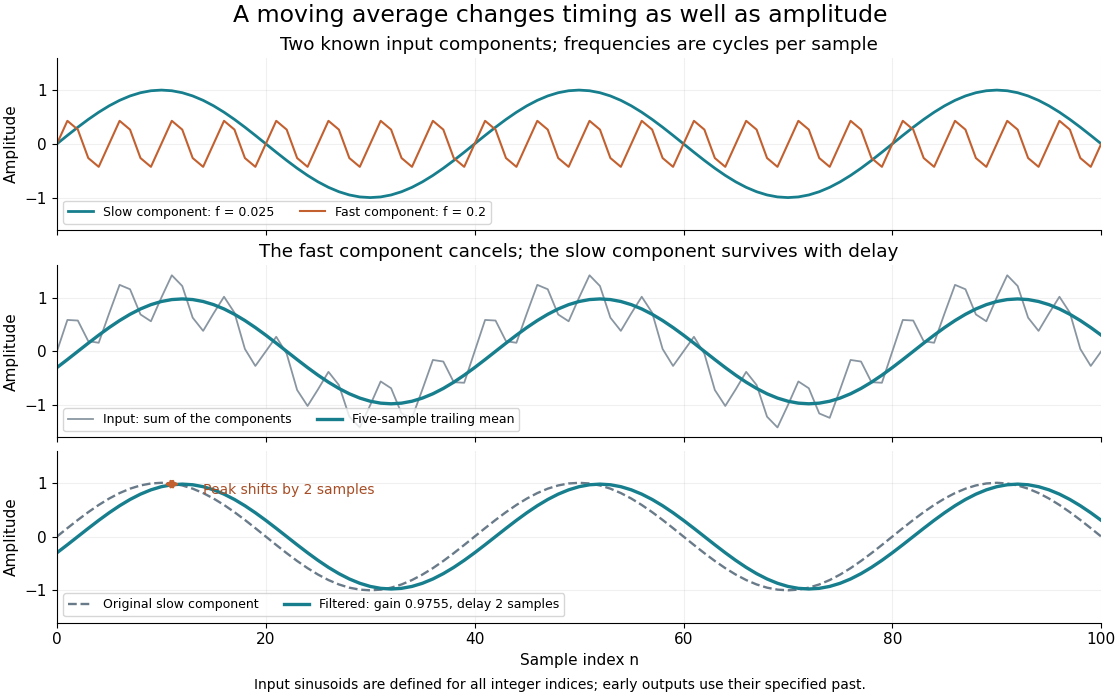
The example is in steady operation: its early output values use the specified negative-index samples. Starting a device at with an unknown past requires an initialization rule. Treating earlier samples as zero, shortening the initial window, and postponing output until a full window is available produce different initial values.
For zero-mean uncorrelated random variables with common variance , the averaged disturbance hasThe standard deviation decreases by , but successive filtered errors share samples and are generally correlated. This variance calculation also assumes the wanted component is not damaged by averaging. A rapidly changing feature can be suppressed along with the disturbance.
The frequency response explains the cancellation and limits of this method. A moving average preserves low frequencies comparatively well, yet its side lobes make it a poor substitute for a sharply selective frequency cutoff. Smith develops this time-domain versus frequency-domain distinction in The Scientist and Engineer's Guide to Digital Signal Processing, chapter 15: moving-average filters.
The cosets of the index- subgroup of the multiplicative group of a finite field are its cyclotomic classes of index . For a character with , their indicators are , with every character extended by zero at zero. Jacobi sums of finite-field characters imply uniformly for .
A separate file containing a path string to be interpreted during lookup. A symbolic link to
a stores that spelling rather than adding another hard link to inode 42; it can remain after a disappears and then fail to reach a target. It does not increase the target's hard link count. The diagrams below track only hard links and open references. [ref]https://pubs.opengroup.org/onlinepubs/009695299/functions/symlink.html. The Open Group, POSIX, symlink: storing the supplied path string
// Target: computer-science.bigb
A directory entry associating a name directly with an existing file. In the inode-based example, successful
link("a", "b") adds the second name for inode 42 and increases its hard link count from 1 to 2. Both directory entries have equal status; removing a leaves b usable. This example assumes both names are in the same file system, the destination name is unused, and the operation is permitted. [ref]https://pubs.opengroup.org/onlinepubs/9699919799/functions/link.html. The Open Group, POSIX.1-2017, link: adding a directory entry and incrementing the link count
Which contents pass through the journal and which persistence dependencies accompany them. The ext4 documentation distinguishes these modes: file metadata and contents both pass through the journal in
data=journal; only file metadata is journaled in data=ordered, with associated contents forced to final locations before metadata commit; only file metadata is journaled in data=writeback, without that data-before-commit dependency.[ref]For our append, full data journaling uses the three-record model. Ordered metadata journaling protects in the journal and first persists directly in free block 9. Before commit, changing an unreferenced free block does not change the visible old file; after commit, journal replay supplies the new file metadata and the new contents are already durable. Without that dependency, recovery can produce correct allocation and size but stale contents in block 9. Ordered metadata journaling does not give general all-or-nothing contents for overwrites of already allocated file data blocks, nor does it combine arbitrary application writes into a file-system transaction. The choice of protected records determines the scope of the guarantee.
Making a recoverable journal entry durable before installing its protected updates at their final locations. In this article the journal contains new record images, so recovery redoes committed changes rather than undoing uncommitted changes. The diagrams assume one isolated file-system transaction, fresh journal slots with unambiguous record identities, no other writer, and atomic storage writes for each record and marker. A crash loses volatile state; previously durable contents remain intact. Storage flushes are honored, and recovery finishes before the file system is exposed. These are model assumptions, not a claim that every physical file data block write is indivisible on arbitrary hardware.
A group of updates treated as one unit for file-system crash consistency. The three-record append above is one explicitly chosen group. Real file-system journaling can batch several system calls or split large work across several groups; it does not automatically make an application's several writes into one file-system transaction. An atomic operation for competing software threads likewise does not by itself provide file-system transaction durability.
Creation shows why the group must include every related change. In a toy file-system directory with space for one more name, creating
notes with contents EFGH needs a directory entry mapping notes to newly allocated inode 42, an inode allocation bitmap marking 42 in use, that inode with size 4 and a reference to block 9, a block allocation bitmap allocating 9, and file data block 9 with the contents. An exposed directory entry must reach an allocated inode, and its content references must reach allocated file data blocks. Protecting just the inode leaves these relationships outside the file-system transaction. This simplified five-record creation excludes parent-directory growth, timestamps and allocation counters; a real file system must include its own additional dependencies.The guarantee that recovery produces a valid file system state under a specified crash model. For the protected file-system transaction in our full-data example, the observable file is either
ABCD or ABCDEFGH; it never names a free block or exposes a half-applied protected append after recovery. This concerns the recovered state. The intermediate final-location records during a journal checkpoint may disagree until journal replay finishes, and live concurrent access requires separate synchronization.An association between a name in a file-system directory and a file. In the toy file system, the pairs are
(a, 42) and (b, 42): each name resolves to the same inode. The name belongs to the directory entry, rather than being the single authoritative name stored in that inode.A file-system allocation bitmap for storage blocks. In the append model, the bit for file data block 9 changes from 0, free, to 1, allocated.
A record of an open access to a file, including its current position and access mode. Each file descriptor reaches one open file description, but several file descriptors can share it. Separately opening the same ordinary file creates separate open file descriptions with independent positions while still reaching the same inode. Thus file descriptors, open file descriptions and hard links have different counts. [ref]
// Target: computer-science.bigb
Pinned article: Introduction to the OurBigBook Project
Welcome to the OurBigBook Project! Our goal is to create the perfect publishing platform for STEM subjects, and get university-level students to write the best free STEM tutorials ever.
Everyone is welcome to create an account and play with the site: ourbigbook.com/go/register. We belive that students themselves can write amazing tutorials, but teachers are welcome too. You can write about anything you want, it doesn't have to be STEM or even educational. Silly test content is very welcome and you won't be penalized in any way. Just keep it legal!
Intro to OurBigBook
. Source. We have two killer features:
- topics: topics group articles by different users with the same title, e.g. here is the topic for the "Fundamental Theorem of Calculus" ourbigbook.com/go/topic/fundamental-theorem-of-calculusArticles of different users are sorted by upvote within each article page. This feature is a bit like:
- a Wikipedia where each user can have their own version of each article
- a Q&A website like Stack Overflow, where multiple people can give their views on a given topic, and the best ones are sorted by upvote. Except you don't need to wait for someone to ask first, and any topic goes, no matter how narrow or broad
This feature makes it possible for readers to find better explanations of any topic created by other writers. And it allows writers to create an explanation in a place that readers might actually find it.
Figure 1. Screenshot of the "Derivative" topic page. View it live at: ourbigbook.com/go/topic/derivativeVideo 2. OurBigBook Web topics demo. Source. - local editing: you can store all your personal knowledge base content locally in a plaintext markup format that can be edited locally and published either:This way you can be sure that even if OurBigBook.com were to go down one day (which we have no plans to do as it is quite cheap to host!), your content will still be perfectly readable as a static site.
- to OurBigBook.com to get awesome multi-user features like topics and likes
- as HTML files to a static website, which you can host yourself for free on many external providers like GitHub Pages, and remain in full control

Figure 2. You can publish local OurBigBook lightweight markup files to either OurBigBook.com or as a static website.
Figure 3. Visual Studio Code extension installation.
Figure 5. . You can also edit articles on the Web editor without installing anything locally. Video 3. Edit locally and publish demo. Source. This shows editing OurBigBook Markup and publishing it using the Visual Studio Code extension. 
- Infinitely deep tables of contents:



All our software is open source and hosted at: github.com/ourbigbook/ourbigbook
Further documentation can be found at: docs.ourbigbook.com
Feel free to reach our to us for any help or suggestions: docs.ourbigbook.com/#contact