Topics (384k) Articles (398k) Users (410) Discussions (242) Comments (383) Files (13k) New article

Choose a finite symmetric generating alphabet and one word representing each group element, with the empty word. The associated paths in the Cayley graph start at the identity and traverse one edge per unit time, remaining at their endpoint after completion. A synchronous combing has a constant such that paths to adjacent endpoints stay within at equal times. An asynchronous version permits increasing reparametrizations. The formal language need not be a regular language; regular synchronous representative languages define automatic groups.
Let be the Mendelian segregation probability, and assume the child's disease status depends on the parental genotypes only through its own genotype, with penetrance proportional to . Bayes' theorem gives the displayed conditional law. For a diallelic parent pair there are four equally likely labelled transmission outcomes. If an unordered genotype occurs in of them, , so its probability is . Dropping multiplicities would, for example, misweight a heterozygous child of two heterozygotes.
A morgan is a unit of genetic map distance: an expected value of one exchange along the transmitted chromatid in the interval. One morgan equals 100 centimorgans; it does not mean a recombination fraction of one.
The Haldane mapping function connects additive genetic map distance to endpoint recombination fraction in a toy model with no crossover interference. Specify the model directly along a transmitted chromatid: the exchange count in the interval has a Poisson distribution with expected value , where is the distance in morgans. Counts in disjoint intervals are independent random variables. This is the transmitted-chromatid convention; is not the mean number of exchanges across all four chromatids in meiosis.
An odd exchange count changes parental phase. Summing the odd terms of the Poisson distribution givesFor , the inverse and short-interval approximation areHere is the natural logarithm. At , the recombination fraction is ; at , the distance is morgans, or about centimorgans. The linear approximation is useful only near zero. The recombination fraction approaches as grows; has no finite inverse in this model.
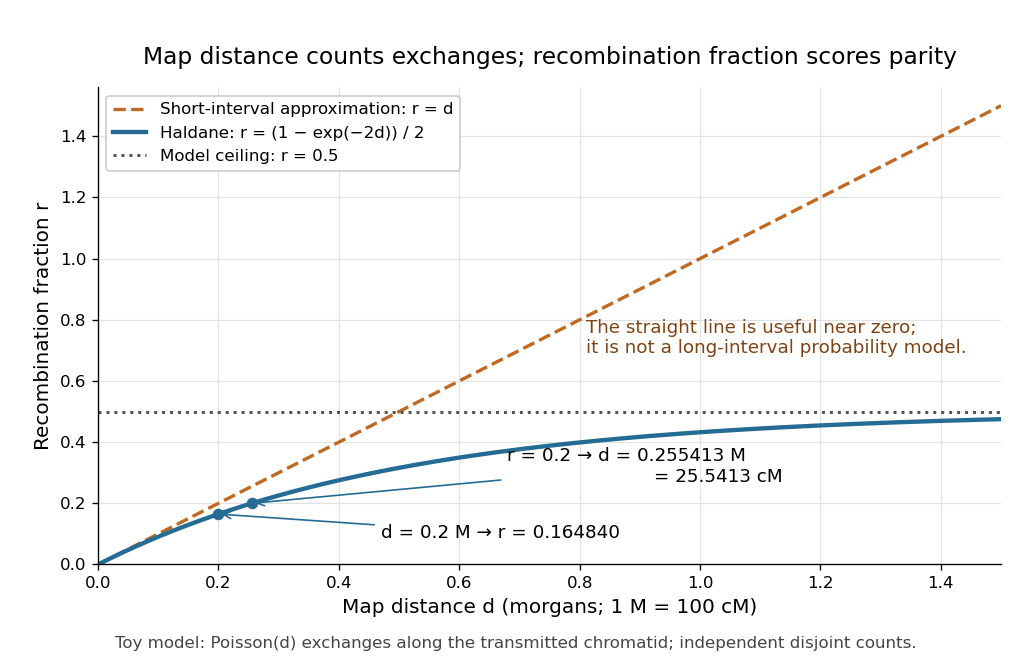
Haldane mapping function versus the short-interval approximation: genetic map distance keeps growing while the recombination fraction approaches one half
. Details. The model is a useful baseline, not a universal rule for every interval during meiosis. Crossover interference can change the relationship between distance and recombination fraction. For the count convention and assumptions, see Weeks, Tang and Kwon (2009): genetic map functions and exchange-count conventions. Haldane's original paper is bibliographically recorded as The combination of linkage values, and the calculation of distances between the loci of linked factors, Journal of Genetics 8 (1919), 299–309, in Selected Genetics Papers of J. B. S. Haldane, edited by K. Dronamraju (1990), contents.
In Java, type erasure implements generic code by replacing a type parameter with its bound, or
Object if unbounded, while inserting required casts and bridge methods. Thus List<String> and List<Integer> share a runtime list class even though the compiler checks different element types. Some generic type information remains in metadata for reflection, so erasure does not mean every trace of generic declarations disappears. Restrictions such as the inability to directly create new T() follow from the absence of a distinct reified runtime class for arbitrary type arguments.[ref]https://docs.oracle.com/javase/tutorial/java/generics/erasure.html. Oracle, Type Erasure: replacement, casts and bridge methods
// Target: computer-science.bigb
Even when
S is a subtype of T, neither G<S> nor G<T> is generally a subtype of the other. This prevents unsafe writes into mutable generic containers. Wildcards express restricted views.// Target: computer-science.bigb
A method declaring its own type parameters, for example
<T> List<T> singletonList(T value). The type parameter connects argument and result types and permits compile-time checking without casts at ordinary call sites. A method mentioning only a generic class's type parameter need not itself be a generic method.// Destination: computer-science.bigb
Two components mutually repress when each inhibits the other's production. With decreasing , the two negative interactions create a positive feedback loop. Sufficiently strong repression can produce two stable states: high , low , and the reverse.
// Target: mathematical-biology.bigb
Biological translation uses a ribosome to read messenger RNA codons and assemble the corresponding amino acid chain. Transfer RNA adaptors match codons through base pairing and carry the amino acids; the genetic code supplies the correspondence. The chain grows from the N-terminus toward the C-terminus, by adding each new residue at the C-terminus. See Clark, Douglas and Choi, Biology 2e: ribosomes, transfer RNA and protein synthesis.
In the gene expression diagram, read in the chosen reading frame. Under the standard genetic code, AUG specifies methionine and GCU specifies alanine; UAA is a stop codon. The result before any subsequent processing is the two-residue chain N–methionine–alanine–C, followed by termination. The stop codon contributes zero amino acids. See Clark, Douglas and Choi, Biology 2e: the standard genetic code. This example assumes appropriate initiation at the displayed AUG in a suitable context in a eukaryote; the diagram displays the coding segment, not a complete independently translatable messenger RNA.
Initiation establishes the starting position and reading frame, using a ribosome, an initiating transfer RNA and additional factors. At a standard stop codon, a release factor promotes release of the chain rather than delivery of another amino acid by transfer RNA. See Clark, Douglas and Choi: initiation and termination of translation. A short two-residue example illustrates decoding, not the size or folding of a typical functional protein.
The useful connection is between two different alphabets: nucleotides specify the order of amino acids through the genetic code. Base pairing helps select transfer RNA, while the ribosome catalyzes joining the delivered amino acids. The messenger RNA remains a template rather than being consumed as the chain's building material. Separating template, adaptor and product makes clear why transcription and biological translation are distinct mechanisms.
Transcription is synthesis of RNA using one DNA strand as a template by an RNA polymerase. During elongation the RNA polymerase reads that template while extending RNA . Only the selected region is transcribed; other regions need not be active, and the template strand can differ between genes. See Alberts et al.: RNA polymerase and selection of transcribed DNA regions.
For the displayed example, align these three nucleotide sequences in the same left-to-right positions:The first template triplet TAC selects AUG: T pairs with A, A with U, and C with G. The next CGA selects GCU, and ATT selects UAA. The coding strand therefore matches the RNA lettering except for T versus U, whereas the template is complementary. Reading that template in its own direction gives ; orientation cannot be discarded. The gene expression diagram keeps all three rows aligned. See Clark, Douglas and Choi, Biology 2e: template and coding strands in transcription.
This correspondence makes nucleotide sequences interpretable, but replacing T by U is valid only after identifying the coding strand. Moreover, RNA may be processed after transcription, so the initial product and mature messenger RNA need not have identical uninterrupted nucleotide sequences. Transcription also makes functional RNA that will not undergo biological translation. See Alberts et al.: RNA processing and RNA as the final gene product.
A transcription factor is a protein that regulates transcription. Combinations of transcription factors help select gene expression patterns during cell differentiation. [ref]
Anatomy and Physiology 2e by J. Gordon Betts and others. Anatomy and Physiology 2e, §3.6, Differentiation and Figure 3.35: transcription factors
A gene promoter is a DNA region involved in initiating transcription. Moving a coding sequence into a nuclear genome does not guarantee that its original gene promoter can drive nuclear gene expression.
In the GAL1 gene promoter system used in the yeast cross-species complementation experiment, the inducing sugar galactose promotes gene expression from the engineered construct, whereas glucose provides a noninducing comparison. The comparison concerns an imposed regulatory system, not the donor species’ native regulation. [ref]
Pathways Over Time Plasmids Engage Students in Functional Genomics Research by Clare O’Connor. O’Connor (2018), Plasmid features enable multiple student experiments and Complementation reveals conservation of function: GAL1 promoter
An ovum is the female gamete. In an anisogamy system it is the larger gamete type, generally contributing substantial cytoplasm as well as a genetic contribution to the zygote.
An oocyte is a developing female germ biological cell; its stage of meiosis matters when describing the gamete precisely. Oogenesis often partitions most of the cytoplasm into one large product while small polar bodies receive the other chromosome complements.
A resident strategy is evolutionarily stable if every distinct mutant earns lower expected fitness when introduced at sufficiently small positive frequency. The upper bound on the frequency may depend on the mutant. In a finite symmetric matrix game, is the expected payoff, with the second argument representing the population strategy. Affineness in this argument yields the two-condition criterion for evolutionary stability. Every evolutionarily stable strategy is a symmetric Nash equilibrium, but a tied best response must also be strictly outperformed against its own mutant population. The Hawk-Dove game supplies an interior stable mixture despite equality of all payoffs against the resident mixture.
Players select sets of resources, and each resource's cost depends on its total number of users. Each player's cost is the sum of the costs of their selected resources. A unilateral deviation changes resource loads, so a finite-player Nash equilibrium compares costs after that change, not at the old loads. For cost functions , the potential changes by exactly the deviator's cost change. A minimizer of this potential in a finite game is therefore a pure Nash equilibrium.
In a nonatomic congestion game, a divisible population chooses resources whose costs depend on aggregate usage. Each individual has negligible size, so changing their choice does not alter those costs. For traffic on a flow network, strategies are routes and an equilibrium is a Wardrop equilibrium: every route with positive flow has minimum delay for its source-sink pair. This differs from a finite-player congestion game, where a deviation changes the load used to evaluate the deviator's new cost. Continuous nondecreasing link delays give a Beckmann potential whose minimizers are exactly the traffic equilibria.
Each voter chooses whether to incur a voting cost. The collective result changes each voter's payoff, and abstention can be optimal when other voters are likely to determine the outcome. The payoff difference between voting and abstaining is the benefit of being pivotal, weighted by the pivotal probability, minus the turnout cost.
// Target: mathematical-optimization.bigb
A payoff is the number assigned to a player's outcome at a strategy profile, with larger numbers preferred. In the usual expected utility model, expected payoffs are probability-weighted averages of these numbers. If a payoff is specified as money and a player has preferences involving risk, first apply the relevant utility function; maximizing expected money assumes risk neutrality. In a two-player zero-sum game, one player's payoff is the negative of the other's. General bimatrix games instead require a payoff matrix for each player.
A repeated game plays a stage game over several rounds, allowing actions to depend on earlier observations. Its payoff convention must specify a finite horizon, a discount factor or a long-time average; these need not have identical invasion properties.
Pinned article: Introduction to the OurBigBook Project
Welcome to the OurBigBook Project! Our goal is to create the perfect publishing platform for STEM subjects, and get university-level students to write the best free STEM tutorials ever.
Everyone is welcome to create an account and play with the site: ourbigbook.com/go/register. We belive that students themselves can write amazing tutorials, but teachers are welcome too. You can write about anything you want, it doesn't have to be STEM or even educational. Silly test content is very welcome and you won't be penalized in any way. Just keep it legal!
Intro to OurBigBook
. Source. We have two killer features:
- topics: topics group articles by different users with the same title, e.g. here is the topic for the "Fundamental Theorem of Calculus" ourbigbook.com/go/topic/fundamental-theorem-of-calculusArticles of different users are sorted by upvote within each article page. This feature is a bit like:
- a Wikipedia where each user can have their own version of each article
- a Q&A website like Stack Overflow, where multiple people can give their views on a given topic, and the best ones are sorted by upvote. Except you don't need to wait for someone to ask first, and any topic goes, no matter how narrow or broad
This feature makes it possible for readers to find better explanations of any topic created by other writers. And it allows writers to create an explanation in a place that readers might actually find it.
Figure 1. Screenshot of the "Derivative" topic page. View it live at: ourbigbook.com/go/topic/derivativeVideo 2. OurBigBook Web topics demo. Source. - local editing: you can store all your personal knowledge base content locally in a plaintext markup format that can be edited locally and published either:This way you can be sure that even if OurBigBook.com were to go down one day (which we have no plans to do as it is quite cheap to host!), your content will still be perfectly readable as a static site.
- to OurBigBook.com to get awesome multi-user features like topics and likes
- as HTML files to a static website, which you can host yourself for free on many external providers like GitHub Pages, and remain in full control

Figure 2. You can publish local OurBigBook lightweight markup files to either OurBigBook.com or as a static website.
Figure 3. Visual Studio Code extension installation.
Figure 5. . You can also edit articles on the Web editor without installing anything locally. Video 3. Edit locally and publish demo. Source. This shows editing OurBigBook Markup and publishing it using the Visual Studio Code extension. 
- Infinitely deep tables of contents:



All our software is open source and hosted at: github.com/ourbigbook/ourbigbook
Further documentation can be found at: docs.ourbigbook.com
Feel free to reach our to us for any help or suggestions: docs.ourbigbook.com/#contact